Atlas Essay — 6 November 2026
The Men's-House Words
In 1902 the German ethnologist Heinrich Schurtz traced four word families for the men's house from Sumatra to Liberia; the bullroarer's own names join all four
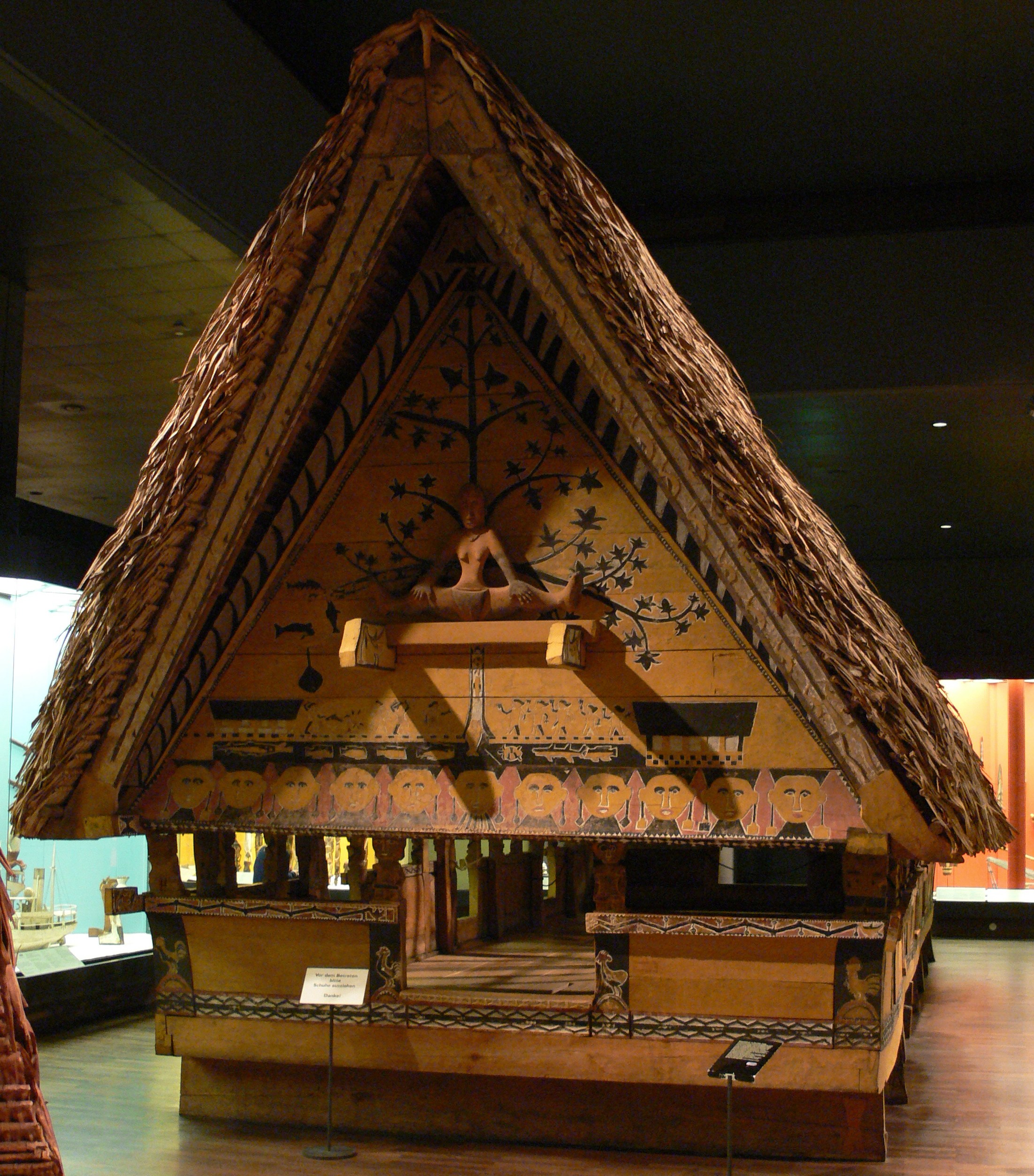
In the last chapter of a long book on men's societies, published in Berlin in 1902, Heinrich Schurtz did something few ethnologists of his day dared. He set down lists of words. Bale, the Batak communal house in Sumatra. Bai, the men's house of Palau. Bora, the boys' initiation in eastern Australia. Barlum, the house on the Huon Gulf of New Guinea that was a monster swallowing the boys. And then, from the other side of the world, Purrah and Belly Paro, the men's secret society and boys' school of Guinea and Liberia. The men's house, he argued, had carried its names with it. A century on, the atlas holds the names of the bullroarer, the instrument that sounded from those houses, for hundreds of peoples Schurtz never read about, and they fall into his families.
The men's house travelled with its words. Heinrich Schurtz's four word families of 1902, for the house, the rite, the sacred and the spirits, run from Sumatra to Liberia, and the bullroarer's own names, recorded since in Africa, New Guinea, Australia and the Amazon, join every one of them.
In brief
- Schurtz's first family, b-l, is a word the linguists of Austronesian now reconstruct: *balay, “public building, community house”, which gives Palauan bai, Malay balai, Fijian vale and Māori whare. A second men's-house word on his list, Vanuatu gamal, goes back to *kamaliR, “bachelor's house, men's house”.
- In the Waria valley of Papua New Guinea, the bullroarer is bora and the initiation house is guhu-bora, named for it; next door the Guhu-Samane roarer is the voice of the Poro spirit.
- In Liberia, where Schurtz placed Belly Paro, the Gbunde call the bullroarer of the Poro bele wola, “the devil's voice”.
- Schurtz's barlum, the house that swallows the boys, has a twin across the strait on Umboi, Barem, house of a patron who swallows the shipwrecked; on the Huon Gulf the bullroarer itself is balum.
- His tabu family gains the bullroarer from West New Britain (tibura) to the Gulf of Papua (tiparu), and in the Upper Xingu of Brazil the roarer is matapu.
- His sampi road through Madagascar to the Congo runs past the Sakalava roarer tambovo and the Bembe and Luba roarers tembwe and tambo.

Schurtz and the men's house
Heinrich Schurtz, curator at the museum of ethnology in Bremen, published Altersklassen und Männerbünde, “Age-Classes and Men's Societies”, in 1902. The book gathered every report he could find of the house where the men of a village slept, ate, kept their sacred things and made boys into men. He found it in Sumatra and Borneo, in Palau and Yap, all along the north coast of New Guinea, in Melanesia and Polynesia, in Australia, in the Brazilian forests and on the west coast of Africa. Wherever it stood, the women were kept out, and very often the thing that kept them out was a sound. In his chapter on initiation he wrote that the women are driven off by “the tones of particular instruments, above all the bullroarer, whose sound they supposedly may not hear from close by without danger to their lives” (p. 101).
In his last chapter, on geography, Schurtz says plainly what his survey had shown him:
“In discussing each feature of the men's house, the clubs, the secret societies and so on, it has been shown again and again how easily customs and usages of this kind spread from people to people; that this has happened far more often and on a far larger scale than can still be proven today is hardly to be doubted.”
Heinrich Schurtz, Altersklassen und Männerbünde (Berlin, 1902), p. 440: “wie leicht sich Sitten und Bräuche dieser Art von Volk zu Volk verbreiten; dass dies viel häufiger und in viel grösserem Masse geschehen ist, als sich gegenwärtig noch sicher nachweisen lässt, ist kaum zu bezweifeln.”
The map of the men's house as he drew it was a map of high water. “The borders are not everywhere the farthest lines to which the flood rose,” he wrote on the same page; an overflowing and an ebbing, again and again, had left the scatter that ethnographers now found. Where the institution was missing, across most of Asia, eastern Europe and East Africa, he blamed the herding peoples, who had “swept away the older conditions like devastating rivers”. Only the islands were beyond their reach (p. 442).
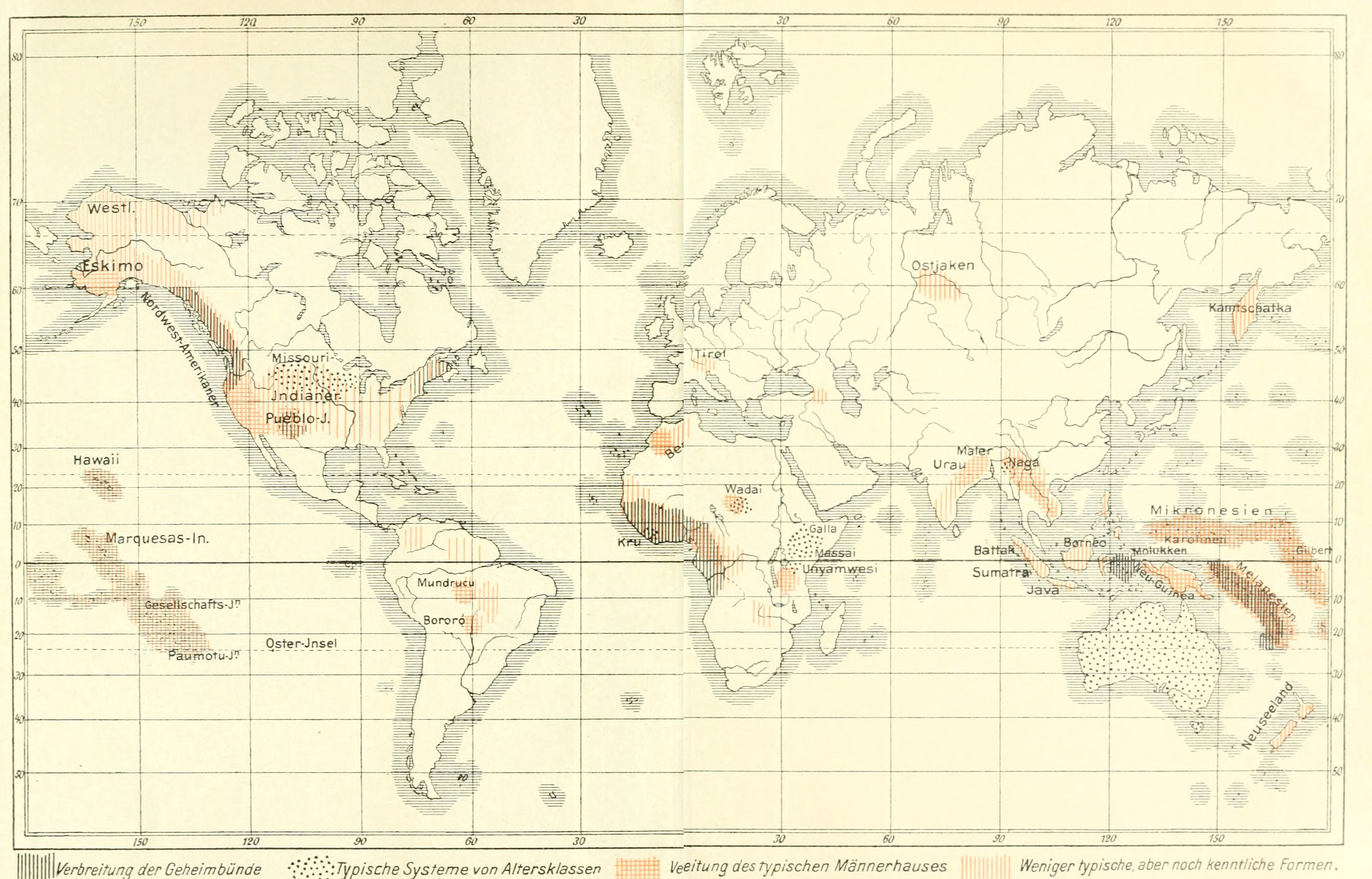
To follow the flood, Schurtz turned to words. He asked one question: “Are there, in the Malayo-Polynesian region, particular words for the men's house and the things connected with it, and how far are they spread?” (p. 442). He gave his rules in two sentences. Vowels change easily and count for little against the consonants; among the consonants, l stands for r, m for b, f for b. And the meanings may look far apart while the inner connection can still be shown (p. 443). Then he set out his lists.
Bale, bai, bora: the house
The first family is the largest. “Most often there appears in the Malayo-Polynesian region a stem b-l, which can also appear as b-r, m-l, m-r and so on; in almost all its forms it seems to name the men's house or the objects and customs bound up with it” (p. 443). His list runs from the Indian Ocean to the middle of the Pacific:
| Schurtz's form | His gloss | Where |
|---|---|---|
| Bale | communal house of the Batak | Sumatra, Indonesia |
| Balei | council house and inn of the Dayak | Borneo |
| Baleuw | communal house | Seram, Moluccas, Indonesia |
| Balebal | men's house | Hatzfeldhafen, Madang coast, Papua New Guinea |
| Bai | men's house | Palau |
| Fe-bai, Falyü | men's house | Yap, Federated States of Micronesia |
| Fale tele, Faleaitu | great house; spirit house | Samoa |
| Marau | chooser of the secret-society novices | Bougainville, Papua New Guinea |
| Gamal | club house | Banks Islands, Vanuatu |
| Whare | house | New Zealand |
| Marae, Malae | assembly place | eastern Polynesia; Tonga and Samoa |
| Bora | boys' initiation | eastern Australia |
| Burbung | place of the boys' initiation | south-eastern Australia |
The heart of this list is now a reconstructed word. The linguists of Austronesian, the family of languages that runs from Madagascar to Easter Island, trace Palauan bai, Malay balai, the Ngaju Dayak balai of Borneo and Balinese bale to a Proto-Malayo-Polynesian *balay, “public building, community house, guest house”. Out in the Pacific the same word gives Fijian vale, Samoan fale, Hawaiian hale and Māori whare. In Palau it is still “village meeting-house”; on Woleai in the Carolines fal is the “men's house, clubhouse”; on Sonsorol, the island where Schurtz found the assembly house Falumar, fare is “boathouse; men's house”; on New Ireland the Label say pal, “house, men's house”. The Batak bale and the Moluccan baileo, the great council house of Seram and Ambon, stand on the same root. Schurtz's guess that the oldest sense was the men's house sits well with what the word still means across half the Pacific.
One of his other forms opens a second word for the same house. Gamal, the club house of the Banks Islands, is the nakamal of Vanuatu, and it goes back to a Proto-Malayo-Polynesian *kamaliR, “bachelor's house, men's house”. In the Admiralty Islands its descendants mean both things at once: on Titan and Ahus, kamal is “men's house; man, male”. Schurtz had put “man” into his lists from Luzon and Sulawesi; in the Admiralties the man and his house share one word.
Schurtz did not stop at houses. The b-l words for tabu, he thought, came out of the house itself:
“It must rather be assumed that all the derivatives meaning tabu (pali, fali, pomali) go back to the fact that women and children were forbidden entry to the men's house and the boys' initiations, whereupon in the end everything forbidden or unapproachable was named with a derivative of the root b-l.”
Schurtz (1902), p. 445: “dass Frauen und Kindern der Zutritt zum Männerhaus und den Knabenweihen verboten war, worauf denn endlich alles Unerlaubte oder Unnahbare mit einer Ableitung vom Stamme b-l bezeichnet wurde.”
That idea, the sacred as the house shut against women, will come back in Australia.
The bullroarer joins the house
Schurtz's two Australian words were names for the rite. Bora is the great initiation of the Kamilaroi and their neighbours in New South Wales; Burbung is its Wiradjuri form, where the boys were taken from their mothers and the bullroarer sounded the voice of the being who made men. The atlas shows the instrument itself carrying the family across the continent. On the Namoi River the Kamilaroi showed their Bora candidates a sacred wand, the dhūrumbulum, the gift of Baiame. On the New England tableland the large bullroarer that summoned the novices and covered their seizure was boolpee (Mathews 1896). Two thousand five hundred kilometres west, on the Nullarbor coast at Twilight Cove in Western Australia, the old men made the sacred boards and “boorbing (bull-roarers)” from the hard wood trees, carving on them the heart and ribs of the eaglehawk they had conquered (Bates 1924). By Schurtz's own rules boorbing is burbung in another spelling, and the eastern word reaches out toward it. On the middle Murray, some 1,600 kilometres from Twilight Cove, the Wathi-wathi and their neighbours called the initiation Boorpung (Cameron 1885), and the Tati Tati at Euston Purbung (Howitt 1904); on the Narran the Euahlayi called it Boorah, and its bullroarer the Boorah spirit's voice (Parker 1905). From the Murray to K'gari the word names the rite at least sixteen times; at Twilight Cove it names the instrument. Further north the small roarer of the Nyangumarta in the Pilbara was booleewan, “making booming noise when twirled”, and on the Fitzroy River in the Kimberley the large roarer was buliuana: in Nyikina myth the brothers who named the creatures put a buliuana into the mouth of the yellow Banaka snake “to make it strong and venomous”.
In New Guinea the word comes back to the house. In the Waria valley, in Morobe Province of Papua New Guinea, the government anthropologist E. W. P. Chinnery found in the 1920s that the people of Borli called the bullroarer bora, and the initiation house guhu-bora, the house named for the roarer sounded inside it. While it sounded, the candidates might not laugh, nor lie down, nor leave without an elder. Schurtz's Australian rite and his Malayo-Polynesian house are one word in a single Papuan valley. Their neighbours in the same valley, the Guhu-Samane, called their cult and its spirit Poro, and the roarer poro ungapa, the slat whose roaring “is regarded as the voice of the Poro spirit”. When the missionary Ernest Richert translated the Psalms for them, the eighth psalm came out: “O Lord, our Lord, in all the great earth your name has the quality of the bull-roarer call.”
On the coast of Central Province, the Roro word beriwa means the spirits and the bullroarer both; the masked taboo-keepers swung it at night to enforce the ban on garden food. In the Solomon Islands, on Nggela, where Schurtz placed the secret society Matambala, the roarer of that society's night mysteries is buro: “they beat the seesee and whirl the buro, and come into the village; and they whistle and cluck, and all the women in the village shut fast their houses and are much afraid, because they think that they are surely ghosts” (Codrington 1891, pp. 94–99).
| Added form | Meaning | People, place |
|---|---|---|
| bora | bullroarer; guhu-bora, the initiation house | Borli, Waria valley, Morobe, Papua New Guinea |
| poro ungapa | bullroarer, voice of the Poro spirit | Guhu-Samane, Morobe, Papua New Guinea |
| beriwa | the spirits, and the bullroarer | Roro, Central Province, Papua New Guinea |
| buro | bullroarer of the Matambala society | Nggela, Solomon Islands |
| dhūrumbulum | sacred wand of the Bora, gift of Baiame | Kamilaroi, Namoi River, New South Wales |
| boolpee | large bullroarer that summons the novices | New England tableland, New South Wales |
| Boorpung, Purbung | the initiation | Wathi-wathi, Tati Tati, middle Murray, New South Wales |
| Boorah | the initiation; the bullroarer is the Boorah spirit’s voice | Euahlayi, Narran River, New South Wales |
| boorbing | bullroarers | Twilight Cove, Nullarbor coast, Western Australia |
| booleewan | small bullroarer | Nyangumarta, Pilbara, Western Australia |
| buliuana | large bullroarer | Nyikina, Fitzroy River, Western Australia |
Purrah and Belly Paro: the West African branch
Then Schurtz crossed an ocean. “The West African region of men's houses and secret societies,” he wrote, “makes a most striking contribution, which takes its place quite naturally beside the Malayo-Polynesian words” (p. 444):
| Schurtz's form | His gloss | Where |
|---|---|---|
| Bulu | communal house of the Mandingo | Senegambia |
| Burri | communal house | Sierra Leone |
| Purrah | secret society of the Susu | Guinea |
| Baluhn | dwelling of the village headman, Mandingo | Senegambia |
| Belly Paro | secret society and boys' initiation | Liberia |
| Deballe | open ground for conjurings and games | upper Mungo River, Cameroon |
“It is certainly remarkable that the great likeness between West African and Malayo-Melanesian conditions, which shows itself so decidedly in the existence of the secret men's societies and the communal houses, returns in language too.”
Schurtz (1902), p. 444: “Es ist gewiss merkwürdig, dass auch im sprachlichen Sinne die grosse Ähnlichkeit zwischen westafrikanischen und malayisch-melanesischen Zuständen wiederkehrt.”
Purrah is the Poro, the great men's society of Sierra Leone, Liberia, Guinea and Côte d'Ivoire, in whose forest school the boys died and were reborn. Among the Vai and Gola of Liberia the boys are carried off to a magic forest, called Berri or Belli, are said to be killed there by a forest spirit and brought back to life, and on coming out pretend not to know their own parents (p. 103). The forest school itself had a b-l name. Among the western Fulbe of Senegambia the boys were swallowed by a spirit called Horny and stayed days in its belly; “one often hears the terrible voice of the Horny (probably a bullroarer) in the woods”. The bullroarer was there, and it carries a name of Schurtz's shape. Among the Gbunde of northern Liberia, George Schwab of the Harvard African Expedition recorded in 1928 how the Poro's Big Devil came to the town:
“Often the devil comes from the Bush heralded by a peculiar call. … The bull-roarer is another of his voices (bɛlɛ wola, Gbundɛ). Still another is the imitation of a night bird.”
George Schwab, Tribes of the Liberian Hinterland (Cambridge, Mass., 1947), p. 270; glossary: “bele wola — devil's voice (bull-roarer)”.
The Gbunde call the highest Poro devil bele mele nafui, “the ram's horn”, and bele bole, “pumpkin to swallow”, is the grade of men who put the novices into the pumpkin for the Big Devil to swallow. Schurtz's Belly Paro was the society and the boys' school of Liberia; among the Gbunde the bullroarer of that society is bele wola, the devil's voice, and the devil swallows the boys.
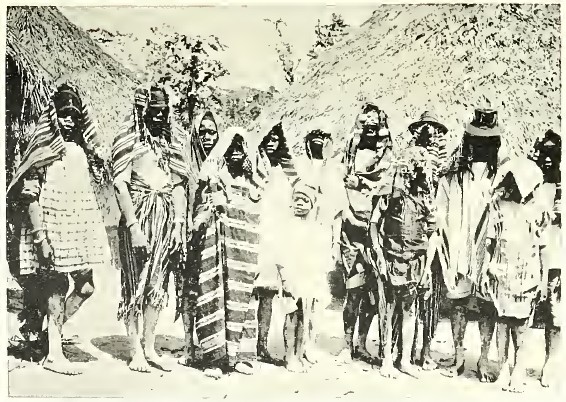
The family runs inland along the Niger. Among the Bozo fishermen of the inner Niger in Mali, the roarers of the Diarra men's society, and the two great roarers kept at its shrine, are billai (Frobenius 1924). In the Lere kingdom of south-western Chad, the Mundang bullroarer is mafali, swung at the circumcision that came once in each king's reign, when boys were swallowed by the masks of the bush and vomited back as men; one of the kingdom's founding lineages is named for it. In the Adamawa highlands of north-eastern Nigeria the Verre men's cult keeps its wooden roarers, baranga, in the cult house, and whirls them in the dark on the night the cult throws hunger away into the bush. Each is a men's instrument with a b-l or m-l name, by Schurtz's own equivalences.
| Added form | Meaning | People, place |
|---|---|---|
| bele wola | “devil's voice”, the bullroarer of the Poro | Gbunde, northern Liberia |
| billai | bullroarers of the Diarra men's society | Bozo, inner Niger, Mali |
| mafali | bullroarer of the royal circumcision | Mundang, Lere, Chad |
| baranga | bullroarers of the men's cult house | Verre, Adamawa, Nigeria |
And the two Poros meet. Schurtz's Purrah is the Poro of Guinea and Liberia, a men's society whose bullroarer is the voice of the devil who swallows the boys. The Guhu-Samane Poro of the Waria valley is a men's cult whose bullroarer is the voice of the Poro spirit. Half the world apart, the name, the voice and the rite are the same set.
Barlum, the house that swallows boys
Schurtz's second family began as a hope. If b-l was the men's house, he wondered whether a root r-m, in the east Indonesian rum, “women's or family house”, might be its opposite number. He tried it, found r-m words for the men's house too, and let it go with a sigh: “Sadly, this beautiful dream cannot be carried through” (p. 446). What remained was a second family of men's-house words, and one word that held both roots at once:
| Schurtz's form | His gloss | Where |
|---|---|---|
| Barlum | festival house of the Jabim | Finschhafen, Huon Gulf, Papua New Guinea |
| Lum | bachelors' house | the same |
| Rumsram | bachelors' house | Doreh (Manokwari), West Papua, Indonesia |
| Narumbe | boys' initiation | South Australia |
| Lobo | communal house of the Poso | central Sulawesi, Indonesia |
| Falumar | assembly house | Sonsorol, Palau |
Barlum, “where the roots b-l and r-m are even joined together” (p. 446), was the house of the Jabim circumcision on the Huon Gulf, and Schurtz knew what it was: “It is meant to represent the monster Barlum, which swallows the boys” (p. 224). The boys walked into its belly and came out men. The Poso lobo of Sulawesi had crocodiles with men in their jaws on the ridge beam, and Schurtz noticed that Melanesian men's houses were carved the same way, with “crocodiles or sharks with men in their jaws” (p. 268).
On the Huon Gulf the bullroarer is the same word. The Jabêm dictionary gives balôm as the ghost of the dead, as “the dread spirit that was supposed to swallow and then vomit out the initiants”, and as the bullroarer that imitates the voices of the departed (Zahn 1982, p. 30). The Bukawa and Jabêm roarer balum is the voice of the monster whose belly is the house. Down the coast at Siboma, the Numbami call the bullroarer and its rite bolomana. The full story of the Huon Gulf word, and the ghost-word behind it, is told in Cult Words of New Guinea.
Schurtz missed a twin across the water. In 1858 the missionary Reina described Rook, now Umboi Island, a short crossing of the Vitiaz Strait from the Huon Gulf. There the boys were said to be swallowed by the being Marsaba and given back only for pigs and taro. And the assembly house of the village patron Nabeao was called Barem. Of Nabeao, Reina adds, he “swallows the shipwrecked” (Zeitschrift für allgemeine Erdkunde, n.F. 4, 1858, p. 397). Barlum on one shore, Barem on the other: both houses of a swallowing being.
The r-m shape returns in the bullroarer's own names. In the Tanga Islands off New Ireland, where the roarers were ghosts' voices at the boys' initiation, the large roarer swung on a bamboo pole is burrarumarum (Bell 1977, p. 198), b-r and r-m in one word, like Schurtz's barlum. At the mouth of the Fly River, the label on a Kiwai roarer read buruma-maramu, “the mother of the yams” (Haddon 1901, p. 104). On the lower Ramu the Bosmun roarer is luana murup, after Murup, the being of the coastal flutes and masks.
Narumbe: sacred from the women
Schurtz's Australian r-m word was Narumbe. It belongs to the Ngarrindjeri, the Narrinyeri of the old books, on the lower Murray and the Coorong in South Australia, and their missionary George Taplin described it at length. When a youth's beard had grown, he was seized at night by men of several clans, his hair torn out, and he was “made Narumbe”. Then the word began to spread outward from the boy to everything he touched:
“Everything which they possess, or obtain, becomes Narumbe, or sacred from the touch of women. Even the bird hit by the club, or the kangaroo speared by their spear, or the fish taken by their hook, is Narumbe. Even if their implements are used by other men, the proceeds are forbidden to all females.”
George Taplin, in A. W. Howitt, The Native Tribes of South-East Australia (London, 1904), pp. 674–675.
At Encounter Bay, on the next stretch of coast, the newly made young men were “Rambe, or sacred, and no female must accept any food from them, not even their own mothers” (Meyer, in Howitt 1904, p. 673). Here is Schurtz's thesis of p. 445 in a single Australian word. The initiate is the men's house, and the sacred is whatever is shut against the women.
Up the east coast the bullroarers of the initiation carry the same consonants. The Kamilaroi called the roarer that mustered the tribes to the Bora murrawan, and its voice, the novices were told, was the voice of Dhurramoolan. On the Shoalhaven River and the south coast of New South Wales the initiation roarer was mooroonga, sounded at dawn and dusk as the signal for the novices (Mathews 1898). Around Sydney, among the Dharug, the being whose voice the bullroarer is bears the name Daramulan; the Wiradjuri said Dhuramoolan, and Ridley's Kamilaroi Bora wand was the dhūrumbulum. Daramulan is r-m and b-l together, as barlum is.

| Added form | Meaning | People, place |
|---|---|---|
| balôm, balum | ghost; the spirit that swallows the boys; bullroarer | Jabêm and Bukawa, Huon Gulf, Papua New Guinea |
| bolomana | bullroarer and its rite | Numbami, Siboma, Papua New Guinea |
| Barem | house of Nabeao, who swallows the shipwrecked | Umboi Island, Papua New Guinea |
| burrarumarum | large bullroarer on a bamboo pole | Tanga Islands, Papua New Guinea |
| buruma-maramu | bullroarer, “mother of the yams” | Kiwai, Fly River mouth, Papua New Guinea |
| luana murup | bullroarer, named for Murup | Bosmun, lower Ramu, Papua New Guinea |
| Rambe | sacred: the newly made young men | Encounter Bay, South Australia |
| murrawan | bullroarer that musters the tribes to the Bora | Kamilaroi, New South Wales |
| mooroonga | initiation bullroarer | Shoalhaven and south coast, New South Wales |
| Daramulan, Dhuramoolan | the being whose voice the bullroarer is | Dharug and Wiradjuri, New South Wales |
Tabu: the ghosts in the house
The third family is the word the whole world borrowed from Polynesia. Schurtz read tabu as a word that first meant the spirits of the dead, and he followed it into the house:
“It is delightful to watch how, from this starting point, the derived words come to name things closely bound up with the men's house, and at last the men's house itself.”
Schurtz (1902), p. 448: “wie von diesem Ausgangspunkt aus die abgeleiteten Wörter zur Bezeichnung von Dingen dienen, die mit dem Männerhaus in engem Zusammenhang stehen, ja wie sie schliesslich das Männerhaus selbst bedeuten.”
| Schurtz's form | His gloss | Where |
|---|---|---|
| Tubuna | ancestors, spirits | Fiji |
| Toboran | evil spirit | New Britain, Papua New Guinea |
| Tabu, Tapu, Tambu | holy, forbidden | Polynesia, New Zealand, Melanesia |
| Matambala | secret society | Nggela, Solomon Islands |
| Tapun | guardian spirits | Berlinhafen (Aitape), Papua New Guinea |
| Tibbut | boys' initiation | “a part of Australia” |
| Dubu | men's house | Port Moresby coast, Papua New Guinea |
| Djabobibi | bullroarers | Hatzfeldhafen, Madang coast, Papua New Guinea |
The word for the sacred is as old as he believed. Linguists reconstruct a Proto-Oceanic *tabu, “forbidden, taboo”, which runs from the Admiralties to Hawai'i. On Nggela, Schurtz's Matambala island, tambu means “set apart; forbidden, taboo; dedicated; sacred, holy; a priest”, and in the Admiralties a suffixed form *tabu-na survives as Loniu topun and Nauna tapun, the very shape of Schurtz's Berlinhafen guardian spirits.
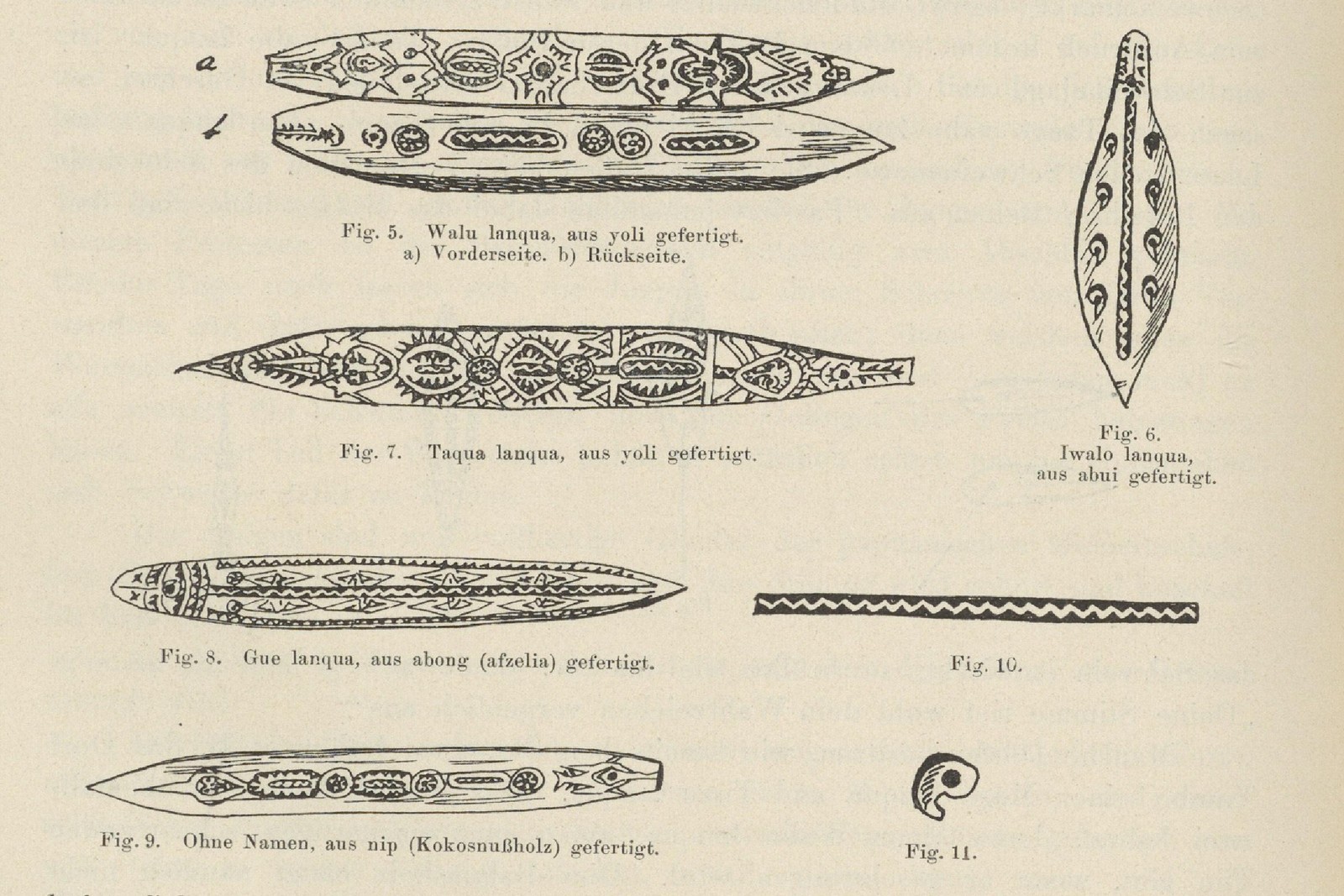
Only one bullroarer name stands in Schurtz's whole chapter, and he put it in this family. On the Madang coast, he wrote, “every village has one or more community houses, here called balebal … Men's festivals, at which the bullroarers (djabobibi) instead of the flutes give the warning signal to the women, have their centre here” (p. 221). Otto Finsch had drawn a djabobibi from Kranket Island in Madang lagoon, swung at the circumcision.

The atlas adds a whole coast of roarers to the family. In West New Britain, not far from the Tolai whose evil spirit was Schurtz's toboran, the Bariai bullroarer is tibura, at once instrument and spirit being; Georg Friederici, on that coast in 1908, heard in it tibur, the forest, and uru, air or breath. Initiation into its mysteries was paid for in pigs. On the Willaumez Peninsula the Bola roarer is tuvura. In the Kaliai bush the roarer Varku is a tambaran, the word the whole Sepik uses for its men's cult and its spirits, its flutes and roarers and the haus tambaran that holds them. There the boys learn the last secret of the rite: that men, not Varku, are the true tambaran.
Across New Guinea, on the Gulf of Papua, the Toaripi roarer of the men's house is tiparu, seen only after initiation; women and young people left the village, lest they hear it and die. At the mouth of the Fly the secret name of the Kiwai roarer is madubu, which means “I am a man” (van Baal 1966, p. 270), and the initiates arranged themselves on the ground in the outline of a bullroarer. Schurtz had Dubu for the men's house on the same coast, and Tau, “man”, from Sulawesi, in this family. In the Banks Islands of Vanuatu the Merelava roarer is worung-tamb, “a wailer”, sounded the night after a death. And in the Channel Country of north-east South Australia the Yandruwandha bullroarer is thuburu, a name with the consonants of Schurtz's Australian Tibbut.
Matapu on the Xingu
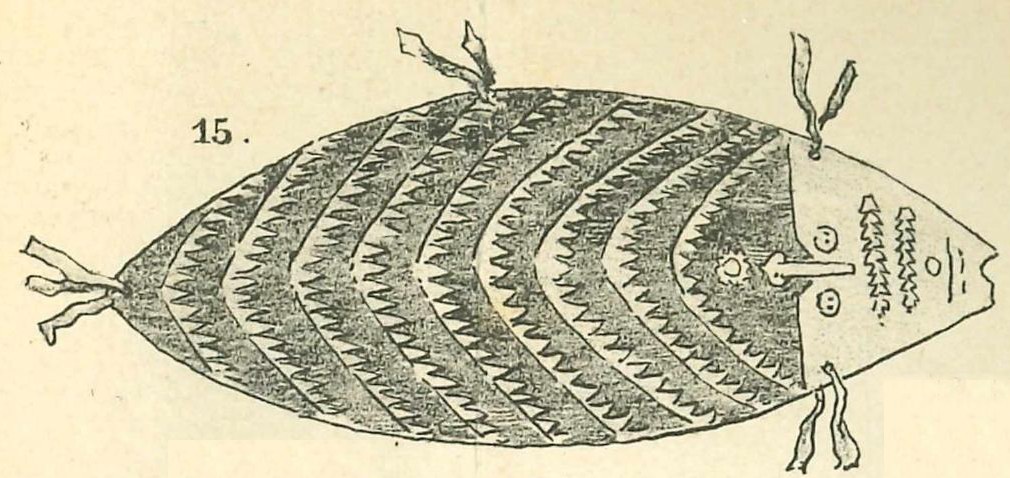
Schurtz had seen the bullroarer of the Upper Xingu in Brazil, in von den Steinen's book. In the Mehinaku festival hut there hung “some twenty painted wooden masks, besides a few straw hangings and a bullroarer”, and the women might enter neither the flute house nor the men's dances (p. 295). He did not know its name. It is matapu, among the Mehinaku and the Wauja, and matavu among the Nahuquá, the people Schurtz noticed showing their roarers openly on the plaza (p. 364). Matapu is a spirit as well as an instrument, the old river-master who teaches lesser spirits to capture souls; the Mehinaku hide its making from the women on pain of sudden death. By Schurtz's rules, matapu sits between his Polynesian tapu and his Solomon Islands Matambala.

| Added form | Meaning | People, place |
|---|---|---|
| tibura | bullroarer and spirit being | Bariai, West New Britain, Papua New Guinea |
| tuvura | bullroarer | Bola, Willaumez Peninsula, Papua New Guinea |
| tambaran | men's cult and its spirits; the roarer Varku is one | Kaliai, West New Britain; the Sepik |
| tiparu | bullroarer of the men's house | Toaripi, Gulf of Papua, Papua New Guinea |
| madubu | secret name of the bullroarer, “I am a man” | Kiwai, Fly River mouth, Papua New Guinea |
| worung-tamb | bullroarer, “a wailer” | Merelava, Banks Islands, Vanuatu |
| thuburu | bullroarer | Yandruwandha, north-east South Australia |
| matapu, matavu | bullroarer and river-master spirit | Mehinaku, Wauja and Nahuquá, Upper Xingu, Brazil |
Sampy: the road through Madagascar
In his tabu family Schurtz set a side branch: the Batak sopo, the bachelors' house of Sumatra, with its kin from Halmahera to Assam. Africa, he said, had given this branch only one word, “but a remarkable one”. In Madagascar sampy named an amulet, anything ghostly or magical, and the royal talismans of the Merina kings bore that name; in southern Africa he found sampu in the same sense, and Leo Frobenius had linked them to Masamputila, a sacred object of the Nkimba society on the lower Congo, whose novices fell as if dead and woke with new names and a secret language. Schurtz drew the road:
“Here, for once, one could follow the road by which such words, and with them of course the spiritual or material culture they name, could press on through Madagascar, settled by Malays, and neighbouring southern Africa as far as the Congo.”
Schurtz (1902), pp. 449–450: “über das von Malayen besiedelte Madagaskar und das benachbarte Südafrika bis zum Kongo vordringen konnten.”
Madagascar was settled from Borneo, and its language is Austronesian, the sister of Batak and Malay. On that road the bullroarer has names of Schurtz's tabu shape. In south-western Madagascar the Sakalava roarer is tambovo at Sakaraha and kitambovo at Beroroha; by 1938, Curt Sachs found, it had left “the world of magic” and become a boy's toy and a bird-scarer over the sown seed. On the mainland, in the mountains above Lake Tanganyika in the Democratic Republic of the Congo, the Bembe god-roarer is Tembwe, whose voice is the leopard's snarl; it is bound to the circumcision, a death and rebirth, and sounds at the funerals of titled men. Further west in the Congo, the Luba roarer is tambo. Schurtz's African k-s words, the nkissi and mokisso of the Congo, he thought were witnesses enough by themselves “of how the customs of the secret societies have spread from people to people over great parts of Africa” (p. 451).
| Added form | Meaning | People, place |
|---|---|---|
| tambovo, kitambovo | bullroarer | Sakalava, south-western Madagascar |
| Tembwe | god-roarer of the circumcision | Bembe, above Lake Tanganyika, DR Congo |
| tambo | bullroarer | Luba, DR Congo |
Korwar and Karwadi: the spirits
The last family is the smallest, and Schurtz loved it: “It is especially fine to watch how the bond between belief in spirits on the one hand, and the circumcision customs, assemblies and houses of the men's societies on the other, comes out here too” (pp. 450–451). Its centre is the north coast of New Guinea: korwar, the carved ancestor figures of Biak and Geelvink Bay in West Papua, which held a dead man's skull; karewari, the bachelors' house of Humboldt Bay at Jayapura; karack, the spirit and ancestor house of Dallmannhafen at Wewak. In Australia he added korroborri, the corroboree, which he called the spirit dance, and Kawarra, “the place of the circumcision ceremonies”.
The bullroarer's names carry the family across northern Australia. On the Daly River in the Northern Territory, the bullroarer of the All-Mother is Karwadi, and the secret cult the young Nanggumiri men brought home from the Victoria River in the 1920s took its name: “a secret wisdom, a power, and a dream shared by no one else on the Daly River” (Stanner 1959). On the Dampier Peninsula of the Kimberley, the Bardi sacred roarers are galaguru, first made by the creator Djamar; down the coast the Karajarri roarer is kaliguru, revealed to the boy after circumcision, embraced against his belly and entrusted to him.
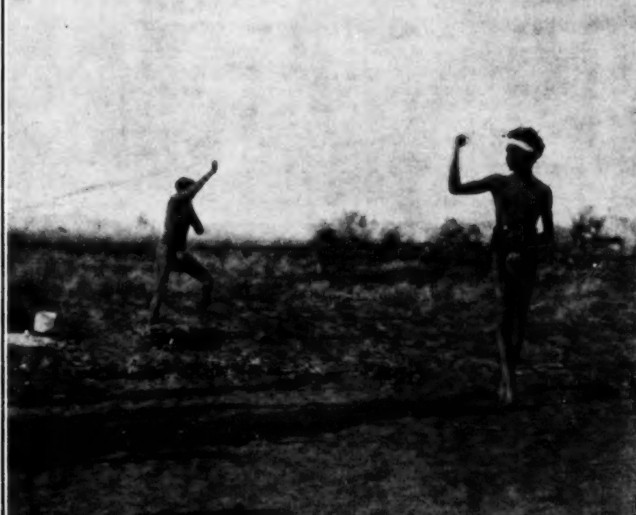
In West Africa the family has a roarer too. Among the Toma of the Guinea forest, in south-eastern Guinea, the bullroarer is guri, sounded through the long forest retreat in which the boys, said to be devoured by the spirit Afwi, spend up to seven years and learn to make Afwi speak.

| Added form | Meaning | People, place |
|---|---|---|
| Karwadi | bullroarer of the All-Mother, and her cult | Nanggumiri, Daly River, Northern Territory |
| galaguru | sacred bullroarers first made by Djamar | Bardi, Dampier Peninsula, Western Australia |
| kaliguru | bullroarer given after circumcision | Karajarri, West Kimberley, Western Australia |
| guri | bullroarer of the forest retreat | Toma, south-eastern Guinea |
The high-water marks
Schurtz closed his lists with a judgement he held to against his own caution. Some comparisons, he granted, were too thin; Tahitian arii beside the Bororo aroe of Brazil would not do. But one thing followed “from many of the examples given”:
“A deeper connection must exist between the African and the Malayo-Melanesian conditions.”Heinrich Schurtz, Altersklassen und Männerbünde (1902), p. 451: “dass ein tieferer Zusammenhang zwischen den afrikanischen und den malayisch-melanesischen Zuständen bestehen muss.”
He wrote with the men's house in view and the bullroarer in the corner of his eye, and he had one roarer name to work with, the djabobibi of Madang. The century since has given the instrument its names, and they land where his words do. Where he had a house, bora, the roarer is bora and the house is named for it. Where he had a society, Belly Paro, its roarer is bele wola, the devil's voice. Where he had a house shaped as a monster, barlum, the roarer is balum and the monster's house has a twin, Barem, across the strait. Where he had tabu, the spirits, the roarer is tibura and tiparu in New Guinea and matapu on the Xingu. Where he drew a road through Madagascar to the Congo, the roarer is tambovo and tembwe. A word for a house can drift by chance; the same names for the same instrument, kept by the same men, behind the same wall against the women, from the Niger to the Coral Sea, did not.
Part of this is now proven beyond his hopes. The house word he put first, bale and bai and whare, is one word carried by canoe across half the world, and the men's house went with it. The rest is the same kind of movement, written in the same kind of trace. The bullroarer was the voice of the men's house, and where the house went the voice went, and its names went with it. Schurtz saw a flood that had risen and fallen and left its lines along the coasts of three continents. He hoped that “the future will bring clearer light on these questions” (p. 451). It has: the bullroarer's names are his high-water marks.
Key sources
- Heinrich Schurtz, Altersklassen und Männerbünde: Eine Darstellung der Grundformen der Gesellschaft (Berlin: Georg Reimer, 1902): p. 101, the bullroarer drives off the women; p. 103, the Vai and Gola forest school and the Fulbe Horny; p. 221, balebal and djabobibi at Hatzfeldhafen; p. 224, the Barlum monster; p. 268, the Poso lobo; pp. 295 and 364, the Upper Xingu bullroarers; pp. 439–452, “Sprachliches”, the word families. Translations on this page are ours.
- Robert Blust, Stephen Trussel, Alexander D. Smith and Robert Forkel (eds.), The Austronesian Comparative Dictionary, online: PMP *balay, “public building, community house, guest house”, and POc *pale; PMP *kamaliR, “bachelor's house, men's house”; PCEMP *tambu, POc *tabu, “forbidden, taboo”, and *tabu-na. Robert Blust, “Lexical reconstruction and semantic reconstruction: the case of Austronesian ‘house’ words”, Diachronica 4 (1987), pp. 79–106.
- George Schwab, Tribes of the Liberian Hinterland, ed. G. W. Harley (Papers of the Peabody Museum 31, Cambridge, Mass., 1947), p. 270 and glossary s.v. bele wola, bele mele nafui, bele bole; fig. 92.
- E. W. P. Chinnery, Natives of the Waria, Williams and Bialolo Watersheds, Territory of New Guinea Anthropological Report 4 (1928), pp. 59–61: bora and guhu-bora. Ernest L. Richert, “How the Guhu-Samane Cult of Poro Affects Translation”, The Bible Translator 16 (1965), pp. 81–86.
- R. H. Codrington, The Melanesians (Oxford, 1891), pp. 94–99, the Matambala and the buro; p. 342, worung-tamb.
- A. W. Howitt, The Native Tribes of South-East Australia (London, 1904), pp. 673–675: Meyer on Rambe, Taplin on Narumbe.
- R. H. Mathews, “Bullroarers used by the Australian Aborigines”, Journal of the Anthropological Institute 27 (1898), pp. 52–60: murrawan, mooroonga, Dhurramoolan; Mathews, “The Burbung of the New England tribes”, Proceedings of the Royal Society of Victoria 9 (1896), pp. 120–136: boolpee. William Ridley, Kámilarói and Other Australian Languages (Sydney, 1875), pp. 140–141, 153, 156: dhūrumbulum.
- A. L. P. Cameron, “Notes on Some Tribes of New South Wales”, Journal of the Anthropological Institute 14 (1885), p. 357 n. 1: Boorpung. A. W. Howitt, The Native Tribes of South-East Australia (1904), pp. 590–591: Purbung. K. Langloh Parker, The Euahlayi Tribe (1905), pp. 62–63: Boorah.
- Daisy Bates, “Aboriginal Stellar Myths”, The Australasian, 26 July 1924, p. 56: boorbing; Bates papers, National Library of Australia MS 365, folio 48/42: booleewan. Horst Südkamp, Wondjina (after Petri), pp. 99, 253–260: buliuana.
- W. E. H. Stanner, “Durmugam: A Nangiomeri” (1959), in White Man Got No Dreaming (Canberra, 1979), pp. 84, 90–92: Karwadi. Ralph Piddington, “Karadjeri Initiation”, Oceania 3 (1932), pp. 46–87 and plate III: kaliguru.
- Heinrich Zahn, Jabêm–English Dictionary, rev. F. Streicher, tr. D. C. Laycock (Pacific Linguistics C-68, 1982), p. 30: balôm. Joel Bradshaw, Numbami–English Dictionary (2014), p. 12: bolomana. L. Reina, “Über die Bewohner der Insel Rook”, Zeitschrift für allgemeine Erdkunde, n.F. 4 (1858), pp. 396–397: Barem and Nabeao.
- F. L. S. Bell, Tanga–English, English–Tanga Dictionary (1977), p. 198: burrarumarum. A. C. Haddon, Head-hunters: Black, White, and Brown (London, 1901), p. 104: buruma-maramu. J. van Baal, Dema (The Hague, 1966), p. 270: madubu. Georg Friederici, Beiträge zur Völker- und Sprachenkunde von Deutsch-Neuguinea (1912), p. 102: tibura. Andrew Lattas, Cultures of Secrecy (Madison, 1998): Varku. Otto Finsch, Ethnologischer Atlas (1888), Taf. V: djabobibi.
- Karl von den Steinen, Unter den Naturvölkern Zentral-Brasiliens (Berlin, 1894), pp. 104, 327: matapu, matahu.
- Leo Frobenius, Atlantis VII (1924), pp. 89, 102–104: billai. Curt Sachs, Les instruments de musique de Madagascar (Paris, 1938), p. 66: tambovo, kitambovo. P. P. Gossiaux, Le Bwamè du Léopard des Babembe, ill. 46: Tembwe.
- Related essays: Cult Words of New Guinea, Names That Travel, Djanggawul and Eurasian Language Origins and What's in a Name?
- As far as we know, setting the bullroarer's names into Schurtz's four families is original to this page.