Atlas Essay —
Cult Words of New Guinea
The bullroarer's names cross language borders with its rites, from the Marind giant Sosom to the Huon Gulf balum
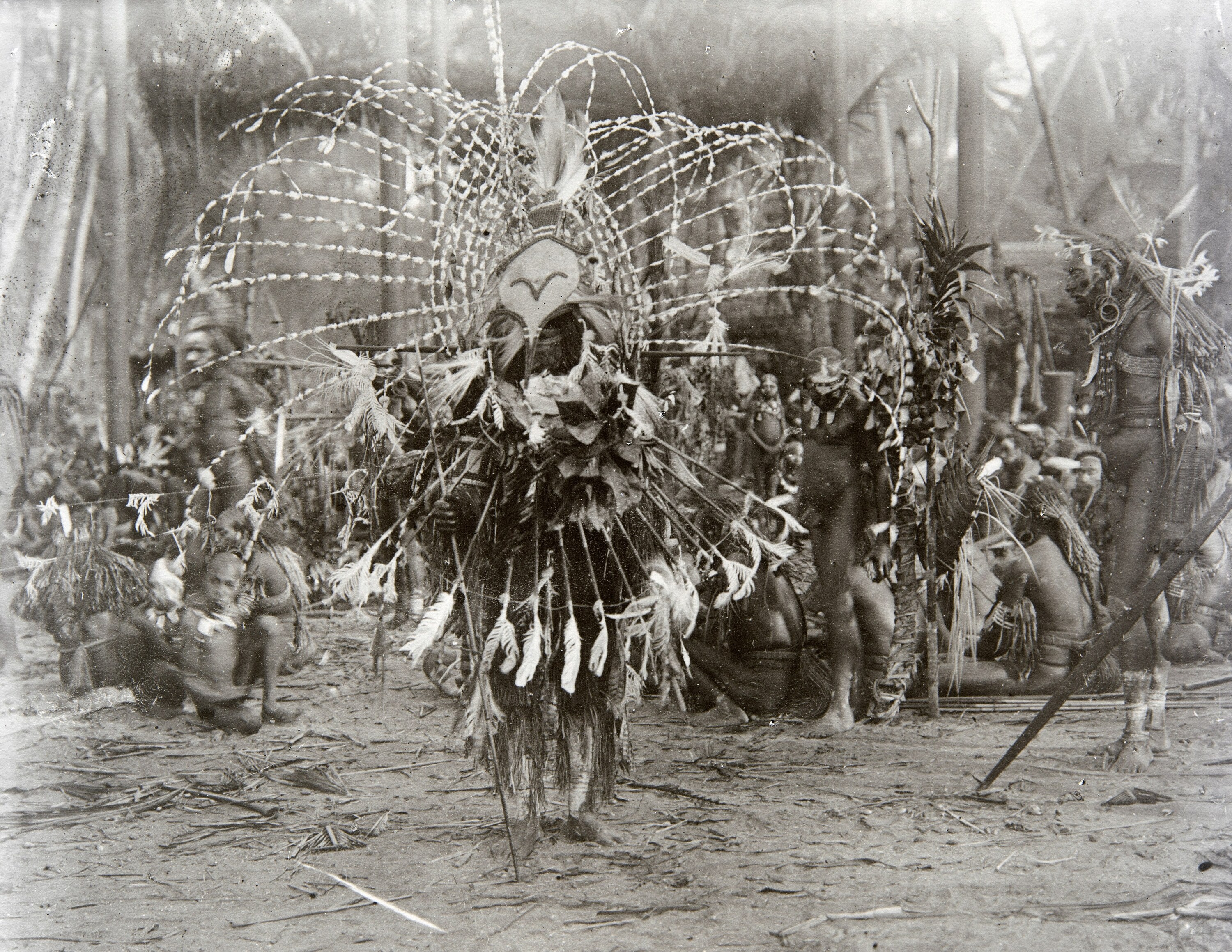
Every year in the dry season, a giant walked out of the east into the villages of the Marind-anim on the south coast of New Guinea. His name was Sosom, and his voice was the bullroarer. Inland and across today's border with Papua New Guinea, the people of Setavi called their bullroarer sosa, and told their women it was an old man who came up out of the water to dry himself by the fire. The ethnographer who wrote that down added three words in brackets: “cf. sosem among the Marind-Anim.” Across New Guinea, the names of the bullroarer behave the same way. They belong to a being, a monster or a spirit, and they cross from one language to the next with the rite.
In New Guinea the bullroarer's name is the cult's own word, and it travels with the cult: the Marind giant Sosom names the roarer from the coast to Setavi, a Purari monster names the Elema roarer, a Nara roarer-word names the Roro spirits, and a single word for the cult runs along the north coast from Bogia to Wogeo.
In brief
- F. E. Williams, working in the Trans-Fly of Papua New Guinea in the 1920s, recorded that “the bull-roarer is called sosa” at Setavi and set it beside the Marind sosem himself. Modern field wordlists add sosam at three more villages along the border, in a different language family from the Marind.
- On the Papuan Gulf, Williams judged the Elema roarer-name kaiavuru to be “simply the Orokolo rendering” of the Purari word for the wicker monster that swallows boys.
- On the coast east of Yule Island, Seligman found the Roro word for spirits, beriwa, was the Nara word for the bullroarer, and suggested the Roro had borrowed it from the Nara.
- On the north coast, Joseph Schebesta wrote that the Sepa cult word lumbeki, which covers the bullroarer, the masks, the flutes and their spirits, “is of the same stem” as Wogeo nebek and Manam embeki.
- On the Huon Gulf, balum is at once the ghost of the dead, the monster that swallows the boys and the bullroarer; K. A. Gourlay drew two lines to it from the far south-west of the island.

Sosom walks inland
The Marind-anim are the people of the long, flat south coast of New Guinea west of the border, around Merauke in what is now the Indonesian province of South Papua. Their bullroarer is sosom, and Sosom is a giant, one of the dema, the ancestral beings who made the world and still walk in it. When he came, the women and children fled and the men took the boys to him. Paul Wirz drew the coastal Marind blades in 1925, and Jaap Kunst described the Sosom roarer as carved in the shape of a fish.
Where does Sosom come from? The Marind say: from the east. K. A. Gourlay, summarising the evidence for the whole island in 1975, put it this way:
“…the tale told by the Marind-Anim of Irian Jaya … that the bullroarer is the voice of the sosom giant who lives to the east, that is, among the Trans-Fly Papuans, comes annually in the dry season and stays in a village for two or three days while men bring him boys which he swallows and later disgorges.”
K. A. Gourlay, Sound-Producing Instruments in Traditional Society (1975), p. 70, citing Haddon's introduction to Williams, Papuans of the Trans-Fly (1936), p. xxvi.
The Trans-Fly is the country between the Indonesian border and the Fly River, in the far south-west of Papua New Guinea. And the book Gourlay cites for the Marind's own direction is the book that found the giant's name there. F. E. Williams, the Government Anthropologist of Papua, worked through the Trans-Fly in the 1920s. In his introduction he notes, in passing, that “At Setavi, in the north of the Semariji country, the bull-roarer is called sosa.” Further in, he gives the scene:
“At Setavi, where the bull-roarer is called sosa (cf. sosem among the Marind-Anim), it is represented to the women as an old man who comes out of the water. He sits by the fire at the place of initiation to dry and harden himself.”
F. E. Williams, Papuans of the Trans-Fly (1936), p. 185; the location at p. xxviii.
Williams was not reaching for a resemblance. He knew Wirz's Marind work, and he set the two names side by side with the shorthand a scholar uses for the obvious. Sosa at Setavi is Sosom's name. The match is not a sound-alike plucked from two dictionaries: it is the name of a bullroarer being, carried by a bullroarer, in the next country along the giant's own road. Even the waters agree. The Setavi old man comes out of the water to dry by the fire; on the Marind coast, in the telling van Baal took from Verschueren, Sosom's severed member “became a watersnake (zanid)” (Dema, 1966, p. 271).
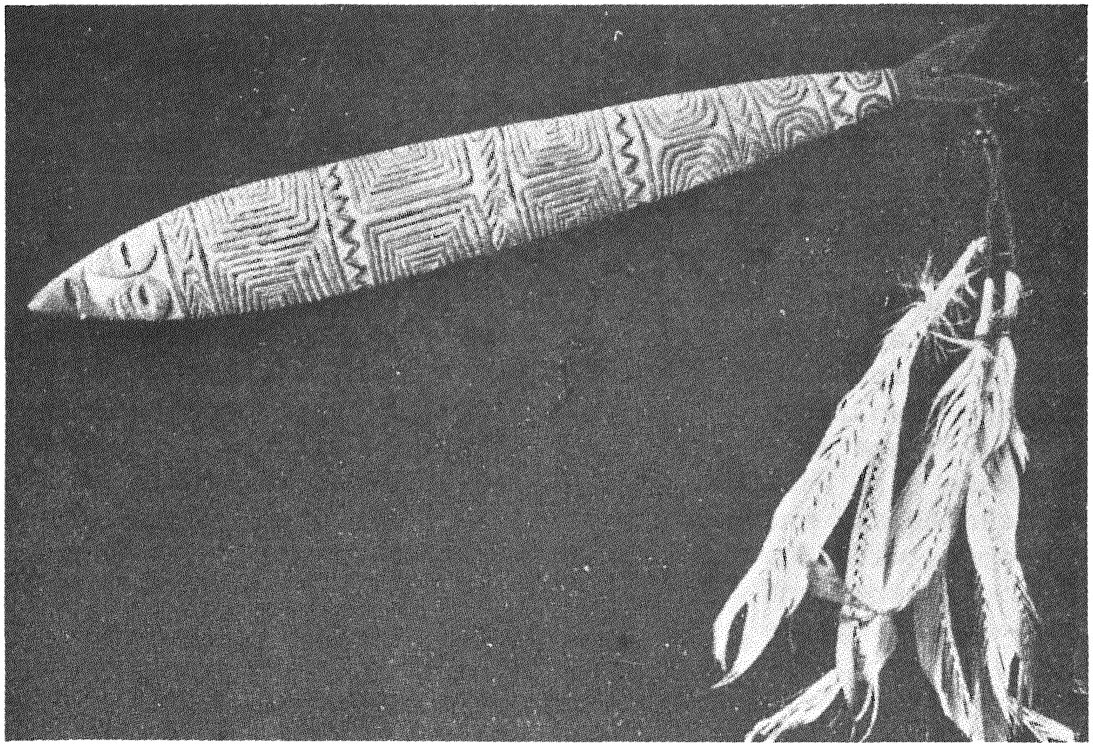
The modern field lexicons now carry the name further. The Southern New Guinea Lexical Database, compiled from linguists' fieldwork in the Morehead country, gives the bullroarer as sosam at three villages near the border: among the Kanum at Sota, just inside Indonesia; among the Rema at Wereave; and among the Arammba at Kiriwa on the upper Morehead River. All three speak languages of the Yam family. The Marind language belongs to another family altogether. So Sosom's name stands on both sides of a language-family line, which is exactly where an inherited word cannot go and a borrowed cult can.
The same lexicon shows what the Trans-Fly called the roarer when Sosom was not involved. A second word runs through the other branch of the Yam family: Keraki moiank, which Williams recorded at the same time as sosa, Nen meyang and its relatives in the neighbouring villages. The two words sit side by side on the map. Moiank keeps to its own languages. Sosam follows the giant.
Dutch scholars had seen the eastern bearing long before the wordlists. Jaap Kunst, writing up the music of western New Guinea in 1950, followed Wirz: the bullroarer had come into the Dutch half of the island “zonder twijfel met bepaalde geheime riten uit het Oosten”, “without doubt with certain secret rites from the East”. And of the Sosom feast he wrote that “this whole feast, including the myths that belong to it, is said to show striking agreement with the initiation ceremonies and legends of the Bukaua, Jabim and Tami in East New Guinea” (De inheemse muziek in westelijk Nieuw-Guinea, p. 76). Those three peoples live on the Huon Gulf, a thousand kilometres away at the other end of the island. That line comes back at the end of this essay.
The Roro borrow a spirit from the Nara
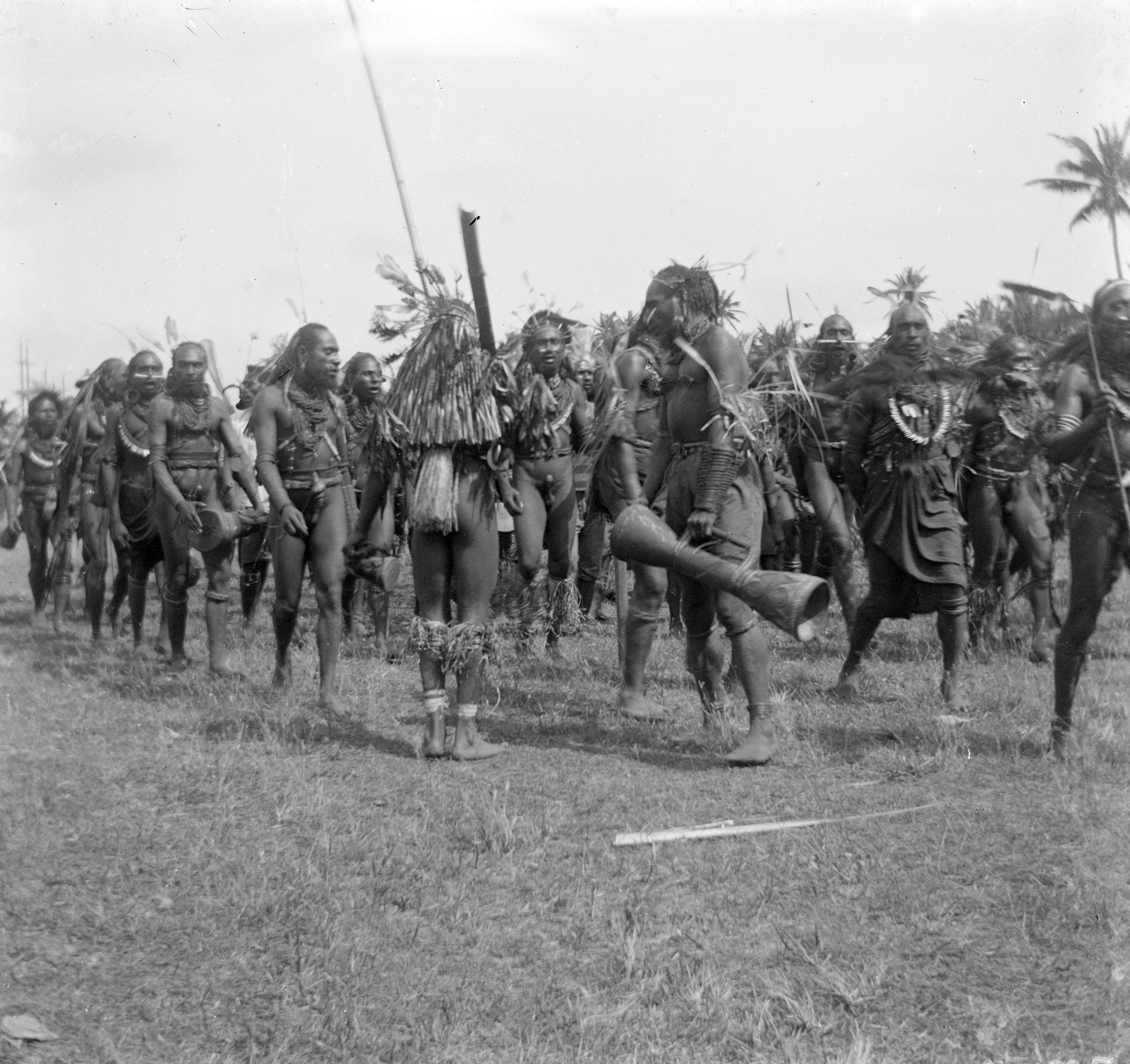
Nearly seven hundred kilometres east, beyond the Gulf of Papua, the same thing happened in plain view of an ethnographer. The Roro live on the coast around Yule Island, north-west of Port Moresby in Central Province; the Nara, also called the Pokao, are their neighbours immediately to the east. C. G. Seligman's glossary in The Melanesians of British New Guinea (1910) gives one word two senses:
“Beriwa (1) spirits, not necessarily of the dead, non-human agencies (Roro); (2) bull-roarers (Pokao).”
C. G. Seligmann, The Melanesians of British New Guinea (1910), p. 748; Pokao and Nara are one people, p. 373.
In the body of the book he explains it, and diagnoses the loan himself:
“Again, although the word beriwa was sometimes used to signify the spirits of the dead, all beriwa were not of this nature, some were malicious agencies who had never been human, while the same word is used for the bull-roarer.”
“Perhaps in this sense the term has been borrowed from the people living in the Nara district, immediately to the east of the Roro-speaking tribes, for these folk who swing the bull-roarer to make their crops grow, also call it beriwa.”
Seligmann (1910), p. 304, text and footnote.
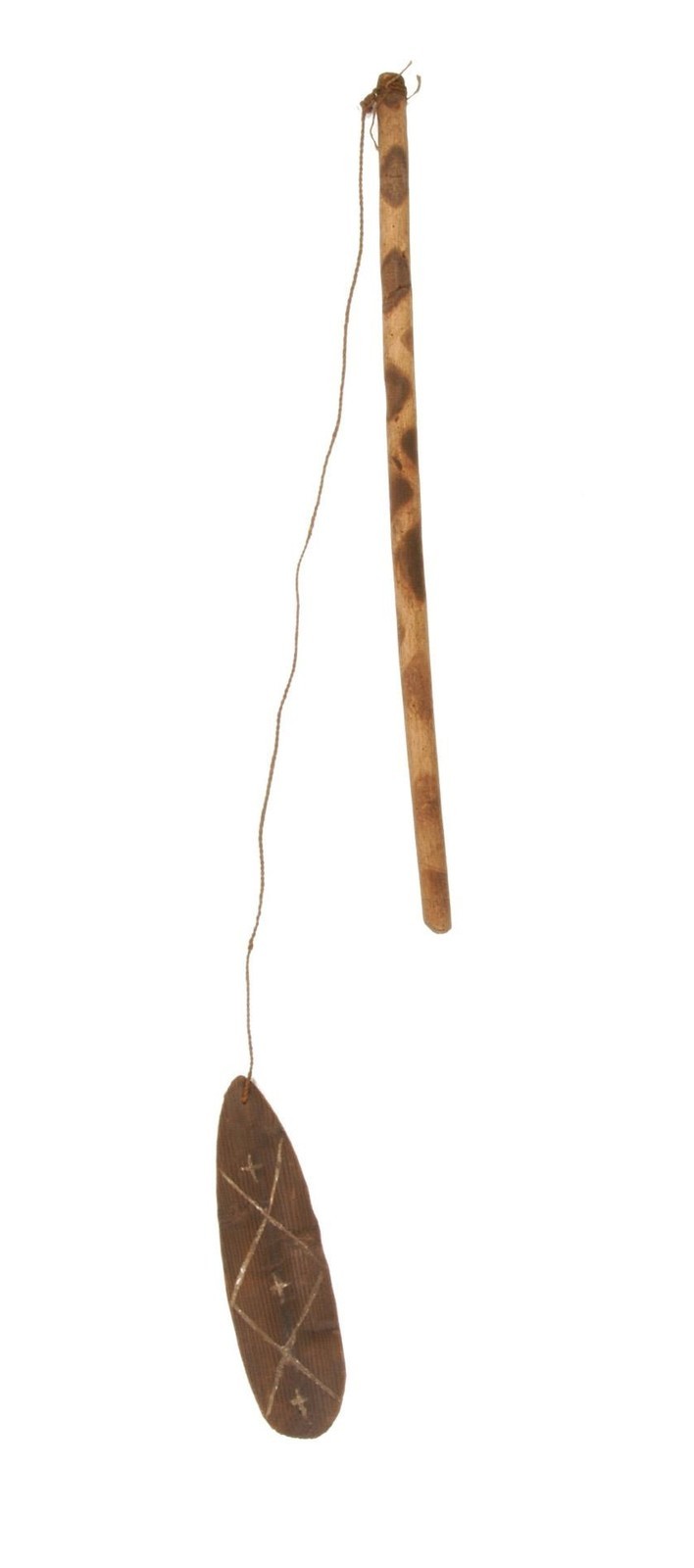
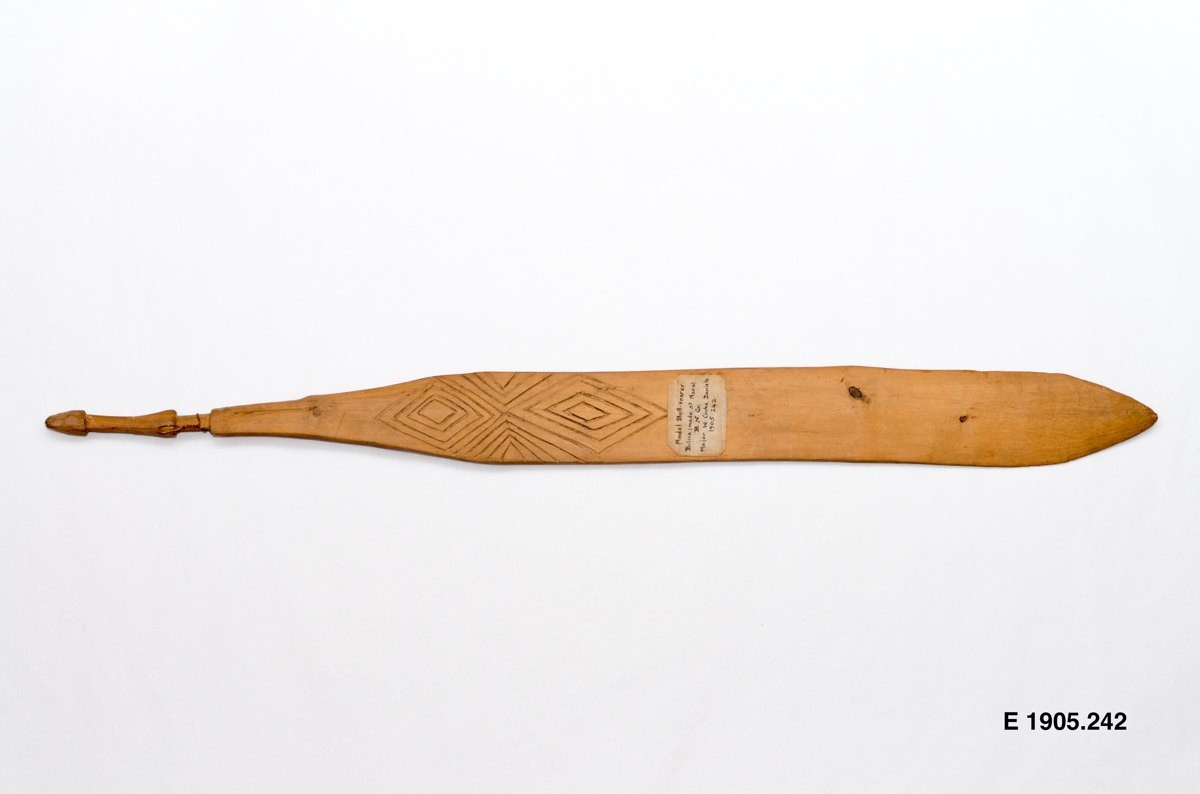
The Nara whirled the roarer to make the gardens grow, and called it beriwa. Next door the Roro used the same word for the bullroarer and for the spirits, human and not, who move through the world unseen. The instrument's name and the beings it voices are one word, and the word has crossed a village boundary. The Cambridge museum's label for a Nara model blade collected on Seligman's own expedition of 1903–1904 writes it biliva, the Nara pronunciation of the same word.
A monster's name for the Elema roarer
Between the Marind and the Roro lies the Gulf of Papua, the great curve of river mouths and mangrove on the south coast of Papua New Guinea. Its peoples built the tallest men's houses on the island and filled them with masks, carved boards and roarers; The Elder Brother tells their story at length. Two of their words belong on this map.
In the Purari Delta, at the western end of the Gulf, the men's house held a kaiemunu or kaiaimunu, a great wicker-work monster that swallowed the boys at their initiation; the Purari bullroarer is imunu viki, the weeping spirit, its voice. Along the coast to the east, among the Elema, Williams found a common name for the roarer that he could trace:
“Thus one of the common generic names for the bull-roarer in the Orokolo Group … is kaiavuru. This, I feel confident, is simply the Orokolo rendering of the Purari Delta word kaiemunu or kaiaimunu, which is there applied ordinarily to the large wicker-work monster kept in the interior of the men's house.”
F. E. Williams, Bull-Roarers in the Papuan Gulf (1936), p. 4; reprinted in The Vailala Madness and Other Essays (1976), p. 78.
The monster's name crossed the language boundary at the Delta and landed on the instrument that is its voice. It is the same move the Roro made with beriwa, run in reverse: there the roarer's name became the spirits' name; here the monster's name became the roarer's. At Orokolo the word now names the bullroarer.
Hevehe, the snake
The Elema's other word for the bullroarer is hevehe. It also names the twenty-foot masks of the great Orokolo cycle, the monsters of the sea, and carved figures further east. In the dialects of the central Elema tribes at Keuru, Opau and Berepa, Williams found its plainest sense: hevehe is “the ordinary generic name for ‘snake.’” He thought that sense was the original one, and the uninitiated were told as much:
“There is however the very significant fact that the bull-roarers are often represented to the women and uninitiated as ‘snakes.’ … in the Keuru group, where the snake is called hevehe, that was the only interpretation given. There the women are allegedly bluffed into believing that the bull-roarers, i.e. the creatures which they do not see but only hear, are snakes; and that the men in the eravo make them howl by poking their tails with a stick.”
Williams, Bull-Roarers in the Papuan Gulf (1936), pp. 6–7; reprint (1976), pp. 80–81.
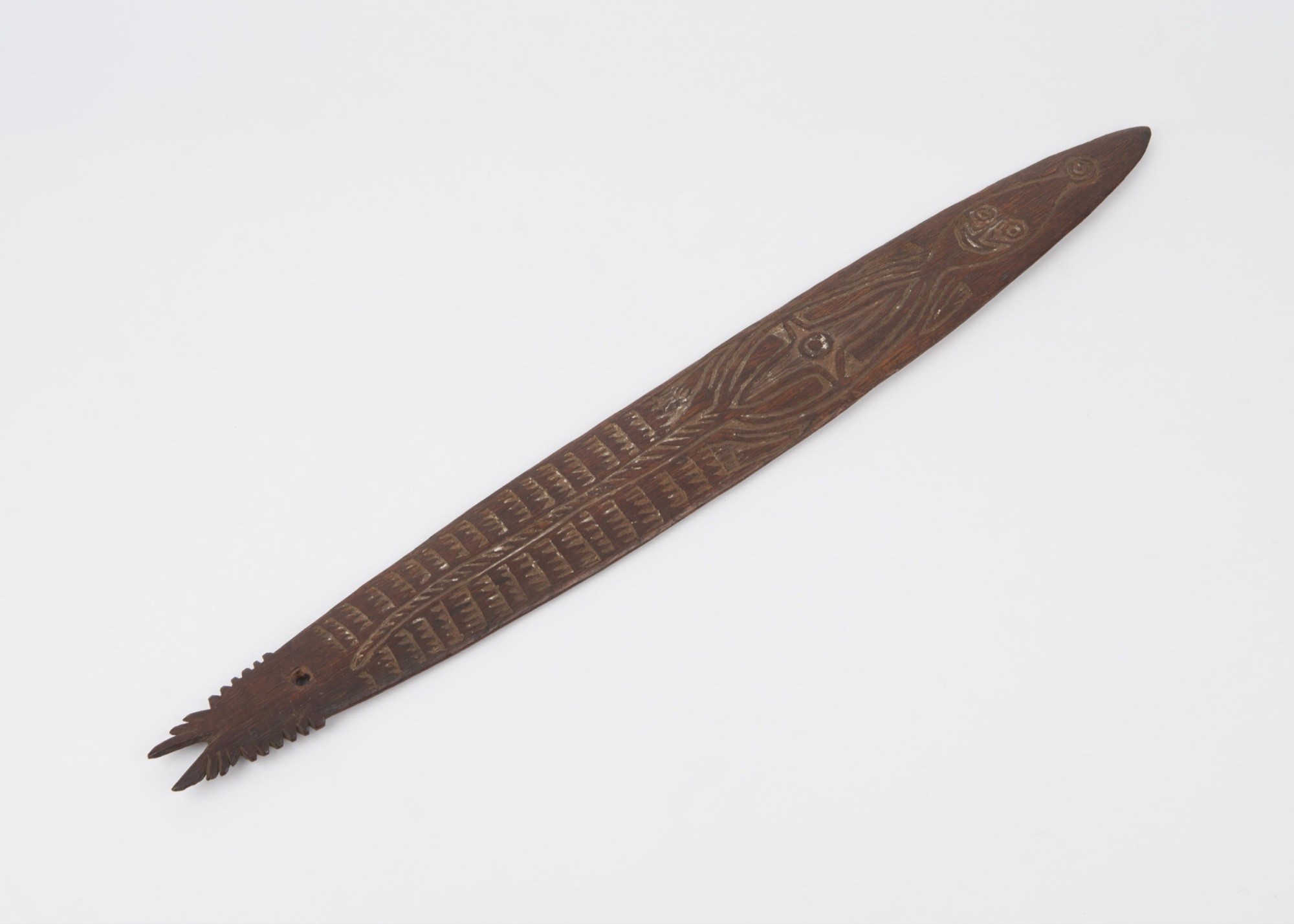
A word that names the roar, the masks and the sea-monsters, and means “snake” at its root, is the serpent at the centre of the bullroarer cult, kept in the vocabulary. Gourlay saw it, and drew his second line from it, below.
A reader of Genesis hears an echo here. Rabbinic commentators long ago played the name of Eve, Hebrew Ḥawwāh, against the Aramaic word for serpent, ḥiwyā. In Genesis Rabbah (20:11), Rabbi Aḥa has Adam say to her: “Ḥivya ḥivyikh, ve-at ḥivya de-Adam”, “the serpent was your serpent, and you are Adam's serpent.” Some nineteenth-century Semitists took the pun for a true etymology. Hevehe and Ḥawwāh are not related words. The resonance is still a striking one: a first woman and a sacred snake share one sound in the Near East, and in the Gulf of Papua a snake-word names the roar the women must not see.
One word for religion on the north coast
On the north coast of Papua New Guinea, in the Bogia district of Madang Province facing Manam Island, the missionary Joseph Schebesta described the cult of the Sepa villages in 1921. Each clan kept two bamboo flutes, a long male and a short female, called maropi or lumbeki; and “the village as a whole also has a common Lumbeki, a bullroarer.” Then he asked what the word meant:
“What, then, does Lumbeki mean? It is of the same stem as Juwo nebek, Wogeo, Manam embeki. The etymological meaning is not clear. But it denotes: 1. the cult objects (masks, bamboo flutes, bullroarer); 2. the spirits that stand in relation to the cult objects; 3. the dance festivals connected with them (for men and for women); 4. certain tools used in making drums. Lumbeki is fairly synonymous with religion; Lumbeki embraces all the cult objects, teachings and cultic activities.”
„Was heißt nun Lumbeki? Es ist gleichen Stammes mit Juwo: nebek, Wogeo, Manam: embeki. … Lumbeki ist ziemlich gleichbedeutend mit Religion.“
Joseph Schebesta, “Parak-Institution im Bogia-Distrikt unter den Sepa”, Anthropos 16/17 (1921/22), p. 1054.
Schebesta writes Juwo for Wogeo, the island off the coast to the north-west; Manam is the volcano island across the strait. Schebesta draws a three-point line along the coast himself: Sepa lumbeki, Wogeo nebek, Manam embeki. A single word for the whole of the sacred, and the bullroarer is one of the things it names.
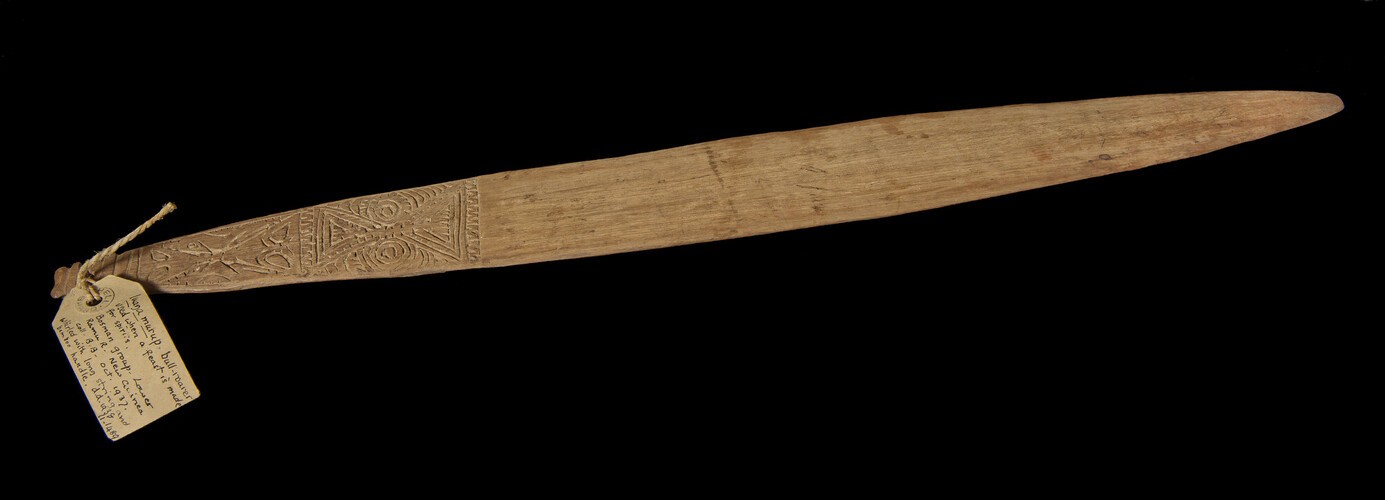
A few villages along the same coast, the Monumbo had a being called Murup. Franz Vormann's Monumbo dictionary of 1914 gives him as “ein geheimnisvolles Wesen”, “a mysterious being”, and lists “Murup flute, mask, ornaments, all of which relate to Murup.” The ordinary Monumbo word for ghost or soul is something else entirely. Inland, on the Lower Ramu River, Beatrice Blackwood collected for the Pitt Rivers Museum a Bosmun bullroarer named luana murup, together with red masks and a hanging figure that carry the same name. Monumbo and Bosmun belong to unrelated language families. Murup crossed between them, with his flute, his mask and his roar.
Balum, the ghost who swallows boys
At the eastern end of the island, on the Huon Gulf on the north-east coast of Papua New Guinea, the cult word is the oldest on the map. Among the Jabêm and the Bukaua, the boys were swallowed at circumcision by a monster and given back as men, and the monster, the ghosts of the dead and the bullroarer all bore one name. The Jabêm dictionary sets it out in three numbered senses:
“balôm: 1. the spirit of deceased persons, ghosts of the dead/departed spirits. 2. Balôm n.prop., the dread spirit that was supposed to swallow and then vomit out the initiants (sagu) during circumcision rites. 3. balôm = kamakeŋ bullroarer, the humming board, used to imitate the voices of the departed ones.”
Heinrich Zahn, Jabêm–English Dictionary, revised by Friedrich Streicher, translated by D. C. Laycock (Pacific Linguistics C-68, 1982), p. 30.
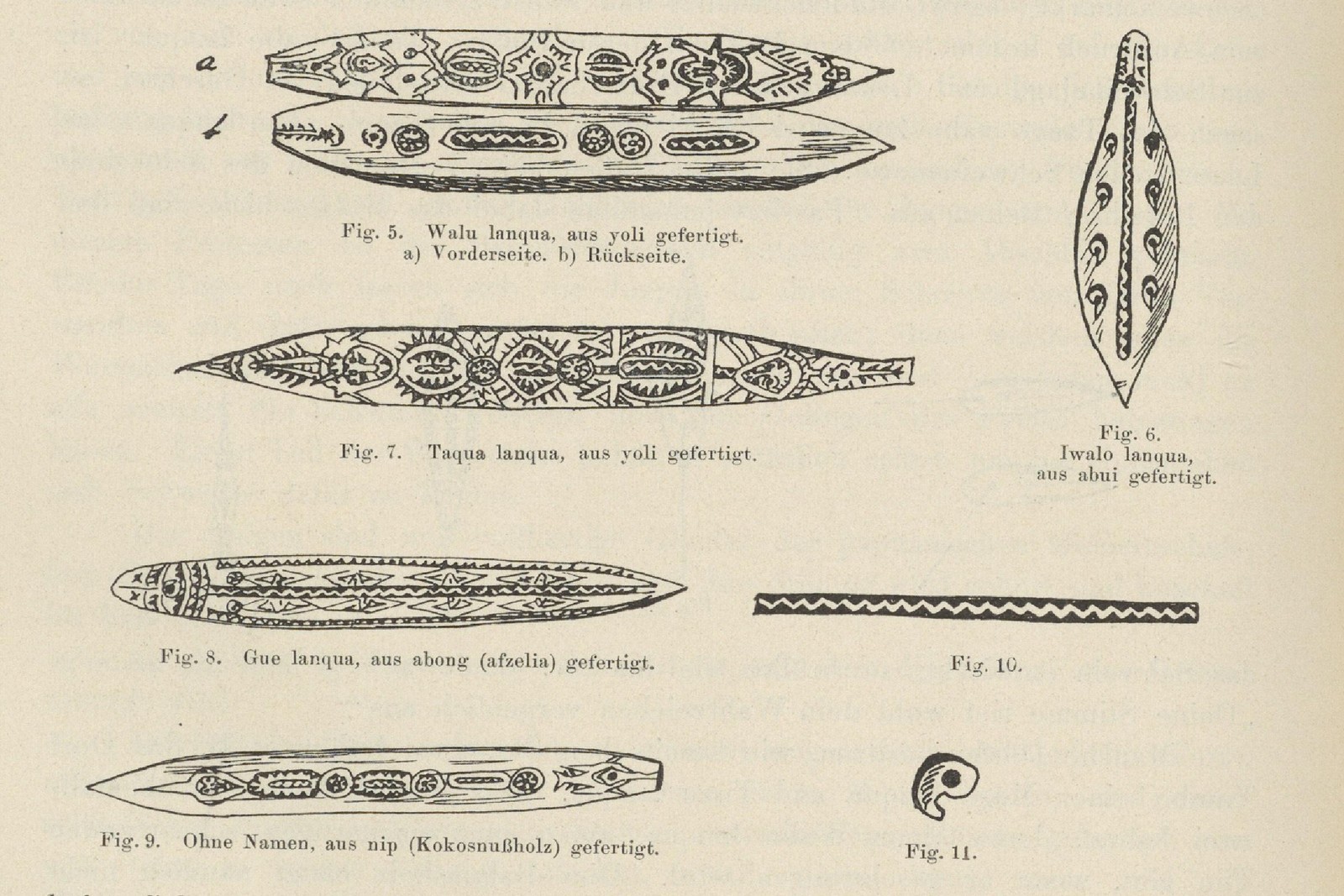
The men's house where the roarers were kept, the lôm, was built for the festival “in shape of open-mouthed crocodile” (p. 327). Here the word is inherited, not borrowed. Linguists reconstruct a word *bara(q)um, “spirit of a dead person”, for the Oceanic languages of Papua New Guinea; it survives as the ghost-word down the eastern tail of the island, in the Trobriand Islanders' famous baloma. Only on the Huon Gulf did the ghost-word become the roarer. Just south along the coast, at Siboma, the Numbami dictionary gives the same word with its own ending: “bolomana n bullroarer, bullroarer ritual”. The Bukaua and Jabêm balum is where the bullroarer's cult took a ghost's name, and kept it.
Gourlay's two lines
K. A. Gourlay's Sound-Producing Instruments in Traditional Society, published in Port Moresby in 1975, is a careful survey of New Guinea's sacred instruments. It never uses the word diffusion. Yet twice, in two pages, Gourlay draws a line the whole length of the island, and both lines end on the Huon Gulf. The first runs from the Marind:
“Despite the distance between them, there would seem to be a connection between the tale told by the Marind-Anim … that the bullroarer is the voice of the sosom giant who lives to the east … while men bring him boys which he swallows and later disgorges, and that of the balum spirit of the Huon Gulf whose similar behaviour has already been recorded.”
Gourlay (1975), p. 70.
The second runs from the Elema snake-word:
“Finally, to the Keum and Opau hevehe means ‘snake’, a design at times carved on bullroarers themselves … and which may perhaps be cognate with the sea-snake of the Huon Gulf mentioned above.”
Gourlay (1975), p. 69.
A page later he adds that the Keraki of the Trans-Fly explained the roar as a monstrous snake or crocodile, and that this “may, however, be compared with the sea-snake of the Huon Gulf and the Sepik ‘crocodile’” (p. 71, n. 1). The sea-snake is real, and it is on the blade: Lehner drew it, a small wavy serpent cut into a Bukaua roarer (Plate IX, Fig. 10).
Both of Gourlay's lines are drawn on the map above, as his. The first one is Jaap Kunst's line too: twenty-five years earlier Kunst had set the Sosom feast and its myths beside “the initiation ceremonies and legends of the Bukaua, Jabim and Tami”. Two scholars who never argued for diffusion, working from opposite halves of the island, put a giant who swallows boys in the south-west and a ghost who swallows boys in the north-east, and joined them.
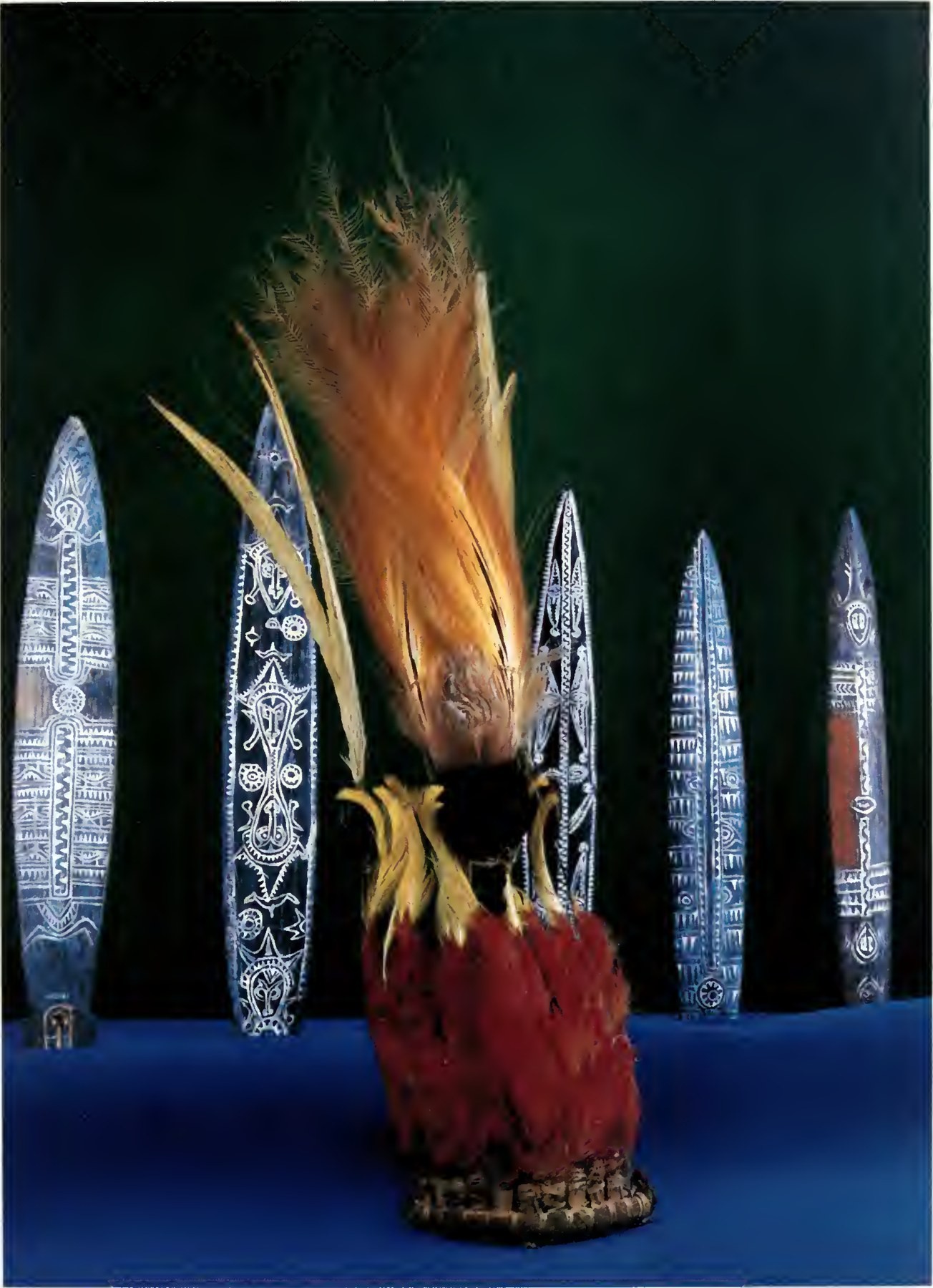
Words that walk with the rite
Set the five cases side by side and they show the same thing. The word that names the bullroarer in New Guinea is the cult's own word: the name of a giant, of a monster, of the spirits, of the dead, of the whole of the sacred. And it does not stay inside one language. Sosom's name stands in the Marind language and in three Yam languages across the border, and Williams heard it at Setavi and named its source in the same sentence. A Purari monster gave its name to the Elema roarer. A Nara roarer-word became the Roro word for spirits. One stem for religion runs from the Bogia coast to Manam and Wogeo, and Murup crosses from the Monumbo to the Bosmun. Each of these is a name passing between neighbours who do not share a language, and in every case it passes together with the thing it names.
Words do not cross language lines by themselves. A word for a cult goes where the cult goes, carried by men who were taught its secrets and who passed them on. In New Guinea, the people who kept the bullroarer told their ethnographers where the being came from, and the names on the map run the way they said: Sosom out of the east, and the voices of the Gulf from one men's house to the next. The bullroarer's names are a record of its travels, written in the languages it passed through.
Key sources
- F. E. Williams, Papuans of the Trans-Fly (Oxford, 1936), with an introduction by A. C. Haddon: p. xxviii, Setavi in the north of the Semariji country; p. 185, sosa “(cf. sosem among the Marind-Anim)” and the old man from the water; p. 181, Keraki moiank; p. xxvi, Haddon on Sosom.
- J. van Baal, Dema: Description and Analysis of Marind-anim Culture (The Hague, 1966), pp. 267–273, Sosom; p. 271, the watersnake.
- Jaap Kunst, De inheemse muziek in westelijk Nieuw-Guinea (Amsterdam, 1950), p. 76 and nn. 203–205: the bullroarer and the Sosom feast after Wirz; English edition in Music in New Guinea (1967), p. 173.
- Matthew J. Carroll, Wolfgang Barth, Nicholas Evans et al., Yamfinder: The Southern New Guinea Lexical Database (University of Melbourne; Lexibank CLDF release 2024), concept “bullroarer”: sosam at Sota (Ngarna), Wereave (Rema) and Kiriwa (Arammba), field data of Emil Mittag; meyang and its relatives in the Nambu branch.
- C. G. Seligmann, The Melanesians of British New Guinea (Cambridge, 1910), p. 304 and note, p. 373, p. 748: beriwa.
- F. E. Williams, Bull-Roarers in the Papuan Gulf, Territory of Papua Anthropology Report 17 (1936), pp. 4–8; reprinted in E. Schwimmer (ed.), The Vailala Madness and Other Essays (1976), pp. 78–82: kaiavuru and kaiemunu; hevehe as “snake”.
- Joseph Schebesta, “Parak-Institution im Bogia-Distrikt unter den Sepa”, Anthropos 16/17 (1921/22), pp. 1053–1055, p. 1054: lumbeki, nebek, embeki.
- Franz Vormann, Die Monumbo-Sprache (1914), wordlists: Murup. Pitt Rivers Museum, Oxford, 1938.36.1562 and companion Blackwood accessions: Bosmun murup.
- Heinrich Zahn, Jabêm–English Dictionary, rev. F. Streicher, tr. D. C. Laycock (Pacific Linguistics C-68, 1982), p. 30 balôm, p. 327 lôm. Malcolm Ross and Meredith Osmond, The Lexicon of Proto Oceanic, vol. 6: *bara(q)um. Joel Bradshaw, Numbami–English Dictionary (2014), p. 12: bolomana.
- S. Lehner, “Bukaua”, in R. Neuhauss, Deutsch Neu-Guinea, vol. III (Berlin, 1911), pp. 402–418, especially p. 412 and Fig. 10.
- K. A. Gourlay, Sound-Producing Instruments in Traditional Society: A Study of Esoteric Instruments and Their Role in Male–Female Relations, New Guinea Research Bulletin 60 (Port Moresby and Canberra, 1975), pp. 69–71.
- Genesis Rabbah 20:11: Rabbi Aḥa on Eve and the serpent.
- As far as we know, setting these New Guinea cult words on one map, with Gourlay's two lines drawn as his, is original to this page.