No. BELL1977-001
Tanga tangalop bullroarer size grades
Papua New Guinea · Tanga Islands (Boang, Malendok, Lif, Tefa) · New Ireland Province · former German New Guinea · Oceania · Sahul
Restricted
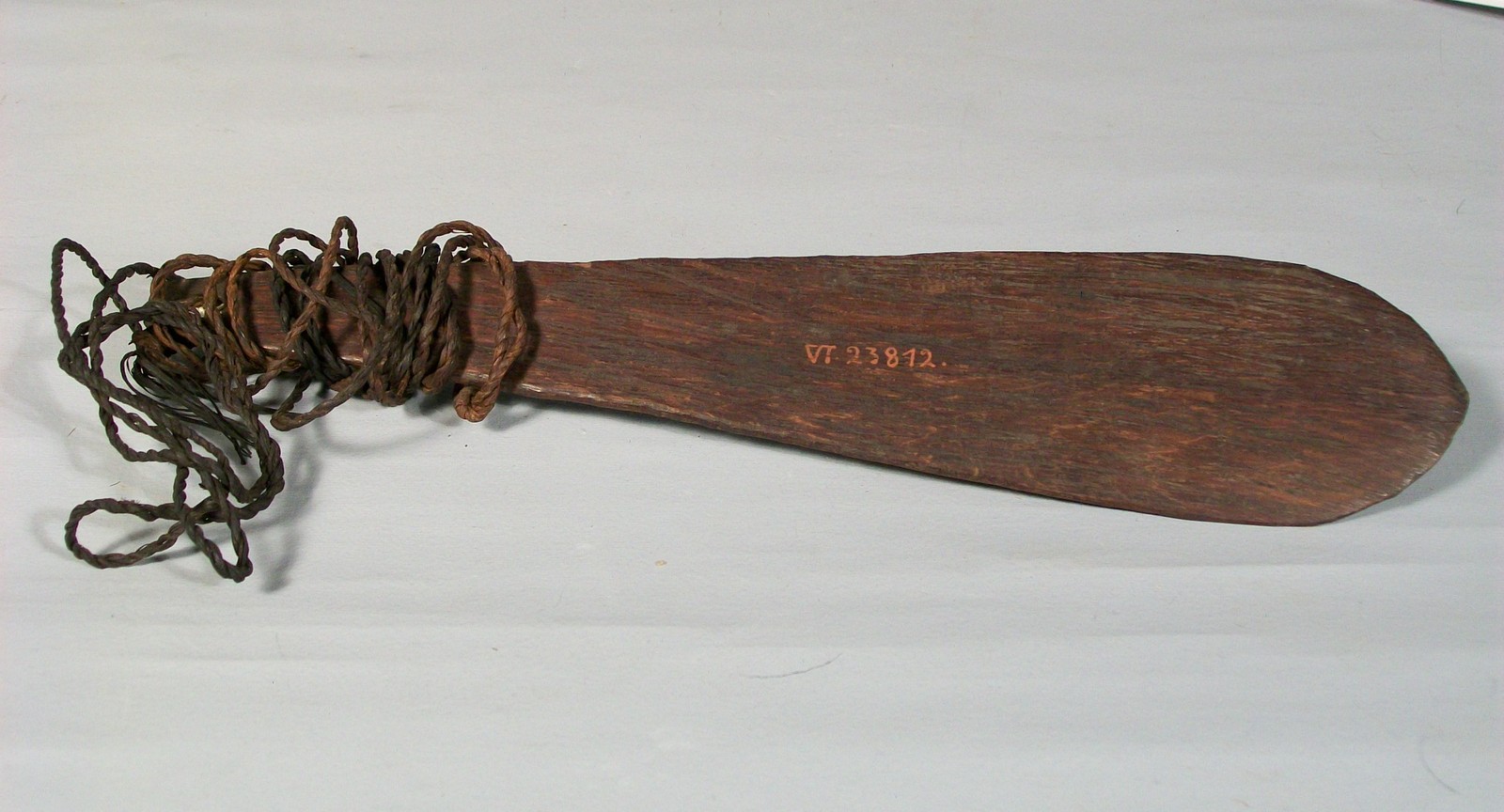
tangalop (common term); tomlulur (small); burrarumarum (large, swung on a bamboo pole); tom-mis-mis (largest)
Source term: bull-roarer
tangalop: Tanga common term for bullroarer, about 11 inches long; tomlulur: small type, about 5 inches; burrarumarum: large type, swung on a bamboo pole; tom-mis-mis: largest type, 2'6" long
Tomlulur’s cry belonged to a nut-gatherer: when the mythical Tomlulur climbed a pel tree, wasps attacked him and he cried out in pain. On Tanga, the small roarer bearing his name repeated that cry. Other sizes had other roles. The common tangalop was about eleven inches; burrarumarum boomed from a bamboo pole, while the largest tom-mis-mis, two and a half feet long, was reserved for high-ranking men of Sokapana. Novices were told the kinit would eat them and vomit them forth; whirling roarers supplied the ghosts’ voices.
BURRARUMARUM larger type of bull-roarer than the tangalop, swung by means of a bamboo pole.
Bell 1977:198
Particulars
- Object
- Four size grades of wooden bullroarer distinguished by Tanga speakers: tomlulur, about 5 inches, the small type; tangalop, about 11 inches, the common term; burrarumarum, larger than tangalop and swung from a bamboo pole rather than by hand; and tom-mis-mis, the largest type, 2'6" long.
- Function
- Sounded at boys’ initiation into Sokapana as ghosts’ voices; the largest tom-mis-mis was reserved for high-ranking members.
Sources
- F. L. S. Bell, Tanga-English, English-Tanga Dictionary (1977), p. 198 View
- Bell, 'Report on Field Work in Tanga', Oceania 4 (1934), p. 303, in K. L. Lansley, The Contribution of Play Activities to the Survival of Traditional Culture in Four Melanesian Societies (1969), pp. 51, 53 View
- Bell, 'Sokapana: A Melanesian Secret Society', JRAI 65 (1935), pp. 317, 339 View · archived