No. LATTAS1998-001
Bush Kaliai Varku bullroarer tambaran
Papua New Guinea · Kaliai bush, Kove · Kaliai Rural LLG, West New Britain · Oceania · Bismarck Archipelago
Restricted
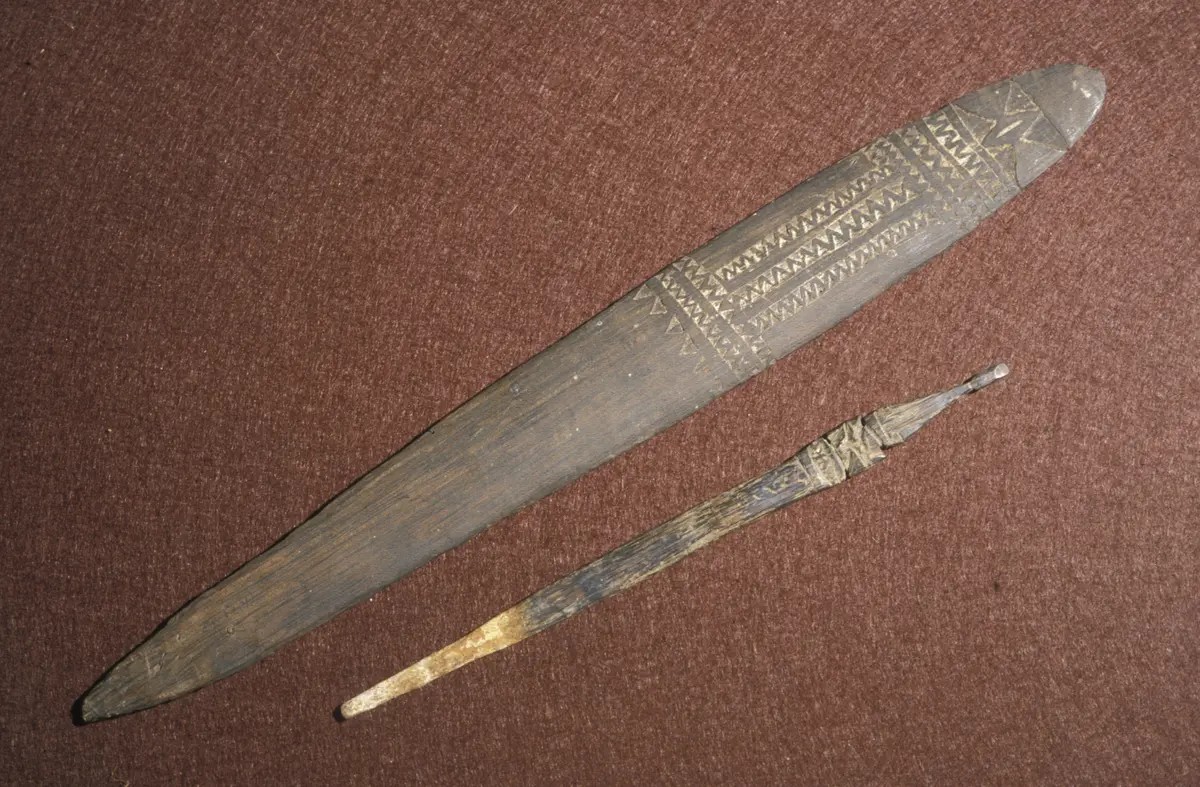
Varku
Source term: bull-roarer / tambaran
Varku: bush Kaliai bullroarer tambaran; Lattas says the mythic woman Kewak first named it Arku before Kowdock renamed it Varku.
Etymology. Varku is at once the bush Kaliai bullroarer and the tambaran it embodies: in myth the ancestral woman Kewak first owned the instrument and named it Arku, and Kowdock later renamed it Varku when he took it from women and gave it to men. The word is thus a proper name rather than a descriptive term, and women were taught to fear its sound as the dangerous presence of the tambaran itself.
The bush Kaliai say the first bullroarer was a woman's invention. Kewak, one of the first mothers of humanity, was breaking firewood when a chip flew off with a loud whirling noise; from it she made the roarer, named it Arku, and told the men its cry was a monster that would eat them. While the women danced and feasted with their tambaran, the men hid in the forest nursing the children — until Kewak's brother Kowdock, fumbling a baby at his breast, tripped and broke his phallus-shaped lime container. He chased the women down, captured Arku and renamed it Varku, then broke his sister's neck in the sea, and she drowned. In initiation Varku was both roarer and mask. The mask, Omroo, was “Varku’s mother”: boys were swallowed into the tambaran’s womb and vomited from its mouth, and painted in cassowary colours; each came out no longer the tambaran’s child but Varku ilau, Varku’s father, with the power to summon him. Since then men have ruled through the roarer they stole, and a widow shown the men's-house secrets once had to die as Kewak died. In the 1960s Koriam's cargo cult ended the old law by tying Varku to a stick and carrying it before the women's eyes.
The ripples created by her drowning body became the origin of waves; before this, the sea was flat.
Lattas 1998, Cultures of Secrecy, ch. 4
Particulars
- Object
- Secret male tambaran identified by Lattas as a bull-roarer; elsewhere paired with a painted wooden mask in Varku rites.
- Function
- Men's-house tambaran used in bush Kaliai initiation and gender-order rites; boys learn the secret that men, not Varku, are the true tambaran.
Sources
- Andrew Lattas, Cultures of Secrecy: Reinventing Race in Bush Kaliai Cargo Cults (Madison: University of Wisconsin Press, 1998), chs. 1, 2, 4, 6 View
- Andrew Lattas, 'Trickery and Sacrifice: Tambarans and the Appropriation of Female Reproductive Powers in Male Initiation Ceremonies in West New Britain', Man n.s. 24(3) (1989): 451–469, p. 462 View · archived