Winter ghosts teach Kato and Yuki boys; four Potter Valley Pomo whirlers roar thunder at the cardinal points of a May rain prayer; Lake Miwok novices learn to dance. Across the northern coast, the Central Valley and the Sierra, the sounding board also heals, draws out poison, stops storms and fills children’s games.
Someone brings spring flowers to the dance house. The Kato boys who have spent the winter inside learn that their confinement is ending. Manzanita berries come next, carried around the fire before the pupils may eat. They are washed, given new clothes and handed back to relatives bringing baskets of food. Behind that spring feast lies a winter of hunger, instruction and nightly visits from ghosts. Bullroarers sounded once the visitors had entered, and the women at home heard the ghosts’ own voices. 1
At dusk around the first of May, Potter Valley Pomo gathered in the assembly house. Four Thunder-stick whirlers waited outside at the cardinal points, with the lightning clappers. At the high priest’s signal the drummer began a long roll with his heels on the foot drum. The clappers struck; the four whirlers answered with an uproar that lasted about two minutes. Then the sound stopped and the priest prayed. The noise drew the gods’ attention; only then were the words offered, a prayer for rain. 2
Kato boys entered at about twelve. Their fathers or male relatives escorted them to the dance house; the chief had already marked their summons with a little stick. Inside, the boys lay beside the fire beneath straw, their bodies blackened and painted. Water and food were severely restricted at first, then acorn soup and pinole were given in larger amounts. They had to use scratching sticks instead of their hands. Firetenders maintained the house and clowns tried to provoke laughter, itself considered dangerous. Over the months they grew weak, “like dead people.” 1
From its roof the chief called toward the hills. Four ghost performers answered with whistles, then rushed down painted red, yellow and black. A man received each at the entrance. They circled the central post in both directions, following a counted pattern whose mistakes incurred fines, then picked up pupils and led them in dances. Only after the visitors entered did the bullroarers sound. Songs wished the boys good luck and protection from illness. At midnight the ghosts returned to the hills; the chief washed and fed the pupils. In the morning the chief taught them about Nagaitco, who could cure the illnesses brought by the big snake or the poisonous mountains, and told them to care for their families, tell the truth and restrain their conduct. 1
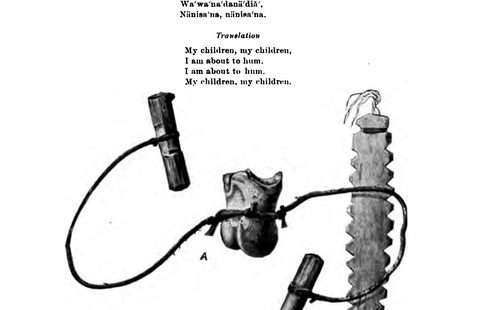
Selected Kato boys went on to doctor training. In that school Nagaitco himself appeared, sounding telbut, a bullroarer made from the shoulder blades of two deer. Sacred songs, dangerous foods and the treatment of illness became matters of professional instruction. Girls could also become doctors, but through their own separate school, assisted by older women doctors. That school had no visiting ghosts or Nagaitco and could be watched by villagers in the evening. 1
In southern Round Valley, the Yuki instructor swung aelamo’otom, thunder breath, on the first day of the Ghost school and at intervals when he spoke about Thunder. Officials divided the work: the chief summoned ghosts and addressed people from the roof, a firetender tended the house, a janitor cleaned it and a teacher instructed the boys. Between ghost dances they learned practical matters and community lore. In spring they passed out through the same wood opening by which they had entered in autumn. 1
A further Yuki course explained Taikomol, He Who Walks Alone, and the creation of the world. The teacher had an array of teaching aids. A reed whistle represented Taikomol’s voice, a cocoon rattle accompanied songs, and eagle feathers recalled the feathers Taikomol laid down when speaking to Coyote. The bullroarer sounded when the lesson turned to Thunder and Taikomol. 1
The same thunder breath could be brought to a sick person’s door. In one Yuki cure, two men stood on either side of the doorway sounding their blades while a masked performer danced inside, in the hope of sending the patient into a trance. 1
The Huchnom winter school, which also took in neighbouring Kato and Pomo boys, mixed instruction with ghost visits, as the Huchnom healer Tony Metock remembered it. Painted in black and white stripes, with flowers in their hair and apparent flames in some headdresses, the ghosts circled the fire and disciplined the boys. They sounded the sacred tet nun toyol during their ceremony. Near winter’s end the pupils were passed out through the smoke opening, where mothers and aunts waited to catch, wash and clothe them. 1
For the Coast Miwok, the boys’ Ghost initiation lasted four nights in a specially built house. The walipo came from the hills, carrying torches with apparent fire in their hair. Inside, the boys lay painted black, and the whirling umul was heard as the ghosts’ voice. This initiation was separate from the adult society, whose members learned costumes and bullroarers in another course in the hills. The society admitted both men and women. Its Pololo dance addressed a different return: deceased relatives came to a memorial gathering, where mourners met the impersonators outside and gave beads before they entered. 1
On the Pololo dance’s second day, the fire dwindled and society members lay down while two men swung bullroarers as thunder. At the end everyone went to the creek to swim, then two women members brought food into the house. 1
At the south end of Clear Lake, the Lake Miwok Ghost initiation selected boys and young men to learn the sacred dances. The yomta paid parents for the boys he wanted to teach; Salvador remembered his grandmother refusing when he was a child, and his eventual recruitment as a young man. Ghost contingents came from different villages. They danced four times in the house, sounding ladiladi between dances. The pupils waited with deer hides covering their heads, then looked up to find the visitors already inside. Their instruction prepared them to become performers themselves, while women and uninitiated children at home believed ghosts had come down from the hills. 1
Coast Yuki boys also underwent winter confinement, and ghost performers entered their dance house. Yet the bullroarer had no part in their sacred ceremonies. Their boys twirled it openly as tinem, thunder, to stop thunderstorms. 1
Among the Wukchamni Yokuts of the southern San Joaquin Valley foothills, the healer did more than whirl the instrument. He rotated the blade between the hands as in making fire, then pressed point-first against the afflicted part of a patient’s body to extract poison. In a harmful use, poison could instead be placed on the blade and projected at someone by whirling it. 3
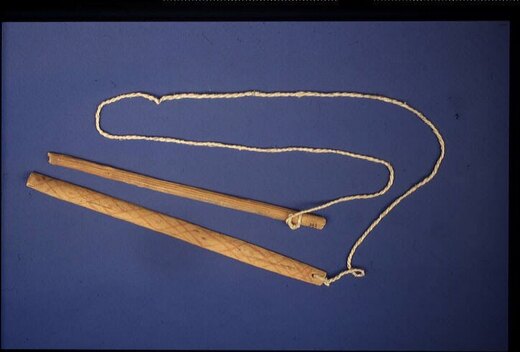
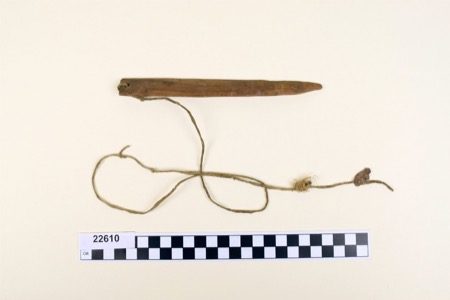
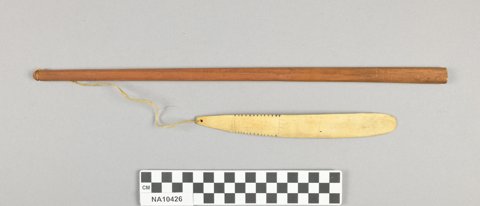
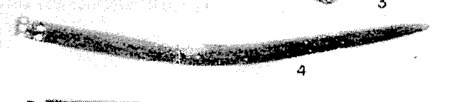
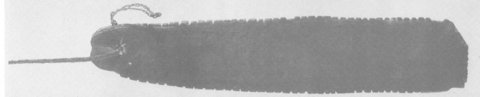
Other blades come from across the region: a manzanita roarer from Cloverdale, a Karuk blade from the Klamath River, a pine one from Yosemite. South through the Yokuts and Western Mono country, and over the Sierra to the Tübatulabal and the eastern valleys, people whirled the board in play, against bad weather and to heal. 6, 7, 8, 3, 5
Among the Kato (Cahto), the southernmost Athabascan people of the California coast, at the head of the South Fork of the Eel River, every boy of about twelve was shut into the earth-covered dance house for the whole winter. Starved, blackened, and laid in a row under straw until they grew weak…
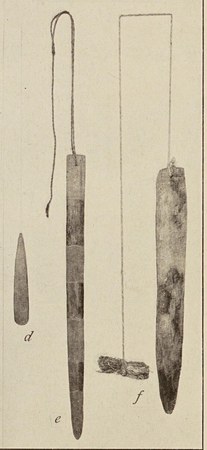
Representative — not this record’s object · Kroeber’s plate of Yokuts, Luiseño, and Pomo bullroarers.
Among the inland Yuki of Round Valley the bullroarer breathed thunder. Called aelamo'otom, thunder breath, it was swung in the winter initiation whenever the teacher spoke of Thunder and Taikomol, the creator. It was also called thunder voice — the voice of Taikomol himself, who was one with…
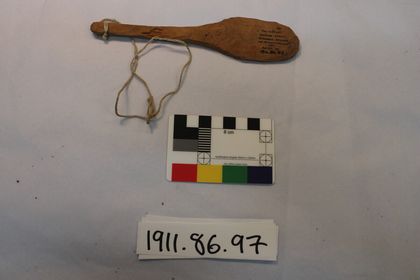
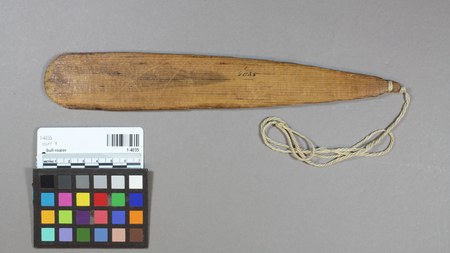
Representative — not this record’s object · The schoolboys' ual ual: a hand-sized paddle on its cotton string
The walipo, ghosts trained in secret in the hills, came down twice in the four nights of the Coast Miwok Ghost ceremony, carrying torches, with fire burning in their hair. Inside a house built for the occasion, umul bullroarers roared, and the women outside took the roaring for the voices of the…
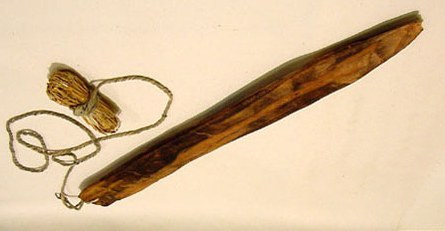
Representative — not this record’s object · Pomo bullroarer from Coyote Valley Rancheria.
About May first, the Potter Valley Pomo gathered at dusk in the assembly house while four Thunder-stick wielders took position at the four cardinal points. At high priest Yum-ta's signal, the drummer sprang onto his foot drum and rolled it with his heels, the lightning-stick clapper struck a loud…
Representative — not this record’s object · Catawba carved wooden bullroarer with its cord
Among the Lake Miwok of Coyote Valley and the south shore of Clear Lake, the bullroarer was the sound of the dead. In the four-day Ghost initiation that Edwin Loeb recorded in the early twentieth century, men painted with white clay and charcoal impersonated ghosts who came down from the hills;…
Representative — not this record’s object · Pomo bullroarer from Coyote Valley Rancheria.
Along the Sierra foothills, from Coarse Gold Creek south to Poso Creek, the Yokuts whirled the same wooden slat to very different ends. On the Kings River the Choinimni gave it to their doctors, who whirled it openly and alone: it raised storms, healed the sick and made the well fall ill. The…
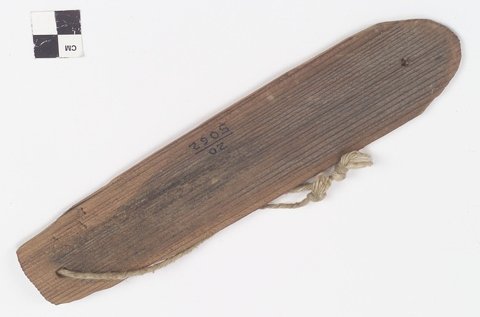
Representative — not this record’s object · Chukchansi bullroarer from California.
Representative — not this record’s object · Pomo bullroarer from Coyote Valley Rancheria.
Valley Yokuts: San Joaquin River people at Friant, Nutunutu (lower Kings River), Tachi (Tulare Lake, Lemoore), Chunut (eastern Tulare Lake), Yauelmani (Kern River and Tejon)
1930 interviews, consultants named on pp. 1–2. Kato: pp. 14–15, 26–34; Huchnom: pp. 58–60; Coast Yuki: p. 55; southern Inland Yuki: pp. 64–68; Coast Miwok: pp. 115–118. These are remembered accounts, with Curtis explicitly distinguished where transmitted. Lake Miwok: pp.121–123, selective Ghost initiation, dance teaching and ladiladi between dances.
p.159: John W. Hudson’s original account reproduced in the Thunder Ceremony box; four stations, drummer, clappers, two-minute sounding and following prayer.
pp.58–60: groups and informants; p.85, elements1233–1244, local uses; p.126, notes1242–1243, Wukchamni poison extraction by hand-rotation and harm by whirling.