RIDDELL1960-001 - ethnographic attestation
Honey Lake tupununoin, the wind-caller
United States - Honey Lake Valley, Lassen County, northeastern California - North America - Great Basin
Weather / fertility magic
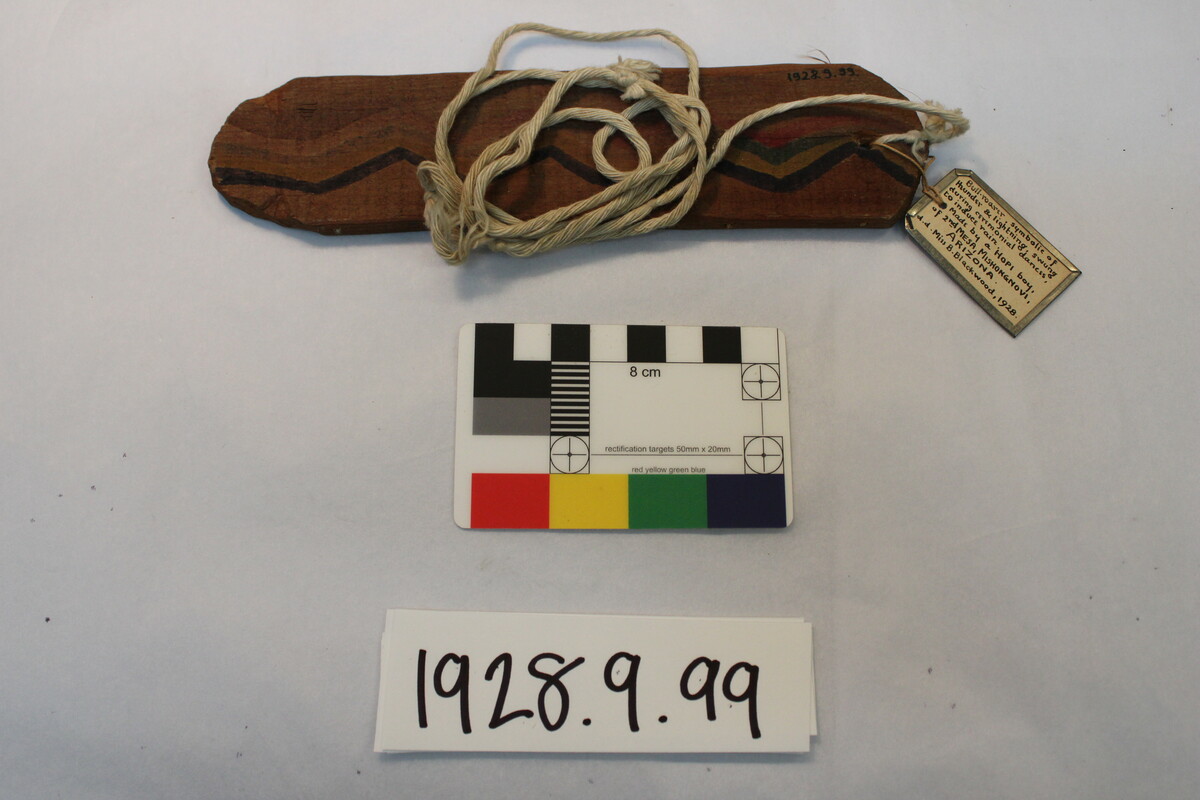
tupununoin
Source term: bullroarer (tupununoin)
tupununoin: “to whirl,” the Honey Lake Northern Paiute name for the bullroarer. kukwapitud: to make the wind blow.
Etymology. The name is simply the action: tupununoin, “to whirl.” Whirling it called the wind, which had its own verb, kukwapitud, “to make the wind blow.”
On the shores of Honey Lake, in the high desert east of the Sierra, the bullroarer was called tupununoin, “to whirl,” and it was swung to call the wind. That made it dangerous in a child’s hands. Gladys made bullroarers when she was little, but her mother and her grandfather Joaquin told her not to use them: whirling one would bring the wind. The rule reached past the instrument itself. Children were not allowed even to lash the air with switches, for that, too, called the wind. Making the wind blow had its own word, kukwapitud.
The bullroarer, tupununoin, “to whirl,” was used to call the wind.
Francis A. Riddell, Honey Lake Paiute Ethnography (1960), p. 50
- Object
- A whirled bullroarer; its form and material are not described.
- Source
- Francis A. Riddell, Honey Lake Paiute Ethnography, Nevada State Museum Anthropological Papers 4 (Carson City, 1960), pp. 50–51
- Source location
- printed pp. 50–51
- Source confidence
- medium
- Location note
- Honey Lake, Lassen County, California, the centre of the Wadatkuht homeland Riddell describes; not a use site.
Regions: The Americas · North America
- Weather magic