No. LOEB1929-020North America
Coast Miwok bullroarer
United States · Central California coast · North America
Restricted
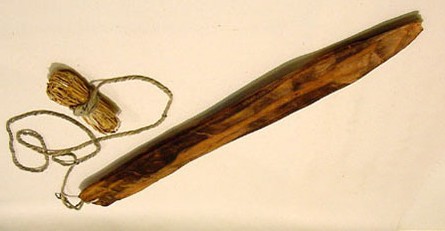
umul
The walipo, ghosts trained in secret in the hills, came down twice in the four nights of the Coast Miwok Ghost ceremony, carrying torches, with fire burning in their hair. Inside a house built for the occasion, umul bullroarers roared, and the women outside took the roaring for the voices of the ghosts. The boys, nine or ten years old, lay painted black on the ground, and now and then the ghosts threw them over the fire. A separate secret society, open to men and women, taught its own members the bullroarers; at its Pololo dance the dead came back, and on the second day the fire was let die down, the members lay on the ground, and two men swung the bullroarers as the voice of thunder.
Bullroarers (umul) were whirled in the ceremonial house, and the women believed the roaring to be the voices of the ghosts.
Edwin M. Loeb, The Western Kuksu Cult, UCPAAE 33(1) (1932), p. 116
Particulars
- Function
- Sounded in the boys' Ghost initiation; in the secret society's pololo memorial dance, two men swung it as the voice of thunder.
Source
Edwin M. Loeb, Tribal Initiations and Secret Societies, University of California Publications in American Archaeology and Ethnology 25(3):249–288 (1929), pp. 267, 269; Edwin M. Loeb, The Western Kuksu Cult, University of California Publications in American Archaeology and Ethnology 33(1):1–137 (1932), pp. 115–118