No. NA-S1952-009
Mono curing bullroarer
United States · California · Great Basin · North America
Sacred / spirit
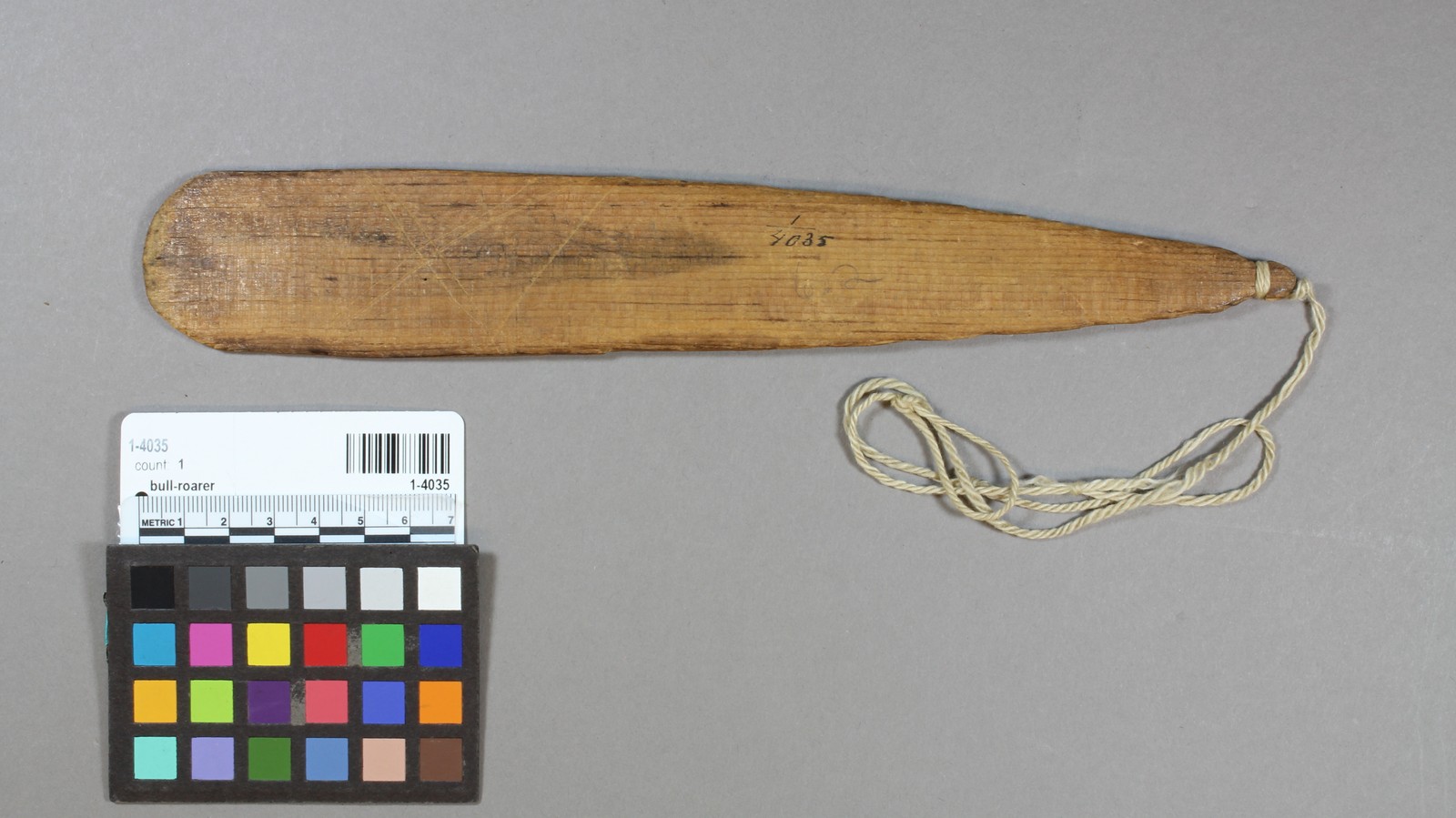
Source term: bullroarer
At North Fork, on the San Joaquin, the Mono bullroarer belonged to the doctors. A shaman whirled it in the open, and only men might handle it. It called people together for ceremony, raised storms, and cut both ways: it could heal a sick person, and it could make a well one ill. South on the Kings River the Western Mono knew its darker side — Woponuch shamans swung it in public to bring a storm or send sickness, Entimbich doctors in private to sicken — while in Sycamore Valley it was a plaything of wood, horn or bone, and at Auberry, on the San Joaquin below North Fork, a wooden toy and nothing more.
In North America, the bull-roarer has curative properties among the shamans of the Diegueño, Mono, Navaho, Tonto Apache, Yokuts, Pomo, and Papago; formerly this was also true of the Tanaina.
Theodore A. Seder, 'Old World Overtones in the New World', Museum Bulletin (University of Pennsylvania) XVI(4) (1952), Bull-Roarer section
Particulars
- Function
- A shaman's instrument. At North Fork it was swung publicly and by men only, to assemble people for ceremony, raise a storm, heal, and cause sickness; among the Kings River Western Mono shamans used it to raise storms and cause sickness, and it was also a plaything. At Auberry it was only a wooden toy.
Sources
- Theodore A. Seder, 'Old World Overtones in the New World,' University Museum Bulletin 16(4) (1952), pp. 51-54 View · archived
- B. W. Aginsky, 'Culture Element Distributions: XXIV, Central Sierra,' Anthropological Records 8(4) (1943), pp. 393-394, 425, elements 1233-1244
- Harold E. Driver, 'Culture Element Distributions: VI, Southern Sierra Nevada,' Anthropological Records 1(2) (1937), pp. 58-60, 85, elements 1233-1244