No. NAMER-020
Tübatulabal ku·lišt, the yucca-stalk plaything
United States · Upper Kern River and South Fork Kern River drainages, Kern River Valley, southern Sierra Nevada, Kern County, California · North America
Play / practical
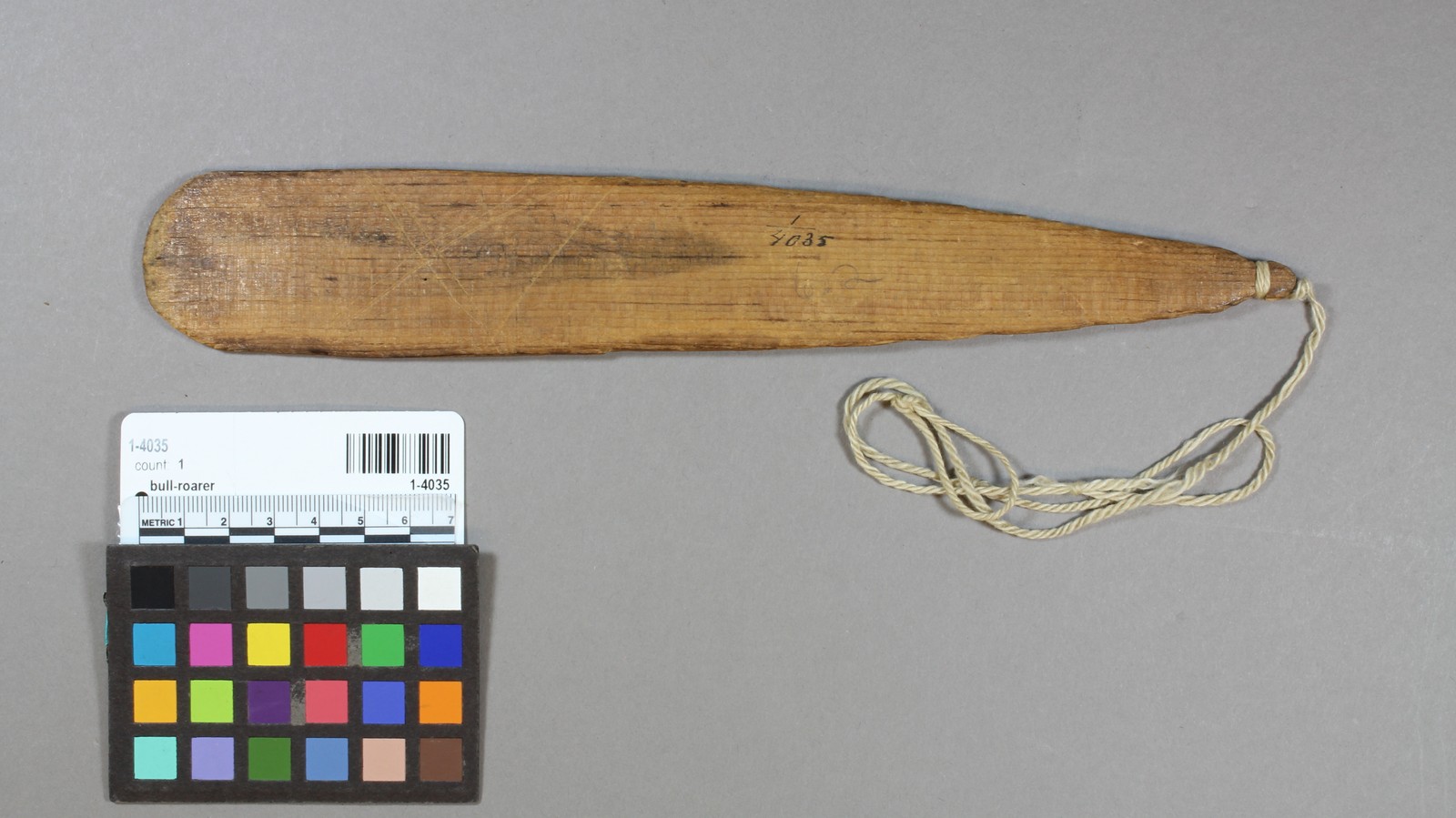
ku·lišt
ku·lišt — literally “instrument for playing,” i.e. a toy (Voegelin 1938, p. 36). The Spanish bayonet is kuyat; its centre stalk, kuya'dibï·l, was “used in manufacture of bull-roarer” (Voegelin 1938, p. 15).
Its name gives the game away: ku·lišt, “instrument for playing.” Tübatulabal boys of the upper Kern River cut it from the dried flower stalk of the Spanish bayonet, a yucca of the foothill and desert slopes, split it, and tied four feet of native twine to an eight- to ten-inch section — at the centre, so oddly that Voegelin added a “sic.” There was no handle; a boy simply whirled the cord. Whirled, the slat could also draw birds in to the hunter.
Bull-roarer (ku·lišt, lit., instrument for playing, i.e., toy) made from stalk of Spanish bayonet … attached at center (sic) to 4-ft. length of native twine; stick handle lacking. Boys' toy.
Erminie W. Voegelin, "Tübatulabal Ethnography," UC Anthropological Records 2(1) (1938), p. 36
Particulars
- Object
- An 8–10 inch section of dried, split Spanish-bayonet (Yucca whipplei) flower stalk, tied at its centre to a four-foot length of native twine; no stick handle.
- Function
- Boys' toy; also whirled to attract birds when hunting.
Sources
- Erminie W. Voegelin, “Tübatulabal Ethnography,” University of California Anthropological Records 2(1) (1938): 1–90, pp. 15, 36. View · archived
- Jerry N. Hopkins, Gerrit L. Fenenga, Alan P. Garfinkel, Samantha Riding-Red-Horse and Donna Miranda-Begay, “Further Reflections on California Rain-Making Shamanism: ‘The Other Half’ of the Tübatulabal Shaman’s Rain-Making Bundle,” Journal of California and Great Basin Anthropology 32(2) (2012): 127–140, p. 136. View