No. LOEB1929-021
Maidu child-toy bullroarer
United States · Northern California · North America
Play / practical
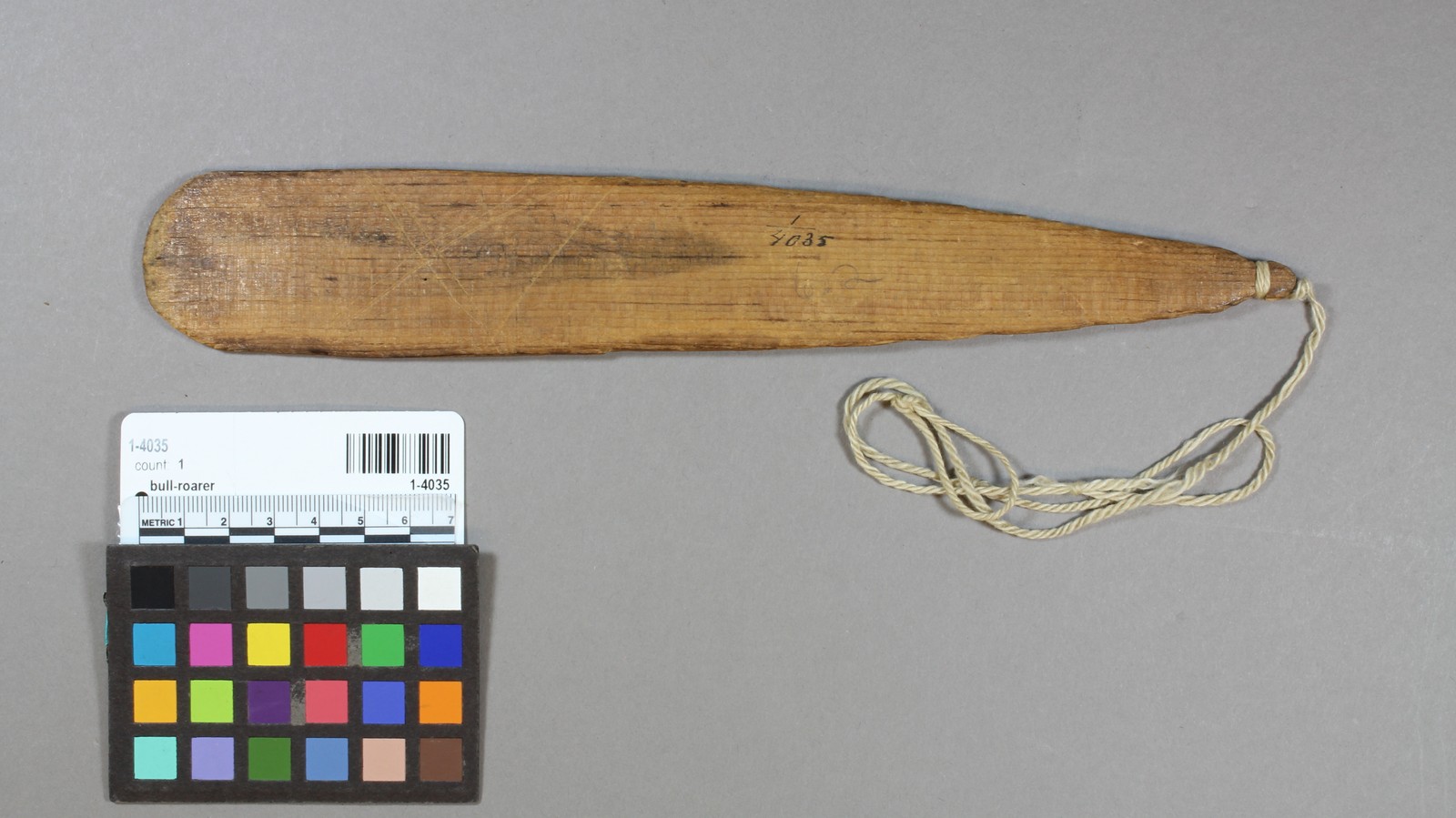
Source term: bullroarer
Among the Maidu of northern California the bullroarer was only a child's toy. Roland Dixon, who studied the Northern Maidu for the American Museum of Natural History at the turn of the century, found nothing there but a plaything. Surveying the secret societies of central California, Edwin Loeb found the instrument nowhere in the region except among the Pomo and Coast Miwok. Where it did carry weight, in the Pomo Ghost ceremony, bullroarers were swung inside the subterranean ghost house and the uninitiated were told the sound was the voice of the dead.
The bullroarer has not been reported for central California outside of the Pomo and Coast Miwok. Dixon describes it as a child's toy among the Maidu.
Loeb 1929, "Tribal Initiations and Secret Societies," Univ. of California Publications in American Archaeology and Ethnology 25(3):269
Particulars
- Function
- A child's toy among the Maidu.
Source
Loeb 1929, Tribal Initiations and Secret Societies, University of California Publications in American Archaeology and Ethnology 25(3):249-288