GARFINKEL2009-001 - rock art depiction
Coso Animal Master figure
United States - Coso Range Rock Art Complex, China Lake Naval Air Weapons Station, eastern California (Inyo - Kern county line) - North America - Great Basin
Sacred / spirit Candidate only
Source term: bullroarer
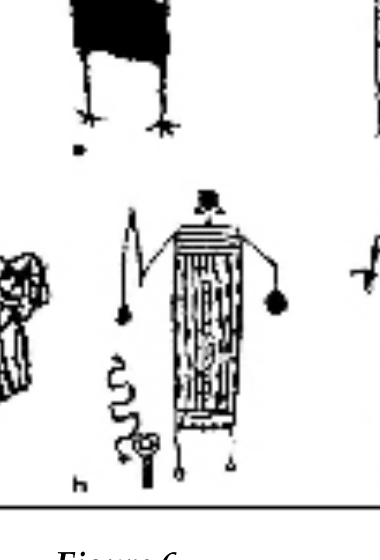
A patterned being stands in the Coso rock art with taloned bird feet and a long, bulb-tipped rod. Garfinkel and his co-authors read figures of this kind as possible images of the Animal Master, a supernatural keeper of game within a hunting religion and its animal ceremonies. The rod may be a bullroarer — or a club, rattle, or hunting bolo. Its religious world is clearer than the object in its hand.
Sometimes the long rod is attached to a bulbous object that may be meant to depict a club, bullroarer, rattle or hunting bolo (Fig. 6h).
Garfinkel, Austin, Earle and Williams, Rock Art Research 26.2 (2009), p. 182
- Object
- Pecked petroglyph, Patterned Body Anthropomorph (PBA) Fig. 6h: a patterned, cross-hatched torso figure with taloned, bird-like feet and outstretched arms. The bent right arm ends in a long, slender rod attached to a bulbous terminal object; a separate wavy line descends from the other arm. No cord, no arc of motion, and no separate performer are shown; the object is one element held by the figure itself.
- Function
- The possible bullroarer is held by a Coso Patterned Body Anthropomorph interpreted as a supernatural Animal Master within a hunting-religion complex; the rod could also be a club, rattle or bolo.
- Source
- Garfinkel, Austin, Earle and Williams, Rock Art Research 26.2 (2009), p. 182
- Source location
Page references
Rock Art Research 26.2 (2009), p. 182, Fig. 6h
- Source confidence
- low Coso Range-level anchor, China Lake Naval Air Weapons Station. The article's shared caption for Figs 6-8 places Fig. 6h among the rock art galleries of Little Petroglyph, Big Petroglyph or Sheep Canyon without resolving which, so no canyon-specific coordinate is used; this point should be read as the range, not the panel.