No. NAMER-019
Lake Miwok
United States · Coyote Valley and the south end of Clear Lake, Lake County, north-central California (around present-day Middletown) · North America
Restricted
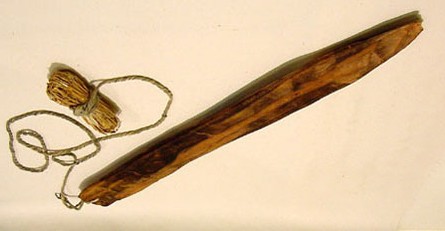
ladiladi
ladiladi — the Lake Miwok name for the bullroarer.
Among the Lake Miwok of Coyote Valley and the south shore of Clear Lake, the bullroarer was the sound of the dead. In the four-day Ghost initiation that Edwin Loeb recorded in the early twentieth century, men painted with white clay and charcoal impersonated ghosts who came down from the hills; women and uninitiated children stayed in their homes, excluded and meant to believe the spirits were real. Each contingent of ghosts danced four times in the dance house, and between the sets they sounded the ladiladi, the whirling slat whose roar filled the gaps in the song. By Loeb's day the rite was less about making a boy into a tribal man than about teaching selected boys the sacred dance steps, its leadership and aim shifted toward the neighboring Patwin Hesi.
Each group danced four times in the dance house. Between dances they sounded the bullroarer (ladiladi).
Loeb, "The Western Kuksu Cult," UC-PAAE 33(1):122, 1932.
Particulars
- Object
- A whirled wooden bullroarer (Lake Miwok ladiladi), a flat slat swung on a cord to produce a roaring hum.
- Function
- Sounded by ghost-impersonators between dance sets during the male Ghost initiation, where women were excluded and believed real ghosts had descended from the hills.
Source
Loeb, Edwin M. 1932. "The Western Kuksu Cult." University of California Publications in American Archaeology and Ethnology 33(1):1-137. The Lake Miwok Ghost initiation, p. 122