No. PERI1982-001
A roarer cut from manzanita
United States · Dry Creek · Cloverdale, Sonoma County, California · North America
Function not recorded
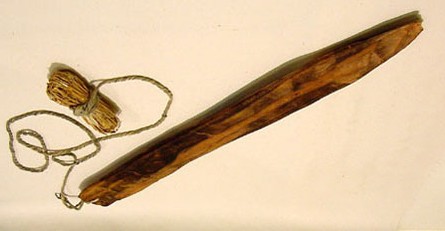
Source term: bull-roarer
Manzanita is a low, red-limbed chaparral shrub with wood hard enough to blunt a blade, and the Southern Pomo of Cloverdale, in the Russian River hills of Sonoma County, put every part of it to use — berries and leaves for food and medicine, the wood for things that had to last. The plant-use record for Cloverdale lists what the wood was worked into: a straight wooden war club, a double-pointed fish hook, and a bullroarer. The compilers had a ceremonial category and used it on the same plant, for the moth cocoons gathered off it for doctors' rattles; the roarer they filed under technology. Who swung it, and on what occasion, is not said.
TECH: Wood fashioned into a simple club (straight wooden war club), bull-roarer, double-pointed fish hook
Peri, Patterson & Goodrich, Ethnobotanical Mitigation, Warm Springs Dam-Lake Sonoma (1982), p. 122.
Particulars
- Object
- Bullroarer worked from manzanita wood; dimensions, cord and decoration not recorded.
- Function
- Not recorded; the survey files the manzanita roarer under technological rather than ceremonial uses, beside the war club, fish hook and harpoon toggle.
Source
Peri, Patterson and Goodrich, Ethnobotanical Mitigation, Warm Springs Dam-Lake Sonoma, California (1982), p. 122