No. NAMER-017
Coast Yuki
United States · Pacific coast of Mendocino County, roughly the Noyo River north to the Sinkyone boundary (Westport–Usal heartland), northern California · North America
Weather / fertility magic
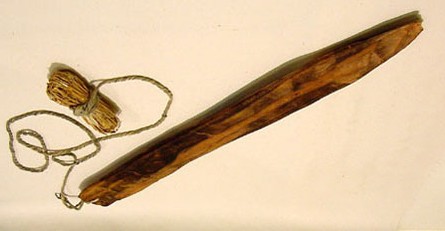
tinem
Source term: tinem (thunder)
tinem — Coast Yuki for "thunder," the name given to the bullroarer.
Etymology. The slat carried the name of the very thing it was twirled to stop.
On the fog-bound Mendocino coast, the Coast Yuki — the 'ocean people' — held the bullroarer out of the sacred world entirely, and the exception is pointed: their creator was the thunder god Keyumka, and the whirled slat they called tinem means 'thunder.' No one impersonated Keyumka, and his namesake instrument was 'openly twirled by boys to stop a thunder storm.' All around them the same slat was a guarded voice: among the neighbouring Huchnom it was sacred, twirled by the ghost-impersonators; Kato women were told the roar was the voices of the ghosts; the inland Yuki swung their aelamo'otom, 'thunder breath,' whenever the initiation instructor spoke of Thunder. Edwin Loeb, who took the account chiefly from the elder Tony Bell in the summer of 1930, tabulated the Coast Yuki as the one people of the region whose boys' schools used no bullroarer at all — and offered no explanation for why they kept thunder's own instrument as a boys' storm-charm. One Coast Yuki consultant in a later survey denied the instrument altogether.
The bullroarer was not used in any of the Coast Yuki sacred ceremonies.
Loeb 1932, The Western Kuksu Cult, UCPAAE 33(1), p. 55
Particulars
- Object
- A whirled flat slat on a cord, called tinem ("thunder"), sounded by being twirled in the air. Among the Coast Yuki it was not an esoteric ceremonial object but openly handled.
- Function
- Twirled by boys to stop thunderstorms.
Source
Edwin M. Loeb, "The Western Kuksu Cult," University of California Publications in American Archaeology and Ethnology 33(1):1–137 (1932)