No. NA-S1952-015
Foothill Yokuts himhimna, doctor's tool and plaything
United States · Sierra Nevada foothills from Coarse Gold Creek and the Fresno River south across the Kings, Kaweah and Tule rivers to Poso Creek; Madera, Fresno, Tulare and Kern counties, California · North America
Sacred / spirit
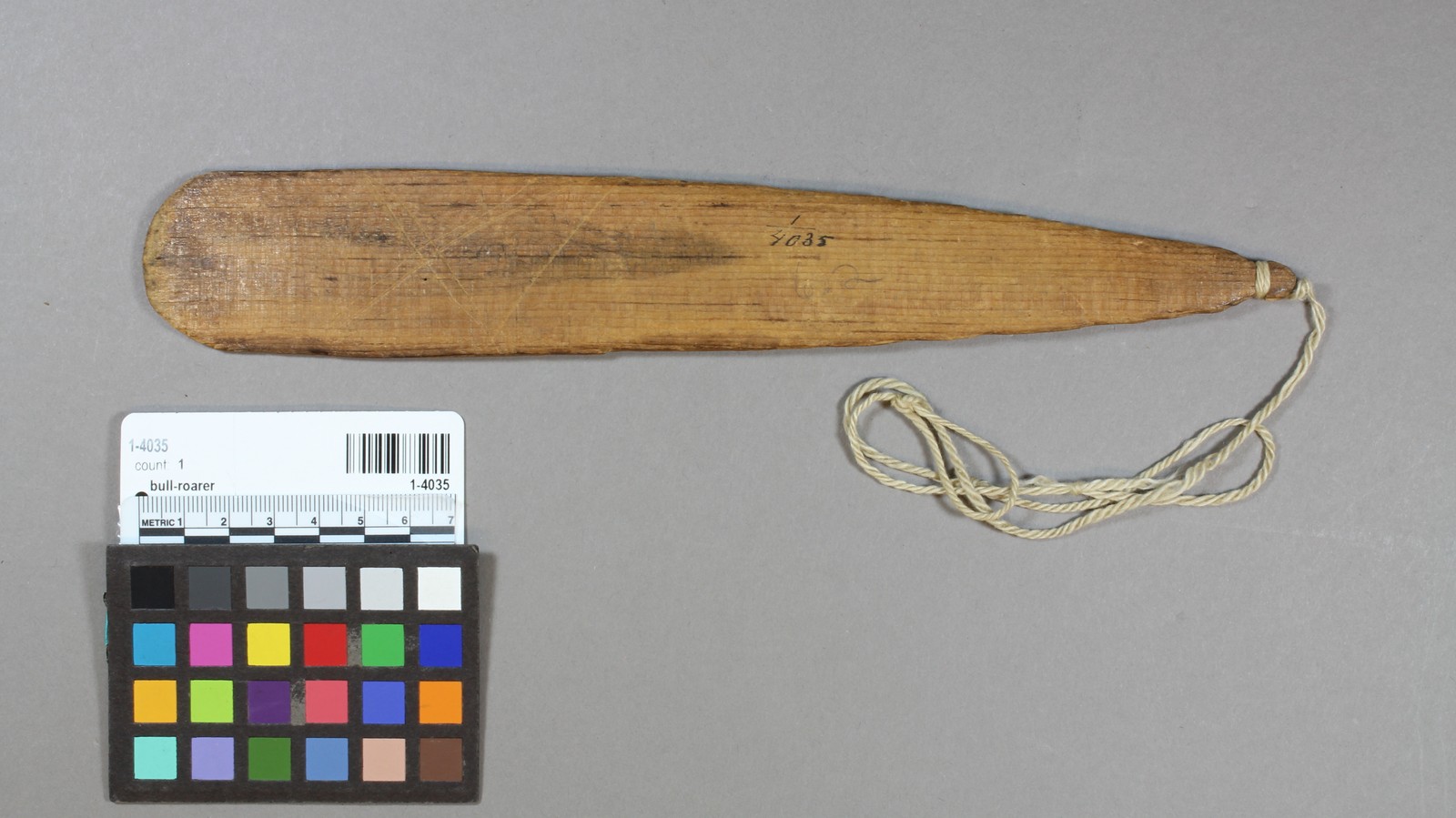
himhimna; huhuudech; hmhm'udech
Source term: bullroarer
Along the Sierra foothills, from Coarse Gold Creek south to Poso Creek, the Yokuts whirled the same wooden slat to very different ends. On the Kings River the Choinimni gave it to their doctors, who whirled it openly and alone: it raised storms, healed the sick and made the well fall ill. The Wukchamni of the Kaweah spun it between the palms and pressed its point to an aching body to draw the poison out; smeared with poison and whirled, it shot sickness into a victim. The Paleuyami of Poso Creek used it to sicken, and for fun. To the Chukchansi, Chukaimina and Yaudanchi it was a plaything.
The bull-roarer was rotated in hands as in making fire and point applied to afflicted part of body. Supposed to extract poison.
Driver 1937, printed p. 126, note to item 1242
Particulars
- Object
- Of wood among every foothill group; not of horn or bone. Kroeber figures a Yokuts example as a small lanceolate blade on a cord.
- Function
- Varied by group. Choinimni: a shaman's instrument, used publicly and privately, said with some doubt to be for men only and to assemble people for ceremony; it raised storms, brought health and caused sickness, and was also swung for amusement. Wukchamni: raised storms; in curing it was palm-rotated and pressed point-first to the afflicted body to extract poison; poison placed on it was projected at a victim by whirling; not for amusement. Paleuyami: caused sickness and was swung for amusement. Chukchansi: swung for amusement by everyone, women as well as men; shamans were said, hesitantly, to whirl it too. Chukaimina and Yaudanchi: a plaything only.
Source
Harold E. Driver, 'Culture Element Distributions: VI, Southern Sierra Nevada,' Anthropological Records 1:2 (1937), pp. 56, 58-59 (columns and informants: Y-Chuk Chukaimina, Doctor Bob; Y-Choi Choinimni, Julia Davis; Y-Wuk Wukchamni, Sam Garfield; Y-Yaud Yaudanchi, Jose Vera; Y-Pal Paleuyami, Dan Williams), p. 60 (symbol key), p. 85 elements 1233-1244, p. 126 notes to 1242-1243 (Wukchamni curing and sorcery). B. W. Aginsky, 'Culture Element Distributions: XXIV, Central Sierra,' Anthropological Records 8:4 (1943), p. 394 (Coarsegold, Chukchansi; Matilda Neal and Mandy Lewis), p. 425 elements 1233-1244 (column Ys), p. 459 note to 1237-1239. A. L. Kroeber, Handbook of the Indians of California, BAE Bulletin 78 (1925), pp. 479-482 (territories), p. 509 and Pl. 44 d (names himhimna, huhuudech, hmhm'udech). A. H. Gayton, Yokuts and Western Mono Ethnography, Anthropological Records 10:1-2 (1948), I pp. 133-135, II p. 150