Atlas Essay —
Burnt and Bald
Heracles leapt into the mouth of the sea monster at Troy, spent three days in its belly cutting it apart, and came out without a hair on his head. A fisherman of the Torres Strait, between Australia and New Guinea, a Cherokee war party's hunter and a Makah hero from the Strait of Juan de Fuca, between Vancouver Island and Washington State, all leave their monsters the same way, scalded bald. On the Huon Gulf of New Guinea the men built such a monster out of thatch and timber, gave it the bullroarer for a voice, and fed it their sons. The boys came home months later with their eyes sealed and their bodies crusted in white chalk.
All around the world a monster swallows a hero, and he comes out burnt and bald. So odd an ending was not invented twice. It is the bullroarer initiation told as a story: the rite swallows boys in the monster whose voice is the roarer, and gives them back singed, shorn and whitened.
In brief
- Thirty-seven traditions end the swallowing tale with the hero burnt and bald, from Greece to Tierra del Fuego, with the thickest clusters on the Northwest Coast and in lowland South America. In 1904 Leo Frobenius called it a “crazy ending” that chance could not have produced twice.
- The tellers blame the heat. The Nootka brothers train for the monster's belly in a box of boiling water, and the Makah hero boils himself in a canoe of hot rocks before he lets the shark take him.
- The rite stages the swallowing. In New Guinea, Australia, Liberia and on the Northwest Coast, novices are swallowed by a monster whose voice is the bullroarer (the swallowing complex).
- The rite returns the boys marked. Theddora novices in southeastern Australia had “all the hair of his head … singed off”; Torres Strait boys were sooted until they “came out ‘white’”; Huon Gulf boys came home under a crust of chalk.
- In the Poro of Liberia the three meet in one rite: the Big Devil swallows the boys, his teeth are their scars, the bullroarer is one of his voices, and they come back “smeared with white clay, and pretending to be new born.”
- On the Gulf of Papua in New Guinea the first bullroarer was found inside the swallowing monster. The instrument comes out of the belly with the boys.
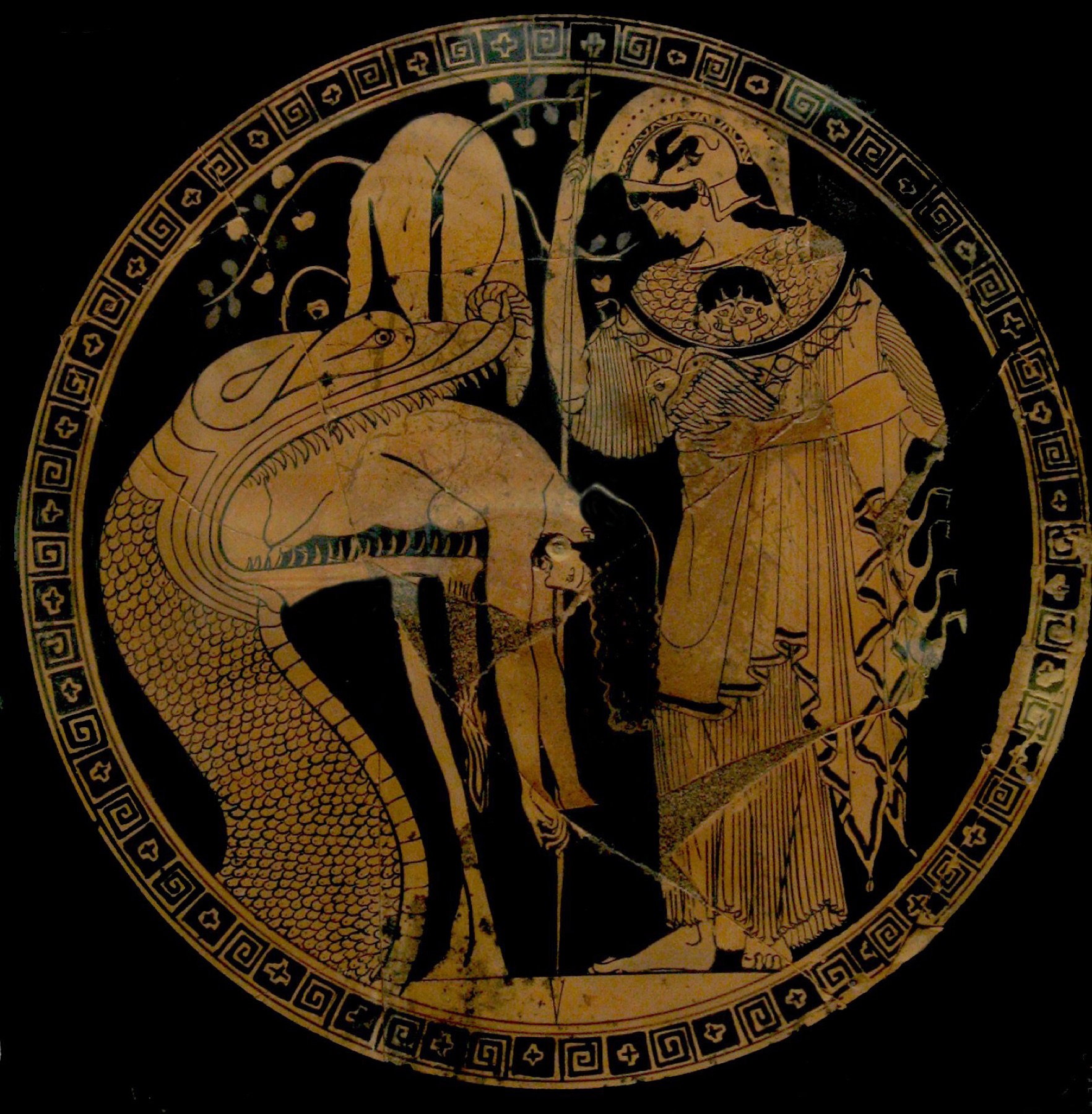
Heracles comes out bald
King Laomedon of Troy had chained his daughter Hesione to the rocks as an offering to the monster Poseidon sent against the city. Heracles came for her. In the oldest telling of the swallowing, recorded in a note on the Iliad that cites the fifth-century mythographer Hellanicus, he went in through the monster's mouth and destroyed it from inside. Lycophron, a Hellenistic poet of the third century BC, adds what the belly did to him:
… the lion that was begotten in three evenings, whom of old Triton's hound of jagged teeth devoured with his jaws. But he, a living carver of the monster's liver, seething in steam of cauldron on a flameless hearth, shed to ground the bristles of his head.
Lycophron, Alexandra 33–37, trans. A. W. Mair (1921)
The Byzantine scholar John Tzetzes, glossing the poem in the twelfth century, explains that Heracles spent three days inside and came out “having lost even the hair of his own head” from the heat and moisture of the entrails.
The ending turns up far from Greece. In 1888 Alfred Haddon took down a story on Badu, an island of the Torres Strait between Australia and New Guinea, about a fisherman named Mutuk whom a shark “swilled down” whole. The shark swam north over the reefs; inside it Mutuk felt warm in the shallows and cold in the deeps, until the fish stranded at Boigu and he felt the sun beating on it:
… so taking a sharp shell … which he carried behind his ear, he hacked away at the belly of the shark until he had sufficiently ripped it open; on emerging from his strange prison he found all his hair had fallen off.
Haddon, “Legends from Torres Straits,” Folk-Lore 1 (1890), p. 56
The Cherokee told James Mooney of the Dakwa', a great fish of the Tennessee River that rose under a war canoe and snapped up one of the men. It was “so hot and close inside” that he nearly smothered. He found mussel shells in the dark, cut his way out and waded ashore, “but the juices in the stomach of the great fish had scalded all the hair from his head and he was bald ever after” (Mooney, Myths of the Cherokee, 1900, pp. 320–21).
Leo Frobenius put these stories side by side in 1904, in Das Zeitalter des Sonnengottes (The Age of the Sun God). In the Northwest of America, in the Torres Strait and among the Greeks, he wrote, the tale closes with the same words: it was so hot in the animal's belly that the hero's hair fell out. “I must admit that my mind cannot grasp how ‘chance’ could have produced the same crazy ending here” (denselben verrückten Schluß, p. 36). Anyone might imagine being eaten by a monster and escaping. Nobody needs the hero to lose his hair. When the same unneeded detail turns up on three oceans, the story travelled.
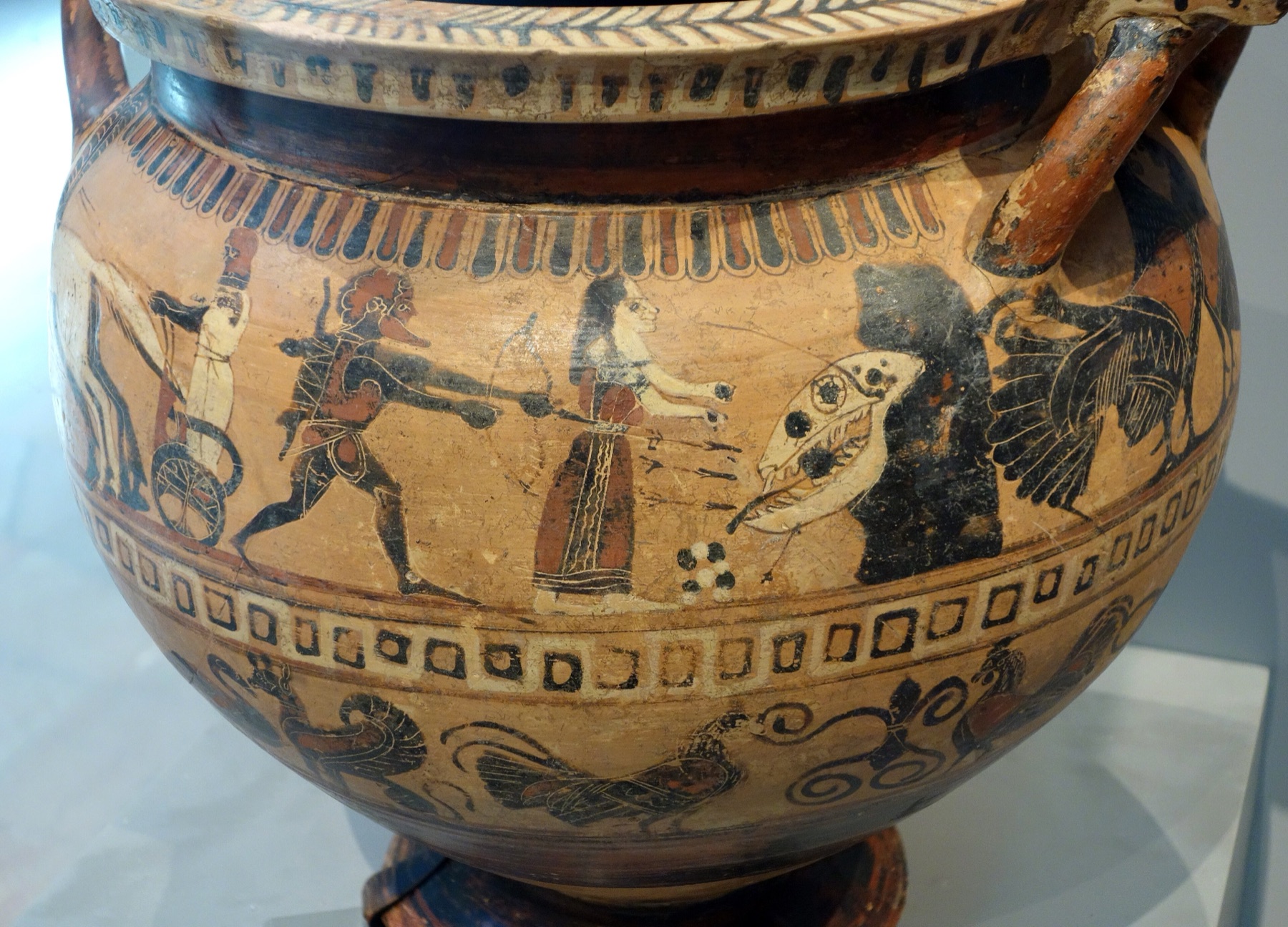
A ring around the Pacific
The folklorists Yuri Berezkin and Evgeny Duvakin catalogue the swallowing tale and the fire in the monster's belly, motifs K8A and L56, across 285 traditions; Stith Thompson gave the bald exit its own number, F921, “Swallowed person becomes bald.” Thirty-seven send the hero out bald, counting Jonah, whose hair falls out from “the intense heat in the belly of the fish” in later Jewish legend (Ginzberg, Legends of the Jews IV, 1913, p. 252). Plotted on one map, they wrap around the Pacific: thickest on the Northwest Coast of North America and in lowland South America, scattered through Melanesia and Polynesia, and running thin across Asia to the Black Sea, where they reach the Georgian hero Amiran, Jonah and Heracles. In Africa the bald exit turns up once, among the Bena-Lulua of the Kasai in the Congo, where Kalulu Kadimuke cuts his way out of the ogre with his razor and everyone inside comes out stripped of hair and scalp.
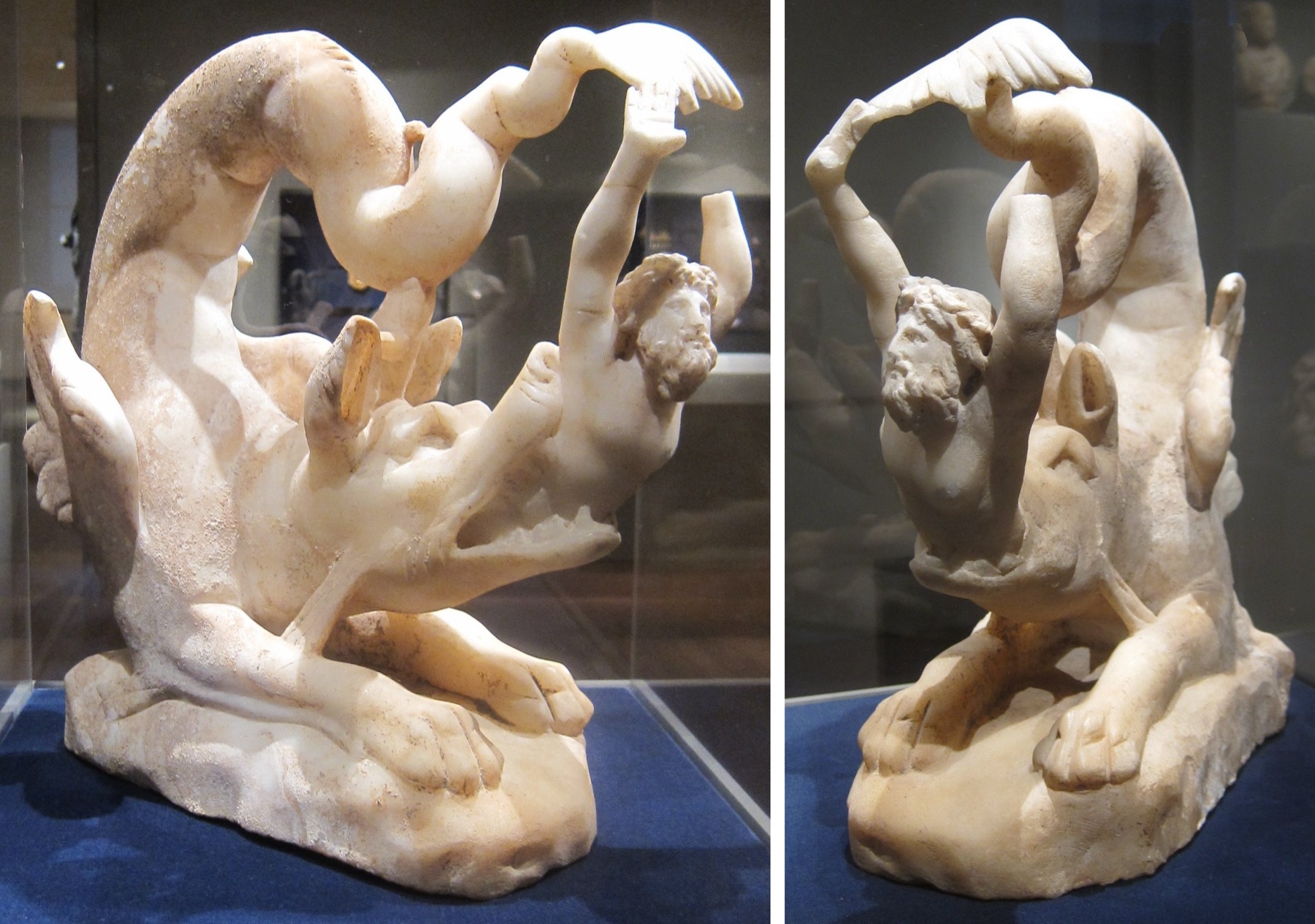
Fifty-one more tales light a fire inside the monster. The swallowed man kindles it with his fire-drill, dries fish over it, or burns the fat of the stomach until the beast swims ashore to die. The bald ending and the fire are two halves of one idea. The belly is an oven.
The map adds a second layer: the atlas's bullroarer rites in which the novices are swallowed by the instrument's monster, or come back singed, shaved or whitened. The two layers meet thickest on the Northwest Coast and in New Guinea with northern Australia, both enlarged below the world map, and they meet again in the Poro country of Liberia, on the bulge of West Africa.
The map
Select a point to read its tale or rite. Arrow keys step from west to east.
- Hero comes out bald (37)
- Fire lit inside the monster (51)
- Other swallowing tales (197)
- Bullroarer rite: novices swallowed (18)
- Bullroarer rite: novices burnt, shorn or whitened (14)
The bullroarer rites on this map (29)
| People | Region | What happens to the novices | Source |
|---|---|---|---|
| Yolngu python paddle, Yurlunggur's voice | Arnhem Land, Australia | The roar is the voice of the python Yurlunggur, who swallowed the Wawalag sisters; men tell the women the snake has swallowed the boys. | Warner 1937; Berndt 1951 |
| Coast Miwok bullroarer | California, United States | Coast Miwok: ghosts come down with fire burning in their hair, and the black-painted boys are thrown over the fire. | Loeb 1929 |
| Kato (Cahto) | California, United States | Kato: novices shut all winter in the earth-covered dance house, starved and blackened, while bullroarers are whirled inside. | Loeb 1932 pp. 26–27 |
| Makah Klokali wolf-ritual roarer | Cape Flattery, United States | Makah Klokali, the Wolf ritual of the Nootka next door: men playing wolves carry off the one to be initiated, to four or five bullroarers; the society punished a liar with a hot stone on his head. | Densmore 1939 pp. 101–04 |
| Banda | Central African Republic | Banda: Ngakola swallows the initiates; they carry on their bellies the scar where he let them out. | Tanghe 1919; Vergiat 1936 |
| Kiwai madubu, mother of the yams | Fly estuary, Papua New Guinea | Kiwai: in the mimia fire ordeal the young men are burned, beaten and fed strengthening magic in the men’s house of the bullroarers. | Landtman 1927 |
| Kissi initiation and ancestor-voice bullroarer | Guinea | Kissi: women are told the roar is nyewonde, a beast fallen from the sky that devours their sons. | Schaeffner 1951 p. 75 |
| Anula Gnabaia bullroarer | Gulf of Carpentaria, Australia | Anula: the roar is Gnabaia, who swallows the boys and disgorges them initiated. | Spencer & Gillen 1904 p. 501 |
| Binbinga Katajalina bullroarer | Gulf of Carpentaria, Australia | Binbinga: the roar is the voice of Katajalina, who eats the boy and brings him back to life. | Spencer & Gillen 1904 p. 366; Frazer 1913 |
| Bukawa / Yabim | Huon Gulf, Papua New Guinea | The monster’s voice is the bullroarer; the novices live months in the hut that is its belly and come home under a crust of white chalk. | Frazer 1913, Balder II pp. 240–42 |
| Kai | Huon Gulf, Papua New Guinea | Kai: the bullroarer and the monster that swallows the novices share one name, ngosa, “grandfather.” | Frazer 1913, Balder II p. 242 |
| Tami | Huon Gulf, Papua New Guinea | Tami: the novices are swallowed by the kani, whose voice is the bullroarer. | Frazer 1913, Balder II pp. 241–42 |
| Nyanga nyabungubungu circumcision bullroarer | Kivu, DR Congo | Nyanga: heads shaved at entry, eyelashes and body hair shaved at the coming-out, in the lodge of the nyabungubungu bullroarer. | Biebuyck (Sherungu memoir) pp. 30–40 |
| Gbunde Poro | Liberia | The boys’ scars are “made by the teeth of the Big Devil in swallowing or ‘eating’ the novice”; he “carries him in his belly” and bears them at the close, kaolin-smeared and “new born.” | Schwab 1947, pp. 270, 284–86 |
| Mano Poro | Liberia | The great spirit eats the boys and they wait in his belly; the bullroarer vu ni is one of his voices. They come back to town “smeared with white clay, and pretending to be new born.” | Harley 1941, pp. 14–17 |
| Roarers before the Bush-spirit | Liberia | Gbande: the crocodile-jawed Bush-spirit swallows the boys; they stay a while in its belly and come out newborn. Roarers herald it. | Spannaus 1936 p. 2 |
| Lovedu 'seizing of the lion' | Limpopo, South Africa | Lovedu: boys leave the lodge shaved but for a crown and the lodge is burnt behind them; the bullroarer roars as a lion. | Krige 1943 |
| Kwanyama edila circumcision Big Birds | Namibia and Angola | Kuanyama: the roar is edila, a giant bird that swallows the candidates; survivors pass out through its body. | Loeb 1948 p. 27 |
| Gringai Torikotti bullroarer | New South Wales, Australia | Gringai: the novices are painted red, then washed and painted white at the water-hole, where the bullroarer is used. | Howitt 1904 pp. 570–71 |
| Murinbata Karwadi Punj ngawuru | Northern Territory, Australia | Murinbata: the boys are swallowed by Mutjingga, the Old Woman, whose voice is the bullroarer. | Stanner 1963 |
| Baniwa bullroarer and Botuto/Jurupari context | Northwest Amazon | The ancestral monster devours the novices and vomits their bones; the sacred instruments are cut from the palm that grows from its ashes. | Zerries 1953; Stradelli |
| Orokolo | Papuan Gulf, Papua New Guinea | In the Elema myth the sea monster Oa Birukapu swallows children; when he is killed and eaten, women wash out his entrails and find the bullroarer inside. | Williams 1940, Drama of Orokolo, pp. 172–80 |
| Toaripi (Motumotu) | Papuan Gulf, Papua New Guinea | Toaripi youths are shaved in the bachelors’ house and see the tiparu only when they leave it. | Chalmers in Haddon 1898 p. 240 |
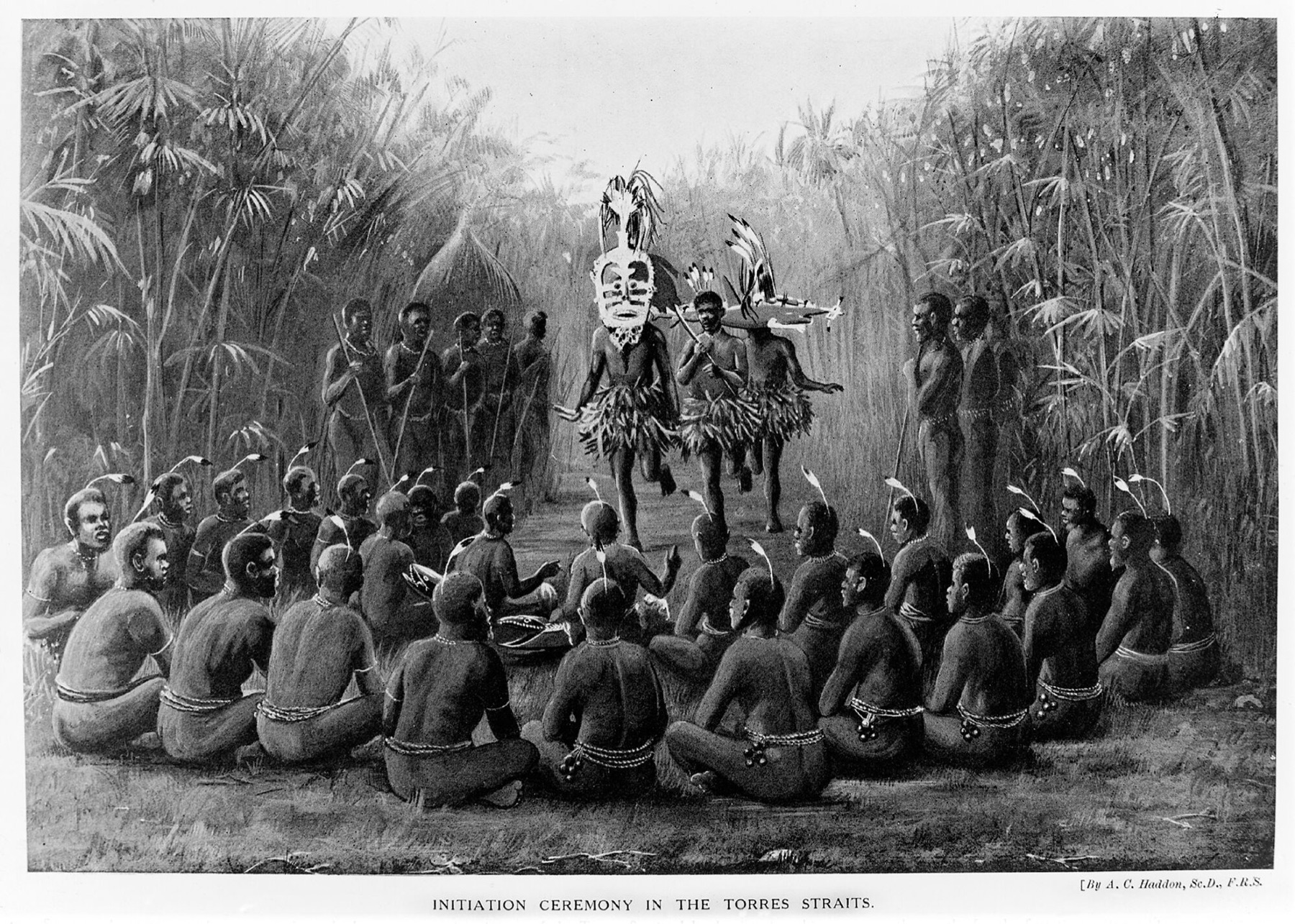
| Hidden in the bush with the wanes | Torres Strait, Australia | Kept hidden in the bush and shown the bullroarer. On neighbouring Tutu the novices were rubbed with fresh soot every day under a mat tent, and a father was delighted if his son “came out ‘white.’” | Haddon 1904, Reports V, pp. 209–10, 218 |
| Mare, the great roaring din | Upper Amazon, Brazil | Tikuna: at the girl’s coming-out feast her hair is plucked out by hand while the sacred voices sound. | Nimuendajú 1952 pp. 85–90 |
| Hupachisat bullroarer | Vancouver Island, Canada | The Wolves carry off the novices in their mouths; the bullroarer is the Wolf’s tail and the chief mystery of the rite. | Drucker 1951 pp. 388, 394 |
| Dja Dja Wurrung growing-song roarer | Victoria, Australia | Dja Dja Wurrung: beard and pubic hair plucked; the novice rubbed with red ochre, or painted white if he bled. | Howitt 1904 pp. 613–14 |
| Theddora (Dhudhuroa) | Victoria, Australia | At the Wahu grade “all the hair of his head was singed off gradually, the women being excluded.” | Howitt 1904 pp. 565–66 |
| Ndumba mwila, the fish-shaped monster | Zambia | Ndembu: the bullroarer of the circumcision lodge means a monster has come to swallow the boys. | Turner 1967 |
As hot as the whale's belly
Frobenius read the lost hair as the rays of a sun swallowed each night by the sea. The people who told these stories said it was the heat. Inside the whale off the Cowichan River on Vancouver Island, two boys swallowed with their canoe sang out to the canoe-builder on the beach: “Oh, we are sitting in the whale. Come and free us. It is so hot here that we are almost burned.” When the people cut them out, “it had been so hot in the whale's stomach that they had lost all their hair” (Boas, Indianische Sagen, 1895, p. 51). The hero Mink of the Comox, farther up Vancouver Island, lit a fire in his whale and dried herring on a rack until the heat made him sick. He came out of the opened stomach without a hair left on him.
On the west coast of Vancouver Island the Nootka hero Kwatyat went after the monster that had swallowed his mother, Canoe-Swallower. First he trained his brothers for it. He filled a great cooking box with water, dropped red-hot stones into it, and had them jump in; the water, Edward Sapir's narrator says, “was as hot as was the inside of Canoe-swallower.” Then they let the monster take them, went “right down his throat clean down to his stomach,” and cut it from within. When they came out on the beach, the people laughed at one of the brothers: “Bald-headed, sure enough, is Tihtipihin!”
They became bald-headed for this reason, that they had not bathed their heads in hot water (when training in the cooking-box).
Sapir and Swadesh, Nootka Texts (1939), no. 5, p. 39
Across the Strait of Juan de Fuca the Makah of Neah Bay told it of a shark whose mouth lay at Tatoosh Island. A small man named Kwati sharpened mussel shells, heated rocks, and dropped them into a little canoe full of salt water:
When the water was boiling hot, he plunged into it, stayed under the water a while, then came up and said he imagined the inside of the shark's stomach was like that.
Densmore, Nootka and Quileute Music (1939), p. 195
The shark drew him in, canoe and all. He cut its heart loose, breaking shell after shell, and rode the carcass ashore, where the birds and little animals began to cut in for the entrails. “Cut carefully or you will hurt me,” he told them. “When they had made the opening large enough the man came out of the body of the shark. He was bald” (pp. 196–97).
These heroes rehearse. They heat water in a cooking box or a canoe, sit in it, and come out able to bear the belly. An ordeal that is trained for, that leaves a mark on the head, and that the whole village waits on the beach to see the end of is not an adventure. It is an initiation.
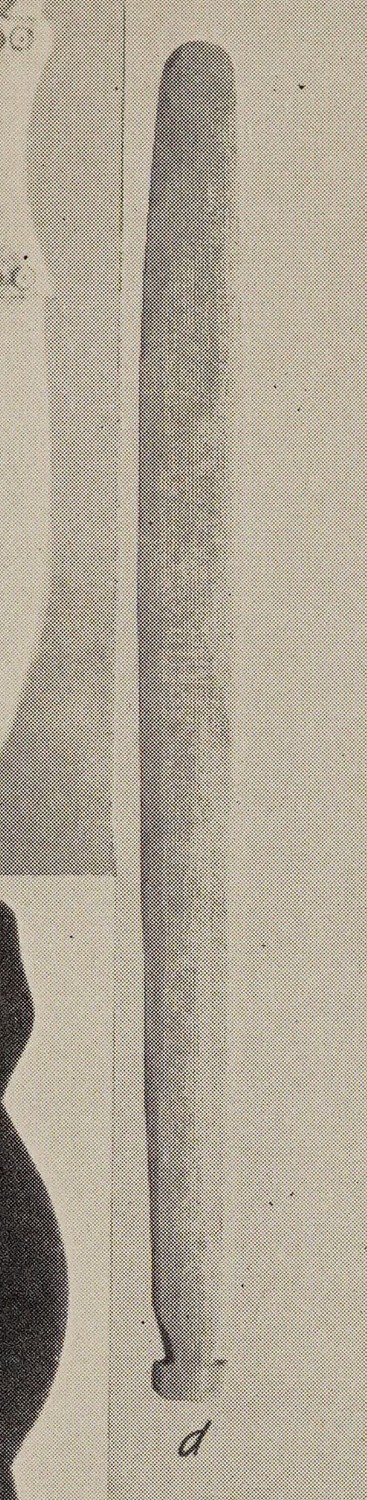
The monster whose voice is the bullroarer
The rite tells the same story, and its voice is the bullroarer. The full complex, people by people, is in The Bullroarer–Swallowing Complex. Its fullest description comes from the Huon Gulf on the northeast coast of New Guinea, where the Yabim, Bukaua, Kai and Tami peoples all used one word for the bullroarer and for the monster that swallowed their sons. James Frazer gathered the missionaries' accounts in 1913:
For this purpose a hut about a hundred feet long is erected either in the village or in a lonely part of the forest. It is modelled in the shape of the mythical monster; at the end which represents his head it is high, and it tapers away at the other end. A betel-palm, grubbed up with the roots, stands for the backbone of the great being and its clustering fibres for his hair; and to complete the resemblance the butt end of the building is adorned by a native artist with a pair of goggle eyes and a gaping mouth. When after a tearful parting from their mothers and women folk, who believe or pretend to believe in the monster that swallows their dear ones, the awe-struck novices are brought face to face with this imposing structure, the huge creature emits a sullen growl, which is in fact no other than the humming note of bull-roarers swung by men concealed in the monster's belly.
Frazer, Balder the Beautiful, vol. 2 (1913), pp. 240–41
Among the Kai a man on a scaffold took a gulp of water as each boy passed beneath him, and let it fall on the boy in a jet when a pig was paid for his release. Among the Tami the boys filed beneath a row of men holding bullroarers over their heads. Then came circumcision, “and the cut made by the knife of the operator is explained to be a bite or scratch which the monster inflicted on the novice in spewing him out of his capacious maw,” while the roarers sounded “to represent the roar of the dreadful being who is in the act of swallowing the young men” (p. 241). The boys lived for months in the long hut that was the monster's belly. They came home, Frazer writes, to women who wept “as if the grave had given up its dead.” They kept their eyes shut or sealed with chalk, seemed not to understand speech, and only the next day washed off “the crust of white chalk with which their bodies had been coated” (p. 242). A boy who died of the cutting had slipped, the mothers were told, into the monster's pig stomach instead of its human one.
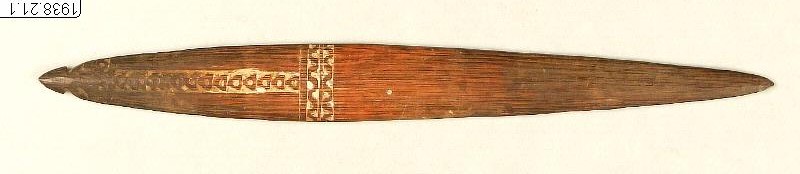
The same scene plays across northern Australia. The Murinbata of Port Keats in the Northern Territory told their novices that the Mother would swallow them alive and vomit them up, and the hidden bullroarers were her voice. The women of the Anula on the Gulf of Carpentaria heard in the roarers the spirit Gnabaia, who swallowed the boys and disgorged them as men; the Binbinga told the same of Katajalina. In Arnhem Land the Yolŋu roarer is the voice of the python Yurlunggur, who swallowed the Wawalag sisters and their children. Farther south, near Lake Eyre, Urabunna women were taught that the bullroarer was the voice of a spirit called Witurna, “who … takes the boys out into the bush, removes all of their insides, provides them with new ones, and brings them back in the form of initiated men” (Spencer and Gillen, Northern Tribes, 1904, p. 258).
Among the Marind-anim of southern New Guinea the instrument and the giant who devours the novices share a single name, sosom. In southern Africa the Kwanyama bullroarer was the voice of edila, a giant bird that swallowed the boys at circumcision. On the Northwest Coast, the Koskimo whirred their sticks on the village roofs at midnight as “the voice of HakaLilaqas … who comes to take away another novice” (Boas 1897, p. 610).
Singed, shorn and whitened
The swallowed boys come back marked on the head and skin, as the heroes do.
The Theddora, in the mountains of Victoria in southeastern Australia, kept a bullroarer about four inches long with notched edges, tied by a string to a short stick, which women and children might not see. A young man was made Wahu when his beard came in:
All the hair of his head was singed off gradually, the women being excluded. When the hair was removed, the men ran up and waved green boughs over his head. After this the men would run some way, returning swinging the boughs, with a swishing sound, in a certain direction, mentioning at the same time the name of the district towards which they were pointing.
Richard Helms, quoted in Howitt, The Native Tribes of South-East Australia (1904), p. 566
One mountain people kept both: a bullroarer that women may not see, and a youth who loses all the hair of his head to fire.
On Tutu in the Torres Strait, a few hours' sail from Mutuk's Badu, the boys in the initiation hut were covered with a mat tent and rubbed every day with fresh soot from burnt coconut shell:
The avowed object of covering the body with soot was to render the skin paler in colour. … If at the end of the period a kernge came out “white,” the father was delighted.
Haddon, Reports of the Cambridge Anthropological Expedition to Torres Straits, vol. 5 (1904), pp. 209–10
On neighbouring Keriri the novice was taken into the bush, blackened with charcoal, and shown the bullroarer. Among the Kamilaroi of New South Wales, the guardians sat the boys in a row with their heads down and told them “that Dhurramoolun is coming to burn them,” while the men who came up behind carried smoking sticks (Mathews 1897, p. 168). The Gringai of New South Wales painted their novice red, kept him secluded with the songs, then washed him and painted him white before he went back to the women. In the Dja Dja Wurrung country of central Victoria, a boy's sister's husband sounded the bullroarer over him for years to make him grow, and at his making the men plucked his face bare. On Ceram in the Moluccas, boys pushed through a doorway shaped like a crocodile's jaws were said to have been swallowed by the devil and were dyed yellow every day “to give them the appearance of having been swallowed”; at the end the high priest led them into the forest and cut “a lock of hair from the crown of each of their heads” (Frazer 1913, pp. 250–51).
In South Africa the Lovedu boys came out of the circumcision lodge with their heads shaved but for a crown, and the lodge was burnt behind them; at night the shepherds whirled the bullroarer as the roar of a lion for the new men to hunt. Nyanga boys of the eastern Congo went into the lodge of the nyabungubungu bullroarer with their heads shaved, and were shaved again, eyelashes and all, when they came out. Among the Xhosa, whose initiates are still shaved and painted with white clay, the nodiwu kept its old meaning in the nursery: a mother would quiet a crying child by having a boy whirl it outside “and then induce the child to be still by pretending that a monster is coming to devour it” (Theal, Kaffir Folk-Lore, 2nd ed., 1886, p. 223).
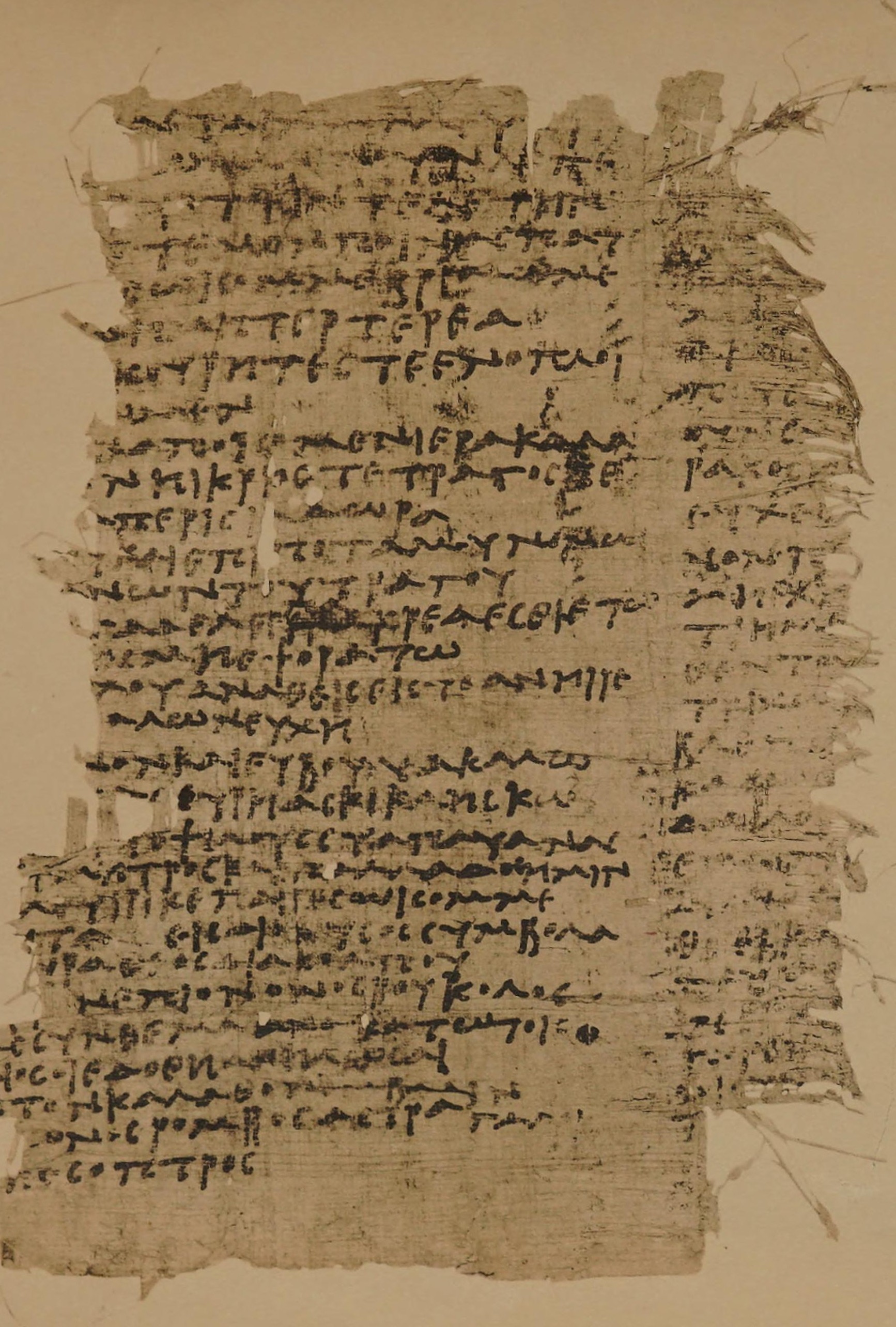
Greece has the whole set in one cult. The Orphic myth of Dionysus Zagreus has the Titans lure the child god with toys, among them the rhombos, the bullroarer. They tore him apart, boiled his limbs in a cauldron and roasted them on spits (Clement of Alexandria, Exhortation 2.17–18), and they did it, the story ran, with their faces whitened in gypsum so as not to be known (Harpocration, s.v. apomattōn; Nonnus, Dionysiaca 6.169). The Bacchic mysteries whitened their initiates the same way. Demosthenes mocked his rival Aeschines for serving his mother's Bacchic rites as a boy, “purifying the novitiates, and rubbing them down with clay and bran, and, having caused them to rise up from the cleansing, directing them to say, ‘I escaped the bad, I found the better’” (On the Crown 259–60). Andrew Lang saw the parallel in 1884: in the Dionysiac mysteries where the toys were shown and the bullroarer whirred, “the performers daubed themselves all over with clay,” and “precisely the same trick prevails in the mysteries of savage peoples” (Custom and Myth, p. 40).
The Big Devil of the Poro
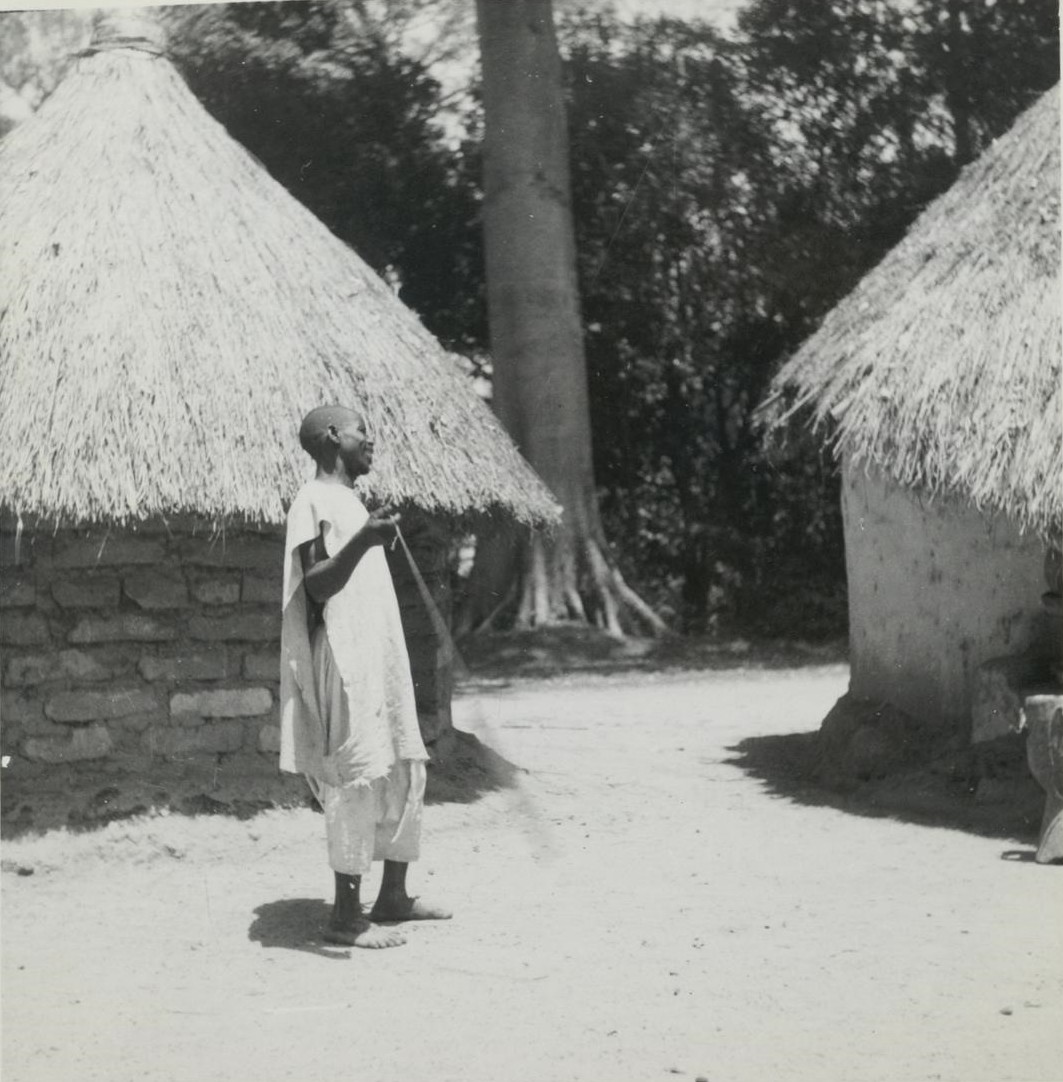
In Liberia the whole sequence happens in one rite. The Poro is the men's society of the forest peoples of the Liberian hinterland, and for months or years the boys live in the Poro bush, out of sight of women. George Schwab, who travelled among the Gbunde, Loma and Mano in the 1920s, recorded what the scars on their chests meant:
This scarification is said to be made by the teeth of the Big Devil in swallowing or “eating” the novice. From now on, the Big Devil “carries him in his belly.” He is in a state of pregnancy, as it were, until the close of the school's session, when those who are still alive are “borne” by him. Those who die … are said to “stay in his belly because he cannot bring them out again.”
Schwab, Tribes of the Liberian Hinterland (1947), pp. 283–84
The Big Devil is heard and never seen by the uninitiated. Among the Gbunde a bullroarer heralds him, and among the Ge of the Mano border the roaring devil vu ni uses a bullroarer that bears his own name: “He is not seen by the uninitiated, or even by boys in the Bush until they are ready to come out” (p. 272). The Mano told the doctor George Harley the same: the bullroarer vu ni was “one of the voices of the spirits” during the first part of the Poro (Harley 1941, pp. 14–15). At the end the swallowed boys are born again, and they come home white:
Finally, the boys came to town, smeared with white clay, and pretending to be new born by the ge, not knowing their own mothers or anyone else among their old associates.
Harley, Notes on the Poro in Liberia (1941), p. 17
Schwab saw the boys come home to Zienshu, a town of the neighbouring Kpelle, with “kaolin-besmeared heads and faces,” strutting in new clothes and pretending to find everything strange (p. 286). The Huon Gulf boy's circumcision wound is the monster's bite as it spits him out, and the Poro boy's scars are the Big Devil's teeth. Among the Gbunde the bullroarer is one of the Big Devil's own voices, as the massed roarers are the Huon monster's growl. In both places the monster holds the boys for months and gives them back chalked and white.
The Wolf's tail
The Nootka, who told of the brothers bald from the cooking box, staged the swallowing in their own rite. In the Shamans' Dance, the great winter ceremony of the Nuu-chah-nulth, men playing Wolves carried off the novices, and for its whole length two ordinary words were forbidden:
… “teeth” (because the Wolves were said to carry off the novices in their mouths), and “tail” (because the bull-roarer was said to be the Wolf's tail).
Drucker, The Northern and Central Nootkan Tribes (1951), p. 388
The bullroarer, ctihyak, was whirled at night or out of sight when the Wolves appeared by day, and with their whistles it “constituted the chief Mysteries of the ritual” (p. 394). The Hupacasath, the Tseshaht and the Clayoquot all swung it. One people tells of brothers who boil themselves in a box to survive a monster's belly and come out bald, and initiates its children in the mouths of Wolves whose tail is a bullroarer.
The Makah ran the same ceremony as the Klokali, the greatest event of their year, with “four or five bull-roarers” among its instruments. The Klokali disciplined its own members on the head. If a woman had told lies “they cut off her front hair diagonally across her forehead.” When a young man was brought in for lying, “they buried a smooth rock in the ashes until it was very hot, then touched the top of his head with it” (Densmore 1939, p. 103). Kwati, the Makah hero, heated rocks to boil himself before the shark took him, and walked out of its body bald.
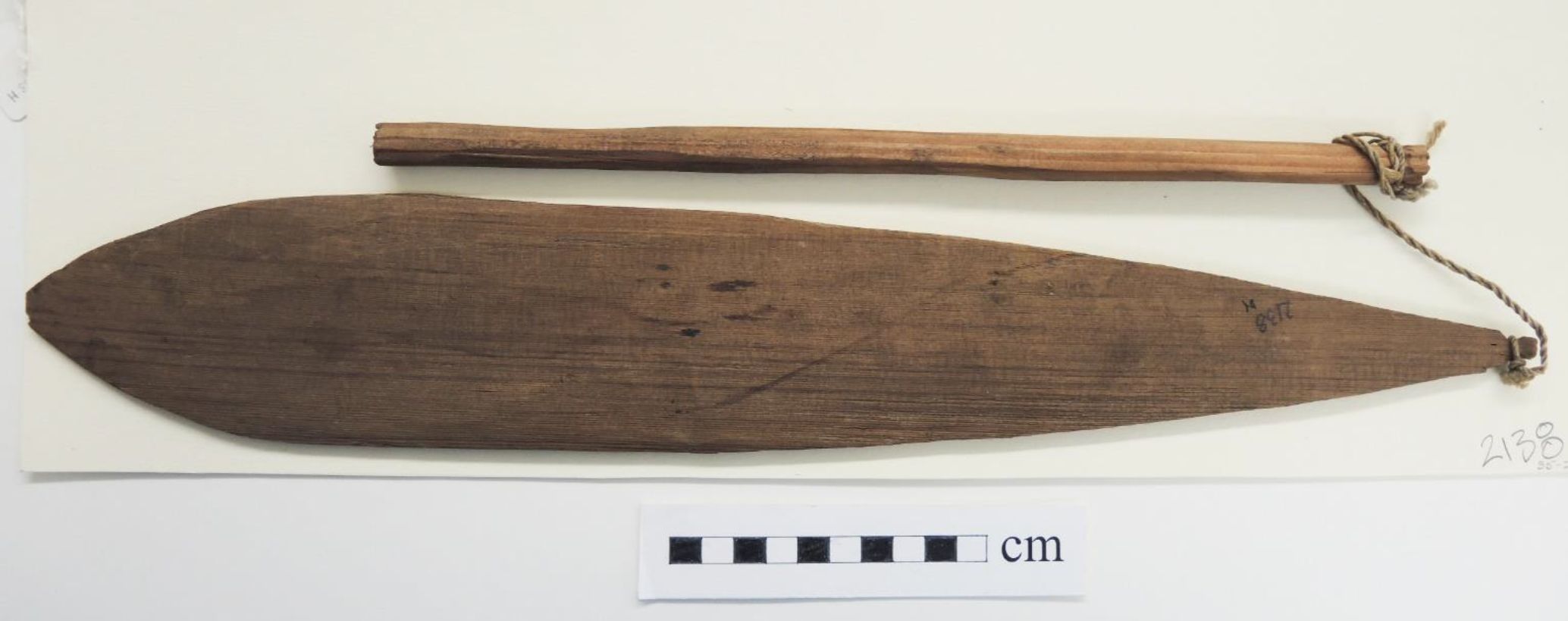
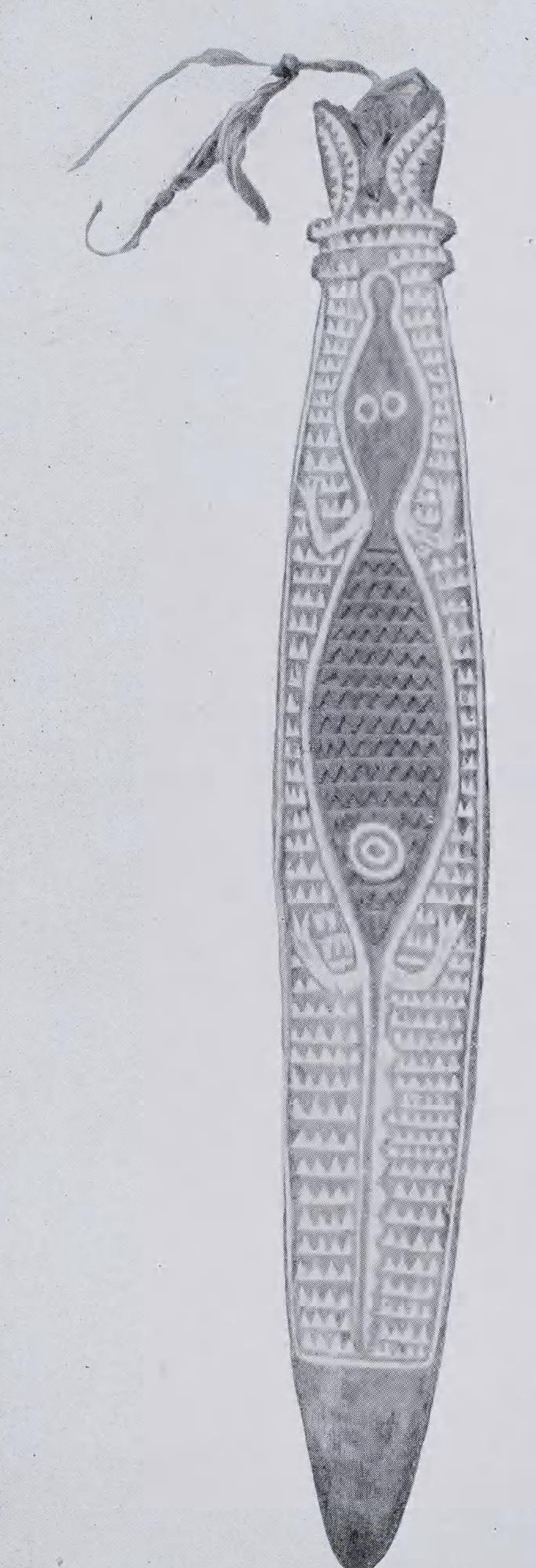
What comes out of the belly
The boys are not the only things that come out of the monster. In the Gulf of Papua the Elema tell of Oa Birukapu, a sea monster who tore up his own house and came from the east carrying it on his back, swallowed children, and was at last killed and eaten. His entrails went to the visiting women, who carried them up the Purari River and washed them out, “and found inside them the bull-roarer” (F. E. Williams, Drama of Orokolo, 1940, p. 179). Oa Birukapu is the eravo, the men's house, and his swallowing of the children is their initiation. At Orokolo the bullroarer lived in that house.
On the Northwest Coast the instrument is the tail of the Wolves who carry the novices off in their mouths. Among the Warramunga of central Australia it is the body of an ancestor named Murtu-murtu, who “had also only a tuft of hair on his head, which looked as if it had been shaved,” and who went about making the noise of a bullroarer with his mouth. Two great dogs tracked the sound, caught him and tore him to pieces. “As the flesh flew through the air it made a noise like that of a bull-roarer,” and trees sprang up where it fell; the Warramunga carve their bullroarers from that wood (Spencer and Gillen 1904, pp. 279–80).
India tells the swallowing as the founding of an order of initiates. Matsyendranath, the first teacher of the Nath yogis, was a fisherman of the Bay of Bengal whom a great fish pulled into the sea and swallowed. Under the sea Shiva was teaching the goddess Uma his secret doctrine, in a house she had built where no one could overhear. Uma dozed off, and when Shiva asked whether she was listening, the man in the fish answered. In the Tibetan lives of the eighty-four adepts, where he is Mīnapa, “Mīnapa received initiation and began a twelve year sādhana inside the fish's belly,” until a fisherman cut the fish open and let him out (Abhayadatta, trans. Dowman 1985, pp. 76–77). In the Skanda Purana Shiva calls him out himself, “Come out of the fish by force,” and the goddess takes him on her lap (Bagchi 1934, p. 16).
In Nepal the tale ends the way it ends on the Tennessee River. In the legend Brian Hodgson sent to H. H. Wilson, Matsyendranath hid in the belly of the fish to overhear the doctrine, and when Shiva, suspecting a listener, commanded him to appear, he “came forth, clad in raiment stained with ochre, smeared with ashes, wearing ear-rings, and shaven, being the chief of the Yogis” (Wilson, Asiatic Researches 16, 1828, p. 471).
The order he founded puts his marks on its novices. One Nath legend says that in his fish-birth Matsyendranath was found already wearing rings in his ears (Briggs 1938, p. 9), the great rings every Nath yogi wears through ears split at initiation. Before the splitting comes the shaving. The novice takes his vows, and a barber “shaves his head, including the scalp-lock”; among the Ratannath yogis he is then “besmeared with ashes” and given a shroud, and “the ashes and the shroud signify death to the world” (pp. 28–29). The man who heard the secret inside the fish came out wearing the mark of the rite, and every novice after him goes in shorn, smeared with ash and dead to the world.
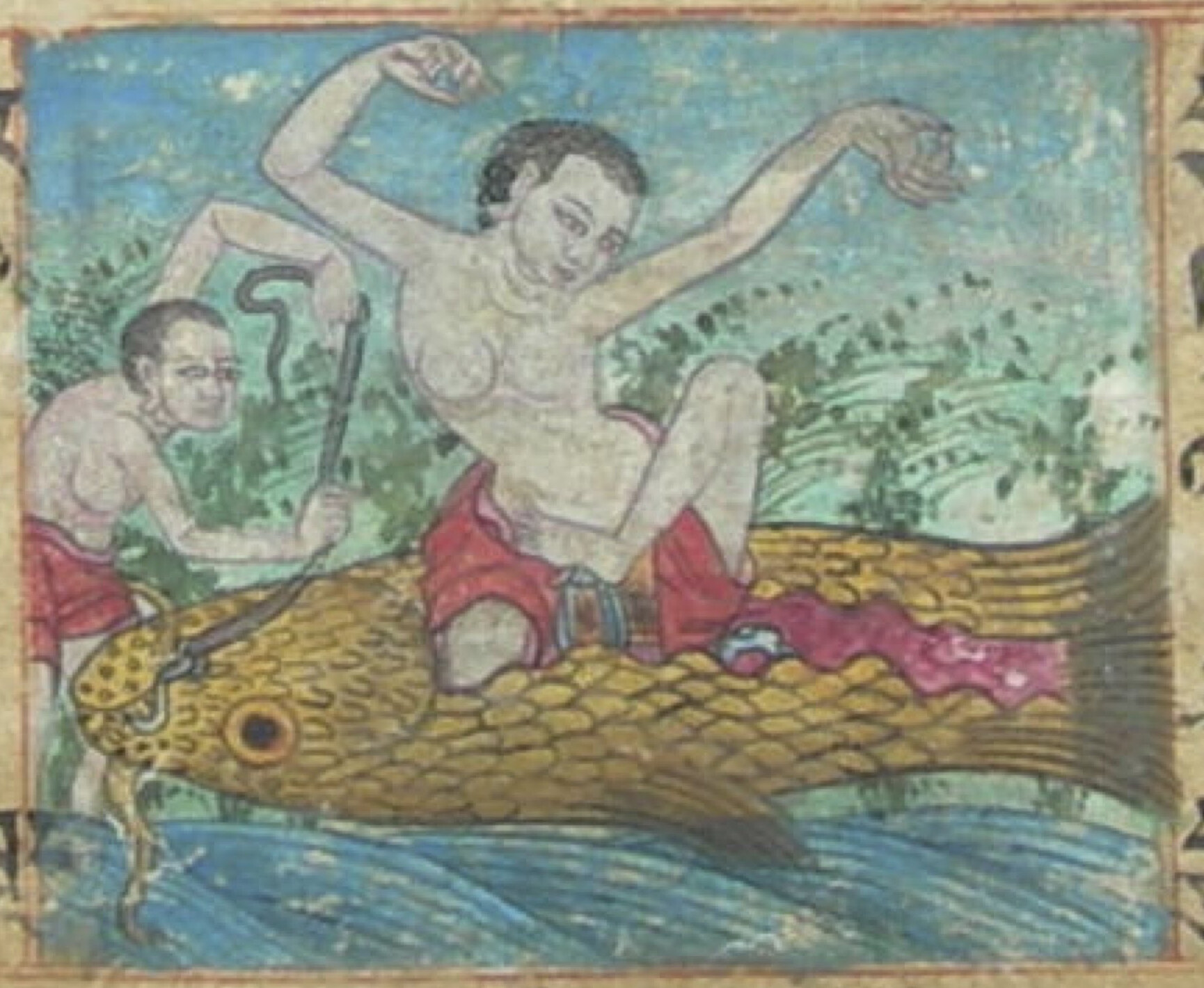
The swallowed boy and the swallowed hero bring something back. The hero brings the monster's death and his bare head. The boy brings his scars, his white skin, his new name, and the secret of the voice that ate him. In Papua the women who washed out the monster's entrails found the voice itself.
The bald man in the kina hut
The Yámana of Tierra del Fuego, at the southern tip of the bald-hero map, told of Little Lasix, who leapt with his knife into the mouth of a great whale and cut it apart from inside, saving the heart for last. The carcass drifted ashore while the men were holding the kina, their secret ceremony of initiation. Two boys about to be initiated were sent to cut meat from it, and from inside the whale a voice begged them not to cut him. They found Little Lasix “pale and thin, bald, and near death.” The men carried him in secret to the kina hut, and there they sprinkled powdered charcoal on his bald head to make the hair grow back (Wilbert, Folk Literature of the Yamana Indians, 1977, no. 40).
The tale ends inside the rite. The bald man comes out of the belly into the hands of two novices and is carried into the initiation lodge, where the men tend his head.
The pattern runs the same way on every coast where the two layers of the map meet. A monster swallows. Its voice is the bullroarer, sounded by men hidden in its belly, in a men's house built in its shape, or whirled as its tail. Inside it is hot: the tale says so, and the rite says so with soot, fire and singeing. The one who comes out is marked on the head and skin, bald or shaved or chalked white, and the village receives him as one returned from the dead. Heracles at Troy, Mutuk on Badu and the Cherokee hunter in the Dakwa' tell from inside the belly what the Huon Gulf, the Theddora, the Nootka and the Poro staged from outside. All around the world a monster swallows a hero, and he comes out burnt and bald. So odd an ending was not invented twice. It is the bullroarer initiation told as a story: the rite swallows boys in the monster whose voice is the roarer, and gives them back singed, shorn and whitened.
The swallowing half of this rite, people by people, is in The Bullroarer–Swallowing Complex. The tales themselves are retold at length in Bald from the Belly on Snake Cult.
Key sources
Lycophron, Alexandra 33–37, trans. A. W. Mair (Loeb, 1921), with Tzetzes’ commentary — Heracles three days in the monster at Troy, bald from the heat.
Frobenius, L. 1904. Das Zeitalter des Sonnengottes. Berlin: Reimer — the “crazy ending” (verrückter Schluß), p. 36, and the whale-myth comparison throughout.
Berezkin, Y. and Duvakin, E. Thematic Classification and Distribution of Folklore and Mythological Motifs by Areas, motifs K8A and L56; Thompson, S. Motif-Index of Folk-Literature, F921, “Swallowed person becomes bald.”
Haddon, A. C. 1890. “Legends from Torres Straits.” Folk-Lore 1, p. 56 (Mutuk); Haddon, A. C. (ed.) 1904. Reports of the Cambridge Anthropological Expedition to Torres Straits, vol. 5, pp. 209–10, 218 (Tutu initiation).
Mooney, J. 1900. Myths of the Cherokee. BAE Annual Report 19, pp. 320–21 (the Dakwa’).
Sapir, E. and Swadesh, M. 1939. Nootka Texts, no. 5, p. 39; Densmore, F. 1939. Nootka and Quileute Music (BAE Bulletin 124), pp. 101–04, 195–97; Drucker, P. 1951. The Northern and Central Nootkan Tribes (BAE Bulletin 144), pp. 388, 394; Boas, F. 1897. The Social Organization and the Secret Societies of the Kwakiutl Indians, p. 610.
Frazer, J. G. 1913. Balder the Beautiful, vol. 2, pp. 239–51 — the Huon Gulf monster hut, the Kai and Tami rites, Ceram.
Howitt, A. W. 1904. The Native Tribes of South-East Australia, pp. 565–66 (Theddora, after Richard Helms); Mathews, R. H. 1897. “The Bora of the Kamilaroi Tribes.” Proceedings of the Royal Society of Victoria 9, p. 168; Spencer, B. and Gillen, F. J. 1904. The Northern Tribes of Central Australia, pp. 258, 279–80.
Lang, A. 1884. Custom and Myth, “The Bull-Roarer,” p. 40; Clement of Alexandria, Protrepticus 2.17–18; Demosthenes, On the Crown 259–60.
Harley, G. W. 1941. Notes on the Poro in Liberia (Peabody Museum Papers 19.2), pp. 14–17; Schwab, G. 1947. Tribes of the Liberian Hinterland (Peabody Museum Papers 31), pp. 270–72, 283–86.
Williams, F. E. 1940. Drama of Orokolo, pp. 172–81 (Oa Birukapu).
Boas, F. 1895. Indianische Sagen von der Nord-Pacifischen Küste Amerikas, p. 51 (Cowichan); Ginzberg, L. 1913. The Legends of the Jews, vol. 4, p. 252 (Jonah); Theal, G. M. 1886. Kaffir Folk-Lore, 2nd ed., p. 223 (the nodiwu).
Wilbert, J. 1977. Folk Literature of the Yamana Indians, no. 40.
Dowman, K. 1985. Masters of Mahamudra: Songs and Histories of the Eighty-Four Buddhist Siddhas, pp. 76–77 (Mīnapa in the fish); Bagchi, P. C. 1934. Kaulajñāna-nirṇaya and Some Minor Texts of the School of Matsyendranātha, introduction, p. 16 (the Skanda Purana telling); Briggs, G. W. 1938. Gorakhnāth and the Kānphaṭa Yogīs, pp. 9, 28–29 (the ear-rings and Nath initiation). Wilson, H. H. 1828. “Notice of Three Tracts Received from Nepal.” Asiatic Researches 16: 450–478, p. 471 note (Hodgson’s legend: Matsyendranath comes forth from the fish shaven).