No. DRUCKER1950-002
Tsishaat bullroarer
Canada · Barkley Sound and lower Alberni Canal, Vancouver Island · North America · Northwest Coast
Sacred / spirit
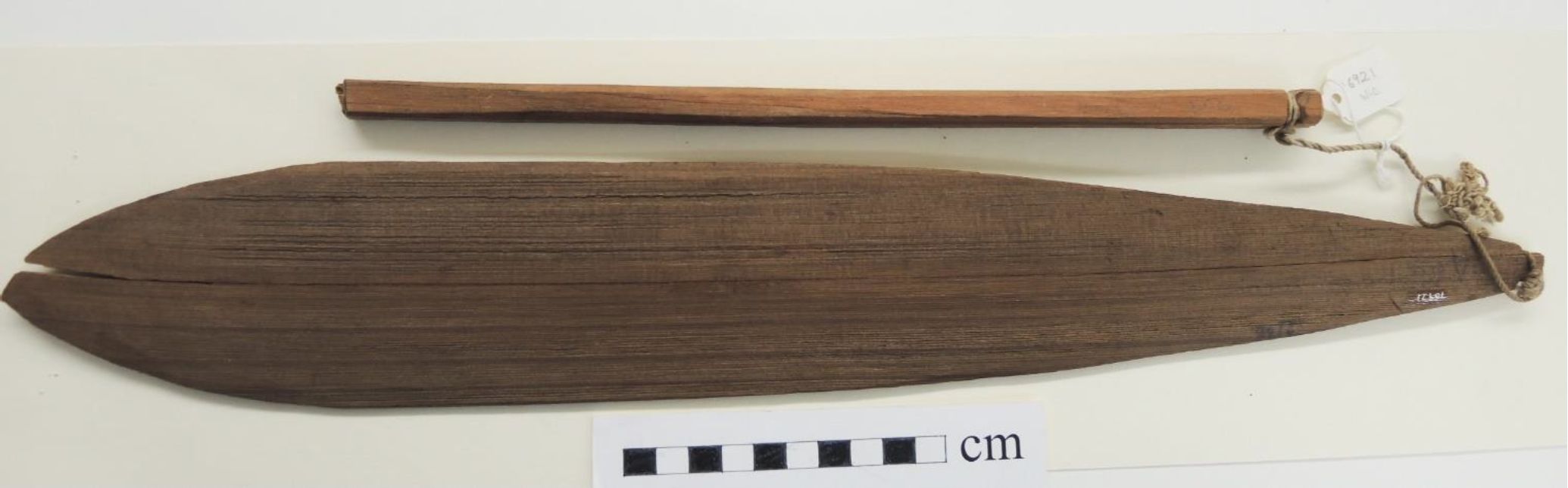
Source term: bullroarer
The Tsishaat, a Barkley Sound people who moved up the Alberni Canal in early historic times, swung the bullroarer from a handle in the Wolf Dance, and to them it was no child's toy. In the Nuu-chah-nulth Wolf Ritual the roar could stand for an earthquake: no masked dancer played the earthquake, but costumed men made its sound with bullroarers, a display that belonged to chiefs as a ceremonial privilege. The roarer kept company with song as well. In 1910 a Tsishaat singer named Tom sang for Edward Sapir's phonograph a Tsiikaa song "used in potlatch with bull-roarer"; songs of the same kind closed the Wolf ritual. Their Hupachisat neighbours upriver had taken the whole Wolf Dance, roarer included, from Nootkan tribes like this one only four or five generations back.
They were in most respects a typical central Nootkan tribe, and seem to have been much less influenced by their ex-Salish neighbors than the latter were by them.
Philip Drucker, Culture Element Distributions: XXVI, Northwest Coast (1950), p. 158.
Particulars
- Object
- A slat swung on a cord fastened to a handle, the standard form all along this coast. Neither dimensions nor material recorded.
- Function
- Sounded in the Wolf Dance, where Nuu-chah-nulth performers used it to make the sound of an earthquake, and with Tsiikaa songs at potlatches; not a child's toy.
Source
Philip Drucker, 'Culture Element Distributions: XXVI, Northwest Coast,' University of California Anthropological Records 9:3 (Berkeley, 1950), p. 199, elements 854-857, with notes p. 268; Canadian Museum of History, Edward Sapir 1910 Nuu-chah-nulth cylinder recordings VII-F-02(a) (archive 3379814; singer Tom of the Tsishaat; 'Ts!iqa' [Tsiikaa] song used in potlatch with bull-roarer') and VII-F-01(1) (archive 3371868; 'used in potlaches and at the end of wolf ritual'); Alan D. McMillan and Ian Hutchinson, 'When the Mountain Dwarfs Danced,' Ethnohistory 49(1) (2002): 41-68, p. 47, citing Sapir and Swadesh 1955: 91