No. MUS2026-142
Mare, the great roaring din
Brazil · Upper Solimões, Amazonas (between Tabatinga and São Paulo de Olivença) · South America · Upper Amazon
Restricted
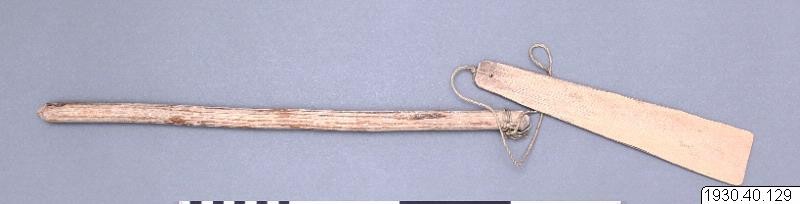
mare
Source term: vinare
mare — name on Nimuendajú’s 1929 collection card; matches the Ticuna sound-morpheme -mare "intensified roar" (cucumare = a great din, Matarezio 2015), i.e. the blade named for its roar.
The one great festival of Ticuna life belongs to a girl. At first menstruation she goes into seclusion as a varekü, invisible and inaudible to all but her mother and paternal aunt, while invisible demons — ṅɔɔ' — crowd around her cell; at her feast, masked dancers embody those demons, and giant trumpets, taboo to women and children, are blown all night with their bells turned toward her wall. Ticuna cosmology hangs on that seclusion. The first people were immortal until a secluded girl answered the wrong caller: Old Age announced himself with shouts, took off her skin, and left her a decrepit woman — since then, people grow old and die. Curt Nimuendajú carried this paddle-and-handle blade out of the Solimões in 1929, his collection card setting it in the mask dance of that feast under the name mare — built on the Ticuna word for a great roaring din. Among the many demon-voices of the festival, this one was made to roar.
Vinare. Användes under maskdansen vid ceremonier vid flickornas pubertet (Mare).
Bull-roarer. Used during the mask dance at the ceremonies of the girls’ puberty (Mare).
SMVK Göteborg catalog card, 1930.40.0129 (Nimuendajú collection, 1929)
Particulars
- Object
- Flat paddle-shaped wooden blade (~25 cm) pierced at the neck, tethered by a cord to a ~44 cm wooden handle. Världskulturmuseet, Göteborg (SMVK/VKM) 1930.40.0129; collected by Curt Nimuendajú, 1929.
- Function
- Sounded during the masked dance at a girls’ puberty ceremony; the museum does not identify the player.
Source
Världskulturmuseet, Göteborg (Statens museer för världskultur), inv. 1930.40.0129 ("vinare"); collected by Curt Nimuendajú, 1929; from a left-bank tributary of the Rio Solimões between Tabatinga and São Paulo de Olivença (Igarapé Preto / Lago Cajary / Igarapé do Caldeirão), Amazonas, Brazil