No. DRUCKER1950-001
Hupachisat bullroarer
Canada · Head of Alberni Inlet, Vancouver Island · North America · Northwest Coast
Sacred / spirit
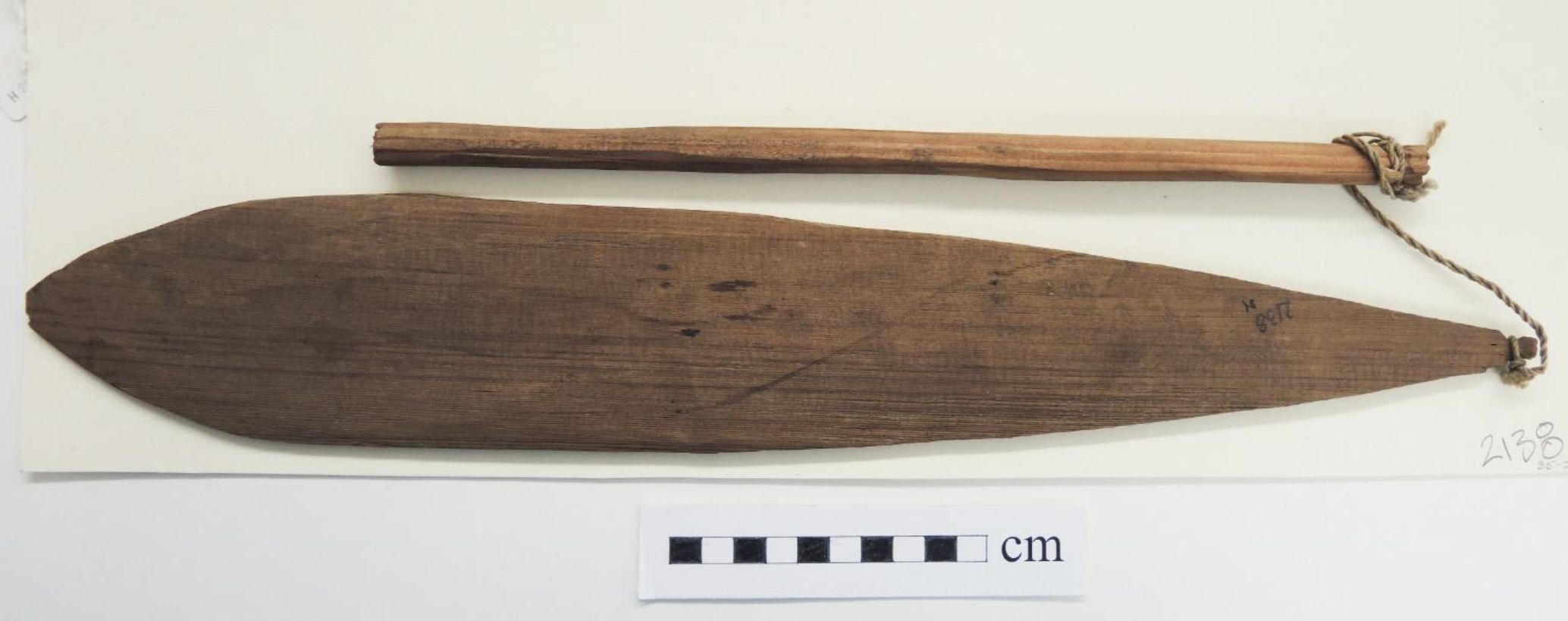
Source term: bullroarer
At the head of Alberni Inlet the bullroarer belonged to the Loqwana, the Wolf Dance — the great winter ritual of this coast, in which wolves carry novices off from the village and the initiated bring them home again. Across the Nootkan Wolf ritual the bullroarer, ctihyak, was the Wolf's own tail. The Wolves were said to carry the novices off in their mouths, so for the length of the rite even the everyday words for "teeth" and "tail" were forbidden, and the whirled tail and the Wolf whistles, sounded mostly at night or out of sight, were the chief Mysteries of the ritual. Almost everywhere in the world the roarer is reported as having always been there. Here it arrived. It came in with the Wolf Dance itself, four or five generations back, when a people who had been Salishan in speech and culture became Nootkan; instrument and ceremonial were borrowed together, and recently enough that the borrowing was still remembered.
Particulars
- Object
- A wooden slat swung on a cord fastened to a handle, the standard form all along this coast. Neither dimensions nor material recorded.
- Function
- Sounded in the Wolf Dance, not given to children; it arrived with the ceremonial itself, four or five generations before.
Source
Philip Drucker, 'Culture Element Distributions: XXVI, Northwest Coast,' University of California Anthropological Records 9:3 (Berkeley, 1950), p. 199, elements 854-857, with notes p. 268; Philip Drucker, The Northern and Central Nootkan Tribes (Bureau of American Ethnology Bulletin 144, Washington, 1951), pp. 388, 394