No. MUS2026-011
Makah Klokali wolf-ritual roarer
United States · Cape Flattery, Washington · North America · Northwest Coast
Restricted
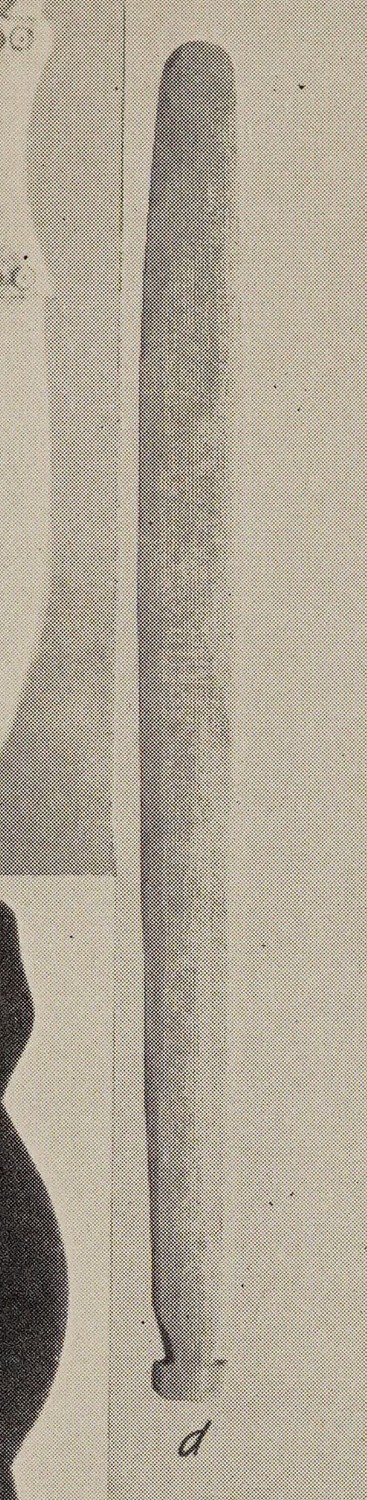
Source term: bull-roarer
Four or five bull-roarers sounded at the Klokali, the Makah Wolf Ritual and the greatest event of their year. Men hid in the woods around the village with whistles, "imitating wolves," then came in and took one of the men "to be initiated" with them, gathering the members house by house. The meeting was of "a very serious character," with "something terrifying" in it; children were kept indoors while the howling and the concealed reed whistles gave voice to the wolves and the thunderbird. The society disciplined wrongdoers: a woman who had told lies had her front hair cut off diagonally across her forehead, and for a young man caught lying they buried a smooth rock in the ashes until it was very hot, then touched it to the top of his head. This blade, collected by Frances Densmore among the Makah, is one of the Klokali roarers.
During the meeting someone would give a signal and all the people would give the wolf howl. It was a blood-curdling sound when given by a roomful of men.
Makah informant, in Frances Densmore, Nootka and Quileute Music (BAE Bulletin 124, 1939), p. 102
Particulars
- Object
- Bull-roarer of the Makah, in the collection of Smithsonian NMNH (NMNH Anthropology).
- Function
- Instrument of the Makah Klokali (Wolf Ritual), an initiation society whose members impersonated wolves; the bull-roarer was one of the Klokali sound-instruments alongside the concealed reed whistles that voiced the wolves and thunderbird.
Source
Smithsonian National Museum of Natural History, Anthropology; Frances Densmore, Nootka and Quileute Music (BAE Bulletin 124, 1939), pp. 29 and 101-104