Atlas Essay — 2026-10-03
The Mother of All
Nimboran, western New Guinea · the Fly River · Arnhem Land · Port Keats
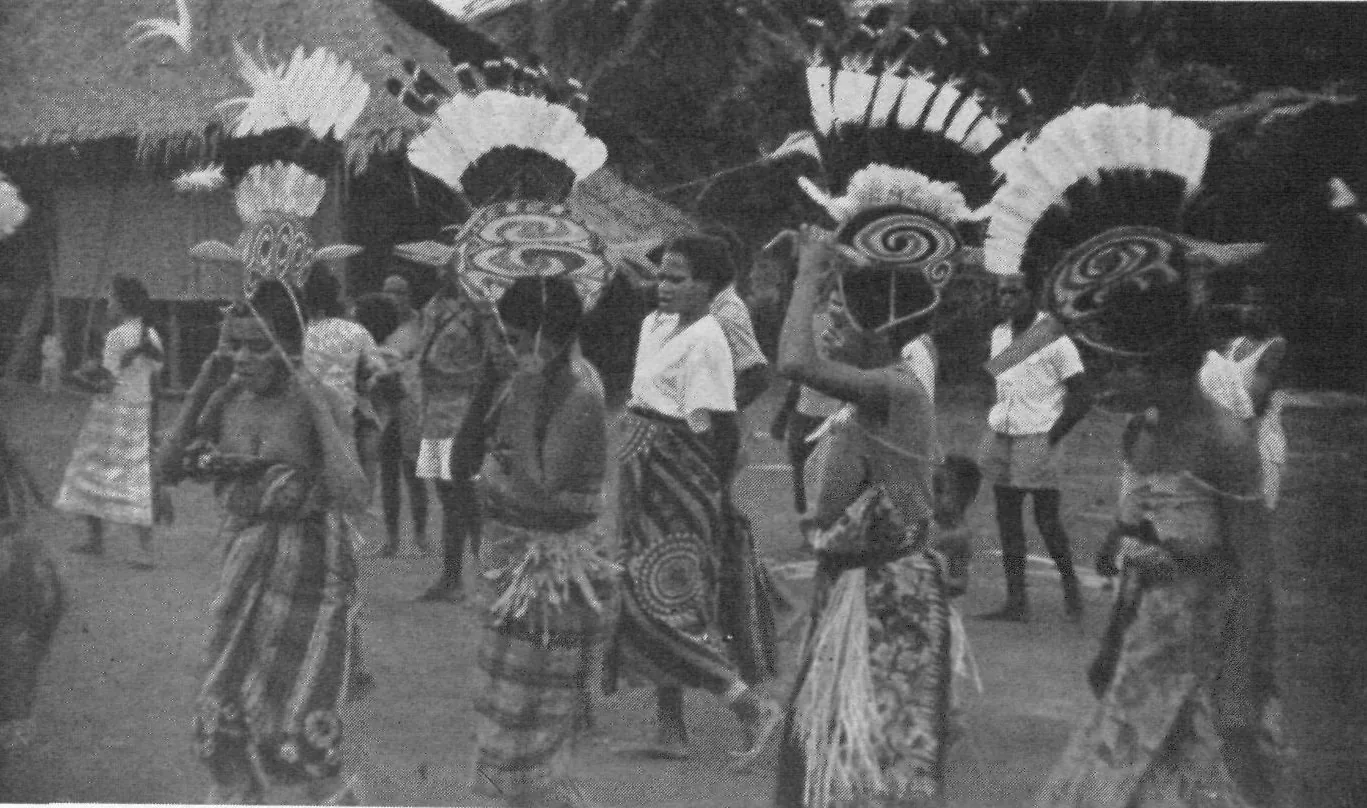
In the Nimboran valleys west of Lake Sentani, in what is now Indonesian Papua, the men built a house on the roots of an upturned tree, and the Mother came to live in it. Her voice poured out of the house for days. The women stayed shut in their own houses, because a woman who saw her would sicken and die. When the feast was over she left in a cloud of ash. Her name was Ndjo. She had made the people, and she had taught them the bullroarer. Fourteen hundred kilometres to the south, across the Arafura Sea in northern Australia, the Dalabon tell of their own Mother, Jingana. She held all life inside her. When she was gone, a bird made a bullroarer, and its sound is her voice.
On both sides of the drowned land between New Guinea and Australia, the bullroarer belongs to one figure: a primordial Mother, serpent-bodied or two-sexed, who holds all life inside her and whose voice the roarer carries after she is gone.
In brief
- On both sides of the drowned land between New Guinea and Australia, the bullroarer belongs to one figure: a primordial Mother, serpent-bodied or two-sexed, who holds all life inside her and whose voice the roarer carries after she is gone.
- In western New Guinea, Ndjo is the old woman and primal mother of the Nimboran. She is both sexes in one body, appears as a snake or a cuscus, bears the people, makes the earth, and teaches the bullroarer. Her voice was first made by whirling a shell on a string.
- In Arnhem Land, the Dalabon Jingana is a snake-like All-Mother who held all life within her. As Lumaluma she swallowed the dancers of the Gunabibi ceremony, and a bird made a bullroarer whose sound is her voice.
- At Port Keats, the Murinbata Mother of All, Mutjingga, swallows children, is drawn in one Murinbata picture as half-woman, half-snake, and speaks through the bullroarer a bird made after her death. On the Gulf, the Mara Mumuna cries out of the roarer Eaglehawk cut.
- Between the two coasts, the Boazi roarer is "the voice of the old woman", a Trans-Fly woman is pregnant with the first bullroarer, and the Kiwai roarer calls itself "father and mother of all yams".
The snake-linked bullroarers of both coasts are mapped together on the Snake-linked lens.
Ndjo bore the people and taught them the roar
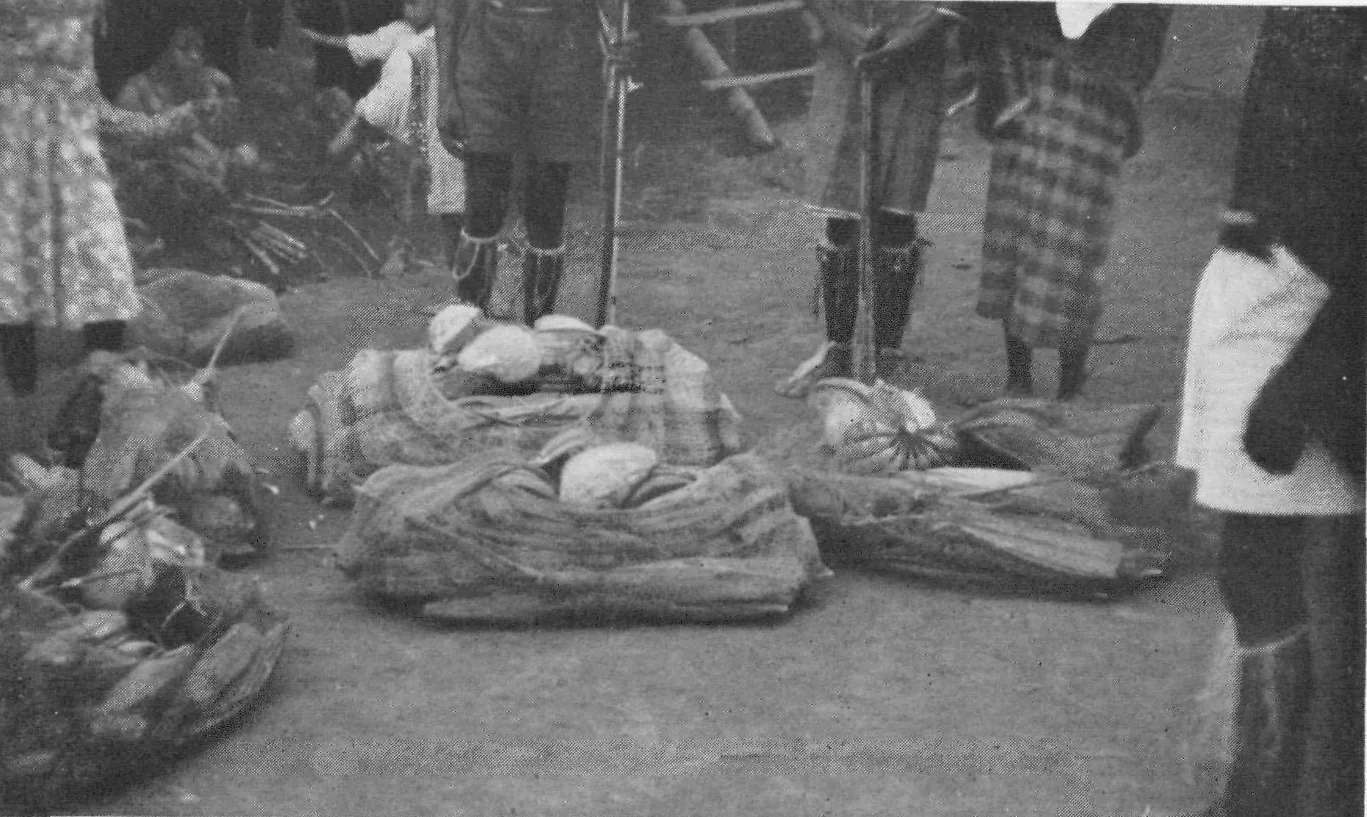
The Nimboran and their Kemtuk neighbours live in the hills and valleys inland from the north coast of New Guinea, along the road from Genjem to the western shore of Lake Sentani. Their great feast was the eram, the festival that made a man a chief. In October 1953 the Dutch ethnologist K. W. Galis watched one at the Kemtuk village of Bonggrang and wrote it up the next year. When he came to the beings behind the feast, he began with the greatest of them:
The chief figure is without doubt the old woman, or primal mother, called Ndjo in Nimboran, who can show herself as a cuscus or as a snake, among other forms. In essence she is two-sexed. She “bears” people, also creates the earth, is connected with the “great flood” (Jawa Nèntëmung), and teaches people sexual intercourse, the eram ritual, the use of the bullroarer (wap) and later of the sacred flutes. She owns earthly riches.
K. W. Galis, “Het Eram-feest te Bonggrang,” 1954, pp. 35–36, translated from the Dutch
Everything the Nimboran needed to go on living comes from Ndjo: the people, the ground they stand on, the act that makes more people, the feast that makes a chief, and the sound that summons the dead. The bullroarer stands in the list beside sex and birth. It comes first among the sacred instruments; the flutes came “later.”
Her animals tell the same story. The cuscus is a slow, round-eyed marsupial of the treetops. The snake is the creature that does not die. Galis goes straight on to say why:
It is believed that snakes, lizards and the like do not die but only change their skin, and so are masters of life and death. The same holds for the cuscus, in several stories at least.
Galis 1954, p. 36
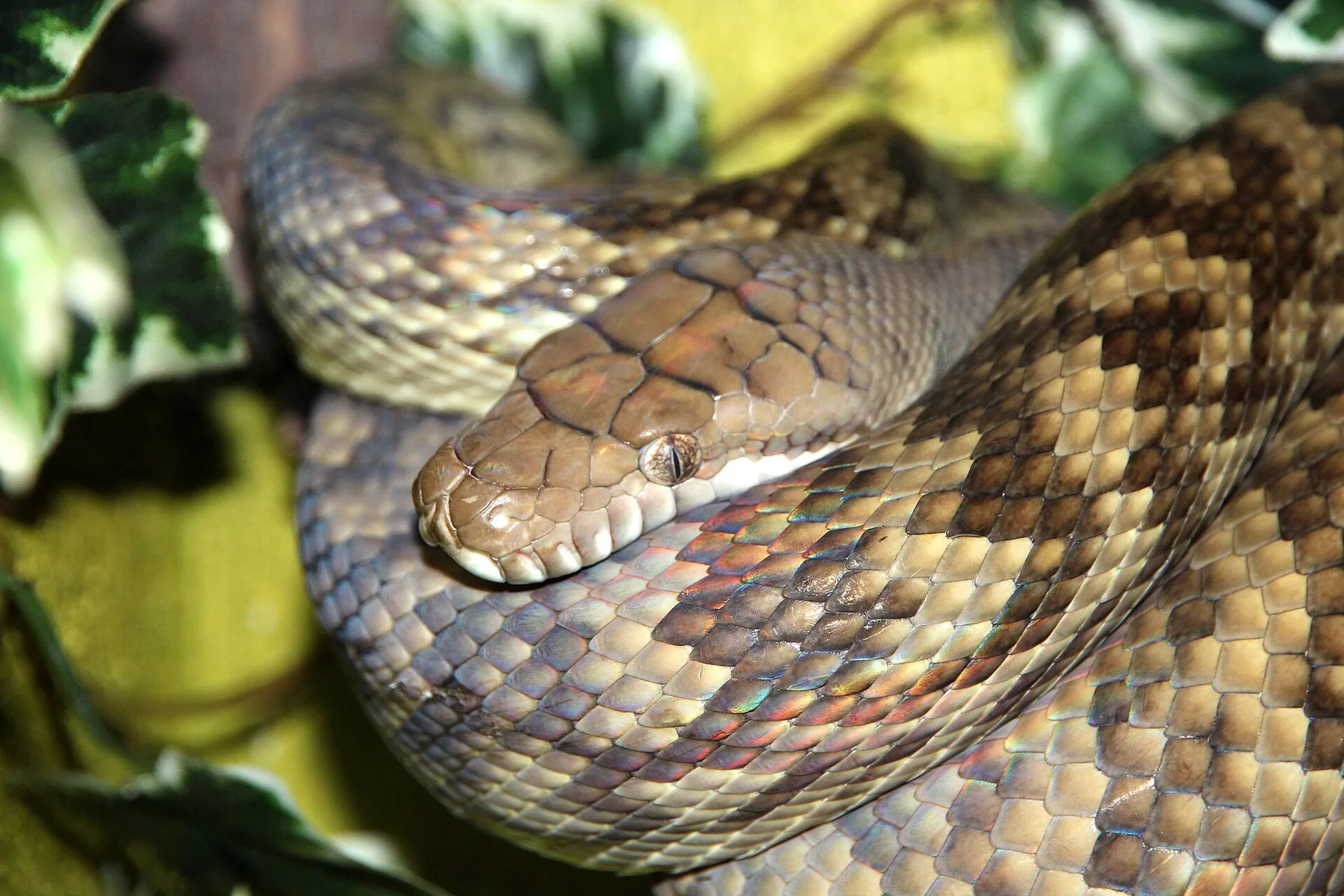
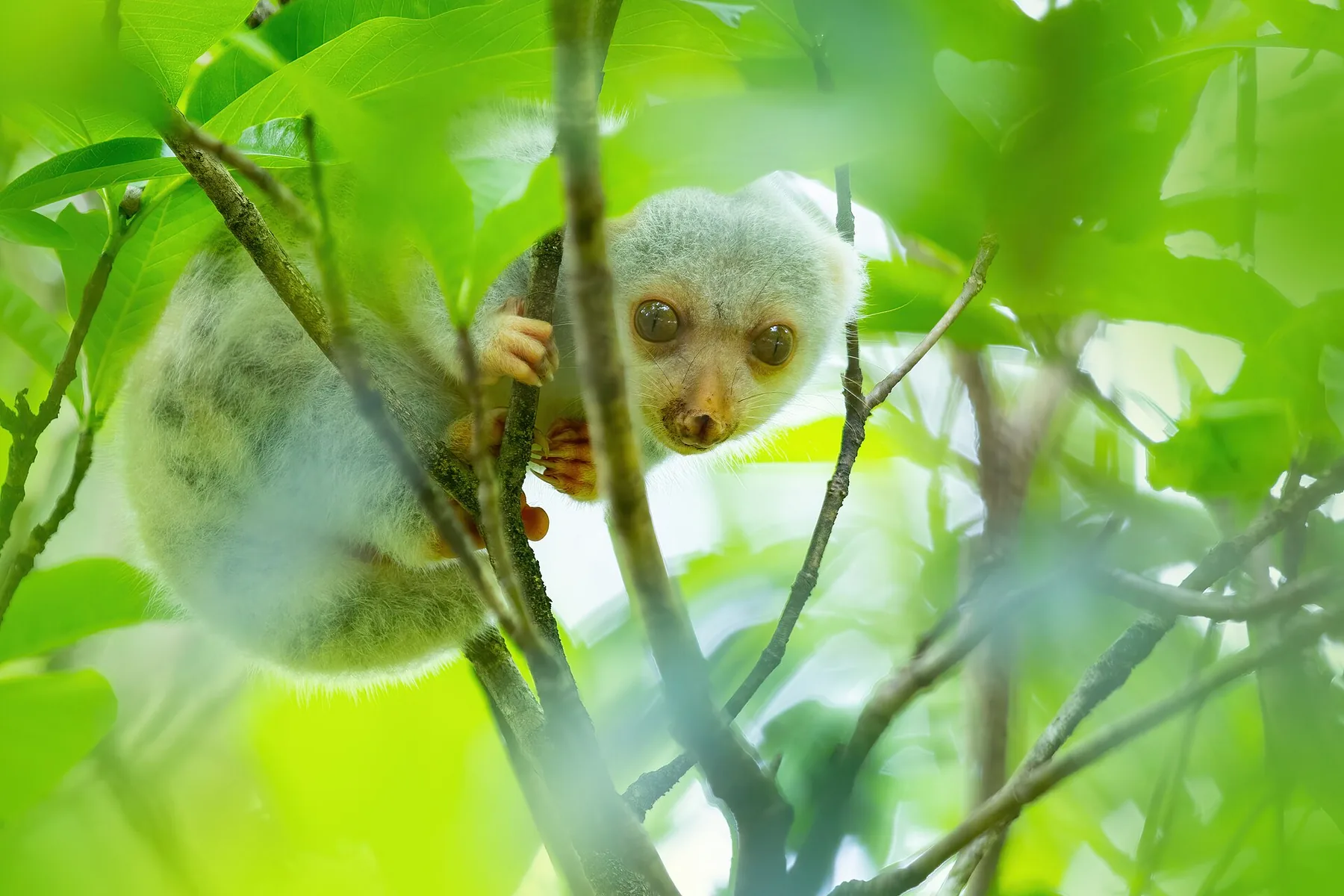
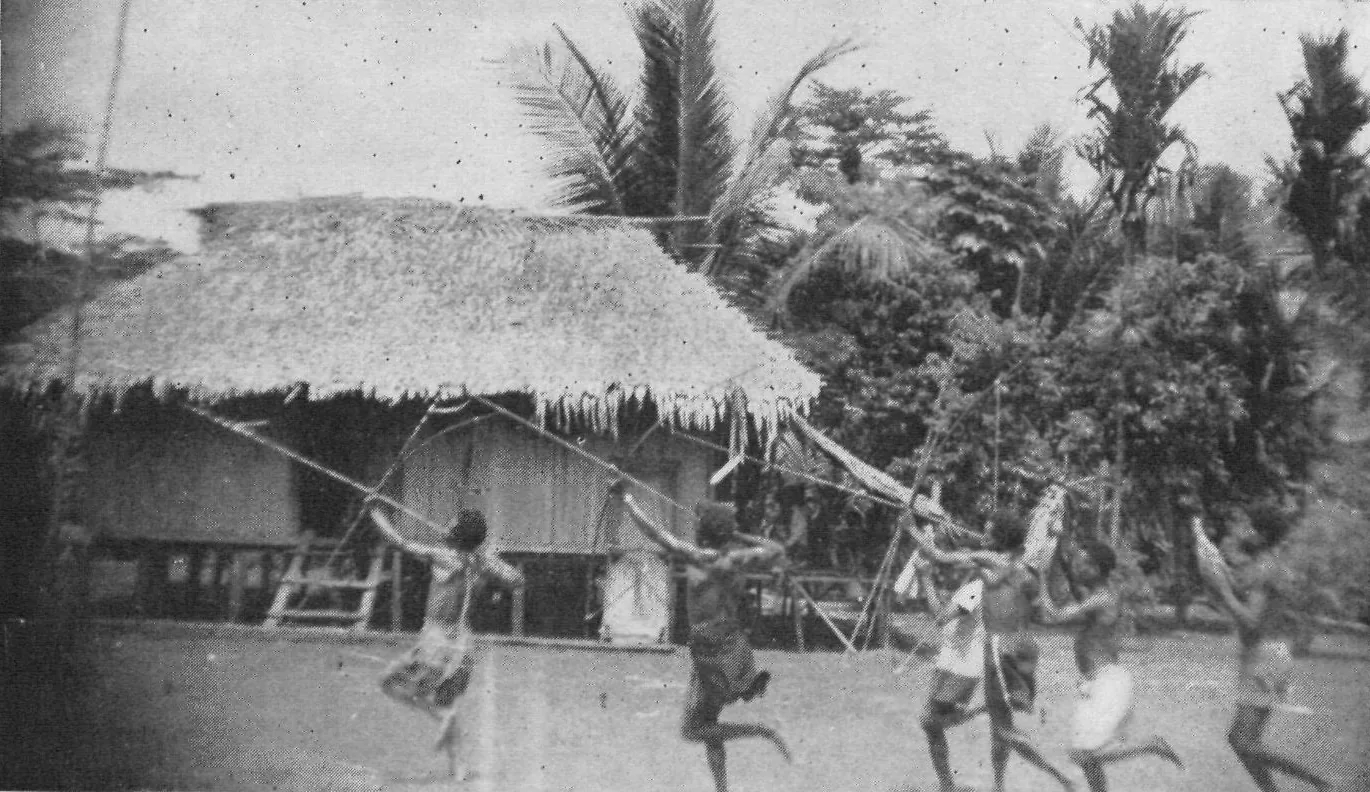
For the Nimboran the snake filled the whole world. The great serpent Bëné lay coiled round the land of the dead. The rainbow was rëmöku manggum, “little red snake, python.” In the Kemtuk telling the creator was Jawa Nèntëmung, whose name means “penis,” and he could take either a snake's or a man's shape. He made the earth, and two people came out of his vomit. Galis watched the archers of the feast circle the square, crouching and hissing, and asked whether the long line of them was a snake: “the primal snake Ndjo, or Jawa Nèntëmung?” Ndjo is the serpent mother of the whole country, and the chief made at her feast is, in Galis's words, “descendant of the bisexual snake.”
“In essence she is two-sexed. She ‘bears’ people, also creates the earth … and teaches … the use of the bullroarer.”Galis 1954, on Ndjo
Ndjo's voice came out of the water
W. J. H. Kouwenhoven described the chief's feast two years later in his study of Nimboran. He drew on the same field notes, those of the Swedish ethnographer J. E. Elmberg, and spelled her name Indjo. In a footnote he describes her:
[Indjo] is the name of a female supernatural being. Indjo dwelt in the mountain rivers in the south of Nimboran. She was closely associated with water. Her power was feared, for if she were displeased she would send rain and thunder, and drown the earth with everything on it. According to Elmberg the voice of Indjo was originally reproduced by spinning the shell of a large crayfish on a length of string (like a bull-roarer). Later, the sound was made by blowing bamboo water-flutes. … The voice of Indjo was said to emanate from the water in these flutes. The flutes were never blown in the open, but only inside a special house: indjo-jamo (= house of Indjo) which was also the house of initiation for the boys.
W. J. H. Kouwenhoven, Nimboran, 1956, p. 31, note 1
The first instrument of the Mother's voice was a whirled thing on a cord. The Nimboran word for the bullroarer is wap, and so is their word for the crab and the crayfish. When Ndjo came into the village for the feast, no crayfish could be caught. The shell that spoke for her was not to be taken while she was among them.
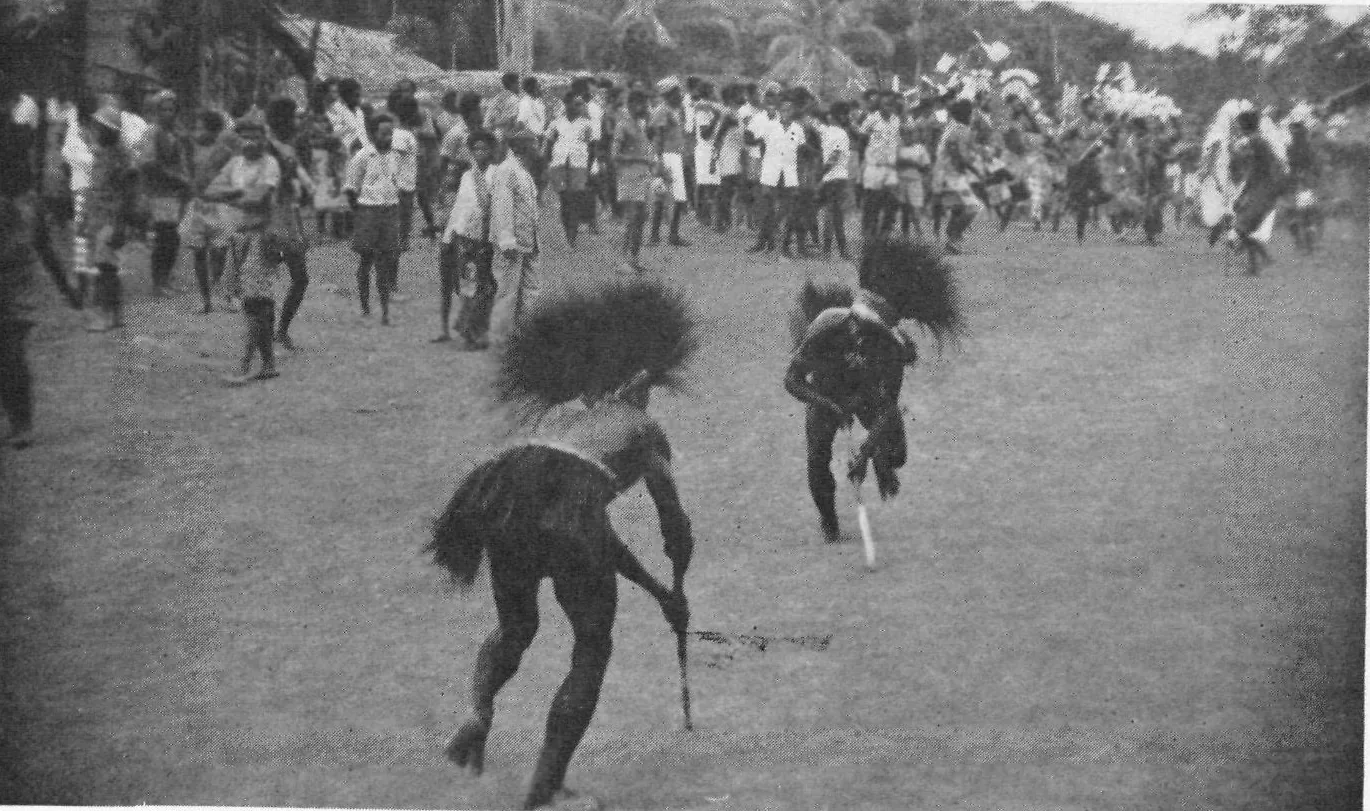
Kouwenhoven then describes her arrival. The drums beat for a long season while the gardens were extended and the sago was stacked. Then the drums stopped. Ndjo “would take up her abode in the jao,” the house on the upturned roots, and the sound of her began and went on for days:
All the time that Indjo made her presence known by the sound of the water-flutes, the women were to keep to their houses, for if they caught sight of Indjo — it was said — they would fall ill and die. … The ancestors — who otherwise were dwelling in Semèn, the underworld, and who were holding an eternal kabi at which the horn of plenty was overflowing — were supposed to be present at an actual kabi. … After a few days Indjo would disappear from the jao in a cloud of ashes.
Kouwenhoven 1956, p. 32
Elmberg was told how the feast used to end. Men hidden in the feast-house raised “an unholy din,” blowing flutes and beating sticks together, then “made a great cloud of ash and ran out in it, into the forest.” The ash cloud meant “the descent, and the vanishing again in a cloud, of the primal-mother snake Ndjo” (Galis, p. 35, from Elmberg's notes). For a few days at each chief's feast, the serpent Mother came down into a house of men. Her voice filled it, the women hid from her, and the dead came up to feast. Then she was gone.
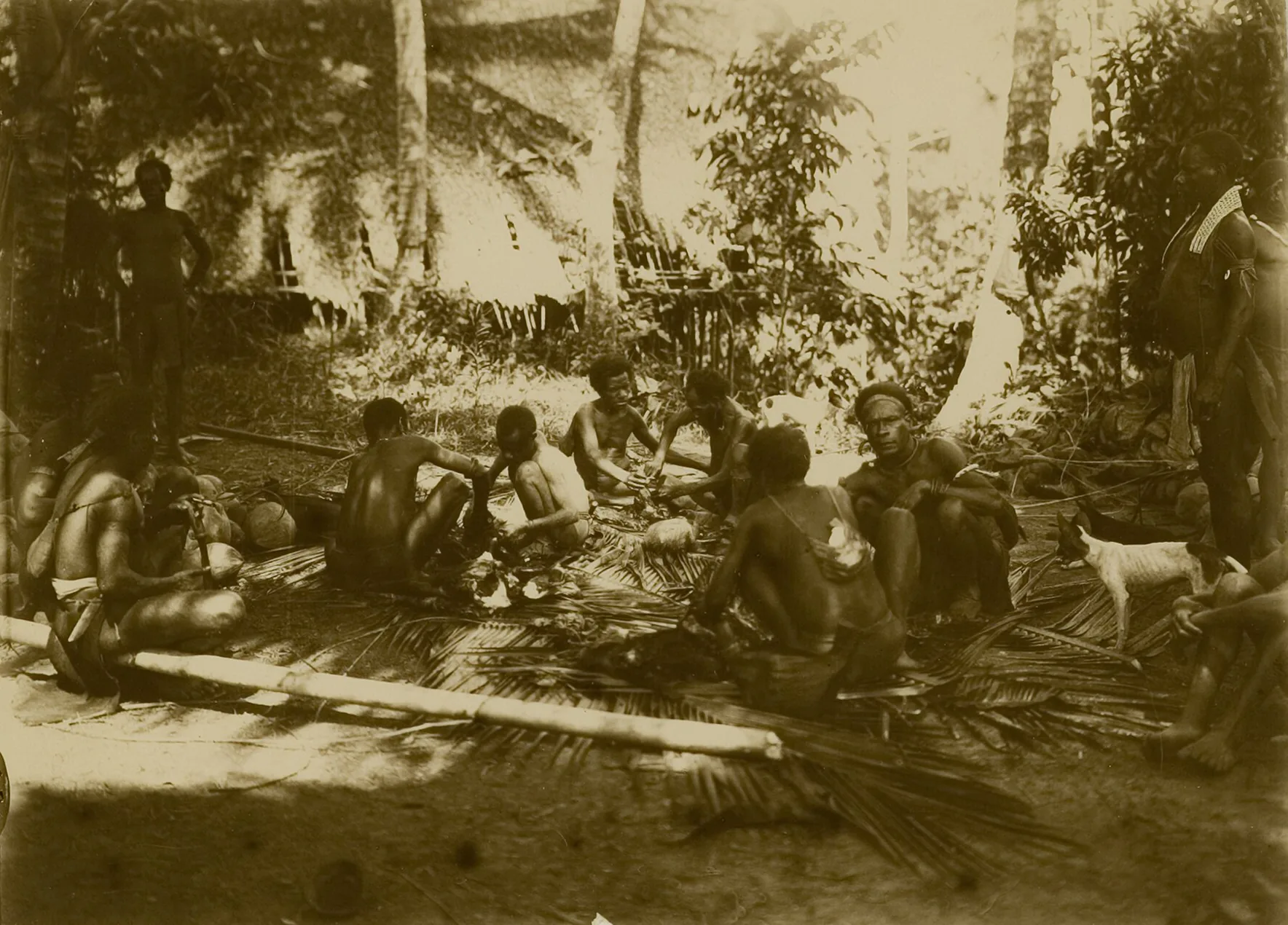
Jingana held all life inside her
Across the Arafura Sea, the Dalabon live in southern Arnhem Land, in the stone country and river valleys of Australia's Northern Territory. The anthropologist Kenneth Maddock worked with them and recorded two stories of their great Mother:
I have collected a Dalabon myth in which Jingana, a snakelike All-Mother, had all life within her but would not let it out. She had to be speared by a left-hander before the beings within her could come forth. Jingana is a rainbow serpent. Another Dalabon myth has it that Lumaluma, a snakelike All-Mother who is Jingana or a version of her, used to swallow Gunabibi actors until at last a father-son pair decided that thenceforth they would celebrate the ceremony without her. A bull-roarer was made by a bird to substitute for Lumaluma and its sound is her voice. During Gunabibi performances the novices are putatively swallowed by her.
Kenneth Maddock, introduction to The Rainbow Serpent, 1978, pp. 11–12
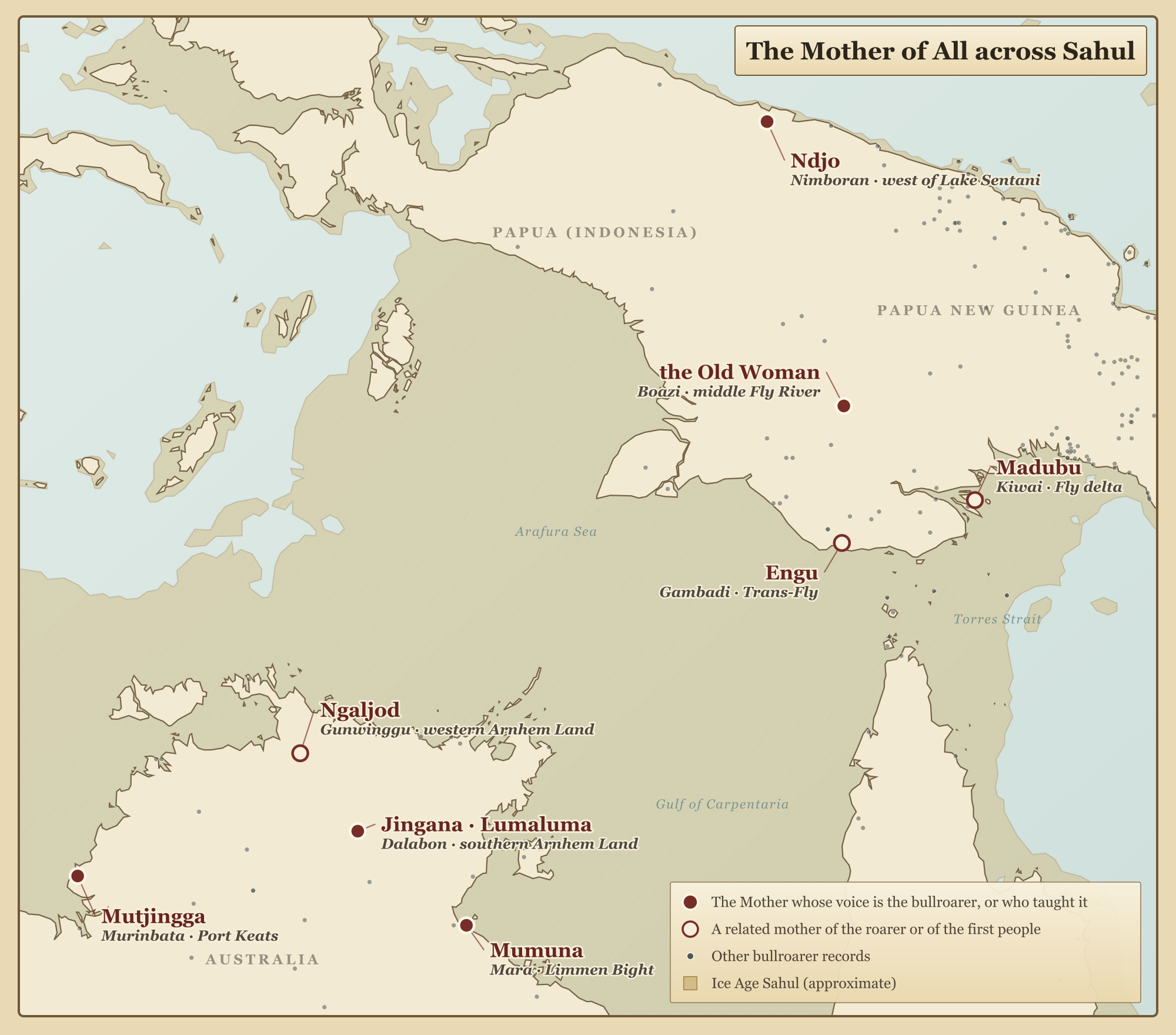
Set this beside Ndjo, as the map does, and the two Mothers line up point for point. Each is a serpent. Each holds the living world inside her body: Ndjo bears the people, and Jingana keeps all life in her belly until it is let out. Each presides over the great men's ceremony of her country, the eram in Nimboran and the Gunabibi in Arnhem Land. Each is kept away from ordinary sight while she is present. And each speaks, in the end, through a whirled instrument the men control. Ndjo's voice came first from a shell spun on a string. Lumaluma's comes from a bullroarer a bird made to stand in for her.
The Gunabibi is the Dalabon name for the ceremony better known as Kunapipi, the great fertility cult that spread across the north of the continent. Maddock notes that in it “bull-roarers (rainbow-serpent symbols) are sounding in concealment” while the women wait nearby (p. 7). The roar is the serpent. Among the Dalabon the serpent is the Mother.
Mutjingga swallowed the children
The pattern runs west to the Murinbata of Port Keats, now Wadeye, on the Northern Territory coast southwest of Darwin. W. E. H. Stanner worked with them from the 1930s and described their most secret ceremony, Punj, in the early 1960s:
The word Karwadi is the secret name of a provenant spirit also described as The Mother of All or as The Old Woman. … The attitude towards her may well be called one of holy dread. She is thought to exercise a rather frightening care of men. The bullroarer is her emblem; the sound it makes when swung is the sign of her real presence.
W. E. H. Stanner, On Aboriginal Religion, pp. 4–5
The youths are taken into the bush, stripped and made nameless, and told “that they will be swallowed alive by Karwadi and then vomited up” (p. 6). They are smeared from head to foot with blood and “are allowed to suppose that it is the blood of The Mother” (p. 7). As the moment comes, the older men cry out “with shouts of well-simulated fear”: “Karwadi! Karwadi! The Old Woman is calling” (p. 8). Then the roaring boards appear.
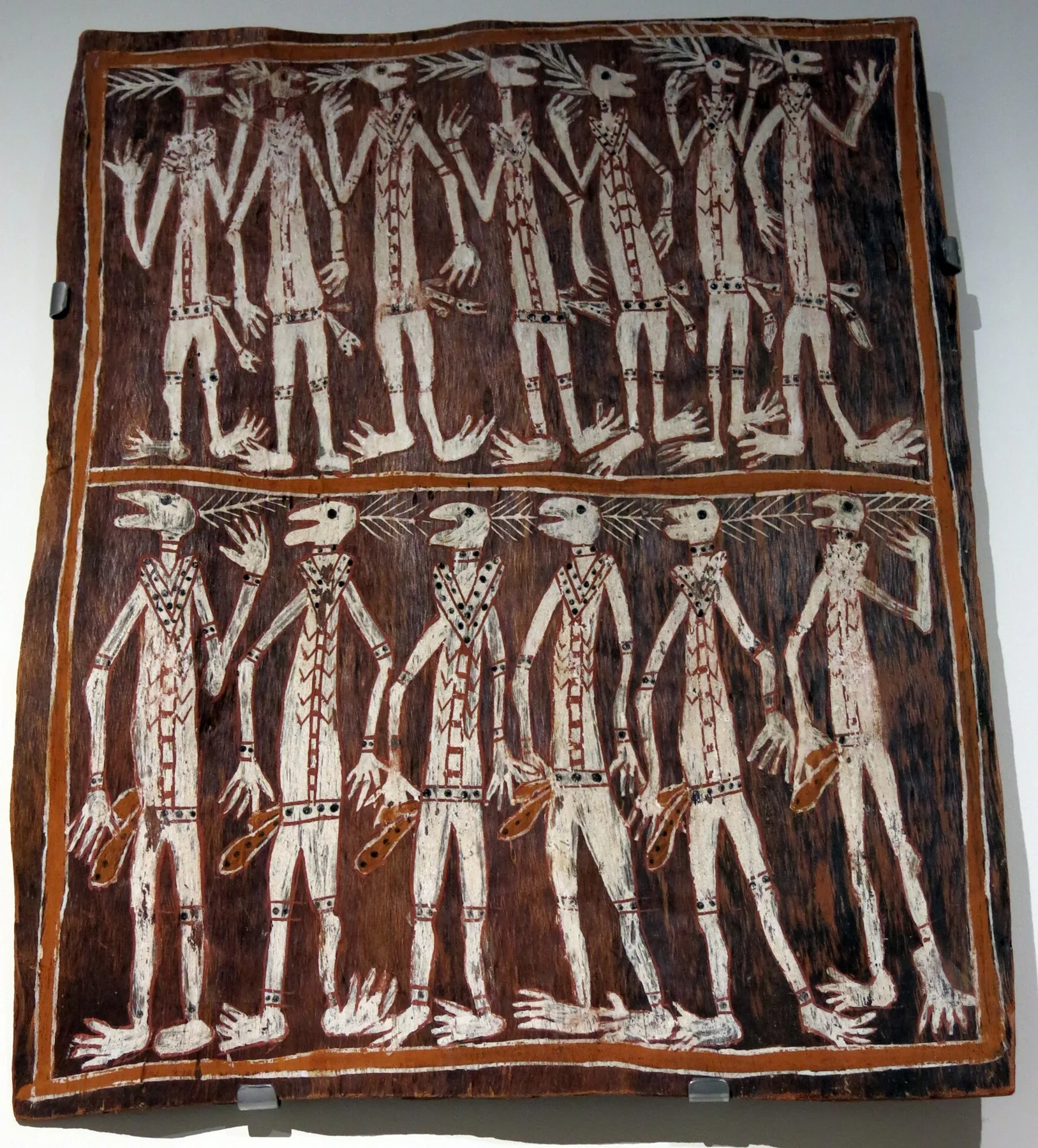
The myth behind the rite is the story of Mutjingga, the Old Woman. The people left their children with her while they went to find honey. She bathed the children, lay down with them in the shade, offered to look for lice in their hair, and swallowed them one by one. The people overtook her at a river and speared her, and cut the children alive from her belly. They painted the children as initiated boys are painted (Stanner, pp. 41–43; Maddock, p. 11). A bird made the first bullroarer after her death, and, in Maddock's summary of Stanner, “its sound is her voice.” Stanner adds a detail from Murinbata drawings: “One drawing shows her as half-woman, half-snake.”
“Karwadi! Karwadi! The Old Woman is calling.”Stanner, On Aboriginal Religion, p. 8
Maddock set the Murinbata and Dalabon stories side by side and found one set of events. Mutjingga and Lumaluma play the same part in the same kind of rite, and Mutjingga's spearing and the release of the lives inside her are Jingana's. “It would be contrived,” he wrote, to separate them (p. 12).
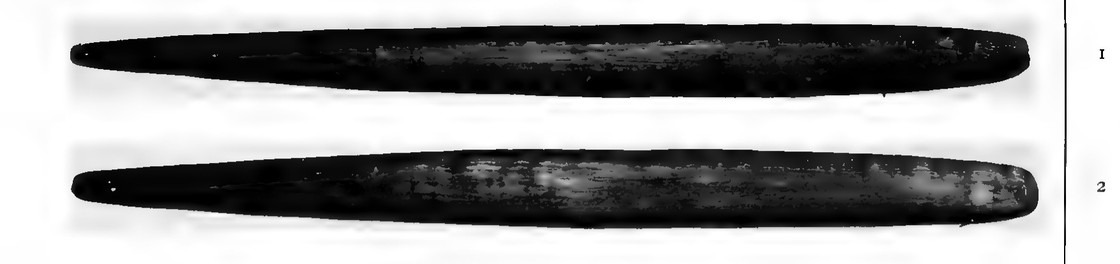
On the Gulf of Carpentaria the Mara tell it with an eagle. Their Mother, Mumuna, enticed men to her camp and ate them: “She swallows them whole but vomits their bones” (Berndt 1951, pp. 148–152). Eaglehawk killed her. Then “Eaglehawk cut a bullroarer from a tree, and in swinging it gave back her cry as ‘mumuna’” (Poignant 1967). Ronald Berndt, who recorded the Mara Kunapipi, wrote that the roarer's sound “is its ‘voice,’ the ‘voice’ of Kunapipi or Mumuna herself when she was killed by Eaglehawk.” The novices come out of the ceremony painted, and the men told Berndt what the paint was: “they are smeared with the inside liquids of Mumuna's womb!” (Berndt 1951, p. 160).
The Old Woman of the Fly River
The ground between Nimboran and Arnhem Land is southern Papua New Guinea, the low country of the Fly River that faces Australia across Torres Strait. The Mother is there too.
The Boazi of the middle Fly call the bullroarer atu gisagaru, “voice of the old woman.” The Dutch anthropologist Jan van Baal recorded their initiation. The novices chant “we kill the old woman.” The women are told that the men are burning the Old Woman's excrement and burying her bones, and the boys go home to tell their mothers that they “have eaten the flesh of the atu” (van Baal 1966, pp. 590–595). It is Mumuna's rite: the Old Woman is killed, and the men keep her voice in a board.
In the Trans-Fly, the country west of Torres Strait, the Gambadi say the first bullroarer came out of a woman. F. E. Williams recorded the story in the 1930s. The Originator, Tiv'r, came from the west with his wife Engu. His failed attempts at intercourse left her pregnant “not with a human child, but with the bull-roarer,” which hummed faintly whenever she moved. He sent a series of birds to take it from her. The last of them, Serekute, snatched it from her body as she swept. Then “Serekute bears the bull-roarer to his master. Tiv'r hugs it to his breast and declares that from henceforth it shall belong to man alone” (Williams 1936, pp. 307–308).
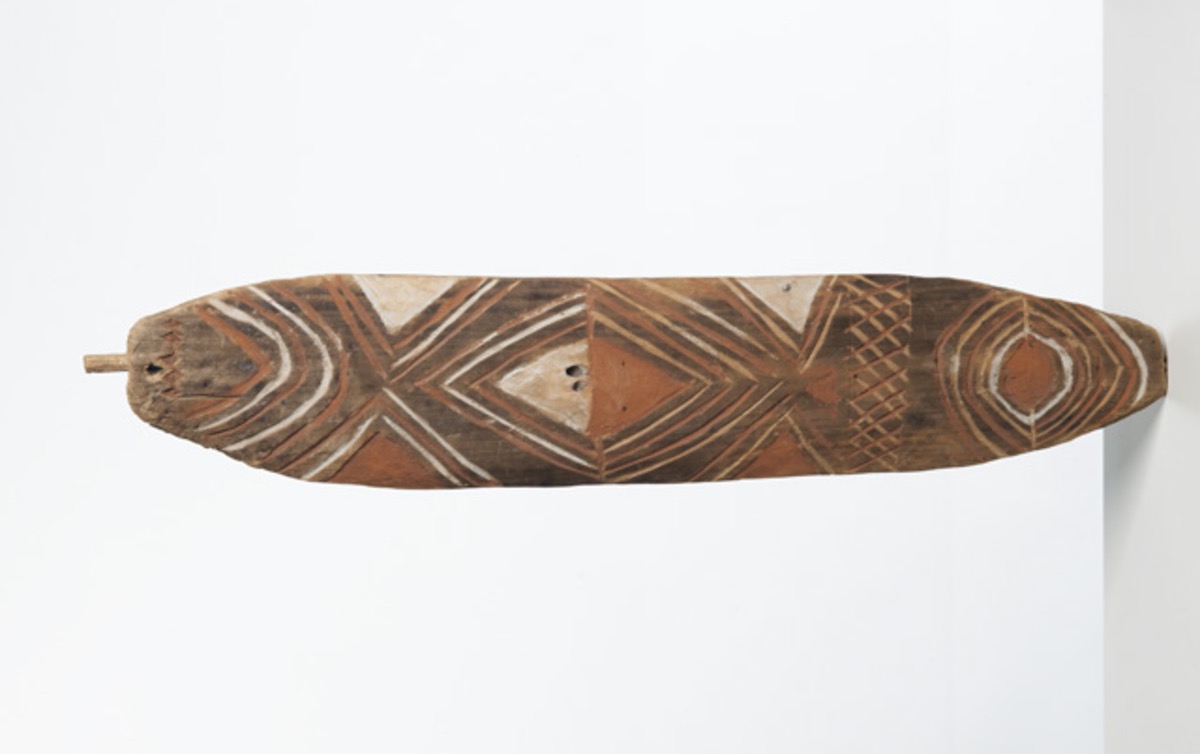
At the mouth of the Fly and on the islands of Torres Strait, the roarer is madubu, and it speaks for itself. A woman found the first one near Bugi and showed it to her husband. In a dream the spirit of the wood told him: “My name is madubu … I am the father and mother of all yams. … No woman or child may see them.” The Kiwai call it umamomaramu, “the mother of yams” (Haddon, Reports, vol. I, pp. 219–220, quoting E. Baxter Riley). They whirl it so that the gardens fill with yams, sweet potatoes and bananas. Like Ndjo, it is both parents at once.
The Mother is both sexes in one body
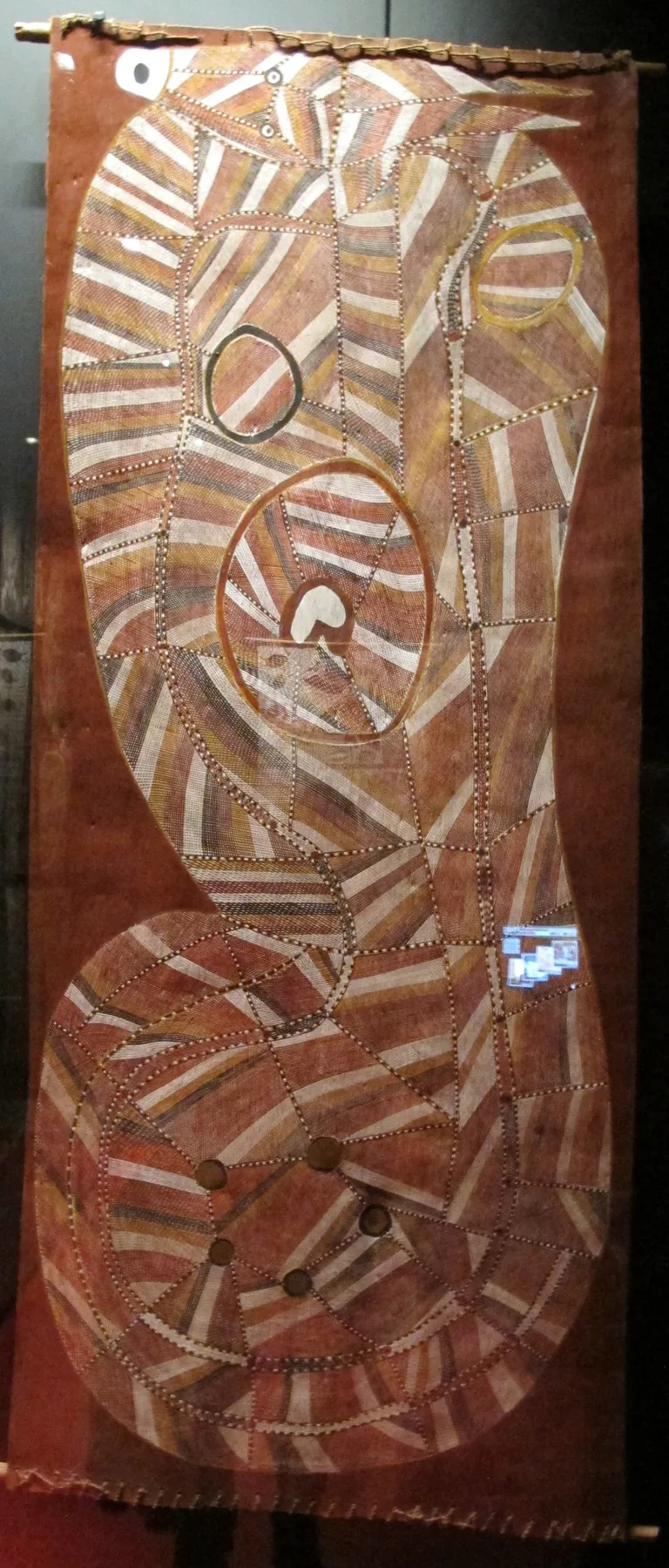
The roarer is a man's object, kept from women, often carved long and swung hard. Van Baal was surprised by the Boazi: “The association of so eminently phallic an object with a female deity is surprising and raises many questions” (p. 595). Ndjo answers him. The Mother who owns the roarer is not a woman only. Galis calls her tweeslachtig, “two-sexed,” and the Nimboran told of another two-sexed being, Wai-dem, who cut himself; from the blood came the wai-eram, and the tree-kangaroo was born of it. Some said the tree-kangaroo was Ndjo herself (pp. 28, 36). The Kiwai roarer is “father and mother.” Engu's husband fathers the roarer and she carries it.
In Australia the same fusion holds. Berndt, writing on the Kunapipi of northeastern Arnhem Land, kept two figures apart: a fertility Mother who stood for “the Uterus” and a rainbow serpent who stood for “the Penis,” working together to bring life out. Maddock answered that Jingana, Lumaluma and Mutjingga “coalesce notions that Berndt's informants separated” (pp. 2, 12): each is a womb in the body of a snake. In western Arnhem Land, the Gunwinggu speak of the rainbow serpent as female, and in their creation story she gives birth to the first people. Their great ceremonies are ruled by “the Mother,” the Old Woman, “who appears sometimes as Ngaljod, the rainbow serpent” (Maddock, p. 12, after Berndt and Berndt 1970).
That is the Mother's shape on both coasts. She is the whole of generation in one body: womb and serpent, mother and father, the one who swallows and the one who gives birth. The bullroarer is that body put into men's hands, a carved shaft that speaks with a mother's voice. Galis saw the whole eram as made in her image. The rite itself is two-sexed, he wrote, because women and men take part, boys dance dressed as girls, and the chief is “descendant of the bisexual snake” (p. 37).
A bird carries her voice to the men
Again and again, a bird stands between the Mother and the men. A bird made Mutjingga's bullroarer after she was speared. A bird made Lumaluma's when the men decided to hold the Gunabibi without her. Eaglehawk killed Mumuna, cut the roarer and swung her cry out of it. Tiv'r sent bird after bird to take the roarer out of Engu, until Serekute snatched it and flew it to him.
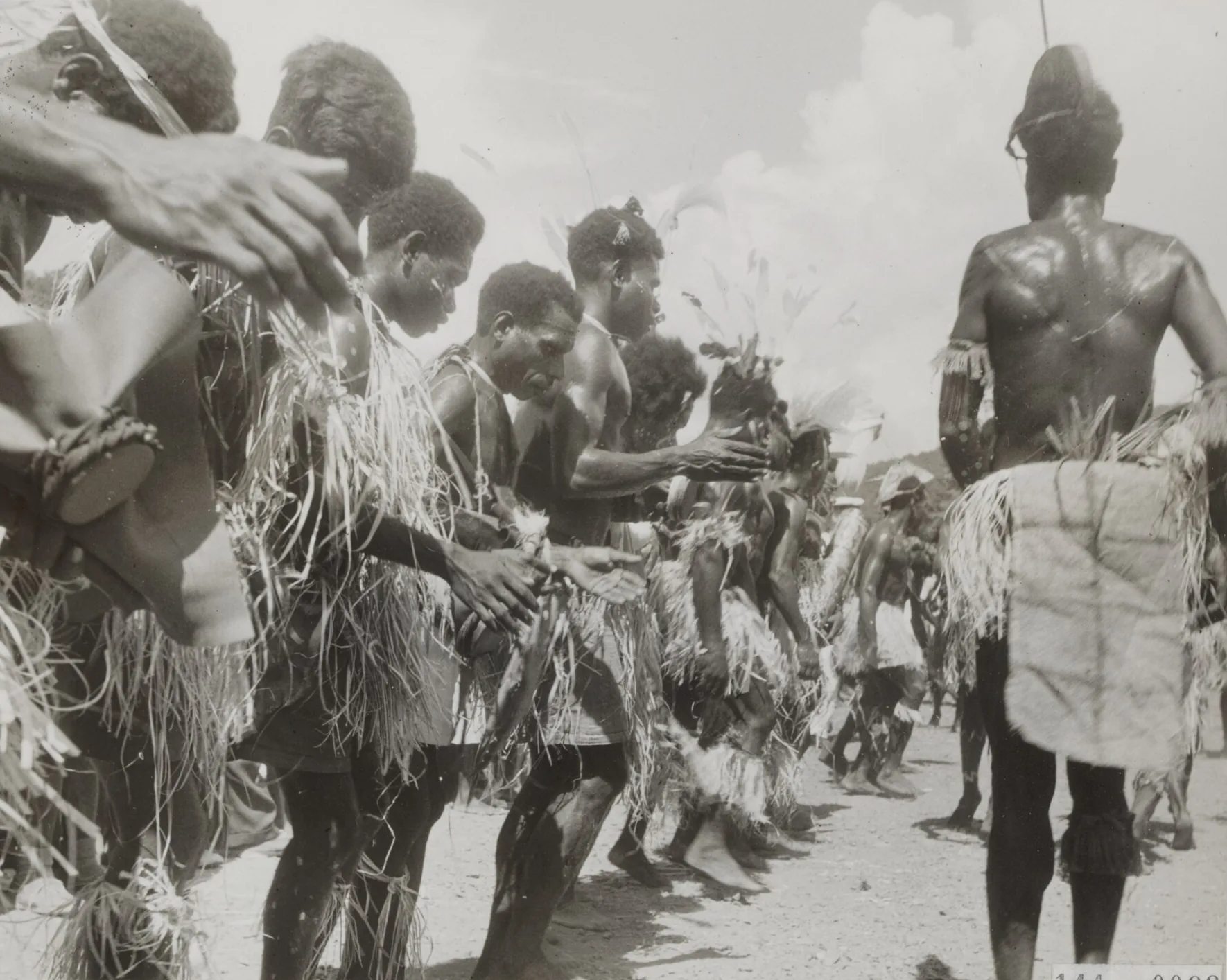
In Nimboran the bird comes at the end of the feast. Once Ndjo has vanished in her cloud of ash, the last dance is the hngari, the bird of paradise. The dancers lift off headdresses heavy with plumes, and the new chief is given the right to wear two birds of paradise, “the bird which dwelt in Semèn with the ancestors” (Kouwenhoven, pp. 32–33). Galis tells the chief's own story the same way. The eram was first a snake himself, “but reborn radiant with two birds of paradise in his headdress” (p. 37). The snake goes into the ground and the bird comes out shining. The men of the central procession wore both at once. His nari-sam headdress, Galis was told, “is the image of the colourful body” of Jawa Nèntëmung, the primal snake, and the birds of paradise stand up out of it (pp. 27, 33).
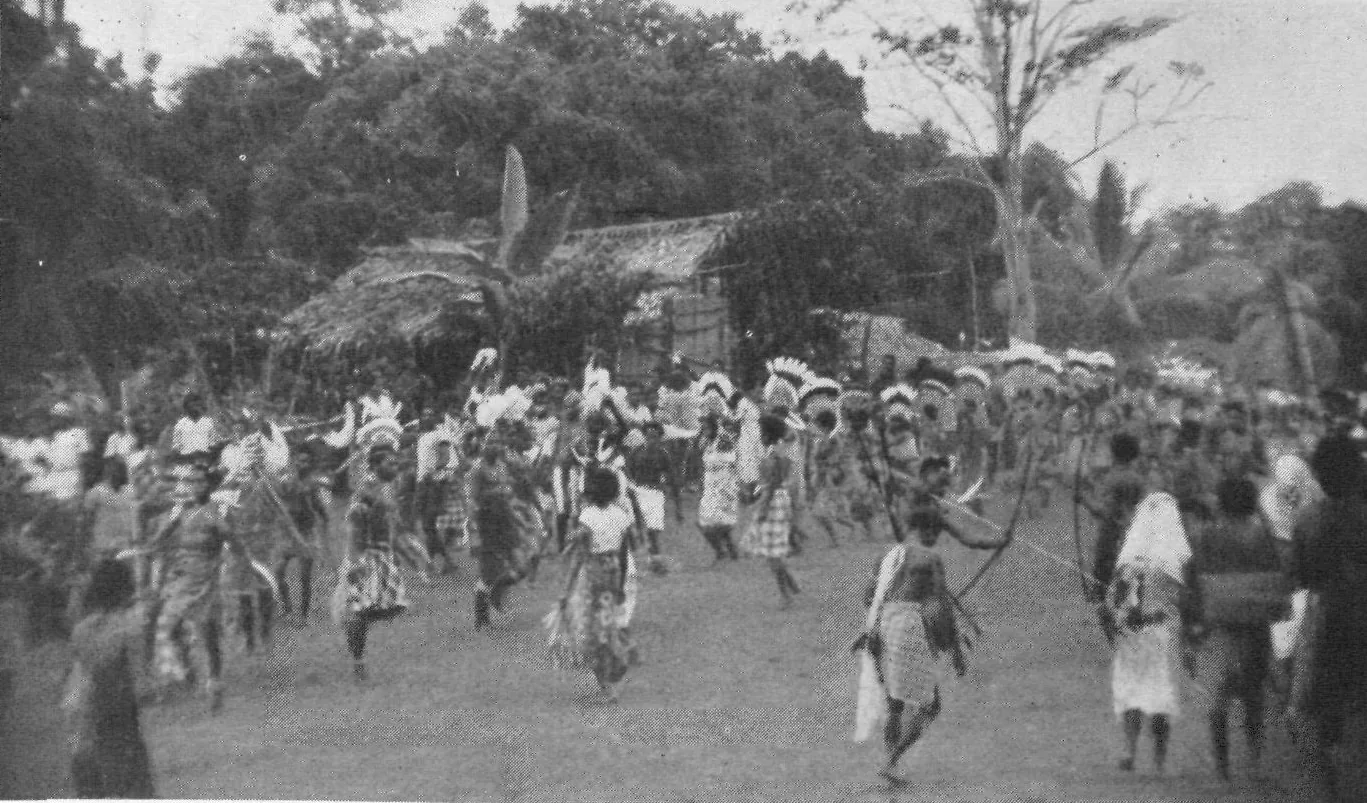
The order of events is the same everywhere. First the serpent Mother holds all life. Then she is killed or sent away, and a bird takes up her voice. Then the men keep it. The Kunapipi men told Berndt plainly what they thought they were doing: “really we have been stealing what belongs to them … all the Dreaming business came out of women” (Berndt 1951, p. 55). The Nimboran have no theft story. Their Mother simply gives the roarer as a gift, along with sex and birth and the making of chiefs. The gift and the theft end in the same place, with a Mother's voice inside a house of men.
One Mother on one drowned continent
New Guinea and Australia were one land for most of human history. Until the seas rose at the end of the last Ice Age, the Arafura Sea and Torres Strait were plains, and a person could walk from the Fly River to Arnhem Land without wetting a foot. Geographers call the old continent Sahul. Its people carried the bullroarer across it, and the roarer still sounds on both of the coasts it joined.
The Mother of All is that tradition at its deepest layer. She is more than a woman who once owned an instrument. She is the being whose body held the world. Her parts recur in the same order on both sides of the water. She is a serpent, or both sexes in one body. She bears or holds all life. She swallows the boys and gives them back as men. She is killed or sent away. A bird or a whirled shell carries her voice. Men keep that voice in a secret house while the women stay away, and the novices come out painted with her blood.
Maddock, looking only at Arnhem Land, drew the conclusion such a pattern demands: “The suspicion that there must be close historical connections between these myths is strengthened” by what the Berndts recorded further east (p. 12). Elmberg found that Ndjo appears in none of the old Nimboran myths. He judged that she reached Nimboran later, and came first only to the house where the boys were initiated before she was set inside the chief's feast-house (Kouwenhoven, p. 35). In Nimboran she was a newcomer. Both coasts point to the same history: the Mother travelled. Fourteen hundred kilometres of land and sea now separate Ndjo's feast-house from Jingana's country, but the sea is young. The Mother is older.
On both sides of the drowned land between New Guinea and Australia, the bullroarer belongs to one figure: a primordial Mother, serpent-bodied or two-sexed, who holds all life inside her and whose voice the roarer carries after she is gone. When the Murinbata men cry “The Old Woman is calling,” and when the Nimboran women shut their doors against the voice in the water-house, they are hearing the same Mother.
Key sources
- K. W. Galis, “Het Eram-feest te Bonggrang (met platen),” Bijdragen tot de Taal-, Land- en Volkenkunde 110 (1954), pp. 20–37, doi:10.1163/22134379-90002389. Bonggrang and the Kemtuk district, p. 20; the snake who makes the earth and vomits the first pair, p. 26; the bisexual Wai-dem, p. 28 n. 8; Bëné and the underworld, pp. 29–30; the archers as “the primal snake Ndjo” and the ash cloud, p. 35; Ndjo, the bullroarer, and snakes as masters of life and death, pp. 35–36; the nari-sam headdress as the snake's body, pp. 27 and 33; the two-sexed rite and the chief as “descendant of the bisexual snake,” p. 37. Photographs from the article's plates. Translations from the Dutch are ours.
- W. J. H. Kouwenhoven, Nimboran: A Study of Social Change and Social-Economic Development in a New Guinea Society (The Hague, 1956). Indjo, the whirled crayfish shell and the water-flutes, p. 31 n. 1; the taboo on crayfish (wap), p. 31; her stay in the jao, the women's seclusion and her departure in ash, p. 32; the bird-of-paradise dance and the chief's plumes, pp. 32–33; Elmberg's view that Indjo came into Nimboran from outside, p. 35. Both Galis and Kouwenhoven draw on J. E. Elmberg's 1949 Nimboran field notes.
- Kenneth Maddock, “Introduction,” in Ira R. Buchler and Kenneth Maddock (eds.), The Rainbow Serpent: A Chromatic Piece (The Hague: Mouton, 1978), pp. 1–21. Berndt's uterus and penis, p. 2; Gunabibi bullroarers as rainbow-serpent symbols, p. 7; Mutjingga and the bird-made bullroarer, after Stanner, p. 11; Jingana and Lumaluma, pp. 11–12; the Gunwinggu Mother and Ngaljod, and “close historical connections,” p. 12. Maddock's own Dalabon account is “Communication and Change in Mythology,” in N. Peterson (ed.), Tribes and Boundaries in Australia (1976), pp. 162–179.
- W. E. H. Stanner, On Aboriginal Religion (1959–63; Sydney University Press ed., 2014). Karwadi, the Mother of All, and the bullroarer as her presence, pp. 4–5; the swallowing, pp. 6–8; Mutjingga as half-woman, half-snake, p. 40 n. 16; the Mutjingga myth, pp. 41–43.
- Ronald M. Berndt, Kunapipi: A Study of an Australian Aboriginal Religious Cult (Melbourne, 1951). The voice of Kunapipi or Mumuna; the men's confession, p. 55; Mumuna's womb, p. 160. Roslyn Poignant, Oceanic Mythology (London, 1967), for Eaglehawk's bullroarer.
- J. van Baal, Dema: Description and Analysis of Marind-anim Culture (The Hague, 1966), pp. 590–597, for the Boazi atu. F. E. Williams, Papuans of the Trans-Fly (Oxford, 1936), pp. 307–308, for Engu and Serekute. A. C. Haddon (ed.), Reports of the Cambridge Anthropological Expedition to Torres Straits, vol. I (1935), pp. 219–220, quoting E. Baxter Riley, for madubu; vol. V (1904), p. 218, for its whirling over the gardens.
- Related essays: Nggwal: The Cult That Crossed Sahul follows the names of the roarer's ancestors across the same drowned plain; The Voice Was Hers and its New Guinea counterpart follow the women who held the sacred voice first.