Atlas Essay —
The Second Cut Is the Deepest
Subincision, the opening of the urethra, belongs to the old continent of Sahul, and there it was cut to the sound of the bullroarer
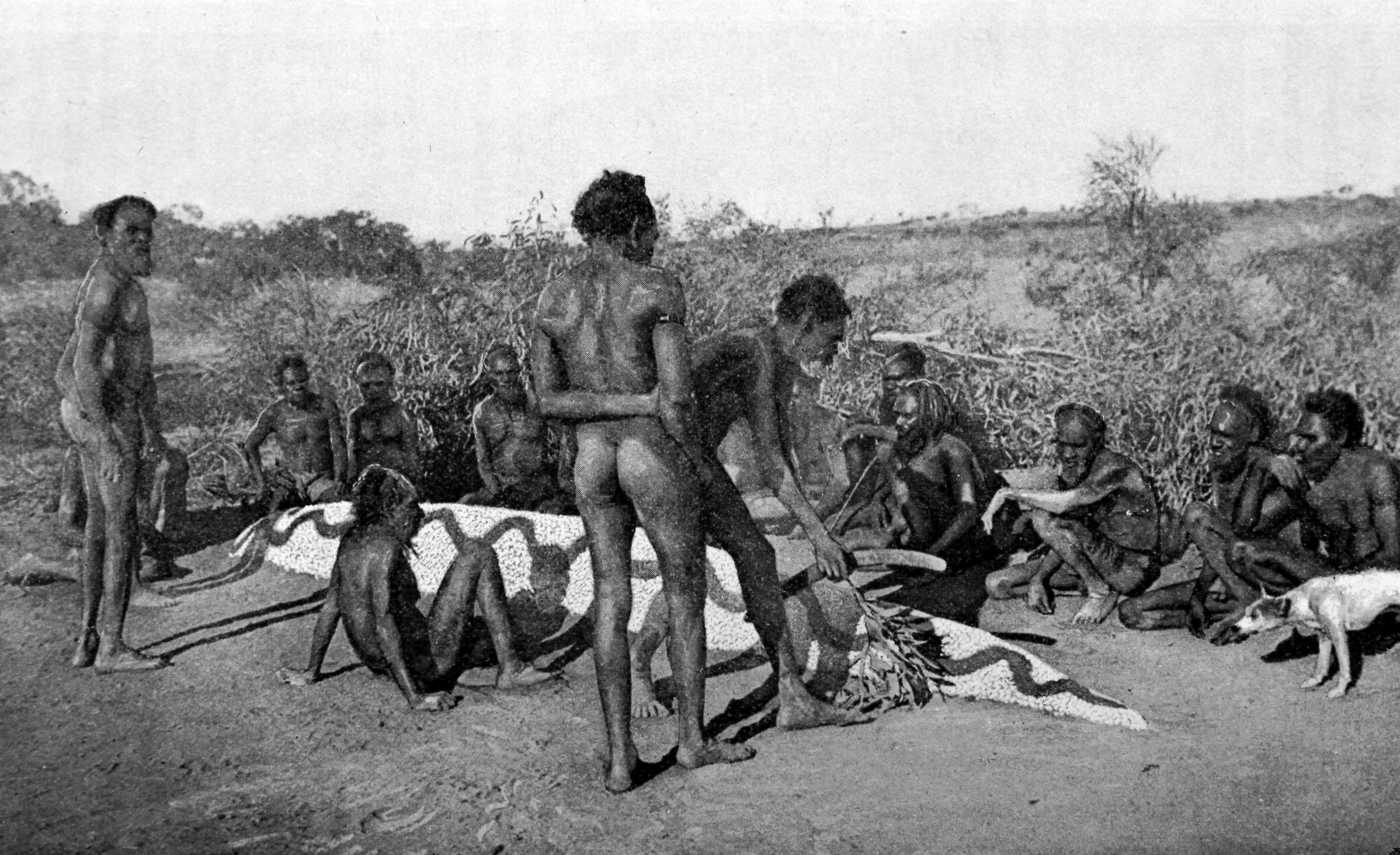
For more than a month in 1901 the Warumungu men at Tennant Creek, in the Northern Territory of Australia, performed the ceremonies of the Wollunqua, the great water-snake who lives in a pool in the Murchison Range. Towards the end the old men built a long mound of earth and painted the snake along it. Then, Baldwin Spencer and Francis Gillen wrote, “the three youths were suddenly seized and told that the time had come when they must be finally admitted to the ranks of the men.” They sat all night with their heads covered while the men sang and danced round the mound and destroyed it. At sunrise the women danced, the first youth was laid across the backs of three men who would be his brothers-in-law, a tassel of his father’s was pressed into his mouth, and a man of his mother’s brother’s class slit open the underside of his penis to the urethra. The blood was caught in a wooden dish (Northern Tribes, 1904, pp. 354–355).
Subincision is the second and deeper cut of initiation: after circumcision, the urethra is laid open along the underside of the penis. It is one of the strangest things people have ever done to themselves, and almost all of it happened in one place. Across Australia, on the north coast of New Guinea and in the islands beyond, whole peoples made the cut, and in Australia and New Guinea they made it in the initiations of the bullroarer. Elsewhere in the world it is a handful of scattered cases, and one of those few belongs to a bullroarer cult too.
In brief
- In central Australia a boy was first circumcised, and five or six weeks later, when he had healed, the urethra was opened from below with a stone knife; no man could marry until he had passed both cuts.
- The opened urethra became a source of blood for the rest of a man’s life, drawn to glue the down of ceremonial designs, to heal the newly cut and to seal oaths of vengeance.
- Sixty-three Australian peoples made the cut, in a band that was still spreading west and south when it was written down; the Bukaua, the Mountain Arapesh and their neighbours on the north coast of New Guinea split the glans.
- In both Australia and New Guinea the second cut belongs to the bullroarer rites: the Anula gave the new man a roarer, the voice of the spirit “who has come to swallow up the boy.”
- Outside Sahul it appears in Fiji and on Espiritu Santo as surgery, among the Samburu of Kenya, in Central America as an offering of blood, and among the Bembe of the Congo, in the Snake grade of a leopard society whose god speaks with the bullroarer.

The second cut
The Warumungu took a boy through two cuts. The first was circumcision, made in the dark to the roar of the bullroarer, the murtu-murtu, which the boy heard behind him (Spencer and Gillen 1904, pp. 351–352). “When he has recovered from the operation,” Spencer and Gillen wrote, “it is customary to perform that of subincision or parra within the course of the next month or two” (p. 354). The Arrernte of Alice Springs kept the same order. “As a general rule there is an interval of about five or six weeks between the ceremony of Lartna and that of Ariltha,” circumcision and subincision, “and it depends simply upon the length of time occupied by the recovery of the boy from the effects of the first operation” (Spencer and Gillen 1899, p. 251). The second cut was held “of at least equal importance with that of circumcision,” and the women, who took part in the first, were shut out of it (p. 252).
It was the last cut. When it was over, the elder brothers tied on the new man’s pubic tassel and told him that “he had no more operations to fear” (p. 256). Through the Centre and the north, Spencer found, “no man in any of the tribes in which these rites are practised is allowed to take a wife until such time as he has been both circumcised and subincised” (Native Tribes of the Northern Territory, 1914, p. 22). A man became a man in two operations, and the second went deeper.
What the knife did
Spencer and Gillen watched the Arrernte ariltha at dawn after a night of totem ceremonies. Two men lay one on top of the other to make a living table, and the youth was laid on his back across them:
As soon as ever he was in position another man sat astride of his body, grasped the penis and put the urethra on the stretch. The operator … then approached and quickly, with a stone knife, laid open the urethra from below.
Baldwin Spencer and F. J. Gillen, The Native Tribes of Central Australia (1899), pp. 255–256
The new men squatted over shields while the blood drained into them. Among the Kaytetye, to the north, the penis was “at once slit along its length with a stone-knife” (Spencer and Gillen 1904, p. 342). In north-west Queensland Walter Roth watched the cut made in two strokes: a first “superficial incision, through skin only, extending from the external meatus down to near the scrotal pouch,” and then a deeper one (Roth 1897, p. 178). The cut runs the whole length of the underside, from the tip of the penis to the scrotum, and leaves the urethra an open channel.
The wound did not end with the healing. For the rest of his life a subincised man carried a source of blood that he could open at will. The blood that fixed the bird’s down to the bodies of dancers in the sacred ceremonies was drawn “either from the arm or from the subincised urethra,” and when it came from the urethra “nothing is done to stop the flow, which appears to cease when the pressure applied by the hand to open out the subincision is removed” (Spencer and Gillen 1904, pp. 596–597). Among the Warumungu, a few days after a youth had been subincised, the older men drew blood from their own subincised urethras in front of him, “to promote the healing of the youth’s wound and to strengthen him generally” (p. 599). Arrernte men setting out to avenge a death “drew blood from their urethras and sprinkled it over one another” (p. 598).
The people who did this gave no reason for it. “So far as I have been able to discover,” Spencer wrote, “the natives have no idea whatever as to the meaning of these customs” (1914, p. 22). It was simply what made a man, done in the presence of the totem ancestors whose ceremonies filled the nights before, and repeated in blood whenever the ceremonies came round again.
The old continent
Sixty-three Australian peoples are recorded opening the urethra. They fill a broad band from the Kimberley and the Pilbara across the Centre and the Western Desert to the Gulf of Carpentaria, western Queensland and the head of the Great Australian Bight. Spencer and Gillen concluded that circumcision and subincision had come to the Centre “at a later time, and again from the north,” over an older rite of knocking out a front tooth that the south-east kept (1904, p. 18). When Norman Tindale mapped the continent tribe by tribe, the band was still moving. The Wajarri of the Murchison, on the west coast, “had been actively proselytizing their rites of circumcision and subincision” to the people near the river mouth (1974, p. 144). The Nyamal of the Pilbara “circumcise but make only a token subincision of the glans sufficient to be regarded as ‘men’ by the invading peoples from the east” (p. 253). The Jadliaura of the Flinders Ranges took circumcision “but resisted the introduction of the further rite of subincision” (p. 211).
Wherever the second cut went, the bullroarer was already sounding, and in its own rite the roar comes back. Among the Anula (Yanyuwa) on the Gulf of Carpentaria, the boy was subincised, and then:
When all was over the boy was presented with a sacred stick (bull-roarer) called mura-mura and told that it was made, in the first instance, by the whirlwind; that it was kurta-kurta (tabooed), and must on no account be shown to women or children, who think that its roaring is the voice of a great spirit called Gnabaia, who has come to swallow up the boy.
Baldwin Spencer and F. J. Gillen, The Northern Tribes of Central Australia (1904), p. 373
The Kaytetye father gave his newly cut son a churinga, and the last instruction the youth received as a man was to keep the roar going: “While out in the bush he must be sure to make the bull-roarer swing, or else another arakurta, who lives up in the sky, will come down and carry him away” (Spencer and Gillen 1904, p. 343). In the Western Desert the Antakirinya told Ronald Berndt that the first bullroarer was made for the first subincision: two iguana ancestors swung it, then cut each other (Berndt 1941, pp. 7–10). In every Australian account full enough to follow the whole course of initiation, from the Warumungu and the Arrernte to the Diyari of Lake Eyre, the bullroarer sounds in it.
| Where | Peoples opening the urethra | Bullroarer held | Bullroarer in the rite of the cut |
|---|---|---|---|
| Australia | 63 | 33 | 6 |
| New Guinea | 5 | 4 | 2 |
| Fiji and Espiritu Santo | 2 | 2, as toys | — |
| Africa | 2 | 1 | — |
| Central America | 2 | — | — |
Australia and New Guinea were one continent, Sahul, until the sea rose over the land between them at the end of the Ice Age. Across the atlas the same rites keep turning up on both sides of the drowned shelf, and the bullroarer with them. The second cut is one more of them.
New Guinea and the islands
On the Huon Gulf, on the north-east coast of Papua New Guinea, the boys were swallowed by a monster whose voice was the bullroarer and whose bite was the circumcision, the “kani-tooth.” When a boy bled to death the men said the spirit had kept him in its stomach, and Georg Bamler, the missionary who wrote it down, explained why: “the Bukaua and a part of the Jabim also split the glans” (Neuhauss 1911, p. 496). Johann Stössel, a missionary doctor on that coast from 1910 to 1922, saw many men whose whole glans had been split in two (Feist 2005, p. 162). Far up the same coast, between the Sepik River and Aitape, the government anthropologist E. W. P. Chinnery recorded the Mountain Arapesh initiation in 1924:
Bull-roarers (waleg), reed pipes (walias), and other noise-producing instruments connected with ghosts (sagabi), are used. The penis of the boy is incised by inserting a cassowary bone into the orifice for about half an inch and then forcing it upwards until the top of the glans penis is split.
E. W. P. Chinnery, Report of the Government Anthropologist (1925), pp. 11–12
Their neighbours did the same. At Yangoru “a sharp object such as a cassowary bone was used to split open the glans from the urethral end,” at a stream, to sever the boy’s ties to his mother (Manineng et al. 2017). Up the Sepik among the Oum, a man named Yenak, initiated in 1952, remembered cutting grass forced into the opening of his penis, a bamboo knife cut into the glans, and nettles after: “The urine came out of the incisions made until the wound healed” (Bragge, Sepik 1, pp. 409–411). In the Eastern Highlands the Awa made “deep, half-inch-long gashes that occasionally penetrate the urethra” (Newman and Boyd 1982). Other Sepik peoples bled the urethra from inside: the Banaro, in a seclusion “connected with the bull-roarer,” pulled barbed stems through it “so that the walls of the passage are cut” (Chinnery 1925, p. 10), and at Ilahita men made “multiple (up to 30) insertions of a barbed stem into the urethra” (Tuzin 1973, p. 252, n. 10).
Further out, in island Melanesia, the cut survived without its rite. On Espiritu Santo, in northern Vanuatu, a French colonial surgeon writing as Jacobus X examined a man with “an artificial hypospadias, made at puberty”: with a sharpened piece of quartz “the urethra is split from the glans to the root of the scrotum,” on subjects the chief designated (1893, p. 333). In Fiji the colony’s Chief Medical Officer, Bolton Corney, described taya ngalengale, “incising the urethra at its meatus to a point just behind the frænum preputii,” and drew the difference from Australia himself: “The Australian lays open the urethra and leaves it so once for all, whereas the Fijian expects the edges of his incision to re-unite” (1890, pp. 648–649). The Fijians used it as a cure. On both islands the bullroarer was a child’s toy (Speiser 1923, pp. 380–381; Fison 1885, p. 22). The cut and the roar had come apart there, and both outlived the rite.
Almost nowhere else
Beyond Sahul and its islands the second cut is almost unknown. Among the Samburu of northern Kenya, boys of about six to ten made a subincision of the urethra, which, Paul Spencer was told, prevented a narrowing and difficulty in passing water (Spencer, Samburu Notions of Health and Disease, p. 2; Weisz 1972, p. 329). In Central America the cut belonged to grown men and the gods. In 1576 Diego García de Palacio reported that a chief of Gotera, in eastern El Salvador, “had his member split and open, which was one of the heathen customs that the bravest used in former times,” and that in 1563 at Ceçori a man split his own member while four boys were circumcised and their blood offered to a round stone idol. A century later the friar Delgado saw the Chol of the Manché, in the forests of Guatemala, “take out the member and split it in three parts, the largest left in the middle, about two fingers long, saying spells” (Caso Barrera 2015, p. 642). That is the whole of it outside Sahul, but for one more people.
The Bembe of South Kivu, in the eastern Democratic Republic of the Congo, were ruled by the leopard society Bwamè, whose god Tembwe roars with the voice of the bullroarer, “the god-bullroarer with the leopard’s growls” (Gossiaux, p. 89). Its grades climbed through animals, and the third was Ngyo’a, the serpent. A knife called mwele, Pierre-Paul Gossiaux recorded, was used to cut the Snake-Men, and “first served to subincise the candidate for the grade of Ngyo’a” (p. 68); a carved figure of the society has its tip notched, “recalling a form of subincision that certain Snake-Men must undergo” (p. 27).
Of the very few peoples outside Sahul known to have opened the urethra, one did it to its Snake-Men, inside a cult whose god speaks with the bullroarer. In Australia the Warumungu made the same cut at the close of the great snake’s ceremonies, and the Anula gave the new man the roarer. Chance or connection, it is a striking match. Of the handful of outliers, the one that cut in ritual did it beside a snake and a roar, as the Warumungu and the Anula did on the other side of the world.
Key sources
- Spencer, B. and Gillen, F. J. 1904. The Northern Tribes of Central Australia. London: Macmillan. Circumcision and subincision “again from the north,” p. 18; the Wollunqua mound, Figs. 76–77, pp. 235–236; Kaytetye, pp. 342–343; Warumungu, pp. 351–355; Anula, p. 373; blood from the subincised urethra, pp. 596–599.
- Spencer, B. and Gillen, F. J. 1899. The Native Tribes of Central Australia. London: Macmillan. The Arrernte ariltha, pp. 251–256.
- Spencer, B. 1914. Native Tribes of the Northern Territory of Australia. London: Macmillan. Circumcision, subincision and marriage, pp. 21–22; the subincising tribes, pp. 90–91.
- Roth, W. E. 1897. Ethnological Studies among the North-West-Central Queensland Aborigines. Brisbane: Government Printer. Pitta Pitta “introcision,” pp. 177–178.
- Berndt, R. M. 1941. “Tribal Migrations and Myths Centring on Ooldea, South Australia.” Oceania 12 (1). The Antakirinya first bullroarer and first subincision, pp. 7–10.
- Tindale, N. B. 1974. Aboriginal Tribes of Australia. Berkeley: University of California Press. Wajarri, p. 144; Jadliaura, p. 211; Nyamal, p. 253; and the tribe entries passim.
- Bamler, G. 1911. “Tami.” In R. Neuhauss, Deutsch Neu-Guinea III. Berlin: Reimer. The kani’s tooth and the split glans, p. 496.
- Feist, W., ed. Johann Stössel’s New Guinea memoir (manuscript of 1955). Natur und Mensch 2004 (printed 2005), pp. 147–182. The split glans, p. 162.
- Chinnery, E. W. P. 1925. Report of the Government Anthropologist. In Report to the League of Nations on the Administration of the Territory of New Guinea, 1923–24. Banaro, p. 10; Mountain Arapesh, pp. 11–12.
- Manineng, C. M., et al. 2017. “Re-Establishing Safer Medical Circumcision-Integrated Initiation Ceremonies for HIV Prevention in a Rural Setting in Papua New Guinea.” PLOS ONE 12 (11). Yangoru-Saussia glans splitting.
- Bragge, L. W. Sepik 1. Oum initiation, pp. 409–411.
- Newman, P. L. and Boyd, D. J. 1982. “The Making of Men: Ritual and Meaning in Awa Male Initiation.” In G. H. Herdt, ed., Rituals of Manhood. Berkeley: University of California Press. Awa penile cutting; the bullroarers, n. 11.
- Tuzin, D. F. 1973. “Ritual Violence among the Ilahita Arapesh.” Ilahita urethral bleeding, p. 252, n. 10.
- Jacobus X. 1893. L’Amour aux colonies. Paris: Isidore Liseux. The Santo operation, p. 333.
- Speiser, F. 1923. Ethnographische Materialien aus den Neuen Hebriden und den Banks-Inseln. Berlin: Kreidel. Santo toy bullroarer, pp. 380–381.
- Corney, B. G. 1890. “On Certain Mutilations Practised by Natives of the Viti Islands.” Report of the Second Meeting of the Australasian Association for the Advancement of Science, pp. 646–651. Taya ngalengale, pp. 648–649.
- Fison, L. 1885. “The Nanga, or Sacred Stone Enclosure, of Wainimala, Fiji.” Journal of the Anthropological Institute 14. The toy bullroarer, p. 22.
- Spencer, P. Samburu Notions of Health and Disease. The boys’ subincision, p. 2.
- Weisz, J. R. 1972. “East African Medical Attitudes.” Samburu ventral urethral cut, p. 329.
- García de Palacio, D. 1576. Carta dirigida al rey de España. Gotera and Ceçori.
- Caso Barrera, L. 2015. Delgado’s account of the Chol of the Manché (1677), p. 642.
- Gossiaux, P.-P. Le Bwamè du Léopard des Babembe (Kivu-Congo). Authored digital edition. Tembwe, p. 89; the notched figure, p. 27; the mwele knife and the Snake-Men, p. 68.