No. MUS2026-015
Mushuau Innu notched bone roarer
Canada · Labrador · North America · Subarctic
Weather / fertility magic
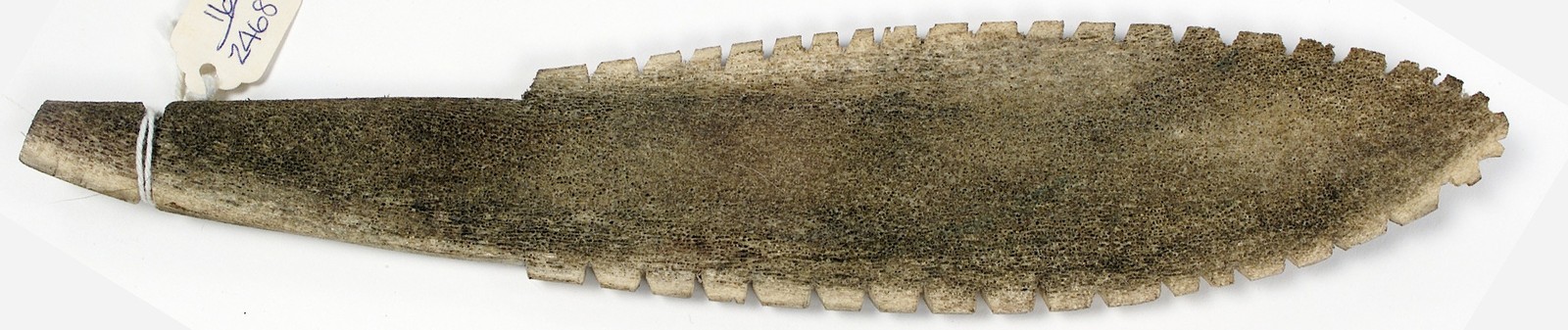
Source term: bull-roarer
A bull-roarer carved and notched from animal bone, collected among the Mushuau Innu — the Barren Ground Naskapi, caribou hunters of interior Labrador — by the anthropologist Frank G. Speck, who sold it to the Museum of the American Indian in 1928. Across the belt of Algonquian country running west from the Naskapi and Montagnais homeland on the St. Maurice River to the Albany River, John M. Cooper found in 1928 the bull-roarer doing the same job wherever he went: whirled, together with a buzzer and a snowman built of snow, to bring the cold north wind. Neighbouring Cree at James Bay used it for exactly that, to harden a crust on the late-winter snow for easier travel by snowshoe and toboggan — the likeliest thing this Naskapi bone blade was swung for too.
To bring the north wind, the buzzer, the bull-roarer, and the snow man are resorted to.
John M. Cooper, 'Field notes on northern Algonkian magic and divination,' Journal of the Washington Academy of Sciences 18(8) (1928), p. 230
Particulars
- Object
- Bull-roarer of the Mushuau Innu (Naskapi), carved and notched from animal bone; collected by Frank G. Speck and purchased from him by the Museum of the American Indian in 1928 (NMAI 16/2468).
Sources
- Smithsonian National Museum of the American Indian, object NMAI_174189, ark:/65665/ws6d95118df View · archived
- Lucien M. Turner, Ethnology of the Ungava District, Hudson Bay Territory, 11th Annual Report of the Bureau of Ethnology (1894)
- John M. Cooper, “Field notes on northern Algonkian magic and divination,” Journal of the Washington Academy of Sciences 18(8) (1928), p. 230