No. MUS2026-048
Konyak ma, swung to call rain
Nagaland (Mon), NE India · South Asia · Northeast India
Weather / fertility magic
Ma
Source term: bull-roarer
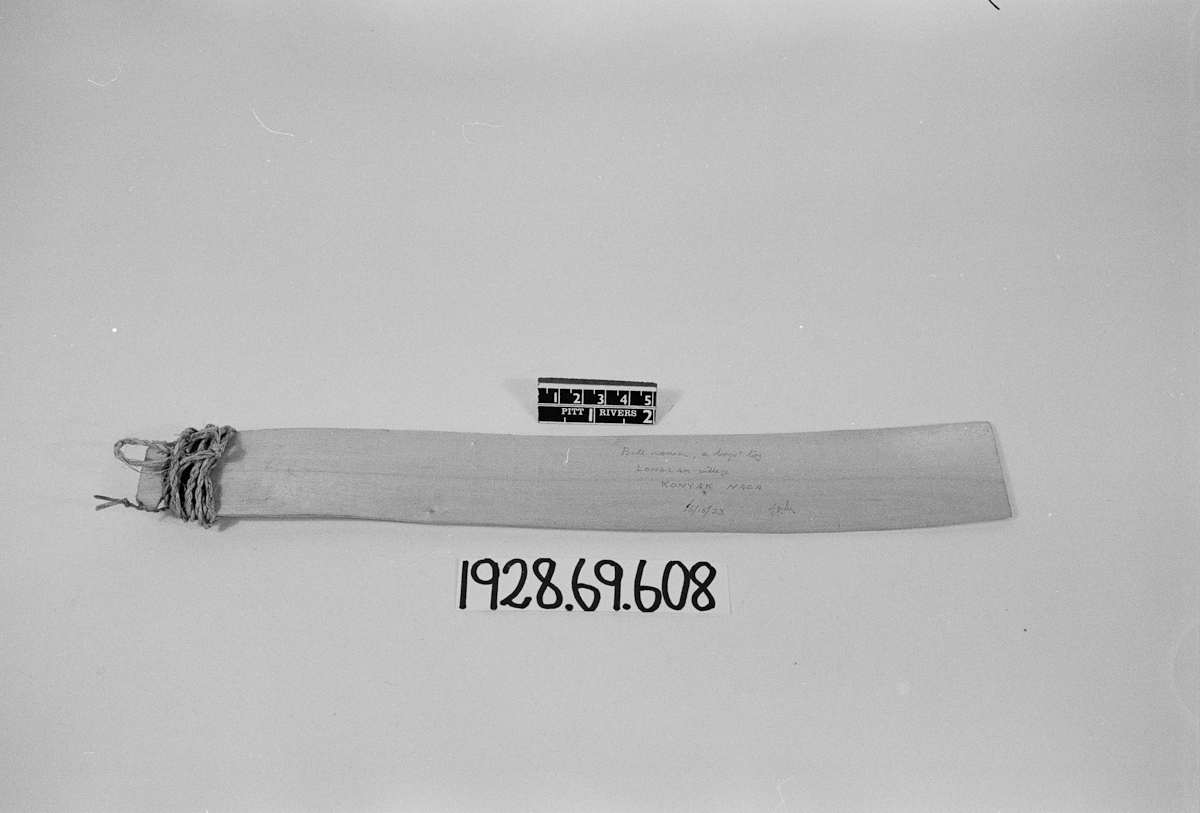
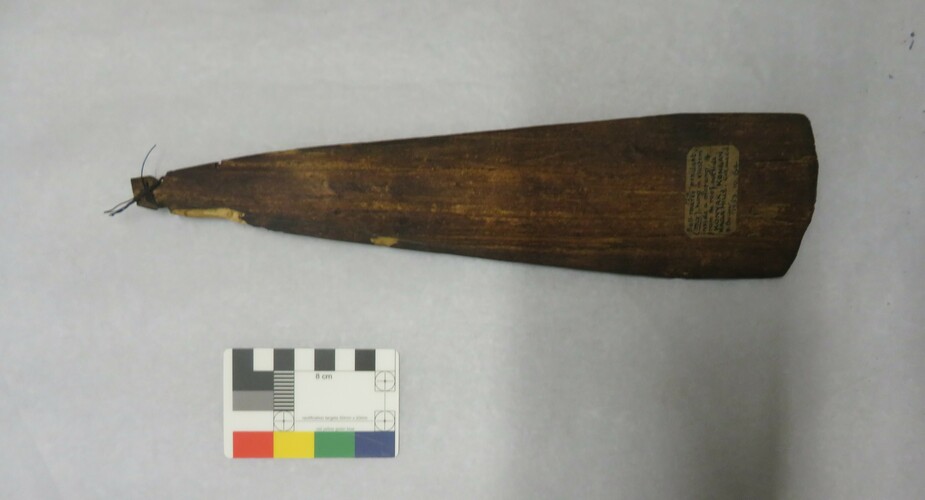
Konyak boys swung bullroarers to call rain, sending a wooden voice into the weather above their fields. J. P. Mills collected two in October 1923 that survive with their notes: one from Shiong, a blade with cane handle, notches and incised decoration, set down as "A boy's toy now becoming obsolete"; one from Tamlu, cut in the shape of a fish-tail and swung by boys to bring rain. A third, long and slender, came from Longlam. Among the neighbouring Angami, a Khonoma bullroarer served as a toy and to scare birds from the crops.
Bull-roarer used by boys as a toy to bring rain, resembling a fish-tail (if the 'fork' were deeper the roarer would split).
Cambridge Naga Database (Exploratour), Konyak bull-roarer, Tamlu, coll. J.P. Mills 16.10.1923 (Pitt Rivers Museum 1928.69.609)
Particulars
- Object
- Bull-roarer of the Konyak Naga, Pitt Rivers Museum, Oxford (acc. 1953.10.64; Henry Balfour coll.). PRM 1928.69.608 is a second Konyak blade, from Longlam, 363 x 51 mm, collected in October 1923.
- Function
- Konyak boys swung such blades as toys to bring rain.