No. STEWART1941-001
Wadatika wind-making bullroarer
United States · Harney Valley and Malheur Lake, southeastern Oregon · North America · Great Basin
Weather / fertility magic
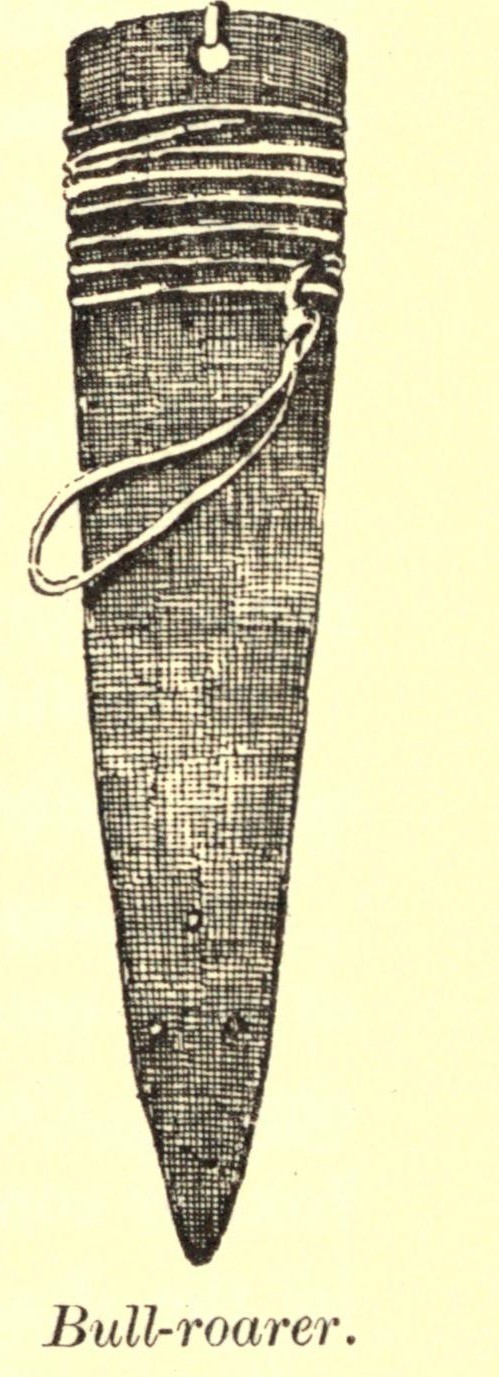
wimo'to
Source term: bull-roarer (wimo'to)
wimo'to: the Northern Paiute word for the bullroarer.
To make the wind blow, Wadatika men whirled a wooden bullroarer — and it was no toy, said Scarface Charlie and Blind Jim, the two elders Omer Stewart interviewed at Burns. A story told by Captain Louey Crook, a Wadatika narrator recorded by the frontier physician W. L. Marsden, is probably this instrument at work. Snow lay waist deep and the people were starving; a thaw-conjurer stood inside a ring of men and women, praying the south wind and the black and yellow pointed clouds into the valleys — then 'he whirled the conjuring stick and made the thaw come. It made a good noise.'
Yes, you who has a tule quiver! Come and see me and bring the wind!
Wadatika text of Captain Louey Crook, in Heizer (ed.), Notes on Northern Paiute Ethnography (1972), Doc. 52, p. 50.
Particulars
- Object
- Wooden bullroarer; no dimensions or surviving object recorded.
Source
Omer C. Stewart, 'Culture Element Distributions: XIV, Northern Paiute,' Anthropological Records 4:3 (1941), pp. 365, 401 and 403; R. F. Heizer (ed.), Notes on Northern Paiute Ethnography: Kroeber and Marsden Records (1972), pp. 49-50