No. EA-KURAWA-001
Kurawa site
Kurawa site, Hachijo Island, Tokyo, Japan · East Asia
Function not recorded Candidate only
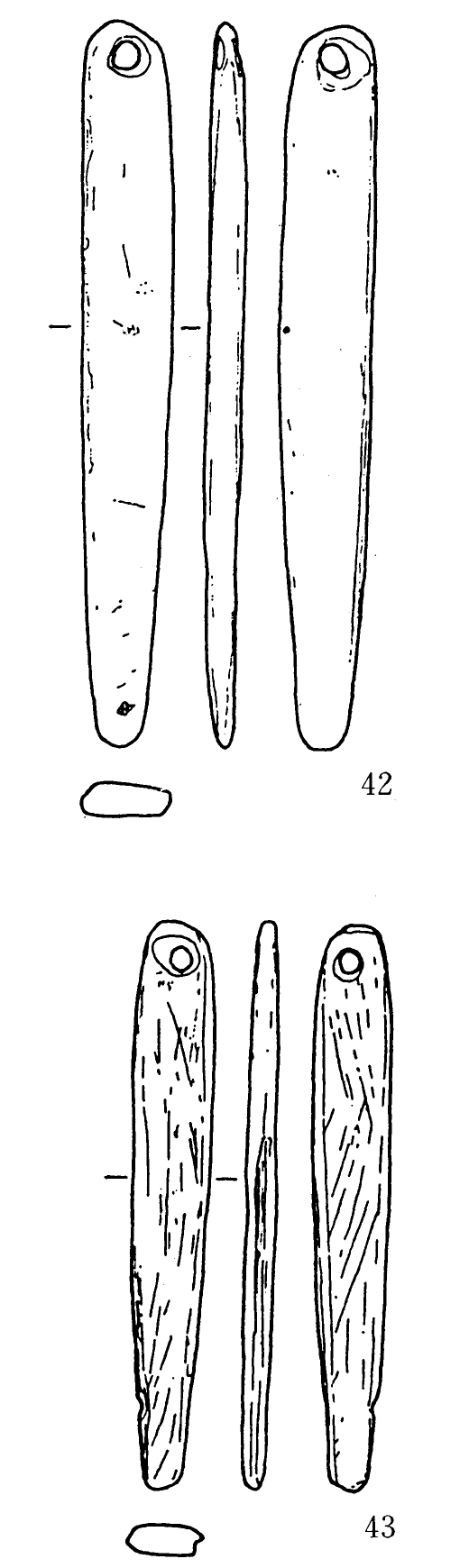
ヘラ状垂飾
Source term: ヘラ状垂飾; 棒状垂飾; hera-shaped pendant; rod pendant; spatula-shaped pendant
ヘラ状垂飾 (hera-jō suishoku): 'spatula-shaped pendant'
On Hachijōjima, three hundred kilometres of open water south of Honshu, the Kurawa site produced burials among its Jōmon houses — and by the back of the skull of an adult woman lay two long stone rods, each pierced through the top. Fujita Fujio made pieces like these the type specimens of his 'hera-shaped pendant' class and read them as hairpin-like hair ornaments, an interpretation the burial position supports handsomely. Kurawa is the strongest case for the ornament reading in the Japanese series: here, for once, the context argues the function. That the stone appears to belong to the hard-jade group, ferried to a volcanic island far from any source, marks the objects as valued; what they were valued as, this grave actually answers.
Particulars
- Object
- Two long, slender stone rods, each pierced once at the top, of stone assigned to the hard-jade group. They lay in a grave pit near the back of an adult woman's head. Terminal Early to initial Middle Jōmon.
- Function
- Published as hair ornaments of the hairpin type (Fujita); found where a hairpin would sit, at the back of the head.
Source
Aomori Prefectural Buried Cultural Property Center, Research Bulletin (研究紀要) 4, Fig. 5 nos. 42-43; Kurawa site excavation reports (1986, 1987, 1994)