No. EA-SANNAI-MARUYAMA-TANZAKU-001
Sannai-Maruyama poem-card pendants
Aomori, Japan; Sannai-Maruyama site, Jomon · East Asia
Function not recorded Candidate only
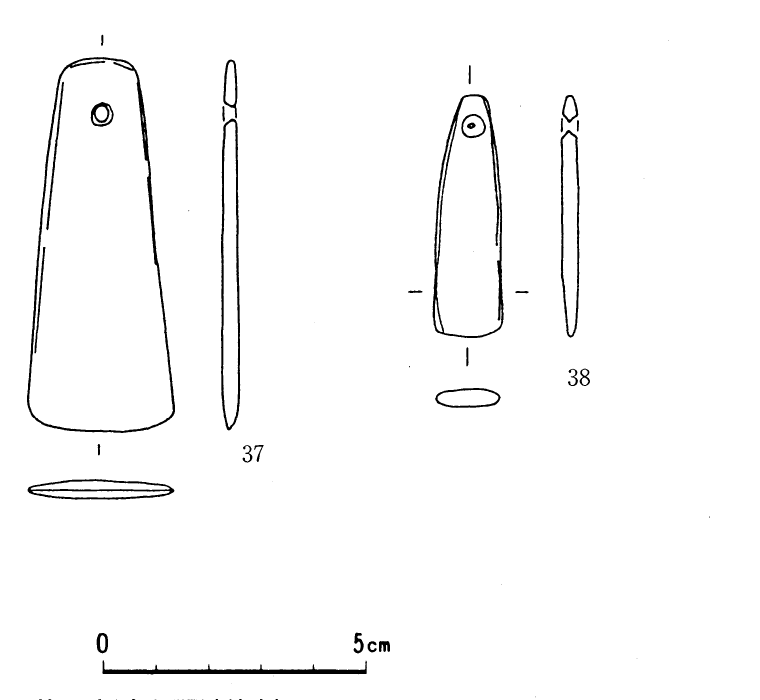
短冊形垂飾品
Source term: 短冊形垂飾品; 石製垂飾品; rectangular/stone pendant; serpentinite pendant
短冊形垂飾品 (tanzaku-gata suishokuhin): 'short-rectangular pendant', literally 'poem-card-shaped pendant'
Sannai-Maruyama produced a pair of flat serpentinite tablets that the specialists could not comfortably name. They resemble the rod-shaped pendants of the slit-earring horizon in their single upper hole and elongated form, but both ends are broad and straight, so an Aomori research bulletin coined a provisional label: tanzaku-gata, 'short-rectangular pendants,' after the paper strips poems are written on. Fujita Fujio, who named the related hera-shaped class, read such pieces as hairpin-like hair ornaments; the bulletin suggests these were pendants, sometimes worn as a set with the site's slit earrings. Cut from the same serpentinite as those earrings and — by figure scale — only three or four millimetres thick, the larger tablet is, in outline and section, as close to a miniature bullroarer as anything in the Jōmon record. Its exact phase is unknown even to its publishers, and no measurements have ever been printed.
仮りに「短冊形垂飾品」と呼称するが、棒状垂飾とは上部の1孔と細長い点が類似している。
I provisionally call them 'short-rectangular pendants'; they resemble the rod-pendants in their single upper hole and elongated form.
Aomori Prefectural Buried Cultural Property Center, Research Bulletin no. 4, on Fig. 4 items 37–38
Particulars
- Object
- Two flat serpentinite tablets, each pierced by a single hole near the upper end. By the published figure's scale, the larger is about 7.0–7.4 cm long, 2.8 cm at its widest and 0.3–0.4 cm thick, with a centred hole near its end and a thin, even profile; the smaller is about 4.6 cm long and 1.2–1.6 cm wide. Four other stone pendants from the site, 4.1 to 7.8 cm long, carry the same single upper hole.
- Function
- Published only under a provisional name, 'short-rectangular pendants', a label that leaves the function open; Fujita Fujio read the related hera-shaped class as hairpin-like hair ornaments. Thin and holed at one end, the larger tablet has the proportions of a whirled blade.
Source
Aomori Prefectural Buried Cultural Property Center, Research Bulletin (研究紀要) 4, Fig. 4 items 37-38