No. EA-MIKAMINE-268
Mikamine site no.268 slate pendant
Sendai, Miyagi, Japan; Mikamine site no. 268 · East Asia
Function not recorded Candidate only
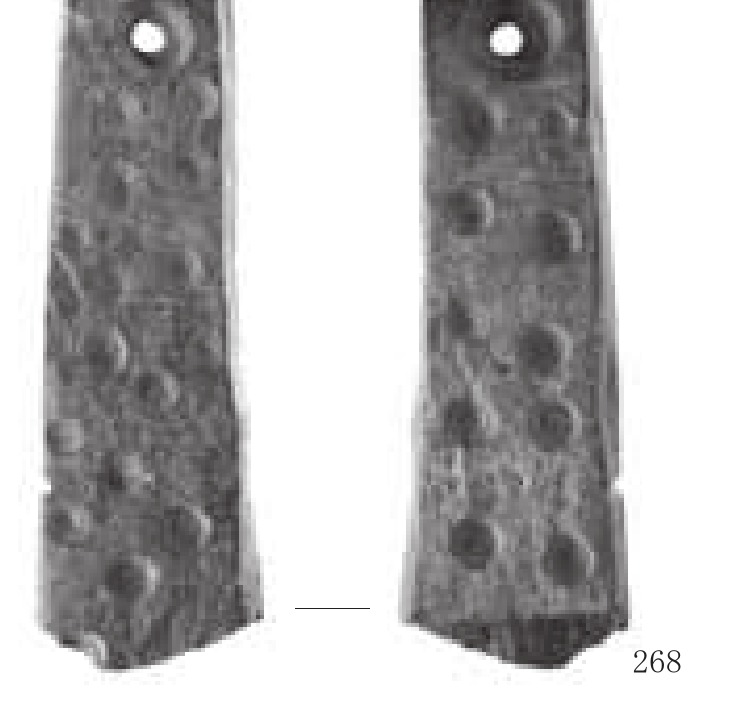
垂飾品
Source term: 垂飾品; slate pendant; perforated slate plate; drilled pendant
垂飾品 (suishokuhin): 'pendant'
Twenty half-started holes pock one face of this thumb-length slate plate, ten more the other — drill after drill sunk and then abandoned before a single one broke through. Only the topmost hole was ever finished, bored from both sides, and one edge carries a worn groove as though a cord had once ridden there. Then the lower end snapped off. Some hunter-gatherer of the Early Jōmon, in a settlement near Sendai roughly 5,700 years ago, made and remade this small thing obsessively; whether it was hung to be seen, swung to be heard, or simply worried at by restless hands, the object itself no longer says.
Particulars
- Object
- A small slate plate, 59 × 19 × 6 mm and 13.1 g, with polished faces and edges. One hole at the top is drilled through from both sides; twenty unfinished drill-pits mark one face and ten the other, and the left edge carries a polished groove. The lower end is broken off. From an Early Jōmon settlement layer of the Ōki 1–2a phase.
- Function
- Published as an Early Jōmon slate pendant.
Source
Sendai City Board of Education, Mikamine site, 6th excavation report (2009), p. 50, fig. 42 and table, no. 268