Atlas Essay ·
Isolation by Deletion
Geneticists remove the New Guinea ancestry from Aboriginal genomes, then report that Australia was isolated
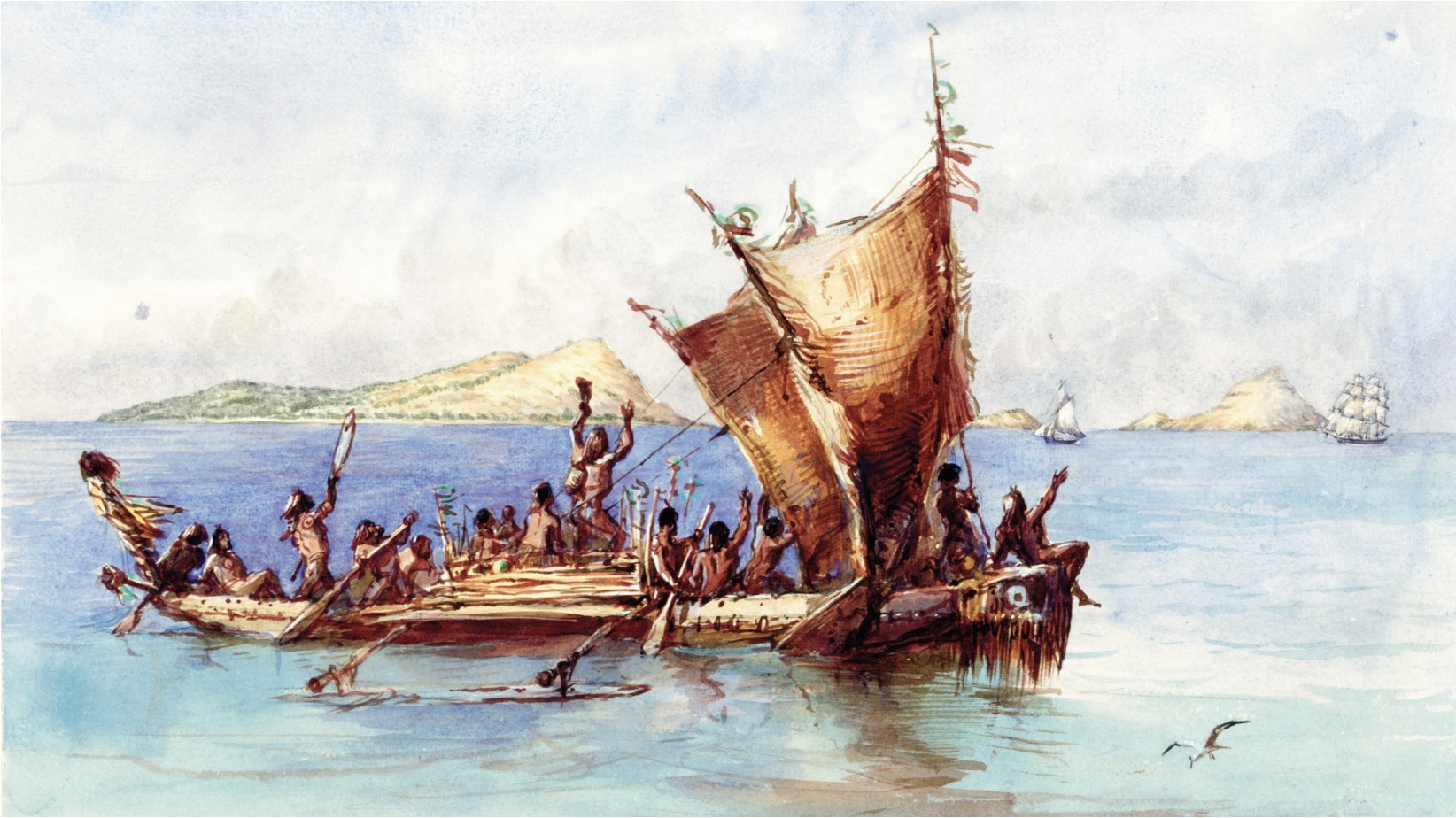
Some time before Europeans settled far north Queensland, a man was buried in the Mulgrave district, south of where Cairns now stands. His skull ended up in the Queensland Museum, catalogued as PA86. In 2018 geneticists read his DNA to work out which country his remains should go home to, and found that about 13 per cent of his ancestry was Papuan. The living people of the same coast carry the same share, and Aboriginal people right across the continent carry some of it. The question is when it arrived.
Dating New Guinea ancestry in Aboriginal genomes is a routine test, and Australian geneticists hold the genomes to run it. Instead they take the New Guinea ancestry out before they analyse, report that Australia was isolated, and call whatever they cannot remove “Pleistocene.”
In brief
- A man buried at Cairns before Europeans arrived was about 13 per cent Papuan, and so are the living people of the same coast.
- Geneticists have dated mixtures from a clock in the DNA since 2011, back thousands of years and now from a single person. High-quality genomes from Cairns, Weipa and Yarrabah have been sequenced for years. None has been dated with it.
- Before analysing, the studies take the New Guinea out. The Cairns study cut its modern comparison genomes down to Aboriginal-only DNA; a survey of mothers’ lines removed the lineages “of assumed New Guinean origin”; the largest study dropped Tiwi Islanders for “substantial recent admixture with PNG.”
- Then they report “long-term genetic isolation” and “no evidence for subsequent introgression events by people from outside Australia (except New Guinea).”
- The one date ever fitted came out recent: New Guinea mixing at Cairns and Weipa about four to seven hundred years ago, from a method blind beyond fourteen hundred. The same paper’s best model was “continuous” gene flow from Papua.
- In 2021 a Griffith University team printed “Pleistocene” for the Cairns ancestry, and conceded in the next sentence that the genomes had been “not fully used” to test for later mixing.

Thirteen per cent
The study that tested the Cairns man was about sending the dead home. Joanne Wright and her colleagues at Griffith University sequenced ten ancient Aboriginal genomes to show that DNA could tell which country a set of remains belonged to. In the middle of that work they found New Guinea in a grave at Cairns, and gave it two sentences:
“Notably, we detected ~13% Papuan-related ancestry in the individual from Cairns (PA86). This was also observed for contemporary individuals from the same region.”
Joanne L. Wright et al., Science Advances, 2018
The man at Cairns was not alone. Their supplement sorts every ancient genome in the study by ancestry and says plainly: “Many ancient Australians show evidence for Papuan (light blue) admixture.” The light blue is in every eastern sample, from Mapoon on Cape York to the Murray River on the Victorian border, more than two thousand kilometres from New Guinea. The one person from the west, at Kalgoorlie, has almost none.
None of the ancient people is very old. The pair on the Murray were buried about 1,500 years ago, the Flinders Island man around 1600 AD, and the Cairns and Willandra people before Europeans arrived; the Cape York hair was cut around 1900. All of them lived thousands of years after the sea closed the Strait, which is why the share runs so even from Cape York to the Murray. By 1,500 years ago at the latest, New Guinea ancestry had spread down the east coast.
The living carry it across the whole continent. In 2016 Anna-Sapfo Malaspinas and her colleagues sequenced 83 Aboriginal Australians from eight regions, and every region carries New Guinea: about a third of Indigenous ancestry at Weipa and Cairns, a fifth in the Pilbara and on the Darling, an eighth among the Nyungar at Esperance on the south coast.
Cape York carries the most: a fifth to a quarter in the hair cut at Mapoon around 1900, a third in the living. For the rest, use Elizabeth “Pocahontas” Warren as the measuring stick. Her own DNA test made her somewhere between a sixty-fourth and a thousand-and-twenty-fourth Native American. Every ancient person east of the desert was at least 12 per cent New Guinean: eight times as New Guinean as Warren is Cherokee on her best day, and more than a hundred times on her worst.
The Kalgoorlie man is the exception because of the yardstick. His hair was cut in the early 1900s on the edge of the Western Desert, and both studies measured everyone against living Western Desert people. A man from next door to the yardstick matches it.
New Guinea runs through the old east of Australia, and through its living people. No one has dated when it came, but the graves set a floor: it was on the Murray 1,500 years ago.
When it came is the whole question. Ancestry left by the first settlers, some fifty thousand years ago, says nothing about religion. Ancestry that crossed the Strait in the last ten thousand years, after the sea cut Australia off, explains a great deal: why the canoe, the drum and the dog came from the north, and why Aboriginal religion is so close to New Guinea’s. In the 1930s Donald Thomson traced the hero cults of Cape York to the north; in A. C. Haddon’s summary of his work, the “virile cults that came from Papua spread down both coasts of Cape York peninsula.” The same road shows in the languages, where both shores of the drowned bridge say “I” with ŋa- (“The First Person of Sahul”), and One Sahul follows the religion that travelled it.
A clock in the DNA
Telling old from new is ordinary genetics. When two peoples mix, a child inherits whole chromosomes from each side. Every generation after that, the chromosomes are cut and spliced again, and the pieces from the newcomers get shorter at a steady rate. Measure how long the New Guinea pieces are, and you know roughly how many generations ago they came in.
Geneticists have read this clock since 2011, when Priya Moorjani and her colleagues at Harvard used it to date the African ancestry in southern Europeans, Levantines and Jews. It has been routine ever since, and it now works on the genome of a single ancient person. It reaches thousands of years back, well past the last 3,500 years, the period the Griffith team itself wanted tested.
The genomes are in hand. In 2016 Eske Willerslev’s team in Copenhagen sequenced Aboriginal people from Cairns and from Weipa, on the west coast of Cape York, to high quality. In 2023 another team sequenced forty-eight people from Yarrabah, just south-east of Cairns. These genomes carry the New Guinea share, and none of them has been dated.
First, take it out
What the studies do instead is remove the New Guinea before the analysis begins. Willerslev’s 2016 paper in Nature says so in its own words:
“In most of the subsequent analyses, we either selected specific samples or groups according to their level of Aboriginal Australian ancestry, or masked the data for the non-Aboriginal Australian ancestry genomic components.”
Anna-Sapfo Malaspinas et al., Nature, 2016
Masking means blanking out. Every stretch of a genome that read as New Guinean, European or Asian was set to missing, and the analysis ran on what remained.
The Cairns study did the same. Having found the 13 per cent, Wright’s team ran its main comparisons against modern genomes that had been “masked,” keeping only the stretches of DNA that read as Australian.
Nano Nagle’s survey of Aboriginal mothers’ lines counted haplogroup P, the oldest family of Sahul lineages, after the “removal of individuals with haplogroups P1 and P3b of assumed New Guinean origin.” Everyone removed traced their mother’s family to the Torres Strait Islands, which are part of Australia.
Anders Bergström’s study of Y chromosomes found two men from Mer, the Murray Island of Plate I, carrying a New Guinea father’s line that had split from its relatives about 10,400 years ago. It called them “very recent introductions into the mainland Australian gene pool.”
The largest study yet, by Matthew Silcocks and colleagues in Nature in 2023, dropped ten people from the Tiwi Islands, off the coast at Darwin, for “evidence of substantial recent admixture with PNG in their genomes.”
Geneticists strip out European ancestry the same way, and with Europeans it costs nothing, because everyone knows when the Europeans came. With New Guinea, when is the question. Take the New Guinea out before you look, and you have answered it without looking.
Then call it isolation
Then the result is isolation. Silcocks and colleagues found “an extended period of continuing interaction” with New Guinea in the deep past, then “long-term genetic isolation, little detectable migration.” Nagle’s survey of complete mothers’ lines found “no evidence of later introgression during the Holocene,” the last ten thousand years. Her survey that had removed the New Guinea lineages closed with a bracket:
“We found no evidence for subsequent introgression events by people from outside Australia (except New Guinea), before the start of European settlement in the eighteenth century.”
Nano Nagle et al., Journal of Human Genetics, 2017
Bergström’s team found the New Guinea men and left the arrival undated:
“Gene flow across this Strait is both geographically plausible and demonstrated by our data, although we cannot determine when within the last 10 ky it occurred.”
Anders Bergström et al., Current Biology, 2016
In 2025 David Lambert, senior author of the Cairns study, put the fact plainly, with two colleagues, in a study of the Yolngu of Arnhem Land in northern Australia:
“In fact, low-level gene flow has continued across Torres Strait to this day.”White, Kumar and Lambert, American Journal of Biological Anthropology, 2025
New Guinea ancestry is all through the north, and one of the field’s own senior authors says it never stopped coming. It is removed before the count and missing from the result.
The one date
Only once has anyone put a number on the New Guinea mixing in these genomes, and it sits in the supplement to Willerslev’s 2016 paper. The main text had already said which way it ran:
“Both ABC and SFS analyses indicate that the best-fitting model for the Aboriginal Australian-Papuan data is one of continuous but modest gene flow, mostly unidirectional from Papuans to Aboriginal Australians, and geographically restricted to northeast Aboriginal Australians.”
Malaspinas et al. 2016
Continuous means it kept coming. In section S14 of the supplement, Oscar Lao fitted dates with a method that could look back only fifty generations, about fourteen hundred years; he wrote that it “is not going to identify older events than 50 generations.” Inside that window he found “recent Papuan admixture”: about 22 generations ago at Cairns and 15 at Weipa, roughly 650 and 450 years before the present, centuries before Cook. The same supplement, describing the people it sampled, gives the reason:
“A regular maritime trade route existed running from Papua New Guinea through the Torres Strait to the ‘main point of contact’ at Batavia River (the mission at Mapoon) … On the eastern side of Cape York there was considerable intermarriage between the Torres Strait and Aboriginal groups.”
Malaspinas et al. 2016, Supplementary Information S02
No one widened the window. Silcocks’s team modelled the New Guinea share at Yarrabah too, “in the last three to seven generations,” the years of the mission. A flow that the field’s own best model calls continuous has been measured only across its last few centuries.
“Pleistocene”
In 2021 Sally Wasef and eight colleagues at Griffith, Joanne Wright among them, reviewed the genetics of Cape York to settle exactly this: whether the myths and rites that came south brought people with them. Their answer and their admission stand side by side:
“Modern northeastern Indigenous Australians from Cairns and Weipa, as well as an ancient individual from Cairns (PA86), showed 13-15% of Papuan-related ancestry in their genomes, indicating a unidirectional, Pleistocene gene flow from Papuans to Indigenous Australians (Wright et al., 2018). While individual admixture date inference is bioinformatically possible through new tools such as DATES (Narasimhan et al., 2019) to estimate the number of generations passed since an admixture event, DNA studies of the Indigenous genomes were not fully used to test the possibility of later Holocene admixture proposed here.”
Sally Wasef et al., Quaternary International, 2021
“Pleistocene” is the Ice Age: anywhere from the first landfall to 11,700 years ago. The paper cited for it gives a percentage and no date. The next sentence names the tool that gives dates and admits the genomes were “not fully used” to test for anything later. From there the word went into the abstract as a finding, and the cults were assigned to “down-the-line trade, exchange, and imitation,” rites passing from hand to hand with nobody moving.
Willerslev, whose team sequenced the Cairns and Weipa genomes, has said how few people it takes. The Pama-Nyungan languages spread across most of Australia from the north-east, and the gene flow that came with them was “just a trickle,” he told Science:
“It’s like you had two men entering a village, convincing everyone to speak a new language and adopt new tools, having a little sexual interaction, then disappearing.”
Eske Willerslev, quoted in Science, 2016
Two men can carry a language and a toolkit across a continent. They can carry a rite.
The genomes that could settle it are not public. Wasef and colleagues say so: “The whole modern genomic dataset for Indigenous Australians, which is one of the largest, is currently not publicly shared.” The people who hold them had the tool, named it in print, and have published no result from it. They even named the work that should come next, “further, targeted analyses of the genomic databases for Indigenous Australians that focus specifically on the movement of people during the last 3,500 years.” It has not appeared. We ran DATES on the one Cairns genome that is public, the man from the Mulgrave, and one thinly read skeleton cannot decide it either way. The genomes that can are locked.
The archaeologists will not look. The geneticists looked, found New Guinea in a grave at Cairns, took it out of the genomes they analysed, and called the rest isolated. They have the genomes and they have the tool. Until they run the test, “Pleistocene” is not a finding. It is a wish.
Key sources
- Joanne L. Wright et al., “Ancient Nuclear Genomes Enable Repatriation of Indigenous Human Remains,” Science Advances 4 (2018), eaau5064: “Nuclear genetic affinities” for the Cairns sentence; Methods, “Local ancestry inference,” for the masked dataset; Supplementary Information for PA86’s provenance and Fig. S9.
- Sally Wasef et al., “A Contextualised Review of Genomic Evidence for Gene Flow Events between Papuans and Indigenous Australians in Cape York, Queensland,” Quaternary International 603 (2021), pp. 22–30, doi:10.1016/j.quaint.2021.02.011; read in the accepted manuscript.
- Anna-Sapfo Malaspinas et al., “A Genomic History of Aboriginal Australia,” Nature 538 (2016), pp. 207–14, with Extended Data Fig. 2b and Supplementary Information S02, S06, S07 and S14 (pp. 153–59).
- Anders Bergström et al., “Deep Roots for Aboriginal Australian Y Chromosomes,” Current Biology 26 (2016), pp. 809–13: “Divergence Times” and “Implications for the Peopling of Australia.”
- Nano Nagle et al., “Aboriginal Australian Mitochondrial Genome Variation: An Increased Understanding of Population Antiquity and Diversity,” Scientific Reports 7 (2017).
- Nano Nagle et al., “Mitochondrial DNA Diversity of Present-Day Aboriginal Australians and Implications for Human Evolution in Oceania,” Journal of Human Genetics 62 (2017), pp. 343–53: Results on haplogroup P and the Conclusion.
- “Why Australia Is Home to One of the Largest Language Families in the World,” Science news, 2016, quoting Eske Willerslev.
- Matthew Silcocks et al., “Indigenous Australian Genomes Show Deep Structure and Rich Novel Variation,” Nature 624 (2023), pp. 593–601: Extended Data Fig. 8, “Historical relationships in Australia” and Discussion.
- Neville White, Manoharan Kumar and David Lambert, “A High-Resolution Genomic Study of the Pama-Nyungan Speaking Yolngu People of Northeast Arnhem Land, Australia,” American Journal of Biological Anthropology 187 (2025), e70063: Results and “Papuan and Aboriginal Australian Relatedness.”
- Francesca Gandini et al., “Genomic Evidence Supports the ‘Long Chronology’ for the Peopling of Sahul,” Science Advances 11 (2025), eady9493.
- Nicole Pedro et al., “Papuan Mitochondrial Genomes and the Settlement of Sahul,” Journal of Human Genetics 65 (2020), pp. 875–87: p. 884 and fig. 3.
- Priya Moorjani et al., “The History of African Gene Flow into Southern Europeans, Levantines, and Jews,” PLoS Genetics 7 (2011), e1001373.
- Vagheesh M. Narasimhan et al., “The Formation of Human Populations in South and Central Asia,” Science 365 (2019), for DATES; Manjusha Chintalapati, Nick Patterson and Priya Moorjani, “The Spatiotemporal Patterns of Major Human Admixture Events during the European Holocene,” eLife 11 (2022), e77625, for its reach of about 200 generations.
- A. C. Haddon (ed.), Reports of the Cambridge Anthropological Expedition to Torres Straits I (1935), ch. III, reporting Donald Thomson, “The Hero Cult, Initiation and Totemism on Cape York,” Journal of the Royal Anthropological Institute 63 (1933).