Atlas Essay —
The Mechanical Scream
A slat of wood · a metre of cord · and five continents that hear the same god in it
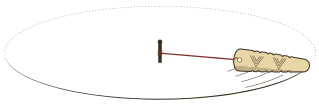
Whirl a thin board on a string and something impossible happens: an object with no throat, no lungs, and no mouth produces a sound that people who have never met one another all hear as a living, dangerous, enormous being. In Australia it is the sky-god Daramulun; in Yorubaland the terror-god Oro; on the Papuan Gulf the wickerwork monster that swallows boys; in Arnhem Land the great python. The obvious question is why. Why does a whirled slat sound supernatural — not merely loud, but numinous, alive, and full of threat? The answer, it turns out, was measured with microphones. The bullroarer is a machine that manufactures, out of nothing but spinning wood and cord, the exact acoustic signature the human ear is wired to read as a large, aroused, and dangerous animal. It is a roughness engine. It is a mechanical scream.
In brief
- Whirled at a normal speed, the bullroarer’s drone is about 70 Hz, produced as a rapid pulsation of a rotating slat — not a plucked or blown tone (Fletcher, Tarnopolsky & Lai, J. Acoust. Soc. Am. 2002).
- Human screams and the most effective alarms cluster at 30–150 Hz modulation — the quality called roughness — and roughness recruits the amygdala (Arnal et al., Current Biology 2015). It peaks near 70 Hz (Zwicker & Fastl). The bullroarer sits on that peak.
- The famous infrasound story is a myth: every radiated tone Fletcher measured lies in the audible 20–160 Hz band, with nothing below 20 Hz. The power is not sub-perceptible — it is hyper-perceptible.
- The instrument’s pitch law is f ∝ V/W — a wider board makes a deeper voice. Peoples worldwide gender their paired roarers along exactly that axis: deep = husband, god, great-grandfather; high = wife, child, the recently dead.
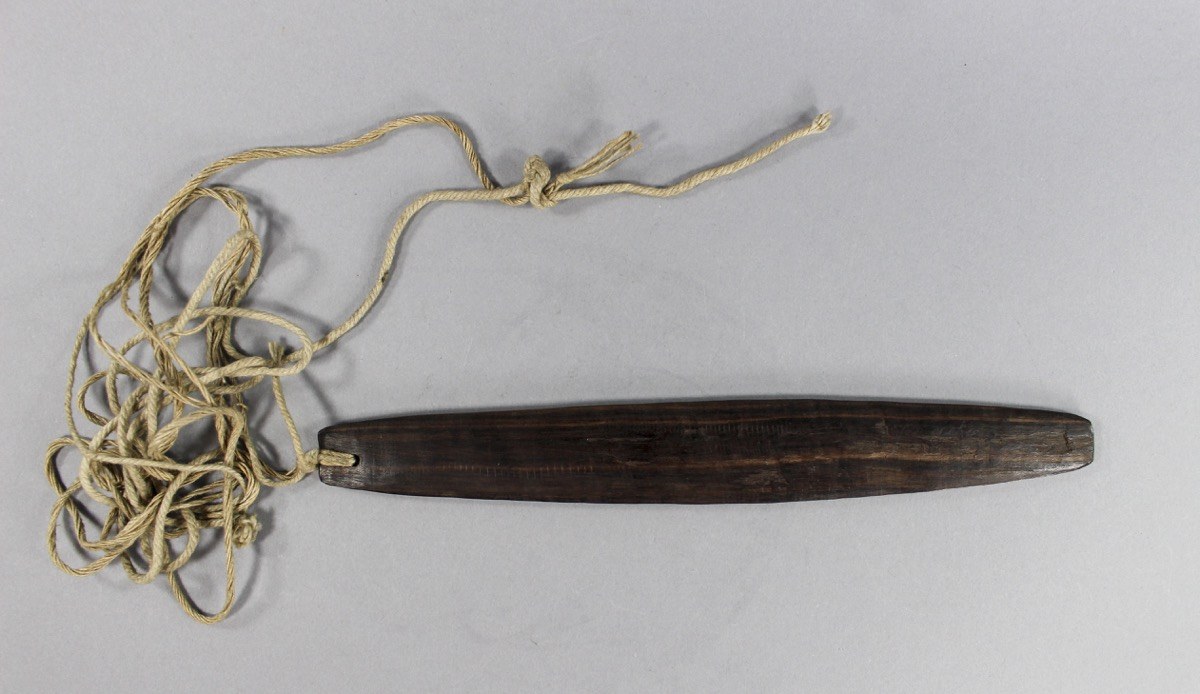
The bullroarer is usually explained by its secrecy: it frightens the uninitiated because they are told it is a spirit, and kept from seeing the trick. But that cannot be the whole story, because the sound is uncanny even to those who know exactly what it is. The deeper reason is acoustic. The instrument’s measured output — a low, rough, throbbing, wandering, sourceless roar — is a near-perfect stack of the cues every mammal reads as a big thing, aroused and hostile, close by. Physics explains why the reading recurs across the planet; where the rite travelled by contact, the ear was already primed to receive it. Cultures did not agree to hear a god in the whirled board. Their auditory systems agreed for them.
What actually happens (the numbers)
The definitive measurements are Neville Fletcher, Andrew Tarnopolsky and John Lai’s Rotational aerophones (Journal of the Acoustical Society of America 111(3):1189–1196, 2002), with a plain-language companion in the Australian Acoustical Society’s 2002 proceedings. Their bullroarer is the ordinary object: “a thin slat of wood … typically 200–400 mm long, 30–60 mm wide and 5–10 mm thick” on a cord about a metre long. The player’s arm turns slowly, roughly once a second; but the aerodynamic forces set the slat spinning about its own long axis far faster — and that fast spin, not the slow arm, is the voice.
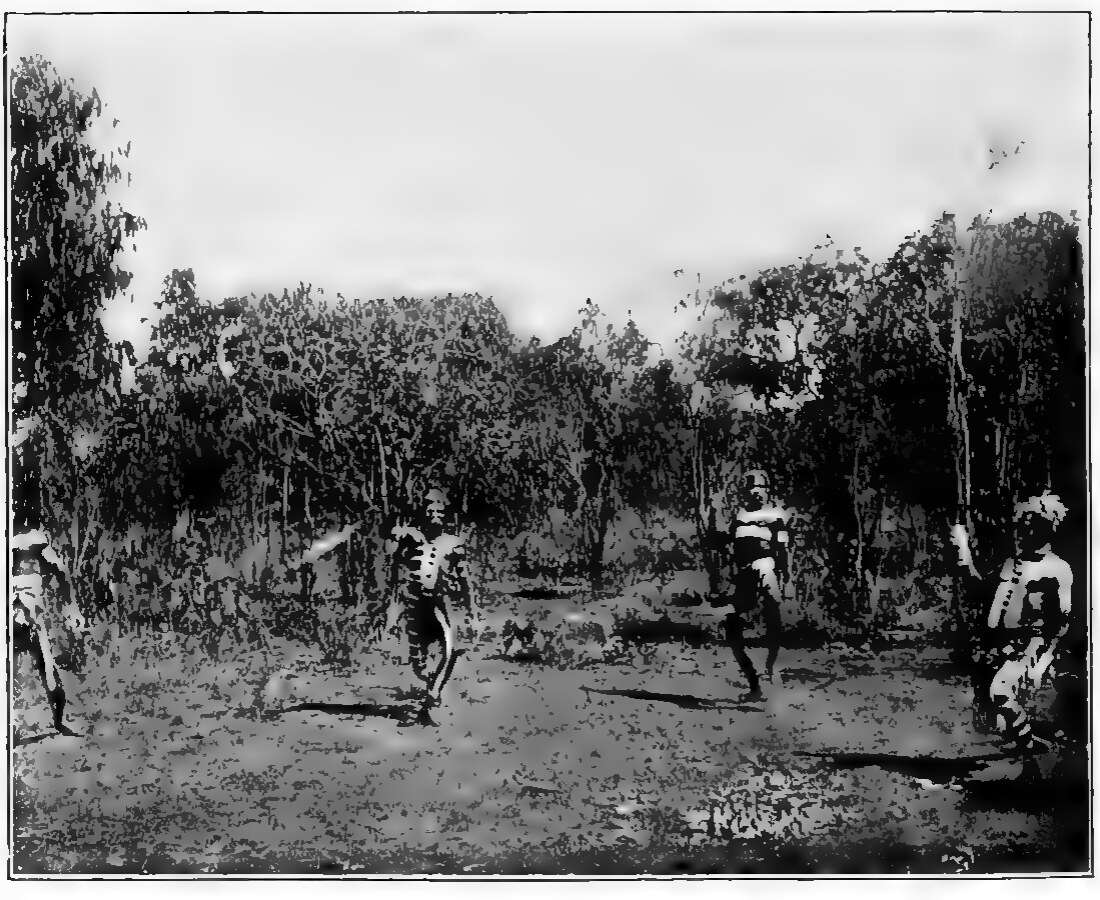
Their first result is the one everything turns on. “It is interesting,” they write, “that the frequency of the bullroarer drone is about 70 Hz, which is comparable with the frequency of the drone of the lip-blown didjeridu.” This is a low tone, down in the bottom octaves of hearing, overlapping the growl register of large animals. And it is not made the way a flute or a string is made. The slat has two broad faces; as it spins on its axis, it swings edge-on and then broadside to the listener twice per turn, once for each face, firing a pressure pulse each time. “The axial rotation speed,” Fletcher notes, “is just half the acoustic frequency” — about 35 turns a second producing 70 pulses. The 70 Hz “tone” is literally a train of ~70 amplitude pulses per second. Hold that fact; it is the hinge of the whole argument.
Everything else piles texture onto that pulsing carrier:
- A low, tunable pitch. Across slat widths of 40–100 mm at ordinary arm speeds the fundamental runs “typically in the range 20–150 Hz.” The governing law is f ∝ V/W: pitch rises with the slat’s airspeed V and falls with its width W. A wider board makes a deeper voice; whirl harder and the pitch climbs.
- A voice that throbs and swells. The loudness is not steady. Fletcher finds “two envelope frequency components, one at the arm rotation frequency or about 1 Hz, and a slower one at about 0.2 Hz or less” — the slow business of the cord twisting up, stalling, and reversing. The sound breathes and surges on a multi-second cycle.
- A pitch that wavers. The cord traces a wide cone and the slat orbits the player, so it is forever approaching and receding. Roger and colleagues (2006) measured the consequence directly: “the Doppler effect makes the fundamental frequency oscillate by an amount of ±3.5 Hz, which is small but noticeable.” The drone glides up and down as it swings.
- A sound that comes from everywhere. On axis at four metres the level is “60 dB at 72 rpm and 72 dB at 120 rpm,” radiated “isotropic to within about ±3 dB” — nearly equal in all directions. A bullroarer fills a clearing and seems to come from no fixed place, its source invisible in the dark.
And real instruments are richer than the idealised aluminium test-slat. Roger’s spectra of trapezoidal, asymmetric boards are “most discrete-frequency in nature … sharp peaks at twice the spinning frequency and harmonics,” plus a broadband hiss of vortex-shedding “between 50 and 100 Hz.” So the actual sound carries audible overtones low in the spectrum, and a wash of noise around them. That richness matters for what comes next.
The instrument does not vibrate at 70 Hz. It pulses at 70 Hz.on Fletcher, Tarnopolsky & Lai, J. Acoust. Soc. Am. 111 (2002)
The scream band
Now put those numbers beside what is known about fear. When Luc Arnal and colleagues asked what makes a human scream a scream — what separates it acoustically from ordinary speech or song — they found the answer was not pitch or loudness but a rate of amplitude modulation. Screams, and the artificial alarms engineers converge on, cluster in a band of “approximately 30 and 150 Hz modulation rates, corresponding to a perceptual attribute called roughness” (Human screams occupy a privileged niche in the communication soundscape, Current Biology 25, 2015). This band is walled off from speech, which modulates far more slowly, around 4–5 Hz. And roughness is not processed like ordinary sound: adding it to a signal speeds detection, raises judged danger, and — the striking part — recruits the amygdala, the brain’s fast subcortical alarm. Roughness is the acoustic texture of terror, and it has its own private channel into the fear system.
Classical psychoacoustics had already located the summit of that texture. In Zwicker and Fastl’s standard account, roughness rises with modulation rate and peaks near 70 Hz — so precisely that the reference unit of roughness, one asper, is defined by a tone modulated 100 percent at 70 Hz. Set the two facts side by side and the coincidence is startling. The bullroarer’s fundamental is about 70 Hz, and it is generated as a 70 Hz amplitude pulsation. The instrument delivers its energy at, and throbs at, the exact rate of maximum human roughness sensitivity. It is tuned to the summit of the scream curve — not by any player’s intent, but by aerodynamics.
A pure 70 Hz sine tone, taken alone, is heard partly as a low pitch rather than pure roughness, but no bullroarer ever arrives alone. Its voice rides on the real instrument’s whole cluster of cues, whose centre of gravity is the 70 Hz roughness peak — and the real instrument supplies the rest of that cluster in abundance. Its low, harsh, broadband growl speaks the oldest rule in animal signalling, what Eugene Morton and John Ohala called the frequency code: low and rough means a large, aggressive body; high and tonal means small and appeasing. A 20–150 Hz roar reads, before any thought, as something big and angry. On top of that, the instrument manufactures the textures of a voice pushed past its limit. Highly aroused animals overblow their calls into nonlinear phenomena — subharmonics, chaos, abrupt jumps — and listeners, humans included, find these maximally alarming. The bullroarer produces them mechanically: the stall-and-reverse of the twisting cord is a periodic bifurcation, the Doppler wobble a wavering glide, and the asymmetry of a real slat makes its two directions of spin unequal in depth and loudness, so the sound is never quite steady. It reads as unstable and alive, the way a screaming, panicking creature sounds — never like a machine.
Stack it all up: a low fundamental (the large-body threat code), a 70 Hz pulsation (the roughness peak, the scream band), a deep multi-second throb, a wavering Doppler glide, and bifurcations that read as arousal — every mammalian alarm button pressed at once, from a loud, omnidirectional, invisible source in the dark. That is not a description of a musical drone. It is the acoustic definition of dread. No wonder the ear reports a monster.
Not infrasound — the opposite
There is a rival explanation in wide circulation, and it deserves a careful hearing, because the man who framed it asked exactly the right question. Donald Tuzin, working among the Ilahita Arapesh of the Sepik, was the first anthropologist to insist that the numinous power of these instruments lies in the sound itself and not merely in the beliefs draped around it. His Miraculous Voices: The Auditory Experience of Numinous Objects (Current Anthropology 25, 1984) is the nearest ancestor of this argument, and its central intuition — that the tone is intrinsically uncanny — is exactly right. Tuzin proposed a mechanism: infrasound, sound below the threshold of hearing, acting on the temporal lobe. Such “subperceptual responses,” he wrote, “must present to consciousness the uncanny, perhaps disturbing sensation of having a mysterious, ego-alien stranger in its midst.” It was a bold, testable guess, made eighteen years before Fletcher put the instrument in front of a calibrated microphone.
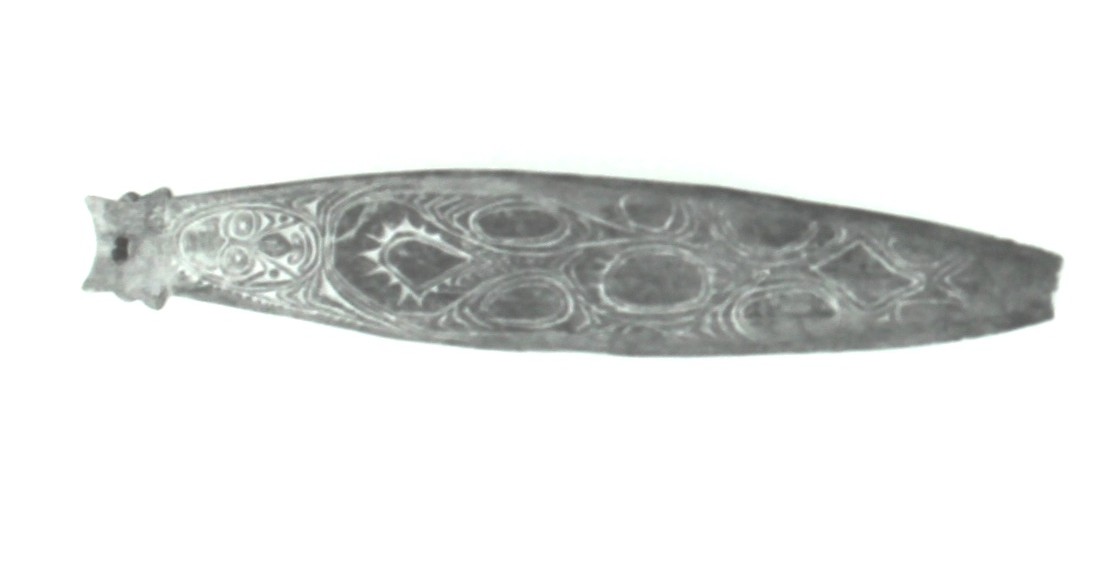
The microphones answered him, and the answer is a correction. Every radiated tone Fletcher measured sits in the audible band; the experimental range was 40–160 Hz, and the fundamentals of ordinary slats fall between 20 and 150 Hz. There is no radiated acoustic energy below 20 Hz. The only sub-20-Hz quantities anywhere in the literature are the loudness envelopes — the ~1 Hz throb and the ~0.2 Hz reversal — and those are modulation rates of a 70 Hz carrier, not propagating pressure waves. You cannot feel a 1 Hz amplitude envelope as a tone in the chest. As airborne sound, the bullroarer simply is not an infrasound device; its power is entirely in the audible low band.
This does not diminish the mystery Tuzin named — it relocates it, from an unmeasurable realm beneath hearing to a measured and far more interesting feature of ordinary hearing. His mechanism was subperceptual; the true mechanism is its opposite. The bullroarer is not too low to hear. It is hyper-perceptible — a rough signal that seizes a fast fear pathway squarely inside the audible range. And that correction is what rescues the worldwide pattern. A fragile infrasonic effect, which most real bullroarers cannot even produce, could never explain why the same reading recurs on five continents. A signal that works through the universal human roughness response can. Every human auditory system carries the same alarm, so every human clearing can hear the same god.
What the world hears
Turn from the physics to the catalog, and the prediction is confirmed in the peoples’ own words. Those words are dominated by a single grammatical shape — the voice of X — and X is, overwhelmingly, a large, devouring, or ancestral being. This is precisely what a low, rough, unseen growl should be heard as. Among the Yuin of the New South Wales coast, the whir was the voice of Daramulun, the sky-being, and its roaring was his thunder. The same god speaks through the roarers of the Coast Murring, the upper Murrumbidgee, and the Murawari — a thunder-being heard, fittingly, in the one instrument that can imitate thunder.
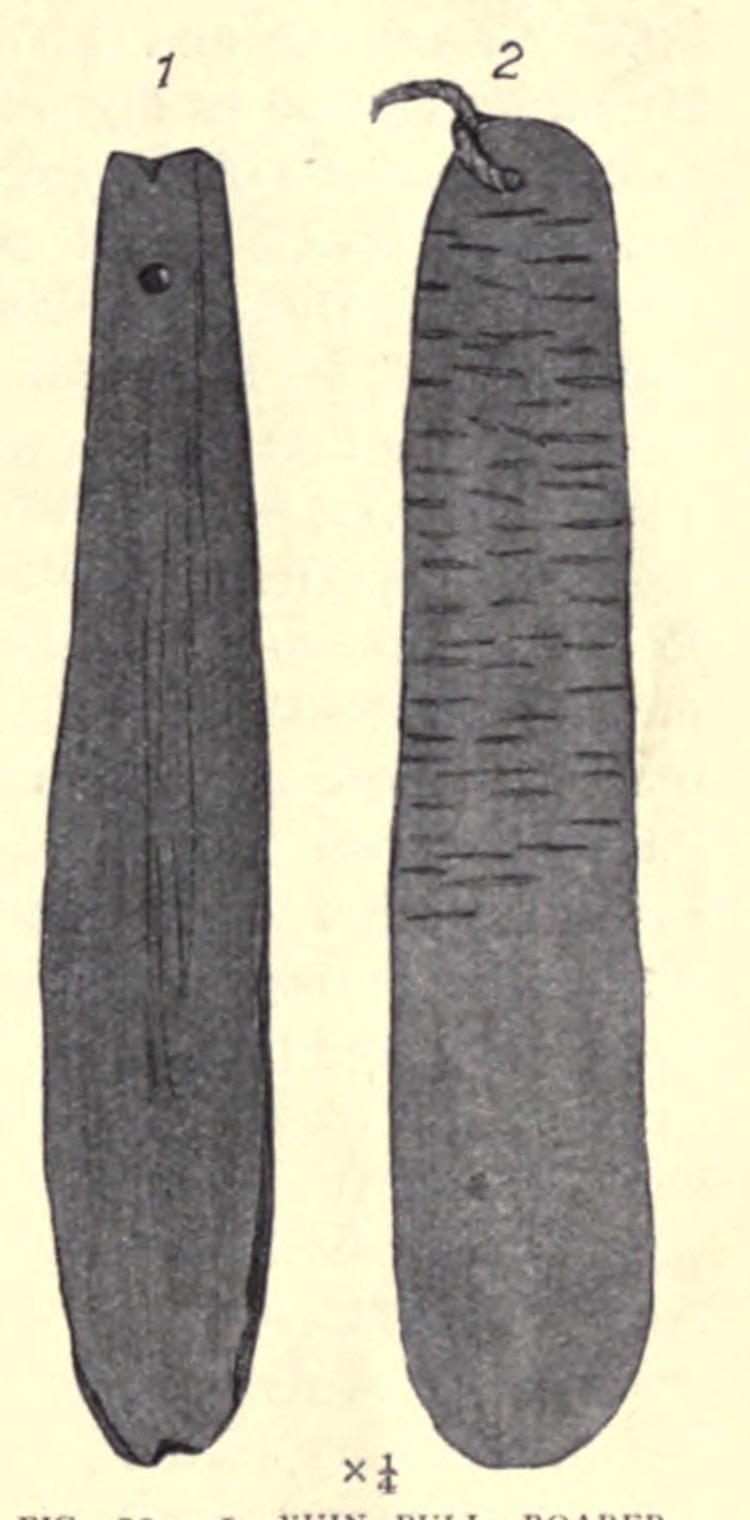
The roaring of the Mudthi represents the muttering of thunder, and the thunder is the voice of Daramulun, and therefore its sound is of the most sacred character.A. W. Howitt, on the Yuin initiation

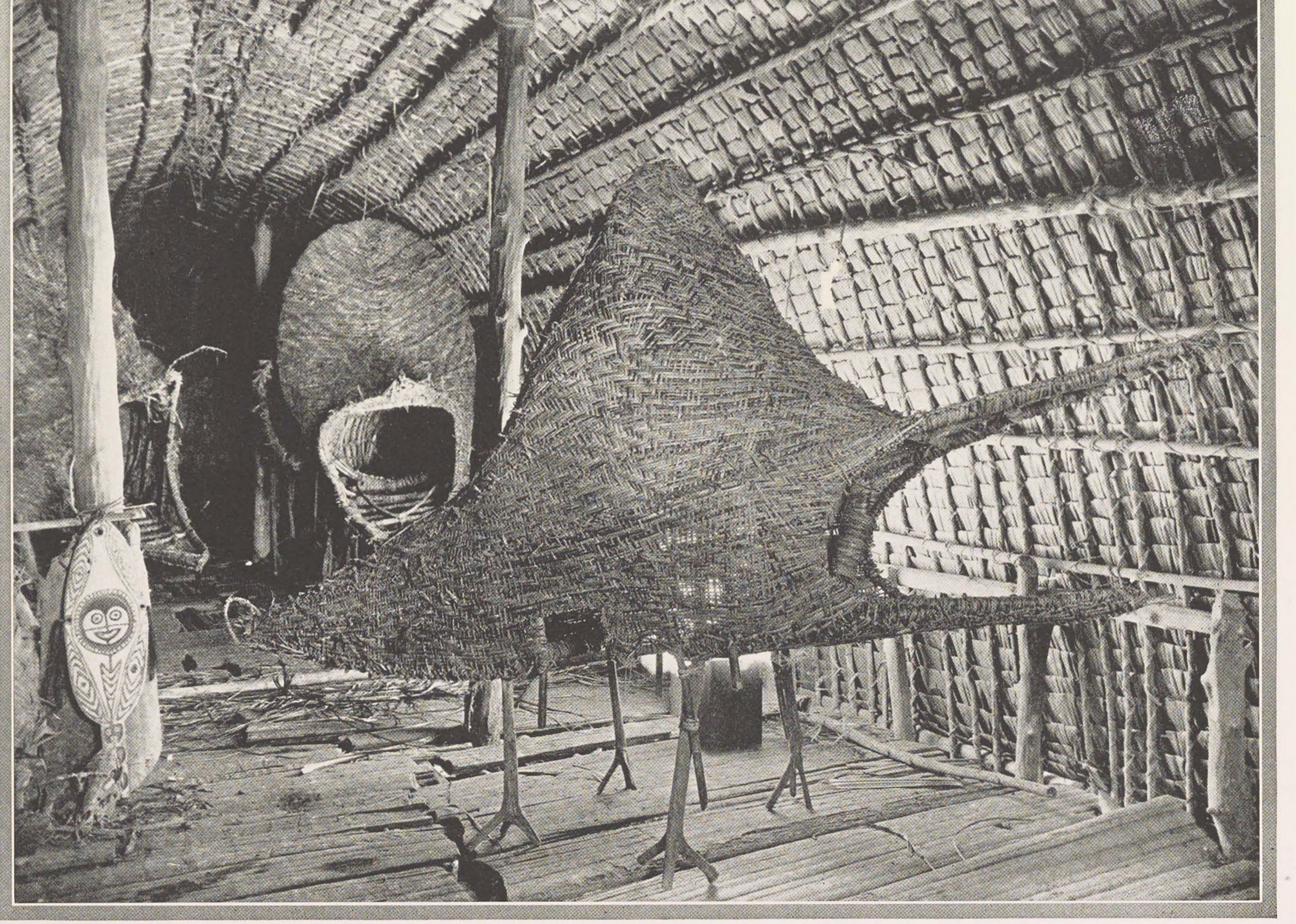
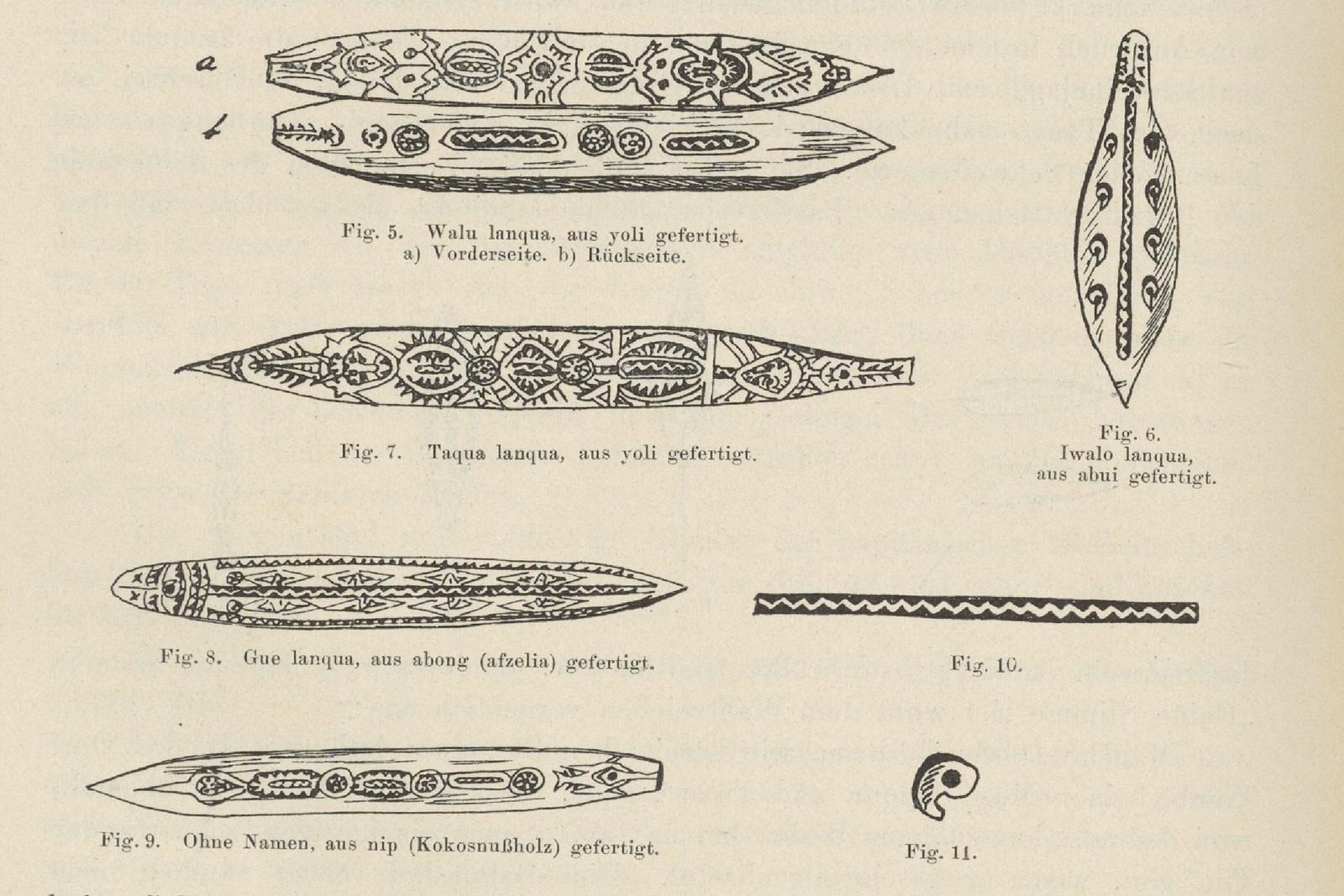
Elsewhere the being is a devourer. On the Papuan Gulf the roar is the cry of the kaiaimunu, the wickerwork monster that eats the novices; on the Huon Gulf it is balum, one word for the ghost of the dead, the swallowing monster, and the roaring wood alike. In Arnhem Land the python-painted paddle is the voice of Yurlunggur, the great serpent: swung hard, the men told the women, it is the snake crying out in hunger, and any woman who comes near will be swallowed whole. And across Yoruba country the whirring roar from the forest was the voice of Oro, the god of terror and vengeance, before whom the women shut themselves indoors on pain of death. Devourer, thunderer, serpent, ancestor, terror-god — the register never varies. The instruments’ very names carry it too: across the catalog the glosses reach again and again, independently, for the same three low-broadband words — roar, thunder, growl — which are exactly the lexicon of the threat register the psychoacoustics predicts.
| What is heard | People / region | Class of being |
|---|---|---|
| Daramulun / the sky-being | Yuin, Wiradjuri, Murring — SE Australia | thunder-god |
| Oro | Yoruba — West Africa | god of terror and vengeance |
| the kaiaimunu | Namau / Elema — Papuan Gulf | swallowing monster |
| balum | Huon Gulf — New Guinea | the swallowing dead |
| the python Yurlunggur | Yolngu — Arnhem Land | the Rainbow Serpent |
| the great-grandfathers | Yoruba, lower Niger | the ancestral dead |
These peoples had no contact in living memory, yet the rite travelled — a single deep tradition seeding the bullroarer complex across the continents. But diffusion carried the ceremony, not the hearing. The rite could be received everywhere as a supernatural voice because it landed on the same instrument, and the same ear, every time. Physics explains why the reading recurs; history explains why the ritual does.
The pitch law, made cultural
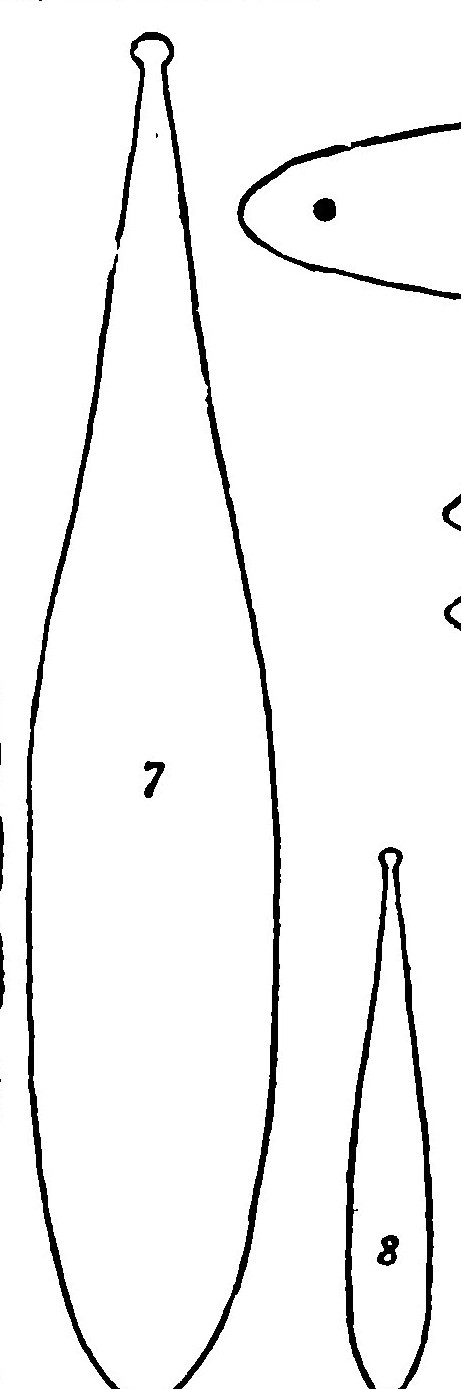
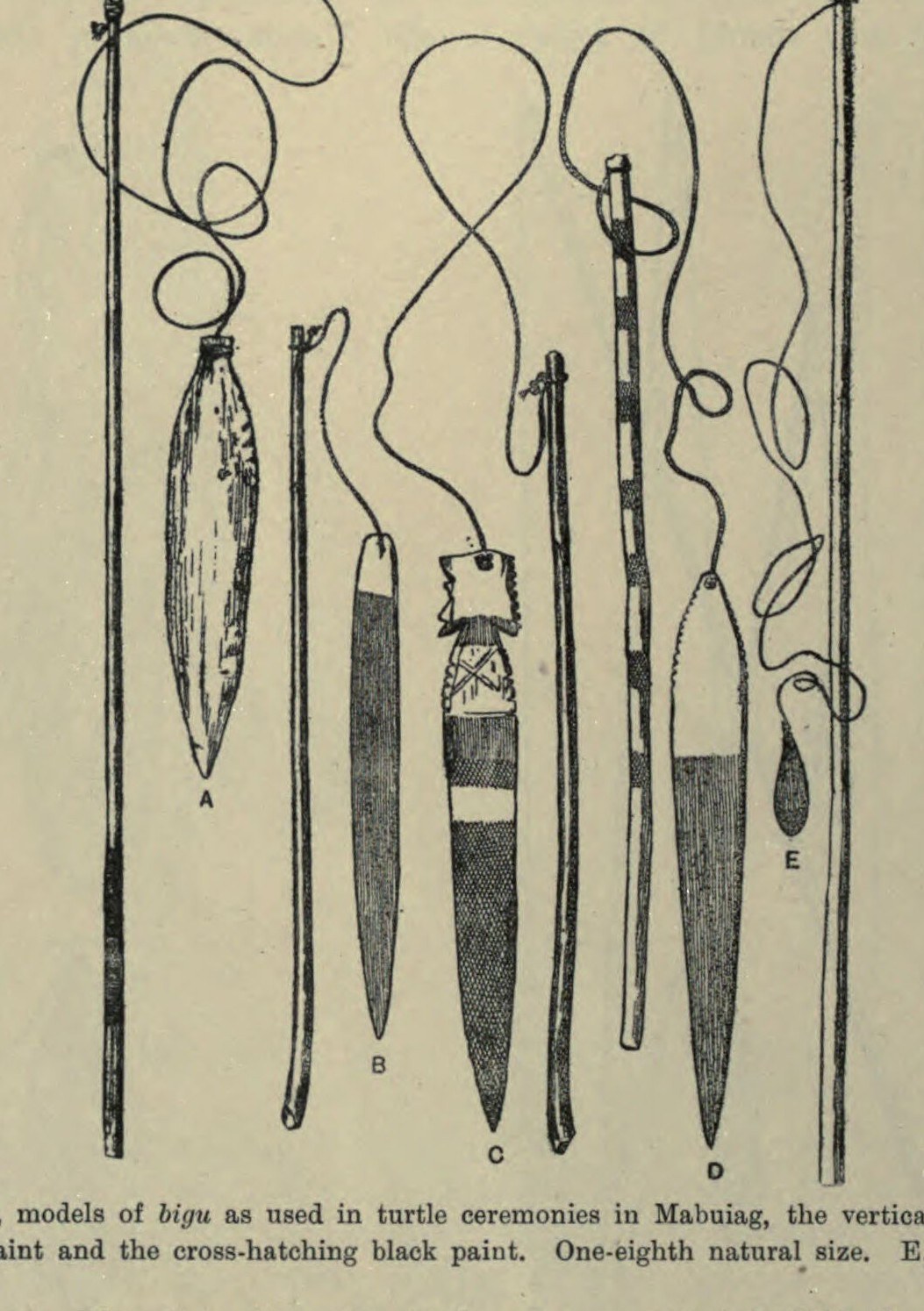
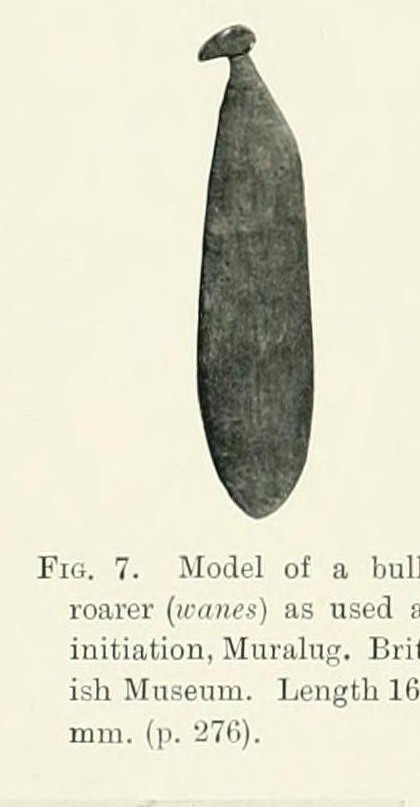
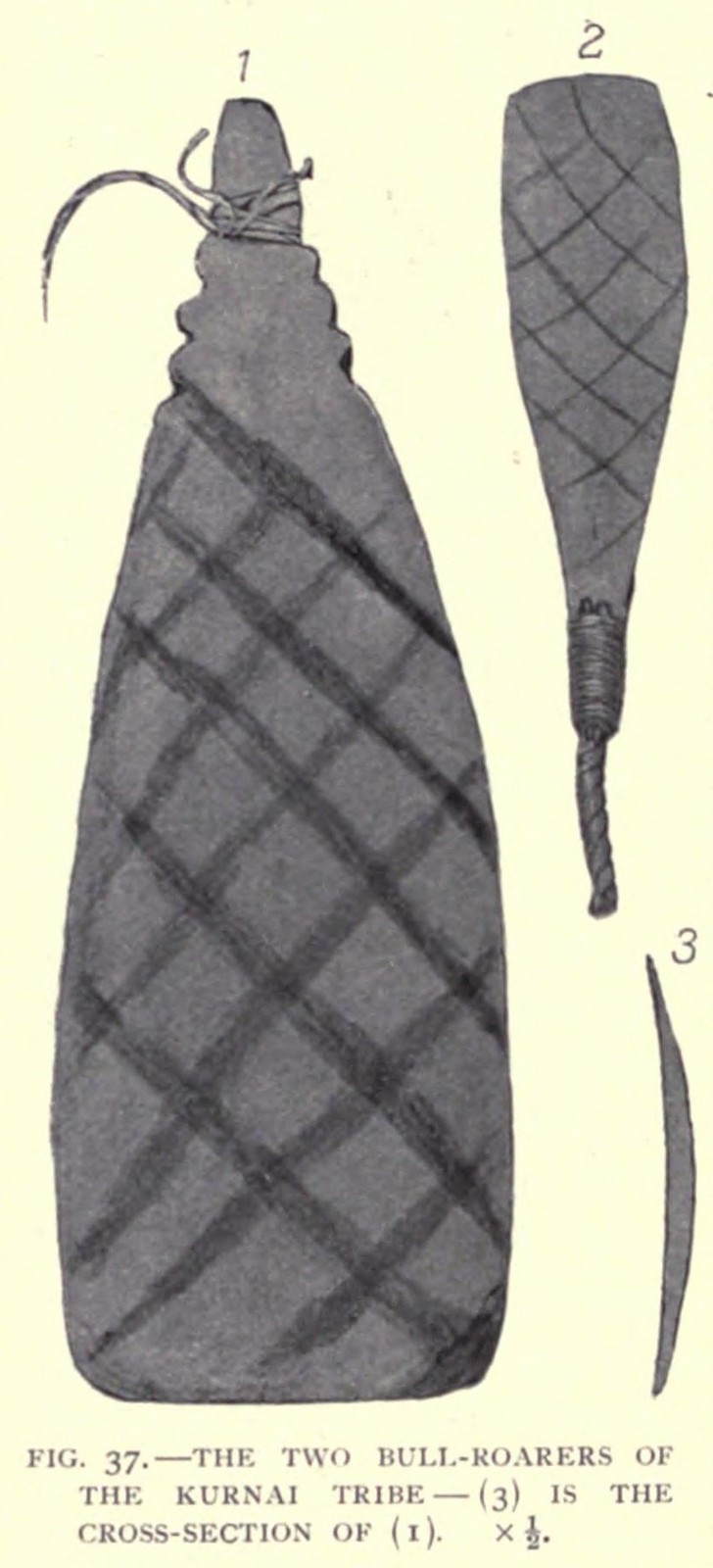
The last piece is the prettiest, because here the physics and the myth are visibly the same law. Fletcher’s equation says a wider board makes a deeper voice: f ∝ V/W, big = deep, small = high. The frequency code, independently, says deep = large, male, senior; high = small, female, junior. Where a people uses two roarers of different size, the two laws fuse, and they gender the pair exactly as the acoustics dictates. Among the Wiradjuri, Mathews recorded a large brigalow-wood mudthega whose deep roar was Daramulun — Dhurramoolan, in his spelling — and a small sandalwood moonibear whose shriller note was the voice of Dhurramoolan’s wife. On the Brisbane River the Turrbal paired a larger Bugerum, with a “louder and deeper-sounding roar,” against a smaller Wobblekum. In the Torres Strait the large bigu sounded the deep note and the small wanes the shrill one, as senior to junior. And on the lower Niger the Yoruba read the same axis in the wood itself: heavy, dark blades voiced the deep-toned great-grandfathers, light blades the higher-pitched newly dead.
| People | Deep voice (wider / heavier) | High voice (narrower / lighter) | Read as |
|---|---|---|---|
| Wiradjuri (Mathews 1898) | large mudthega = Dhurramoolan | small moonibear = his wife | husband / wife |
| Turrbal (Howitt 1904) | Bugerum, “louder and deeper” | Wobblekum, smaller | paired male / female dyad |
| Torres Strait (Haddon 1912) | large bigu, the deep note | small wanes, the shrill note | senior / junior |
| Yoruba, lower Niger (Bastian) | heavy dark wood = great-grandfathers | light wood = the recently dead | seniority of the dead |
The pattern is the physics wearing a mask. Because a wider slat is mechanically deeper, and because the ear already reads deep as big, male, and old, peoples who never met one another put the deep roarer in the role of the husband, the god, the great-grandfather, and the shrill roarer in the role of the wife, the child, the recent dead. The two voices of the paired instrument are the two sexes of the cosmos, assigned by an acoustic law the players never knew they were obeying — the same logic that runs through the grandfather-and-mother namings, the thunder the roarer calls down, and the wind it is made to be.
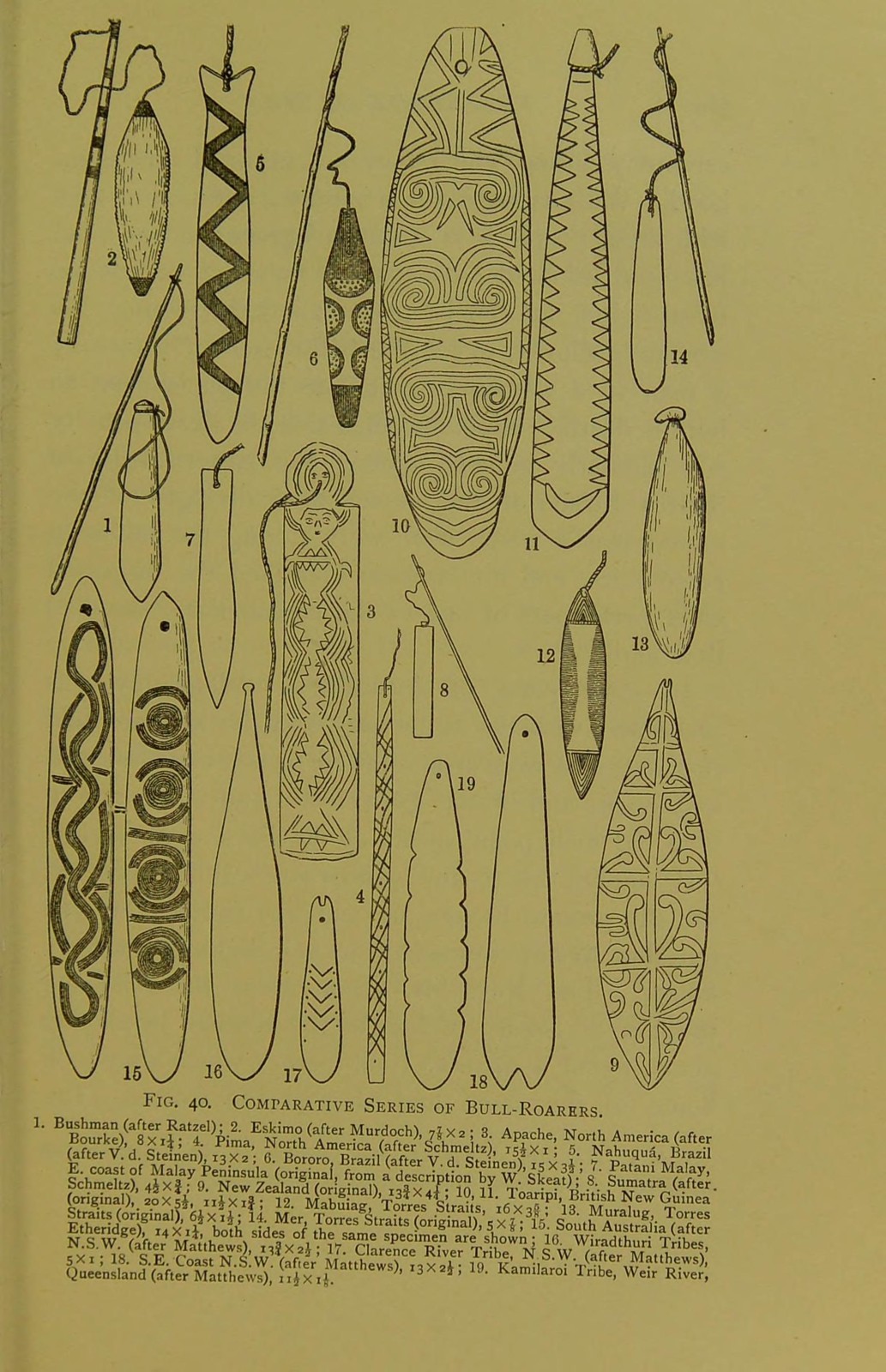
So the whirled slat is not an accident that the world happened to find frightening. It is a machine, discovered independently again and again, that presses the alarm every human is born wired to answer. Strip away the myth and the trick and the secret, and the bare acoustic fact remains: swing the board, and the ear hears a large, hostile, living thing where nothing living is. The cultures simply named what they heard — a scream, produced, uniquely in the human toolkit, by a mechanism with no throat at all. And once you know it is a machine, and can hold it and swing it yourself, the sound loses none of its power. That is the surest sign the effect was never really about belief. It was in the air, at 70 Hz, all along.
Key sources
Fletcher, N. H., Tarnopolsky, A. & Lai, J. C. S. 2002. “Rotational aerophones.” Journal of the Acoustical Society of America 111(3):1189–1196 — the drone “about 70 Hz” and the didjeridu comparison (p. 1189); the axial rotation “just half the acoustic frequency” (p. 1190); the size–pitch relation f ∝ V/W and the measured band 40–160 Hz (p. 1191); “60 dB at 72 rpm and 72 dB at 120 rpm,” isotropic to ±3 dB (p. 1191).
Fletcher, N. H., Tarnopolsky, A. & Lai, J. C. S. 2002. “Australian Aboriginal Musical Instruments — The Bullroarer.” Acoustics 2002 (Australian Acoustical Society), pp. 186–189 — fundamentals “typically in the range 20–150 Hz”; envelope components at ~1 Hz and ~0.2 Hz; “primarily sinusoidal, with the second harmonic about −30 dB” (p. 187).
Roger, M. & Aubert, S. 2006. “Aeroacoustics of the Bullroarer.” Acta Acustica united with Acustica — the Doppler oscillation of ±3.5 Hz; the discrete-frequency spectrum with harmonics; the vortex-shedding contribution “between 50 and 100 Hz”; deliberate size/pitch selection by Amazonian players.
Arnal, L. H., Flinker, A., Kleinschmidt, A., Poeppel, D. & Giraud, A.-L. 2015. “Human screams occupy a privileged niche in the communication soundscape.” Current Biology 25(15):2051–2056 — screams and effective alarms cluster at “approximately 30 and 150 Hz modulation rates … roughness,” segregated from speech, recruiting the amygdala.
Zwicker, E. & Fastl, H. Psychoacoustics: Facts and Models — roughness rising with modulation rate to a maximum near 70 Hz; the asper defined by a tone 100% amplitude-modulated at 70 Hz.
Morton, E. S. 1977. “On the occurrence and significance of motivation-structural rules.” American Naturalist 111:855–869; Ohala, J. J., on the frequency code — low, harsh, broadband sound = large body and aggression. Fitch, W. T., Neubauer, J. & Herzel, H. 2002; Anikin, A. et al. 2025 — nonlinear phenomena (subharmonics, chaos, bifurcations) heighten alarm in human listeners.
Tuzin, D. F. 1984. “Miraculous Voices: The Auditory Experience of Numinous Objects.” Current Anthropology 25(5):579–596 — the pioneering claim that the sound itself is numinous, with an infrasound-and-temporal-lobe mechanism (“subperceptual responses … ego-alien stranger”) that Fletcher’s later measurements do not support.
The voices and the paired roarers: Mathews 1898 (Wiradjuri mudthega and moonibear), Howitt 1904 (Yuin Daramulun, p. 538; Turrbal Bugerum and Wobblekum), Haddon 1912 (Torres Strait bigu and wanes), Bastian (Yoruba Oro; the great-grandfathers and the newly dead), Hamlyn-Harris and Haddon (Papuan Gulf kaiaimunu), and Warner (Yolngu Yurlunggur).
The identification of the bullroarer’s ~70 Hz drone with the ~70 Hz peak of auditory roughness — the instrument as a “roughness engine” or mechanical scream, and the reading of the size→pitch gendering as the frequency code riding on f ∝ V/W — is, as far as we know, original to this page: it joins an acoustics literature and a psychoacoustics literature that had not been introduced to one another.