Atlas Essay —
The Whirlwind
Torres Strait · Hokkaido · the Siberian Arctic · a Norwegian fjord · the Great Basin · Central Australia · the Navajo country
Watch a bull-roarer at the end of its cord and it is easy to hear a voice in it — a droning, otherworldly thing that the uninitiated are told is a spirit. But a great many of the people who swing it hear something else first. They hear wind. From the reefs of Torres Strait to the Siberian tundra to the high desert of Arizona, the roarer is swung not to speak but to raise weather: to call up a hunting breeze, to break a calm, to bring the rain. And their reason is the same everywhere, and it is nearly correct: the thing makes wind because it is wind — a small storm you can hold in your hand.
In brief
- Across at least four unconnected culture areas the bull-roarer is swung to make, call, or quell wind — Torres Strait, the Ainu rera-suyep (“wind-swinger”), the Siberian Arctic, a Norwegian fjord, and the American West.
- The recorded native theory is consistent: it breeds wind because it sounds like wind. The Arapaho whirled it and “held [it] to produce wind because it sounded like wind” (Loeb 1929).
- The physics agrees. A swung slat autorotates as an aerofoil and sheds a helical vortex wake (Roger & Aubert 2006): it is, mechanically, a portable little whirlwind.
- On three continents children are forbidden to swing it lest they raise a storm — a shared prohibition that travels with the belief.
- Where wind is also the soul, the two fuse: the Anula initiation roarer was “made, in the first instance, by the whirlwind” (Spencer & Gillen 1904), and in the Navajo Mountain Chant the whirled “groaning stick” makes a “mimic storm” inside a myth where the Wind God’s whirlwind digs a cave the hero descends into and emerges from renewed (Matthews 1887).

Three things sit in the record, and they have never been set in one line. First, the bull-roarer is a real, widespread weather engine — swung to make wind, on the explicit native theory that it raises wind because it sounds like wind. Second, in several parts of the world the small travelling wind-vortex is held to be a spirit, a vehicle for the souls of the unborn and the dead. Third, where a single cosmology holds both beliefs at once, they fuse, and the roarer becomes a soul-engine. This page assembles the wind-making cluster, sets the whirlwind-soul belief beside it, and shows the two joining at two documented places on two continents — with the physical fact, missed by the ethnographers, that a swung roarer genuinely is a miniature whirlwind supplying the reason the join is not arbitrary.
The instrument that makes wind
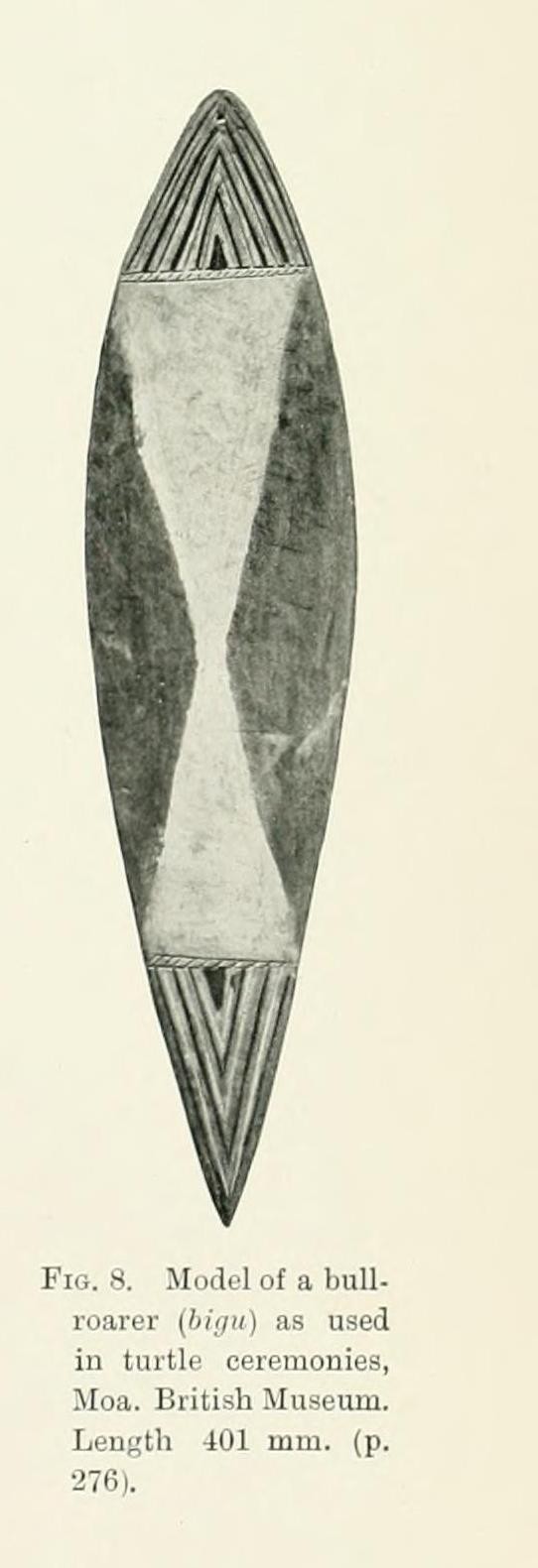
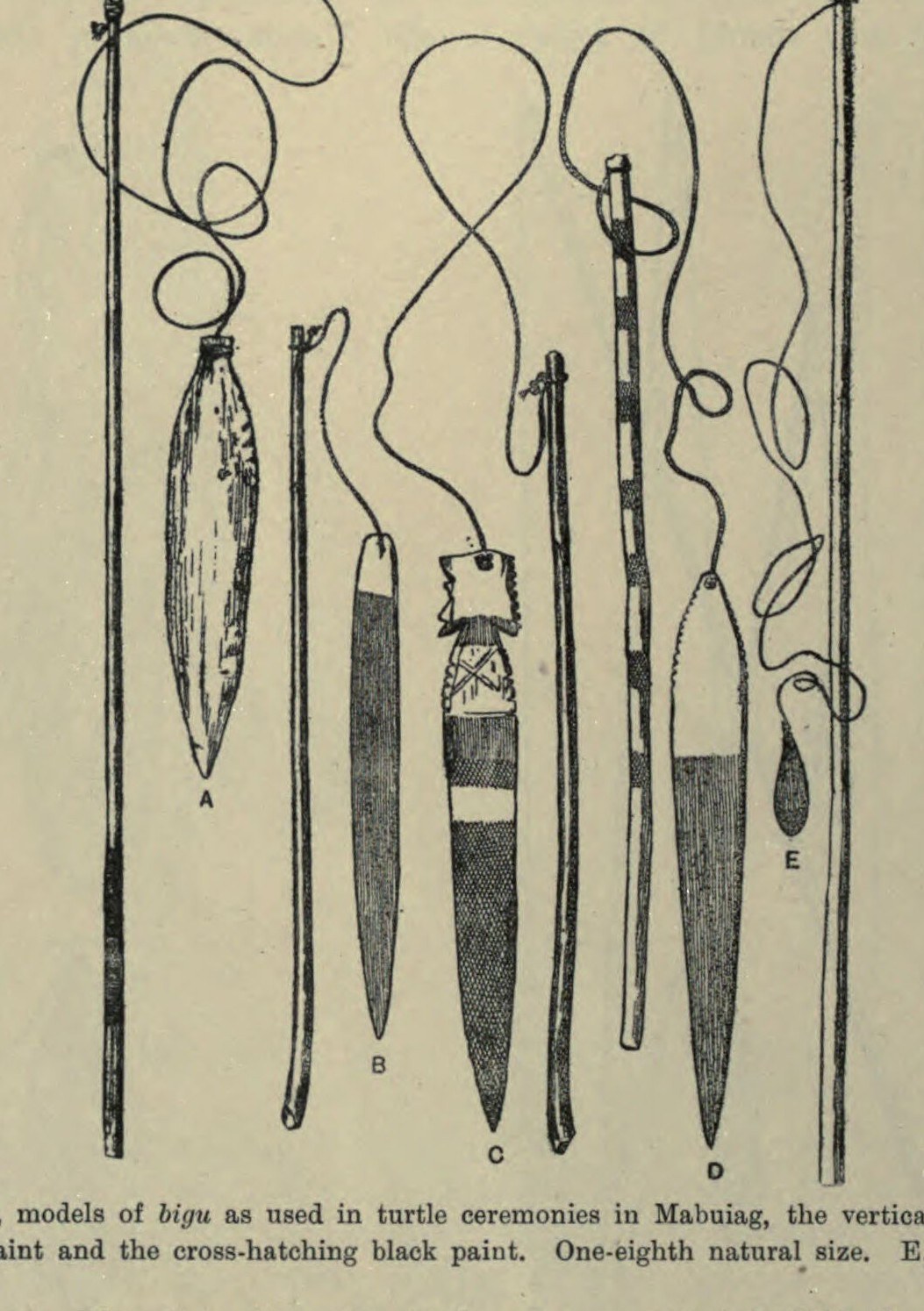
Begin with the plain function, because it is broad and it is consistent. In the eastern Torres Strait the Meriam of Murray Island (Mer) swung the bull-roarer they called bigo to raise a wind and, in dead air, to break a calm; on Moa and on Mabuiag the same bigu served the winds and the turtle-hunt. Far to the north, the Ainu of Hokkaido swung theirs to obtain a favourable wind for hunting deer; they called it the rera-suyep — literally the wind-swinger, from rera, wind, and suye, to swing. The name simply is the function.
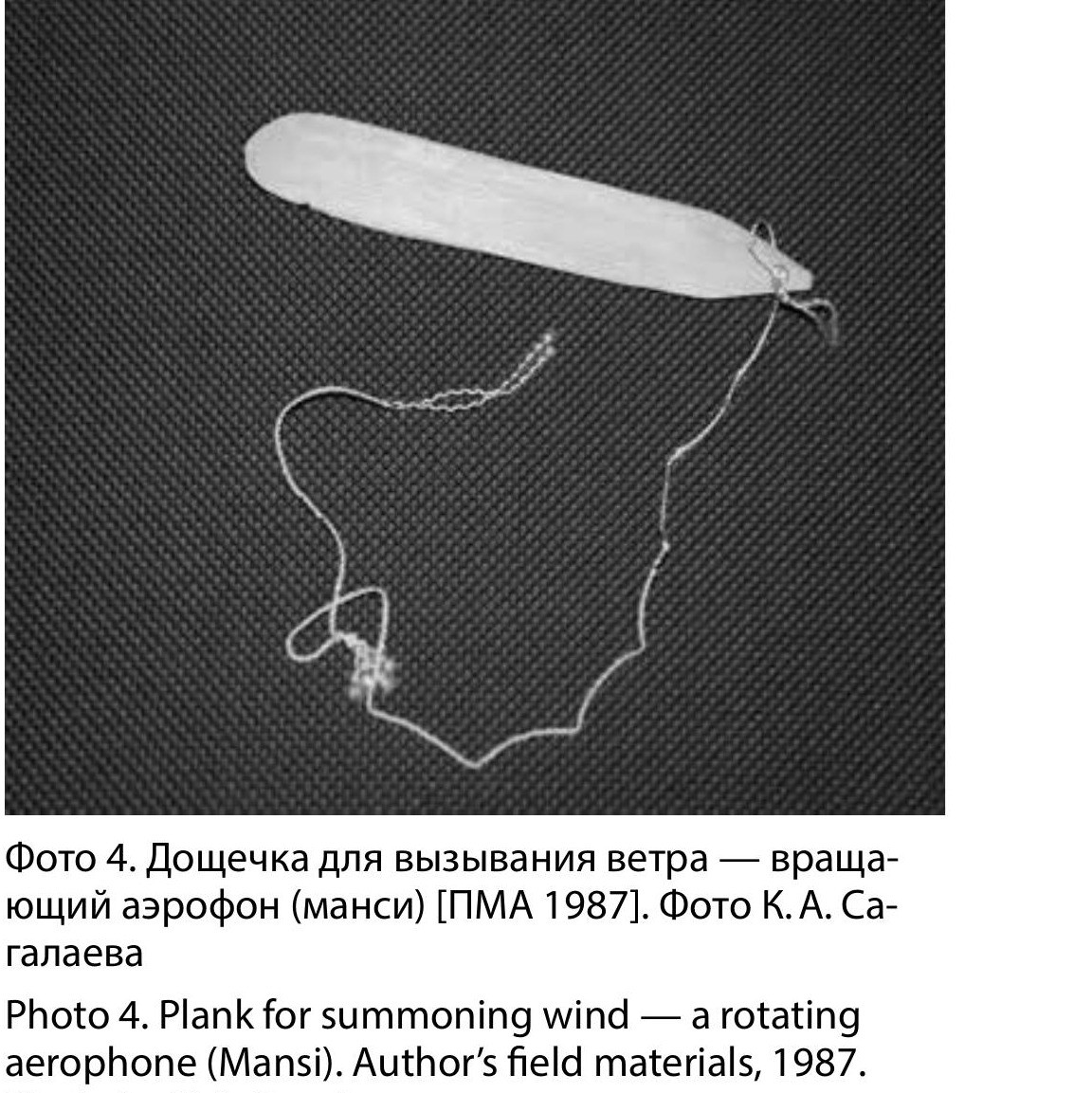
The densest band runs across the Siberian Arctic. The Mansi of the Ob kept a “wind-calling flying board,” a shaman’s tool spun to summon or turn the wind; the Enets and the Nganasan did likewise, and the Nganasan word carries the meaning in its root — biakhery, from bia, wind. The Nenets named theirs for the noise of wind itself. The belief reaches Europe: on the Norwegian coast the fjord fishermen swung a slat as a charm against the dangerous local winds. And it saturates the American West, where the Arapaho and their Gros Ventre kin, the Northern Paiute, the Ute, and the Eastern Apache all whirled the roarer to breed wind or bring the rain.

What lifts this above a coincidence list is that the peoples tell you why, and the answer is the same. It is not an arbitrary symbol; it is an observation about sound. Loeb reports that the Arapaho held the roarer “to produce wind because it sounded like wind.” Kroeber recorded the neighbouring Gros Ventre calling it nakaantan, “making cold” — the very word they used for a thermometer — and traced the name to “the widespread Indian idea that the bull-roarer breeds wind.” The Ainu name says wind outright; the Nenets name says the noise of wind. This is sympathetic magic in the strict sense — like produces like — but it is built on a real acoustic likeness, not a fancied one. The roarer is not said to be windy the way a red stone is said to be the sun; it genuinely sounds like a rising gale, and everyone who swings it says so.

The strongest signal that this is a single travelling belief, and not a scatter of local inventions, is the prohibition that rides along with it. On three continents children are forbidden to swing the thing, for exactly one reason. Ainu children were kept from lashing spatulas through the air lest they raise a storm. Ngati Porou children on New Zealand’s East Cape were chided for sounding it, because it “would cause a rain storm.” Northern Paiute children were told the roarer would “call the wind”; Eastern Apache parents scolded theirs because it “brought the wind.” A shared danger is a stronger fingerprint than a shared use: it is the belief, not merely the object, that has spread. (This is the roarer at its most utilitarian, the weather-charm end of a spectrum whose other end is the roarer that fell all the way to a schoolyard toy.)
A whirlwind in the hand
The native theory — it makes wind because it sounds like wind — is usually filed by outsiders as charming error. It is closer to correct than that. When a modern aeroacoustic analysis took the instrument apart, it found that the roar is radiated by an oscillating, rotating dipole across the slat: the airfoil-shaped board autorotates about its own long axis as it is dragged through the air, and this autorotation locks in like the shedding of vortices from a wing (Roger & Aubert, “Aeroacoustics of the Bullroarer,” 2006). Put plainly, the swung slat is a small rotating aerofoil trailing a helical wake — it stirs and sheds a spinning parcel of air behind it. The mechanism that makes the scream is the same mechanism that makes the wind.
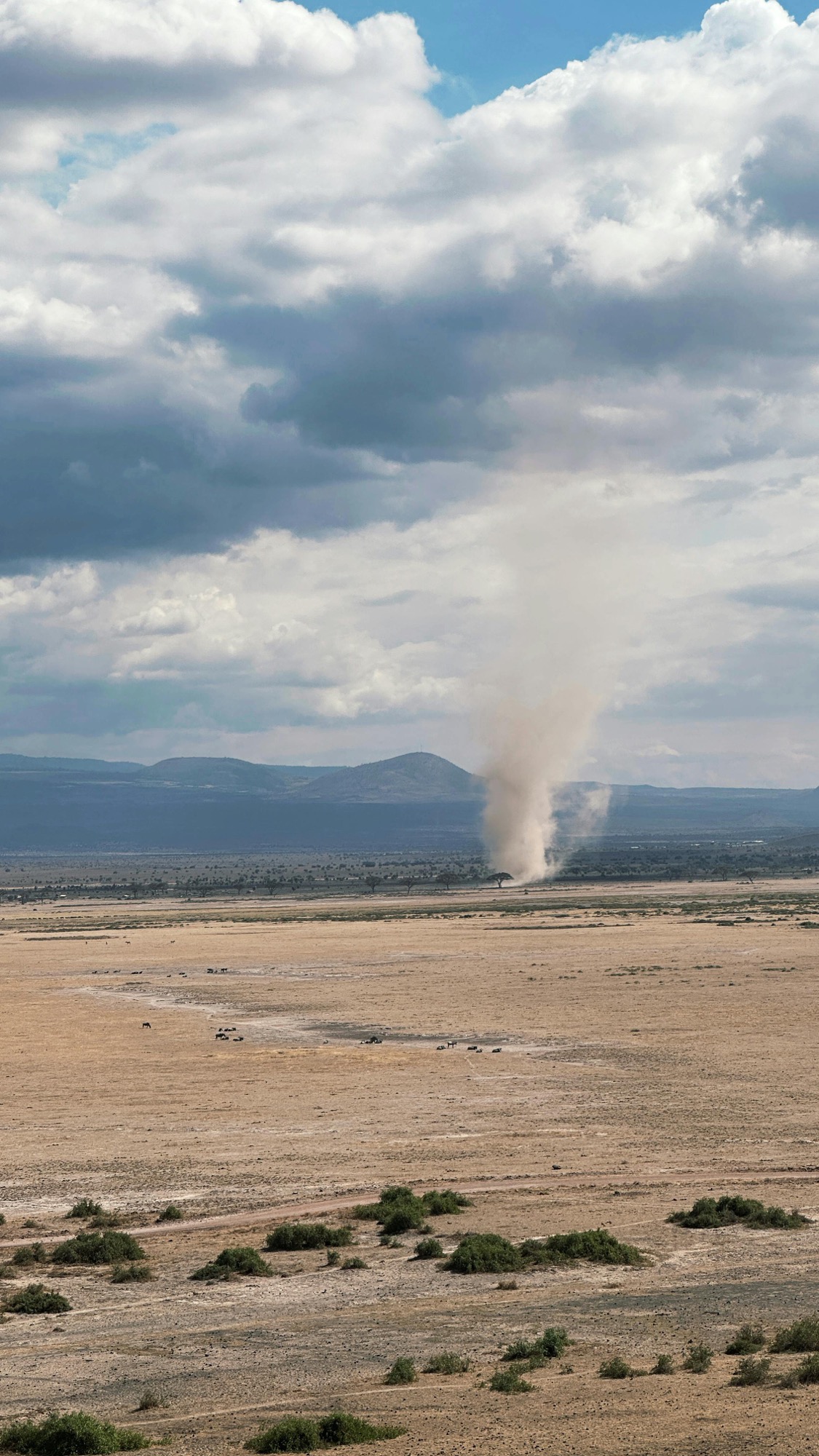
So a people who watch dust-devils spin up off the plain, and then watch a swung slat throw off its own spinning roar, are not making a wild leap. They are doing rough field aerodynamics, and getting it broadly right. The bull-roarer is a portable, controllable whirlwind. That single fact turns the whole cluster from “magical thinking” into “native acoustics” — and it is what makes the next step possible. For if the roarer really is a little whirlwind, then in any culture that already knows what a whirlwind is, the roarer inherits that meaning whole.
The whirlwind carries the dead
Set beside the wind-makers a second belief, recorded independently and just as widely: that the small travelling wind-vortex is alive — a spirit, or a body the dead and the unborn ride in.
In Central Australia the whirlwind is a nursery of souls. Spencer and Gillen found that Arunta women feared the willy-willy because “spirit children travel about in them, and that if they should happen to be caught in one the children would enter their bodies” (Northern Tribes of Central Australia, 1904, pp. 631–632). The whirlwind here is a means of conception: it carries the incoming soul and installs it. The same book records a whirlwind totem with its own increase ceremonies, and a myth in which the ancestor Unkura “met with a whirlwind which took him away up into the sky.” Across Aboriginal Australia the willy-willy is a spirit form, and children are warned that something will step out of the spinning dust.
In the Navajo country the whirlwind reads as the dead. The ch'íídii — the ghost-residue a person leaves behind — appears as the dust-devil, and its spin is read like a pulse: turning sunwise it is harmless; turning against the sun it is the dead walking. And in the same cosmology wind is not merely a spirit but the animating principle. Navajo philosophy makes Níłch'i, the Holy Wind, the breath that enters a person at birth and stands within them — the source of life, thought, speech, and motion (McNeley, Holy Wind in Navajo Philosophy, 1981). Wind is the soul; the whirlwind is the wandering dead.
That the wind-making roarer and the whirlwind-soul both cluster in Central Australia, and both cluster again in the American Southwest, is the hinge. In two places the belief that the roarer makes wind and the belief that wind is soul are held by the same people at the same time. In two places, therefore, they meet.
“Made by the whirlwind”
The first meeting is on the western Gulf of Carpentaria. Among the Anula, a young man newly through the knife was handed a bull-roarer, the mura-mura, and told the thing plainly: it had been made, in the first instance, by the whirlwind. It was buried in a hole said to represent one of the mungai spots of the whirlwind; the whole business was “the whirlwind ceremonies.” The women and children, hearing the roar, took it for the voice of a being who swallowed the boy and afterward brought him up again a man.
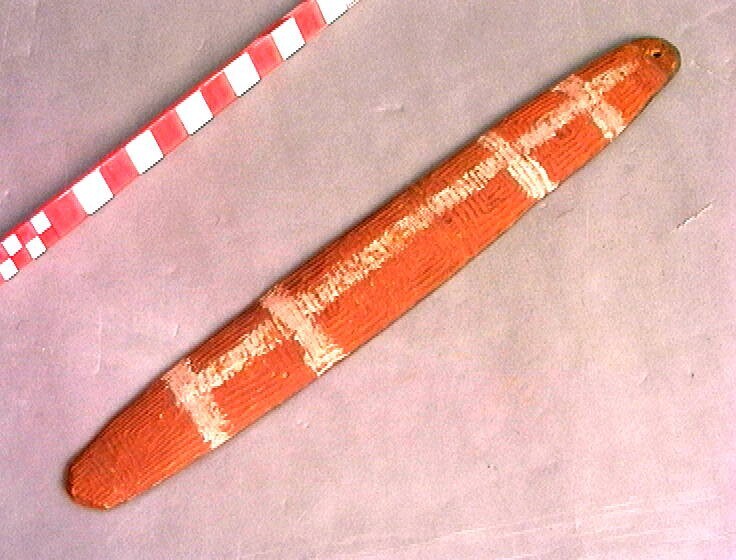
Now recall what the whirlwind does three hundred pages later in the very same book. Caught by a woman, it puts a spirit-child inside her. So one wind-vortex stands at both ends of a Central Australian life: it ensouls the child at conception, and it manufactures the roarer that opens the rite in which the boy is unmade and remade. Spencer and Gillen felt the pull of this — they wrote that “the relationship between the whirlwind and the bull-roarer used at initiation is very suggestive” — but they left the remark hanging and never carried it back to their own conception passage. Put the two together and the roarer is revealed as a soul-carrying technology: the whirlwind is deployed twice in a lifetime, once to bring the soul in, and once, through the roarer it makes, to bring the man out. (Central Australia carries the soul-installation further still: the churinga is named as the initiand’s own second body.)
The mimic storm
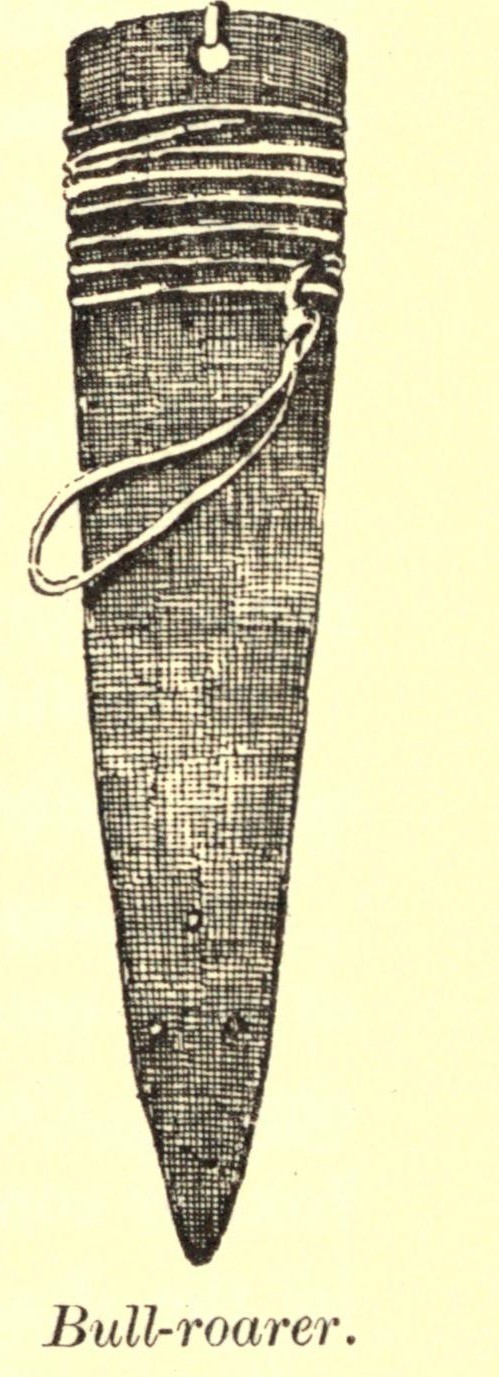
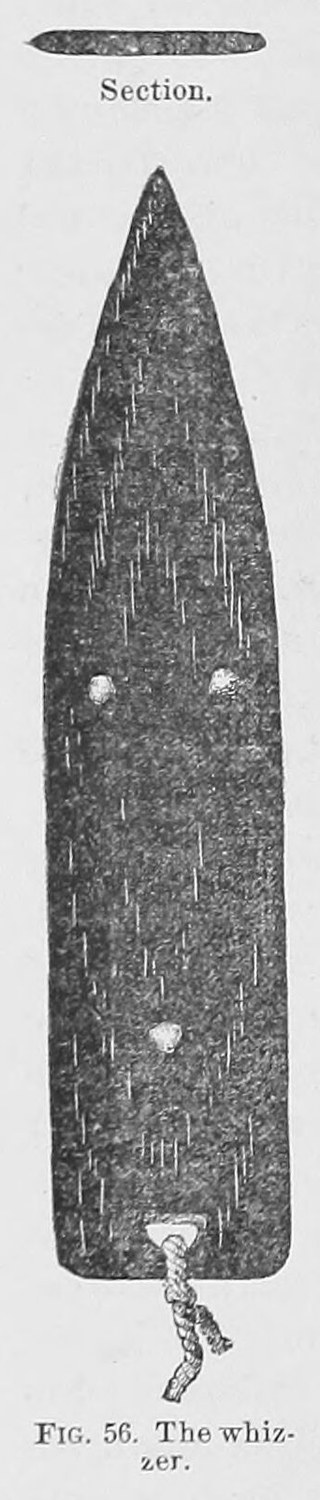
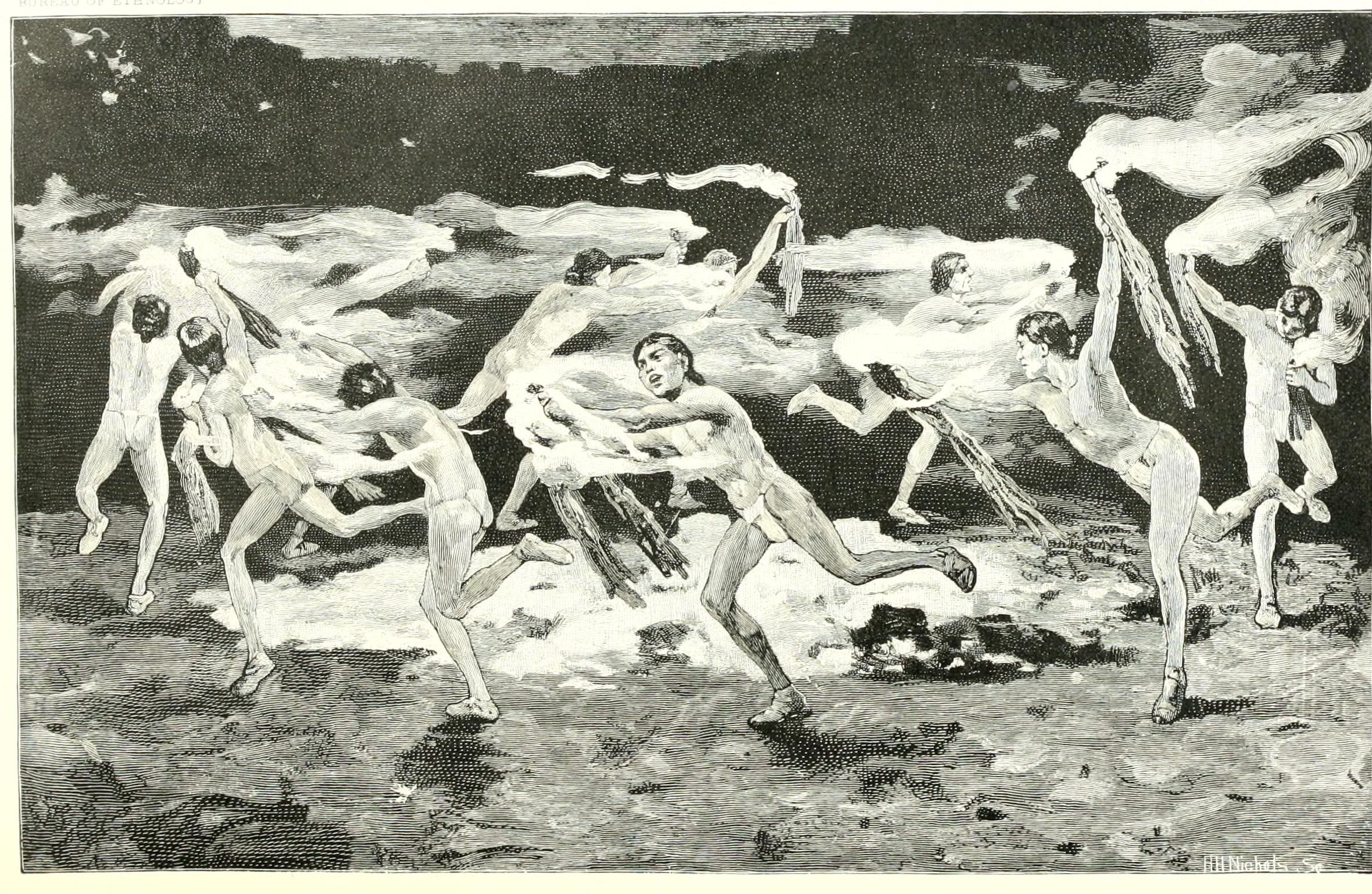
The second meeting is the one no one seems to have named, and it is the richer of the two. In the Navajo Mountain Chant — a nine-day healing ceremony recorded by the army surgeon Washington Matthews in 1887 — a dancer leads the third-night procession carrying a whizzer, which “he constantly whirled, producing a sound like that of a rain storm.” Matthews calls it making “his mimic storm.” The instrument is the tsin-di'ni', the “groaning stick,” and the chanters say the sacred one may be cut only from “the wood of a pine tree which has been struck by lightning.” A storm-scarred tree, swung to sound like storm.
The rite re-enacts a myth, and the myth turns on a whirlwind. The hero, exhausted and pursued, finds the Wind God, Niltci (the Holy Wind, Níłch'i), at his side:
“And Niltci brought a great dark whirlwind, which roared a moment beside them and then buried its point in the ground and dug a deep hole there; it dug a cavern with four chambers. … Niltci … told the Navajo to descend into the retreat which the whirlwind had formed. He went down and rested secure, while he heard overhead great peals of thunder, the loud rushing of the tempest, and the heavy pattering of enormous hailstones.”
Washington Matthews, The Mountain Chant (1887), par. 39
The storm dies, and the Wind God calls him back up out of the ground, his enemies scattered. It is a descent into the whirlwind and a return from it — a small death and rebirth inside the wind-vortex, worked not by a swallowing monster but by the wind itself. So within one ceremony three things stand together: a roarer whose whole job is to be the storm-wind; the Wind God Níłch'i, who is also the animating soul of every Navajo, cast as the rescuer; and a going-down-and-coming-back that is the deep grammar of initiation everywhere. The elements are all in Matthews and McNeley; they have simply never been laid side by side. (The Lightning god the travellers reach next in the same journey is “bald, like the Great Serpent” — a serpent standing, as so often, just at the edge of the roarer’s world.)
The whirlwind complex
Lay the strata one on another and a single figure comes clear. There is an instrument-class whose sound is wind, used across continents that never met to make wind, on a native theory that is really rough acoustics — and the acoustics are right, because the swung slat is a rotating aerofoil that sheds a helical vortex, a whirlwind you can carry. There is an independent, equally wide belief that the whirlwind is animate: the willy-willy that ferries spirit-children into women, the dust-devil that is the walking dead. And in the two places where one people holds both at once, the beliefs fuse and the roarer becomes a soul-engine: made by the whirlwind at Anula, and roared as a “mimic storm” inside the Wind God’s whirlwind-cave in the Navajo desert.
And the complex behaves like a law, because it obeys its own condition. The roarer becomes a soul-engine exactly where the cosmology already makes wind a soul, and stays a plain weather-tool where the wind carries nothing but weather: the Norwegian fisherman’s hurre guards against the fjord squall and asks no more of the air, because for him the squall holds herring-weather, not the dead. That is what a real mechanism looks like — the fusion fires where the fuel is present. And everywhere between the two poles, the halves are visibly drifting toward each other. The Even roarer sits among instruments “said to mimic the wind … the work of spirits”; the Enets name their wind-whirler in one breath with the bell rung to address the soul of the dead. Wind-tool and soul-tool keep turning up in the same sound-world, one word away from being called the same thing.
The standard treatments keep the two drawers shut — wind-magic filed under weather, ghost-lore filed under religion, and never a corridor cut between them. The corridor is the whirlwind, which is at once the shape of the wind and the shape of the soul, and which the roarer, spun on its cord, manufactures out of thin air. What the bull-roarer makes, wherever it is swung, is a wind. What that wind carries depends on who is listening. Sometimes it is only weather. Sometimes it is a storm called down to heal. And sometimes it is a soul, going in or coming out.
Key sources
Matthews, W. 1887. The Mountain Chant: A Navajo Ceremony (Fifth Annual Report, Bureau of Ethnology), pars. 39 (the Wind God’s whirlwind-cave), 133, 135 (the whizzer, the “mimic storm,” tsin-di'ni' and the lightning-struck pine).
Spencer, B. & Gillen, F. J. 1904. The Northern Tribes of Central Australia. London: Macmillan, pp. 280–281 (the Anula bull-roarer “made, in the first instance, by the whirlwind”; the “very suggestive” note), 631–632 (spirit-children travel in whirlwinds and enter women).
McNeley, J. K. 1981. Holy Wind in Navajo Philosophy. Tucson: University of Arizona Press — Níłch'i, the Holy Wind, as the animating breath that enters at birth; and the ch'íídii as the dust-devil ghost of the dead.
Kroeber, A. L. 1908. Ethnology of the Gros Ventre (Anthropological Papers, AMNH) — the roarer nakaantan, “making cold,” from “the widespread Indian idea that the bull-roarer breeds wind.”
Loeb, E. M. 1929. “Tribal Initiations and Secret Societies” (University of California Publications in American Archaeology and Ethnology 25) — the Arapaho roarer “held to produce wind because it sounded like wind.”
Haddon, A. C. (ed.) 1904–1912. Reports of the Cambridge Anthropological Expedition to Torres Straits, vols. IV–VI — the bigo/bigu swung to raise and quell wind on Mer, Moa, and Mabuiag.
Best, E. 1925. Games and Pastimes of the Maori (Dominion Museum Bulletin 8), pp. 293–296 — the Ngati Porou roarer and the children chided for sounding it.
Munro, N. G. 1962. Ainu Creed and Cult (on the Ainu rera-suyep, “wind-swinger”); Riddell, F. A. 1960. Honey Lake Paiute Ethnography, pp. 50–51 (Northern Paiute tupununoin); Opler, M. E. (Eastern Apache); and Smith, A. M. 1974. Ethnography of the Northern Utes, p. 164 (Ute) — the wind-calling function and the child-prohibition across the Great Basin and Southwest, as compiled in Buckner, W. 2019, “The Bullroarer” (Traditions of Conflict).
Soldatova, G. E. 2019. Традиционная культура 20:4, pp. 51–52 (the Mansi “wind-calling flying board”); Sheikin, Yu. I. 2002, via Arctic Megapedia (the Enets and Nganasan wind-whirlers); Lund, C. S. “The Bullroarer: A Global and Timeless Sound Instrument” (EMAP exhibition volume), p. 31 (the Nenets, and the Norwegian fjord fishermen’s wind-charm).
Roger, M. & Aubert, S. 2006. “Aeroacoustics of the Bullroarer.” Acta Acustica united with Acustica — the roar as an oscillating-rotating dipole; the airfoil slat autorotates and sheds a helical vortex wake.
Assembling the wind-making cluster and the whirlwind-soul cluster into a single complex, and joining them at the Anula and Mountain-Chant loci with the aeroacoustic fact that a swung roarer really is a small whirlwind, is, as far as we know, original to this page. The individual data — wind-making, whirlwind-souls, the Anula “very suggestive” note, the Mountain Chant, and Níłch'i — all stand on the sources above.