Atlas Essay —
The Relay
Torres Strait · the Kasai · Lake Iro · Vancouver Island · the Trans-Fly · the Papuan Gulf · the Tanami
On Boigu, the northernmost island of Torres Strait, a man swung the first bullroarer before his own people, and some of them ran into the water. Then the men of Saibai and Budji came to find out what the sound was, and they wanted it. The Kiwai who told the story to Gunnar Landtman remembered what it cost: the visitors brought their women to the Boigu men as the price of admission into the secret, and the Boigu men, somewhat reluctantly, handed over the roarers and showed them how to use them. The roarer did not travel as a thing. It travelled as a secret, with its rite, its medicine, its rule against women and its work in the yam gardens, and it was paid for. Every hand-off of a bullroarer cult that history has caught in the act looks like this one.
In brief
- Every documented hand-off of a bullroarer cult moves the whole complex: the rite, the roarer as a spirit's voice, and the death and rebirth of boys, from neighbour to neighbour, often for a price.
- The Goula Iro of Chad took their roarer-voiced initiation from the Sara in the 1860s, and the Sara say they had it from the Mbay. The Bushongo of the Congo had theirs from the Bakete about 1625, and the Bakete perhaps from the Baluba.
- On the Northwest Coast the Wolf Dance reached the Hupachisat four or five generations before 1936, roarer and all; a new member's friends paid property to the society's chief. At Boigu the price was women.
- The donor's own words travel with the rite: Cupeño children danced to songs in Luiseño, and the Marind took the sosom feast from the Kanum “including the myths that belong to it.”
- A roarer bought without its rite arrives as a toy. The instrument does not travel alone, which is why it keeps the same meaning wherever it goes.
- Borrowers call the rite their own within a few generations, so only the latest hand-offs are ever remembered. A dated transfer is the relay caught in the act, not evidence against a deep origin. That relay is how an ancient institution reached four continents.
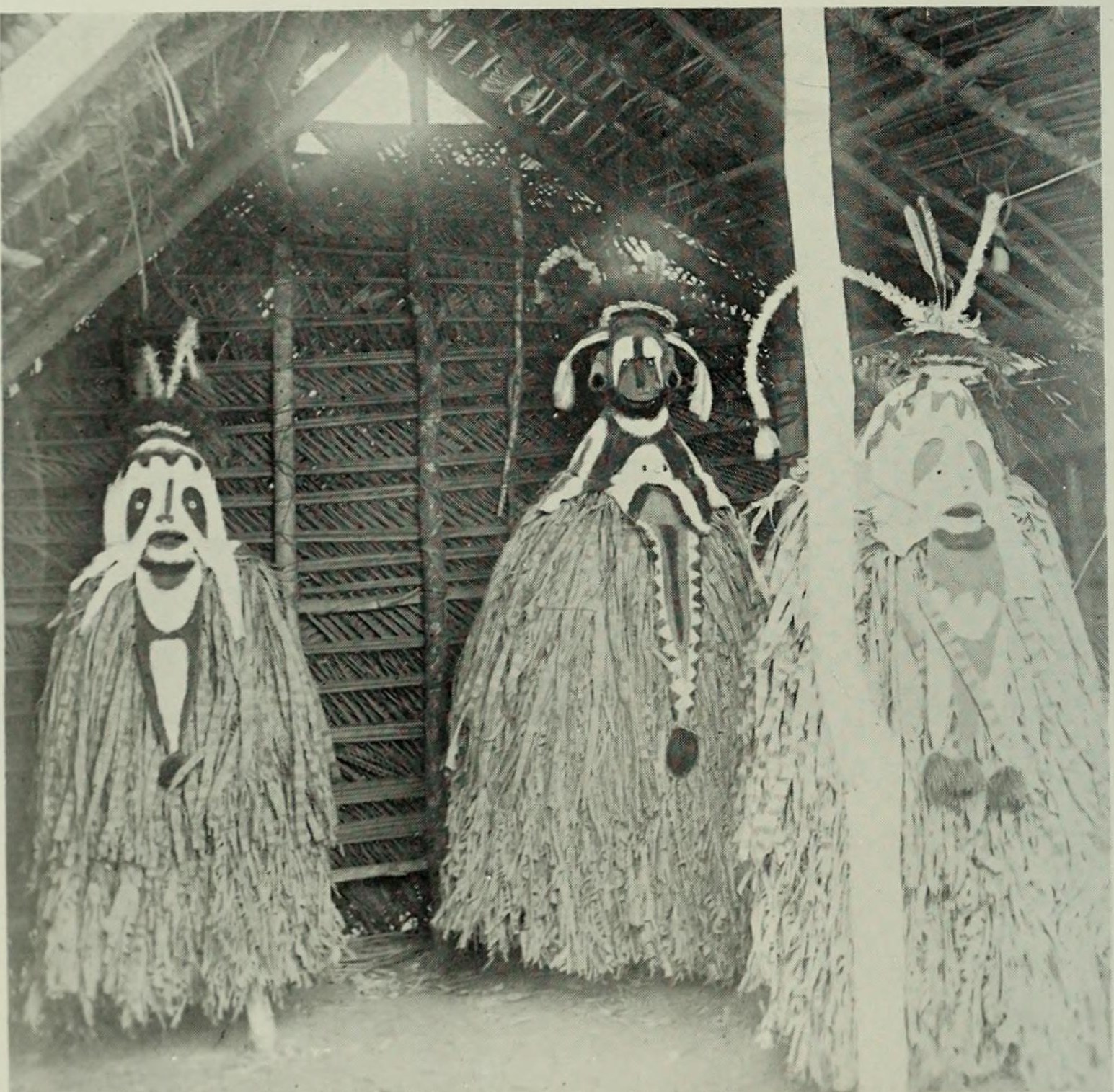
Every documented hand-off of a bullroarer cult moves the whole complex — the rite, the roarer as a spirit's voice, the death and rebirth of boys — between neighbours, often for a price. That relay, run over and over, is how one ancient institution reached four continents, and a dated hand-off is the relay caught in the act, not evidence against a deep origin.
The price of admission
The Kiwai live at the mouth of the Fly River in southern Papua New Guinea, facing the low islands of Torres Strait. Their story of the first bullroarer begins with a woman, Méte, splitting firewood on Boigu, when a chip flies up crying bigu, bigu. In a dream the chip tells her how to bore it, string it and anoint it so that it will make the yams grow. Her husband swings it, the ground shakes, and he calls the men together, sends the women away and draws his bow on anyone who would tell. Then the story turns outward, and Landtman took down its ending as he heard it from Námai of Mawáta:
“The man let the others swing the bull-roarer too, and everyone of them went afterwards and made a similar thing for himself, and the sound of bull-roarers was heard all over Bóigu. The first man taught the rest how to use them when planting yams. The Sáibai and Búdji men and many other people came to find out what the wonderful sound was, and all wanted bull-roarers. They brought their women to the Bóigu men as the price of their admission into the secret, and somewhat reluctantly the Bóigu men gave them bull-roarers and showed them how to handle them. The use of bull-roarers began in Bóigu and spread thence all over the country. The old people prepared the secret ‘medicine’ for the bull-roarers, and the younger men only used them when ready, for not until they had attained a considerable age were all the details revealed to them.”
— Gunnar Landtman, The Folk-Tales of the Kiwai Papuans (1917), tale 261, “The First Bull-Roarer,” p. 317
Everything that matters is in that paragraph. The thing that spreads is a secret, not an object: the Saibai men could have carved a slat of wood themselves, and what they paid for was admission. The secret arrives with its use, the yam rite, and with its graded knowledge, the medicine the old men keep back until the young ones are old enough. It moves to the neighbours, island to island. And it costs something real. The Kiwai say the bullroarer came to them from Boigu, and the word for it rides the same route: bigu on Mabuiag in the western Strait, bigo on Mer in the east, bigu and boigu in the Kiwai tale.
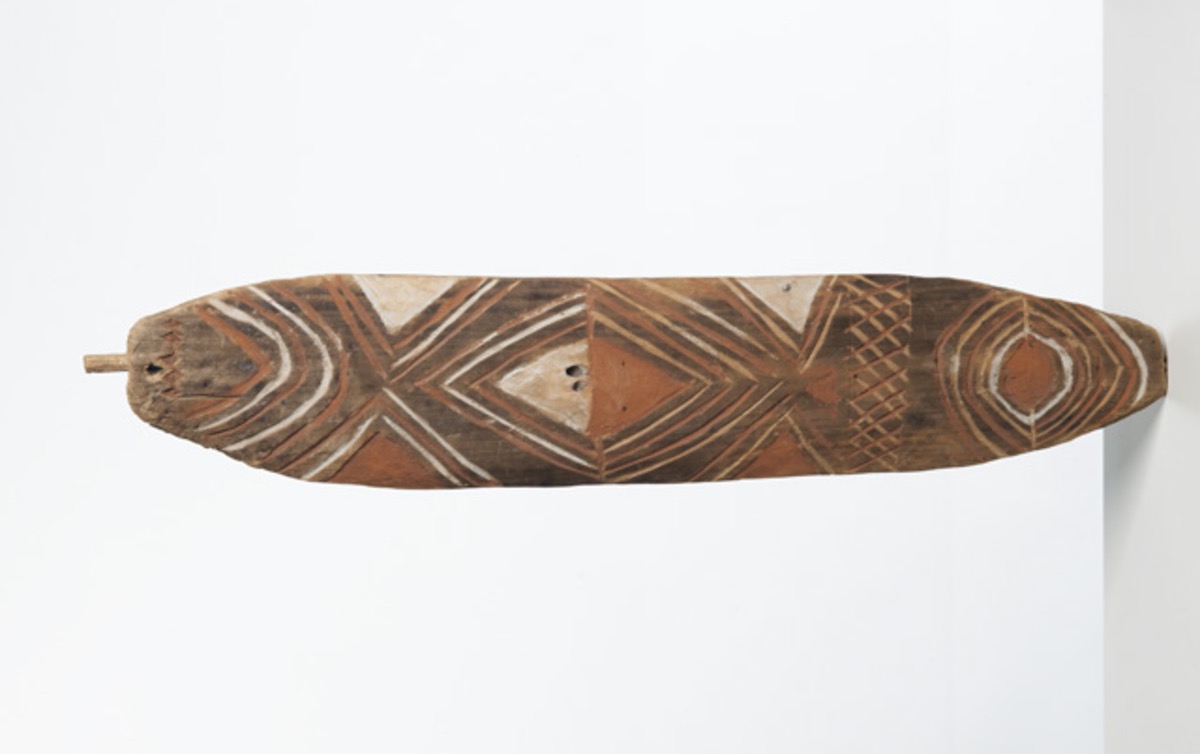
A price recurs wherever these cults take in newcomers. On the Northwest Coast of North America, Franz Boas found that anyone who wished to join the Nootka winter society could do so, or be invited, and then “the friends of this man make a collection in his behalf and turn over the property collected to the chief of the Lo'koala, who distributes it during a feast among the members.” Among the Coast Miwok of California, where the whirled umul was the voice of the ghosts and of thunder, “an entrance fee, payable in bead money (later in commodities), was required,” and a stranger who blundered into the Pololo dance “had to pay in beads and join the society.” On the Cross River in Nigeria the Efik of Old Calabar took the Ekpe society over from their Ekoi neighbours, a spirit “never seen but only heard,” and built it into a graded society “whose higher grades were restricted to those who could afford the exorbitant entrance fees.” Among the Ekoi themselves the roarers of the men's clubs were called Enyara Akum, “the dark things of the clubs,” and women were not allowed to learn what made the noise.
A secret that can be bought is a secret that can be sold, and the people who sell it are always the neighbours.
A hundred years ago, from the Sara
In 1959 the French ethnologist Claude Pairault settled at Boum Kabir, a village of the Goula Iro between Lake Iro and the Bahr Salamat in south-eastern Chad. Boys there, at ten or fifteen, were called to “die yondo”: with their age-mates they went through a symbolic burial outside the village, and came back reborn as a new generation of men. On the first page of his article Pairault explained the word in a footnote, and the footnote gives the cult a date:
“Yondo (or yontô in phonological spelling) denotes the men's initiation, whose model the Goula Iro borrowed from their Sara neighbours about a hundred years ago. Written with a capital, Yontô is the proper name of the spirit who presides over the death and rebirth of the young novices taken into the bush. The bullroarer is identified with the speech of Yontô.”
— Claude Pairault, “Boum Kabir en présence de la mort,” Journal de la Société des Africanistes 34 (1964), p. 141 n. 3, translated from the French
About 1864, then, the Goula Iro took from their neighbours not a noise-maker but a model: a named spirit, a bush camp, a death, a rebirth, and a roarer that is the spirit's speech. Follow the Sara and the chain goes back another step. Among the Sar of the old kingdom of Bédaya, the priests who lead each band of boys hold the roarer, whose sound is called “the chief of the dead” and “the voice of the ancestors,” and the head of those priests is the king himself. At the exit of the initiation camp stands a guardian post, “a sacred relic called Mbay njow kor, a post half a metre to a metre high, brought back from the Mbay together with the secret of the initiation.” The Sar name their donors and keep a piece of them planted at the gate.
And the Mbay have it too. A film made near Moïssala in 1968 records the first night of their initiation, the ndo: the boys are whipped out of a hut, a masked bird dances past them, the master knocks each boy's head against a log “so that your body may become hard,” and when they lie down to sleep near the village, “if they still chatter, the bullroarer (kinga-muru-mbi) howls out near them; then they are afraid and fall silent.” The film's author glossed the name of the camp: yo-ndo names the bush camp itself, “but also means ‘outwitting death’,” and the initiation is “a feigned death with the aim of a ritual rebirth.” The Mbay yo-ndo is the Goula Iro yondo. The name went down the line with the rite, from the Mbay to the Sar to the Goula Iro, and at each step the receivers said where they had it from.
Under Bongo Lenge
The Bushongo, the royal people of the Kuba kingdom in the Kasai of what is now the Democratic Republic of the Congo, kept a list of their kings, and Emil Torday, who worked among them for the British Museum in 1907–09, used it to date their institutions. Two initiations were held in the capital. The lesser one, still practised, shut boys of eight or ten in a bush enclosure for nine days. The greater one, the Nkanda, was for youths at puberty, and it had a history:
“It is said to have had its origin among the Bakete, and to have been introduced among the western sub-tribes in the reign of Bongo Lenge (about 1625). The Bakete claim to be related to the Baluba, and this theory seems to be confirmed by their dialect. It is not impossible that the ceremony had its first origin among the Baluba.”
— E. Torday and T. A. Joyce, Les Bushongo (1910), p. 82, translated from the French
Bongo Lenge was the successor of Shamba Bolongongo, the culture hero-king of the Kuba, and the chronicle remembers the Nkanda's arrival by the trouble it caused. A band of men, punished by the king with ten months' exile in the forest without clothes or the sight of their wives, ran away eastward and founded a colony near Lusambo that still existed in Torday's day; because the Nkanda came in under that same king, it was said that their offence had been to refuse the ordeal. What came in was the full rite. The youths went naked into the forest under one of the king's sons, wearing only a comb of plaited rattan, impure, unseen; a woman who met them had to flee. And at night the roar began:
“At night the old men surround the camp, raise the most unearthly cries, and whirl instruments made of very thin strips of palm-leaf rib tied to a string (bullroarers). The man in charge of this rite, who bears the name Kananyenge, visits the young men from time to time, and they, much alarmed, tell him that ghosts go about at night. The Kananyenge answers: ‘Surely you are not afraid of ghosts, you who are so impertinent and mock your elders! Do not run away; soon I will come back and show you the things that have frightened you so.’”
— Torday and Joyce (1910), pp. 82–83, translated from the French
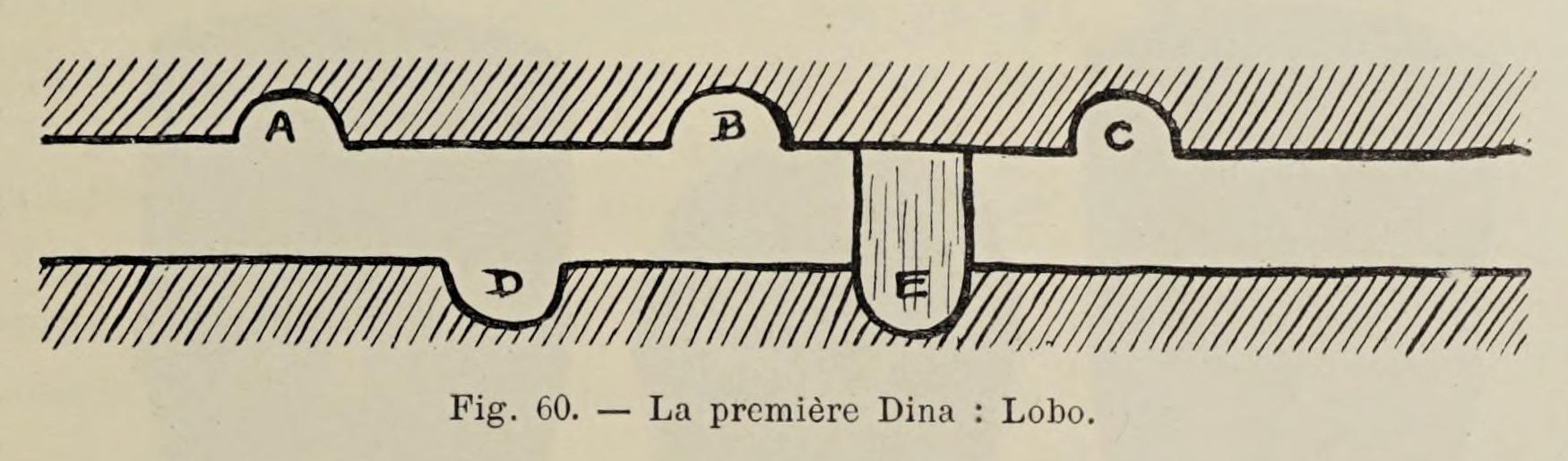
After a month came the first ordeal, the Lobo: a covered trench ten feet deep with five niches in its walls, in which waited a man in a leopard's skin, a warrior with a knife, a smith with two red-hot irons, a pit of water and a grotesque figure with another knife. One by one the youths were driven through. “The idea contained in this ordeal,” the authors wrote, “is that the novices must show that they fear neither beasts, nor men, nor fire, nor water, nor ghosts.” Each boy went into the earth and came out the other end.
Yet the king also told Torday the Nkanda's origin as a Bushongo story: a son who kept his palm wine from his father, a father who waited for him on the forest path at dusk and frightened him with a strip of palm-leaf rib whirled on a cord, and the old men of the village, called together that night, agreeing to do the same with all their sons. “Such is the origin of the Nkanda initiation.” The two accounts sit side by side in the same book: the chronicle says the rite came from the Bakete under Bongo Lenge, and the king's story says it was born in a Bushongo village. The Nkanda then held for more than two and a half centuries, until it lapsed in 1885. A rite that arrives whole can stay a long time.
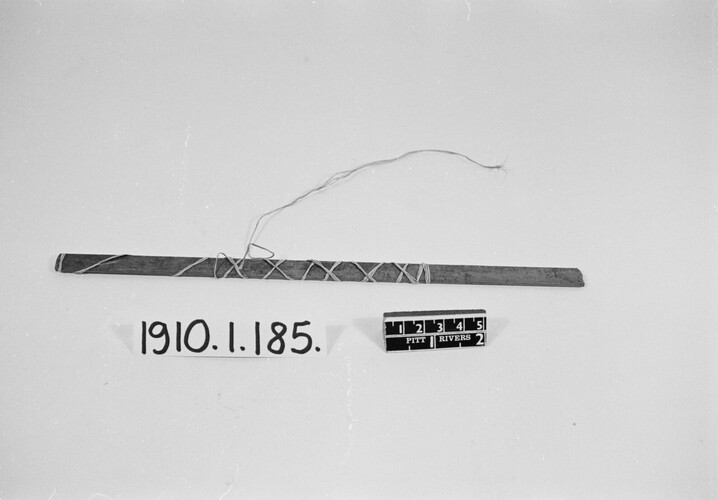
Four or five generations
The great winter ceremonial of the Northwest Coast was a secret society of the dead and the reborn. On Vancouver Island the Nootka said it was founded by wolves, who carried off a chief's son, failed to kill him, became his friends and taught him the rite, and ordered him to teach it to his people when they brought him home. Its name, Boas found, was not Nootka at all: “The name of the ceremonial among the Nootka is Lo'koala, a Kwakiutl word, which designates the finding of a manitou.” The rite came with the giver's word for it, and Boas drew the general conclusion from the whole coast: the ceremonials are “in the main derived from the same source,” and “the most certain proof of their common origin lies in the identity of name among the various tribes.”
One of the coast's peoples could say roughly when the ceremonial reached them. In the 1930s Philip Drucker asked informants up and down the coast whether they had the bullroarer, and against the Hupachisat of Alberni Inlet he put a mark found nowhere else in his tables, present but recent. His note explains it:
“The statement of ‘recency’ refers to the informant's belief that the Wolf Dance (Loqwana) was fairly recent among his people, having been introduced since they became Nootkanized four or five generations ago.”
— Philip Drucker, Culture Element Distributions XXVI: Northwest Coast (1950), p. 268
The Hupachisat had been “not Nootkan but Salishan in speech and culture” not many generations before. When they became Nootkan, they took the Wolf Dance from their new neighbours, and the roarer came in inside it. Drucker's informants elsewhere on the coast agreed what the instrument was for: it was used in the Wolf Dance.
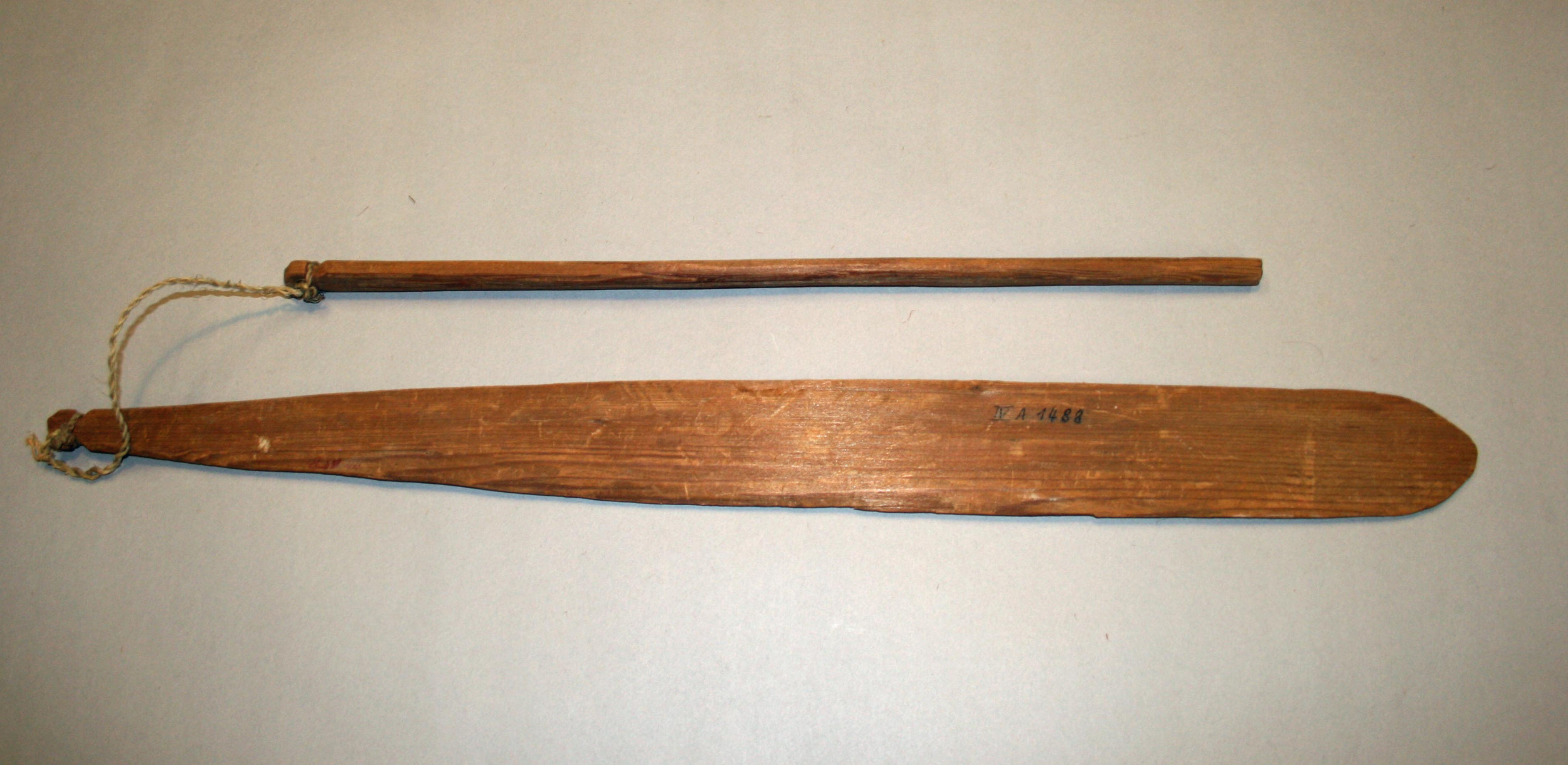
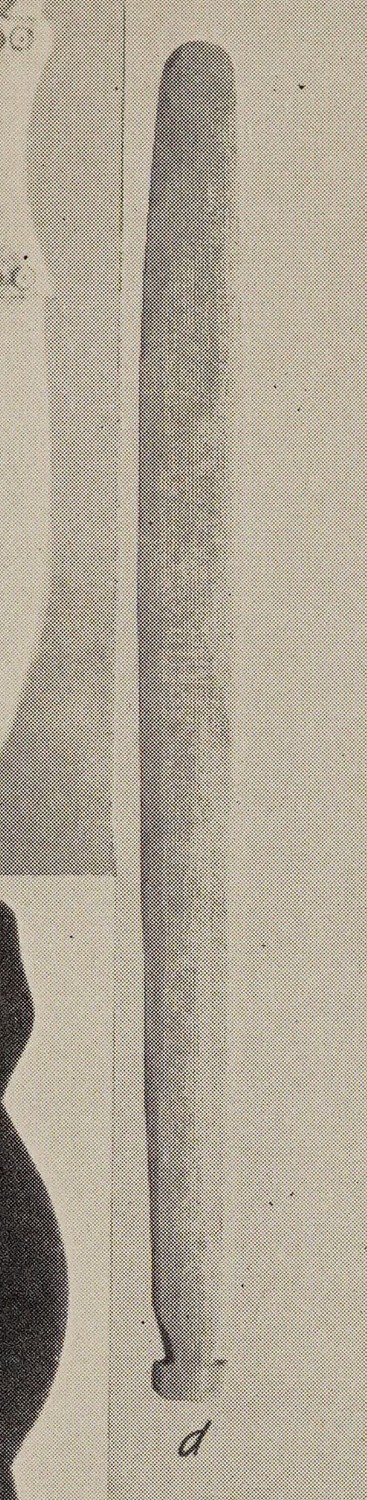
South across Juan de Fuca Strait the same ceremonial reached the Makah at Cape Flattery as the Klokali, and the Makah remembered it as a thing that grew on the road. Luke Markishtum told Frances Densmore: “The Klokali came up from the west coast of Vancouver Island, each tribe that it passed through adding something to it.” Young Doctor told her its purpose was “to display wealth,” and that he had given a Klokali three times. Men hid in the woods with whistles “imitating wolves,” came in and took a man “to be initiated,” and “the instruments used at Klokali included four or five bull-roarers.”
Songs in the giver's tongue
A borrowed rite often keeps the donor's language, the way the Nootka kept the Kwakiutl word. In the mountains of southern California the Cupeño held a Whirling Dance for boys and girls of sixteen to twenty. The ceremonial leaders, the pahas, took the young people to a secluded place away from the village and taught them the songs and steps, and when they brought them back, one paha cried “hou-ou-ou!” and kicked the wall three times, the other answered from outside, and both whirled bullroarers, aīil, while each boy and girl danced in turn until exhausted. William Duncan Strong recorded two facts about the dance that belong together:
“All the songs were in the Luiseño language. … The Cupeño say that this is the way the dance came to them from the Luiseño.”
— W. D. Strong, Aboriginal Society in Southern California (1929), p. 258
The boys' initiation that followed, the Manet, had come the same way: it “was given the kavalim clan by Luiseño from Pichanga,” and some of its songs were in a language the Cupeño did not understand at all. A people who sing a rite in words they cannot follow are not improvising it. They are keeping a package exactly as it was handed over, down to the syllables. Among the Luiseño themselves the chief whirls the roarer three times in the Image ceremony, when the images of the dead are carried in and the singers chant “the spirit appears.”
The same thing happened on the Niger Delta. At Brass, an Ijaw town, the roarer cult called Noin-nama was, in the words of a local writer who watched it, “equivalent to the Yoruba term Oro,” and the sentence the roarer was made to speak there, Aiye jona pelu Iya, was in Yoruba. The name of the cult changed at the language line; the voice kept speaking the language of the people it came from.
The fish-shaped voice goes west
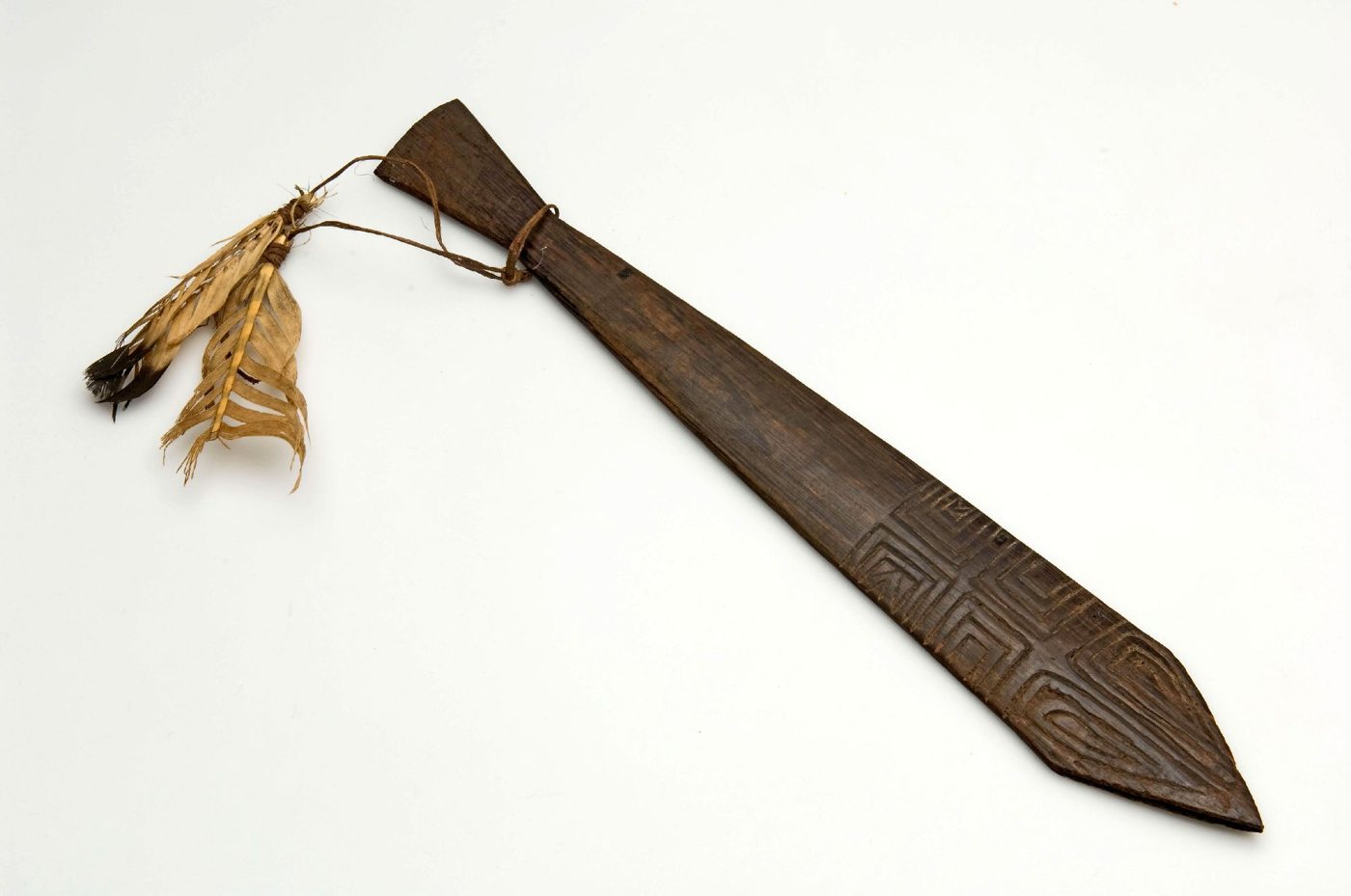
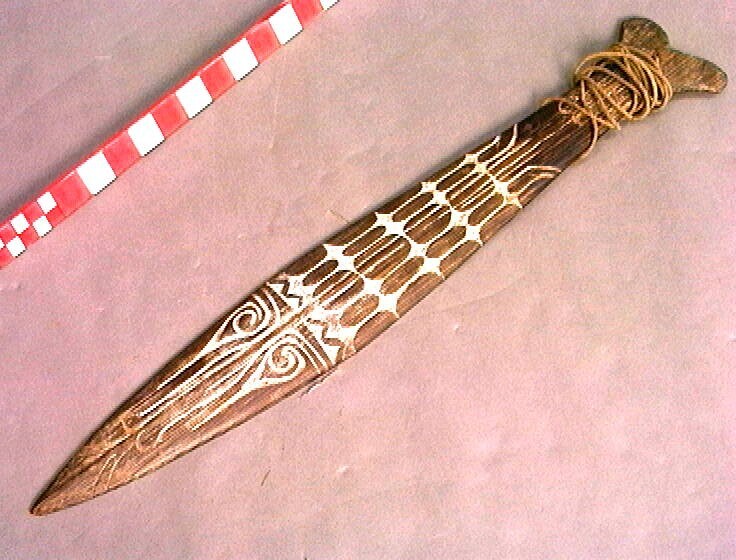
Back in New Guinea, on the south coast west of the Fly, the Marind-anim held the feast of Sosom, a giant so vast he stands with a foot on each bank of the Merauke River, who comes each year with the south-east monsoon. Women may not look on him. The bullroarer, carved in the shape of a fish, is his voice, and at initiation it is Sosom himself, who swallows the novices and brings them back. The Swiss ethnologist Paul Wirz, who lived among the Marind from 1916 to 1919, recorded where the feast had come from, and the musicologist Jaap Kunst set it down after him:
“In the Dutch part of the island it came, according to Wirz, without any doubt from the East, together with certain secret rites. The Marind-anim, for example, took over from the Kanum-anim the Sosom feast, in which the bullroarer carved in the shape of a fish plays an indispensable part as the voice of the giant Sosom, and this whole feast, including the myths that belong to it, is said to show striking agreement with the initiation ceremonies and legends of the Bukaua, Yabim and Tami in eastern New Guinea.”
— Jaap Kunst, De inheemse muziek in westelijk Nieuw-Guinea (1950), p. 76, translated from the Dutch
Kunst's footnote takes the chain one more step east: the Kanum had it “apparently in turn from the Keraki tribe living east of them, who call the giant corresponding to Sosom, and likewise the bullroarer representing his voice, sosa!” Three peoples, three steps, one giant whose voice is the roarer, and one name, sosa becoming sosom. “Including the myths” is the whole point. The Marind did not take a fish-shaped slat; they took a feast, a giant, his story and his voice.
The far end of Kunst's comparison is the Huon Gulf, on the north-east coast of New Guinea, where the Yabim, Bukaua and Tami told their boys that a monster swallowed them at circumcision and gave them back as men, and used one word for the monster, the roarer and the dead. The Bukawa, too, named their donors across the water: they traced their ritual bullroarers to a village near the mouth of the Waria River far to the south, and the missionary Georg Bamler judged that the Tami cult had come from much further afield than the island where their own story set its discovery.
The borrowers call it their own
At Waima and Hisiu on Hall Sound, on the south coast of Papua east of the Gulf, C. G. Seligman found the kaivakuku, masked men who alone could pronounce the most dreaded taboo on garden food. By day they walked the village on the sides of their feet so that no one would recognise them. “At night they would swing bull-roarers.” Of their origin Seligman had no doubt at all:
“Among the Roro-speaking tribes they exist only at Waima, Hisiu, and perhaps at Kevori, and there is not the slightest doubt that the custom has been introduced from the Elema tribe of the Papuan Gulf.”
— C. G. Seligman, The Melanesians of British New Guinea (1910), p. 299
Seligman added a note, drawing on his fellow fieldworker Dr W. M. Strong: “It appeared, however, that the Waima folk considered the custom their own, though Dr Strong writes that Inawi, the one village of Mekeo who have kaivakuku, admit that they acquired the custom from the Gulf.” Two villages had received the same complex from the same donors. One still remembered the gift. The other had already made it its own. The Elema end is on record too: among the Elema the conical-masked Kovave, “messengers of the mountain god,” walked in the same initiation cycle as the nightly roarers, and a man who told that the voice was “not the cry of a god but the work of a man” was put to death. At Waima the kaivakuku were taken seriously but were less dreaded than among the Elema, and a man who broke their taboo could buy them off: they would raid his property, killing his pigs and dogs, “only desisting when a present was made to them.”
Lake Kutubu, in the highlands of Papua, shows the moment of handover itself. When F. E. Williams worked there in the late 1930s the bullroarer, amaga, had its headquarters at the village of Wasemi. Its arrival was within living memory: it “had occurred in the boyhood of the old man Yaru, who was said to have been the first Kutubuan initiate; and the initiators had been invited for the purpose from Kaibu.” The Kutubu men could say little yet about what the rite meant, and Williams, who knew the roarer elsewhere as a monster that is always demanding food, expected the meaning to follow the form: the cult, he wrote, would spread through the lake “and its functions will develop in the process.” A cult does not arrive as a doctrine. It arrives as men invited to perform it, and the meaning catches up, as the Warlpiri show.
“The same as that which we know of”
In the early 1880s the ethnographer A. W. Howitt persuaded the Yuin of the south coast of New South Wales to hold their initiation, the Kuringal, so that he could witness it. He took with him a bullroarer he had made himself, and secretly showed it to the old headman Brupin. The two old men put their hands over their mouths and looked at it for some moments. Then Brupin called over the men he had brought and held it up before them:
“This is a mudthi which he (pointing to me) has brought from a long way off. It is the same as that which we know of, and which was given to our fathers by that great Biamban you know about.”
— A. W. Howitt, The Native Tribes of South-East Australia (1904), pp. 517–518
At the Kuringal itself Howitt brought a second roarer, “one from the Dieri tribe, and had been used at one of their ceremonies,” from the Lake Eyre country some 1,500 kilometres inland. “The Yuin looked at it with great interest. I was surprised that they should wish to use it.” They did: the Dieri roarer was swung to rouse the camp, and every man sprang to his feet, for “the roaring of the Mudthi represents the muttering of thunder, and the thunder is the voice of Daramulun.” A roarer from the far side of the continent was not foreign to the Yuin. It was the thing their fathers had been given.
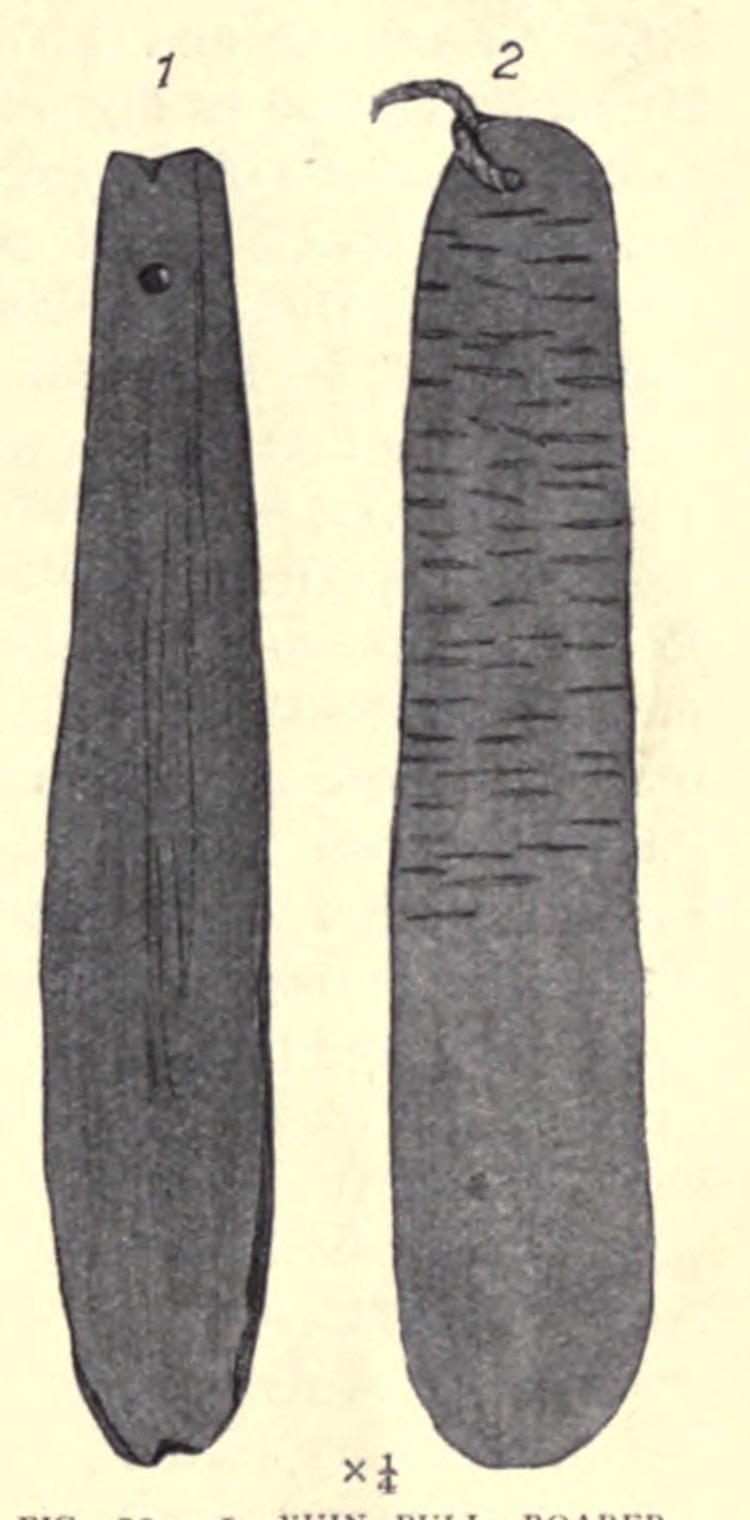
In the Tanami Desert of Central Australia the Warlpiri hold a cult they call katjiri, and they know it is foreign. “The word katjiri itself means ‘woman,’” the ethnomusicologist Stephen Wild wrote, “although the Walbiri recognize it as belonging to languages spoken north of them.” Its main symbols are two bullroarers, a small shrill one and a large deep one, and the small one is the elder sister of the large. Blindfolded novices are told that the Two Sisters are walking close by; then the roarer is swung for them, and “they are told that it is the Two Sisters themselves.” The rite ends in a birth. The boys sit in a pit dug at the centre of the ground, the womb of the Two Sisters, under a twelve-foot pole that is “a huge bullroarer in the form of a tall flattened pole,” and crawl out of the pit along its length.
The katjiri shows what happens after a hand-off. When M. J. Meggitt worked among the Warlpiri in the mid-1950s, they said the cult's heroes were men, “despite the fact that a substantial part of it was evidently borrowed from northern tribes where the heroes are female.” By about 1970, Wild found, “the Walbiri explicitly assign the katjiri heroes to the female sex.” Within fifteen years the borrowed cult had settled back into the shape it had where it came from. To the west at Balgo, among the Walmajarri and Kukatja, the same cult belongs to the Old Woman, the Mother, and its origin myth says her women swung the roarers first. The package travels with its own centre of gravity, and where a receiver bends it, it springs back.
The hand-offs on record
Set side by side, the documented transfers make one pattern. The receivers are neighbours of the givers; what passes is a rite with its spirit, its voice and its initiates; and the price, where it is recorded, is women, property or fees.
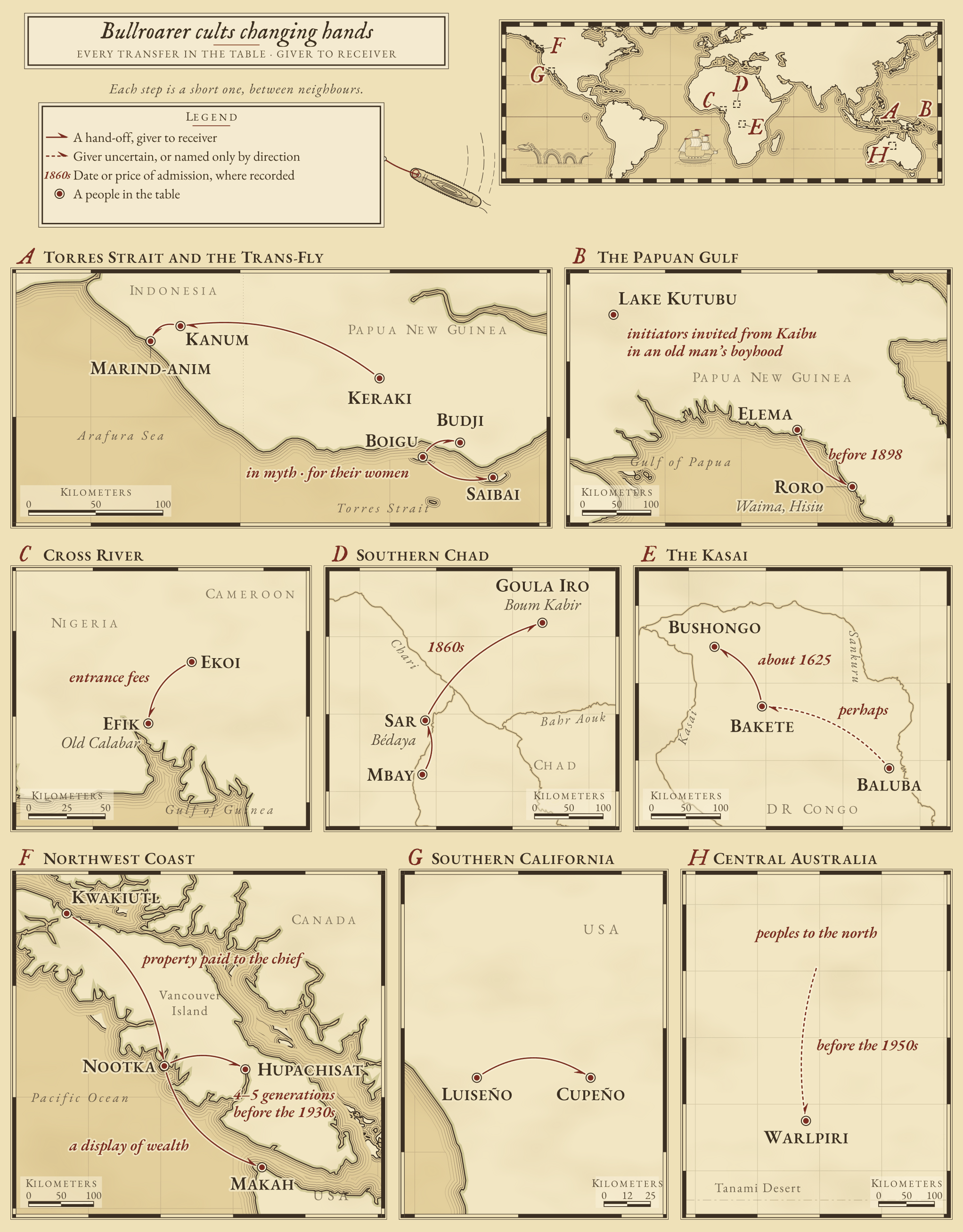
| Receivers | Givers | When | What moved | Price of admission |
|---|---|---|---|---|
| Saibai and Budji, Torres Strait | Boigu | in myth | the roarer, the secret, the yam rite and its medicine | their women |
| Goula Iro, Chad | Sara | 1860s | the yondo: a spirit, a death and rebirth, the roarer as his speech | |
| Sar of Bédaya, Chad | Mbay | unrecorded | “the secret of the initiation” and a guardian post | |
| Western Bushongo, Congo | Bakete, perhaps from the Baluba | about 1625 | the Nkanda: seclusion, the ghosts' roar, the trench of ordeals | |
| Hupachisat, Vancouver Island | Nootkan neighbours | four or five generations before the 1930s | the Wolf Dance, with its roarer | |
| Nootka | Kwakiutl | unrecorded | the Lo'koala and its name | property paid to the chief |
| Makah, Washington | west coast of Vancouver Island | unrecorded | the Klokali, with four or five roarers | a display of wealth |
| Cupeño, California | Luiseño | unrecorded | the Whirling Dance, its roarers and its songs in Luiseño | |
| Marind-anim, New Guinea | Kanum, from the Keraki | unrecorded | the Sosom feast, “including the myths” | |
| Roro of Waima and Hisiu, Papua | Elema | before 1898 | the masked kaivakuku and their night roarers | |
| Lake Kutubu, Papua | Kaibu | in an old man's boyhood | the amaga initiation, its initiators invited | |
| Warlpiri, Central Australia | peoples to the north | before the 1950s | the katjiri: its name, the Two Sisters roarers, the rebirth | |
| Efik of Old Calabar, Nigeria | Ekoi | unrecorded | Ekpe, the spirit heard and never seen | entrance fees |
Alone, it comes in as a toy
The roarer can travel without its rite, and when it does it arrives as something else. In Western Australia, Daisy Bates recorded the great trade roads along which spears, belts, pearl shell and magic stones passed for immense distances, and among the goods: “Bull-roarers, the most sacred Central Australian objects, were bought by the Bibbulmun, whose children whirled them in play.” The Bibbulmun of the south-west paid for the object and got an object. In the Naga Hills of north-east India the Rengma used bullroarers to scare birds off ripening fields, “but they are admittedly borrowed from the Semas, and may not be brought into the village”; their Sema neighbours used them for the same field work. In Torres Strait, Alfred Haddon was given a roarer in strict secrecy on Muralug, the chief whispering its name and making him promise never to show it to a woman, and a few weeks later on Mer watched mission-school boys from Saibai playing with the same thing in the open.
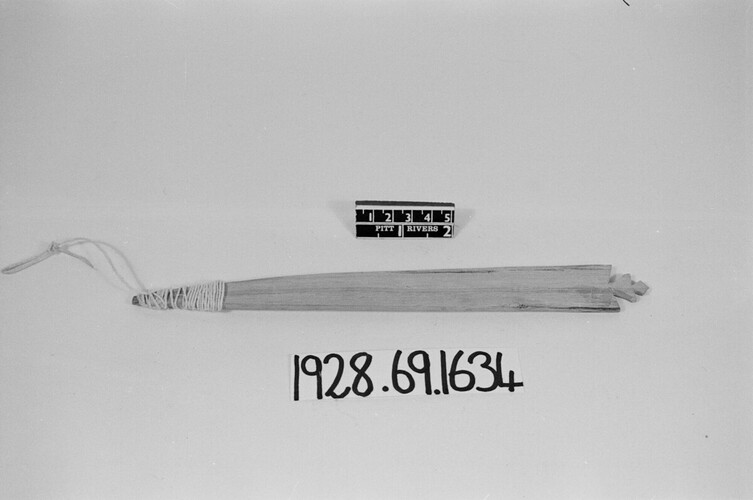
These cases are the control that proves the rule. A slat on a string can be copied by anyone who hears it, and wherever it is copied alone it becomes a toy or a tool. Yet across Australia, New Guinea, Africa and the Americas the roarer is, again and again, the secret voice of a spirit that swallows or kills boys and gives them back as men, kept from women on pain of death. That sameness cannot come from the object, which carries no instructions. It comes from the package. Edwin Loeb saw it in 1929:
Nor does the bullroarer travel alone in connection with male initiation rites. … There is no psychological principle involved which would necessarily group these elements together, and they therefore must be regarded as having been fortuitously grouped in one locality of the world, and then disseminated as a complex.— Edwin M. Loeb, Tribal Initiations and Secret Societies (1929), p. 285
The hand-offs on record are that dissemination, seen at close range.
The relay, caught in the act
Why are the hand-offs we can date all recent, a century here, four or five generations there, the reign of a king in 1625? Because borrowing is forgotten fast. Seligman caught the forgetting in progress: Inawi still said the kaivakuku came from the Gulf, and Waima, holding the same rite from the same people, already called it its own. The Bushongo kept the Nkanda's origin only because they kept a list of kings. A people that has held a rite for five hundred years does not say it was borrowed. It says the ancestors gave it, the way Brupin said the great Biamban gave the mudthi to the Yuin fathers, or it tells how a woman found the first one splitting firewood on its own ground. Remembered borrowing reaches back a century or two. Behind that horizon, every hand-off turns into an origin myth.
So the dated cases are not a rival to deep antiquity. They are the only part of an ancient relay that memory can still see. And they point backward. Each giver, asked in turn, names a giver of its own: the Goula Iro point to the Sara and the Sar point to the Mbay; the western Bushongo point to the Bakete and the Bakete to the Baluba; the Marind point to the Kanum and the Kanum to the Keraki; the Makah point up the coast, and the Nootka use a Kwakiutl word. Nowhere does a remembered chain end in a man who invented the rite from nothing. It ends where memory runs out, and there the origin myth takes over.
Run the relay long enough and it covers the world. Neighbour hands to neighbour, island to island, for women at Boigu and for property on Vancouver Island, a few hundred kilometres a step and a few generations a step. In a few thousand years an institution passed that way crosses a continent, and in the depth of time the bullroarer has had, it crosses all of them. The rite that reached Boum Kabir in the 1860s and the rite at Boigu are the same rite because they are one institution, handed on whole each time.
Every documented hand-off of a bullroarer cult moves the whole complex — the rite, the roarer as a spirit's voice, the death and rebirth of boys — between neighbours, often for a price. That relay, run over and over, is how one ancient institution reached four continents, and a dated hand-off is the relay caught in the act, not evidence against a deep origin.
Key sources
- Landtman, G. 1917. The Folk-Tales of the Kiwai Papuans. Helsingfors: Acta Societatis Scientiarum Fennicae 47, tale 261, “The First Bull-Roarer,” pp. 316–317.
- Boas, F. 1897. The Social Organization and the Secret Societies of the Kwakiutl Indians. Report of the U.S. National Museum for 1895, p. 632 (Nootka Lo'koala) and pp. 660–661.
- Loeb, E. M. 1932. “The Western Kuksu Cult.” University of California Publications in American Archaeology and Ethnology 33(1), pp. 116–117 (Coast Miwok).
- Jones, G. I. 1984. The Art of Eastern Nigeria. Cambridge University Press, quoted in Museum of Archaeology and Anthropology, Cambridge, photograph record 375964 (Ekpe). Talbot, P. A. 1912. In the Shadow of the Bush, p. 284 (Ekoi Enyara Akum).
- Pairault, C. 1964. “Boum Kabir en présence de la mort.” Journal de la Société des Africanistes 34(1), pp. 141–167, at p. 141 n. 3.
- Nodjitolabaye, N. 2019. Article on the sacred among the Sara Madjingaye of Bédaya, pp. 342, 345, after J. Fortier, Le couteau de jet sacré (1982). Konrad, W. 1973. Sara-M'Bai (Zentralafrika, Mittlerer Schari): Herstellen einer Maske für die Knaben-Initiation. IWF film E 1519, booklet pp. 5–6, 9.
- Torday, E., and Joyce, T. A. 1910. Notes ethnographiques … Les Bushongo. Annales du Musée du Congo Belge, pp. 82–84 and fig. 60 (Nkanda); the king-list entry for Bongo Lenge; the chronology for 1885; the origin legend of the Nkanda, pp. 240–241.
- Drucker, P. 1950. Culture Element Distributions XXVI: Northwest Coast. Anthropological Records 9(3), pp. 158, 199, 268 (element 854).
- Densmore, F. 1939. Nootka and Quileute Music. Bureau of American Ethnology Bulletin 124, pp. 101–103 and pl. 11.
- Strong, W. D. 1929. Aboriginal Society in Southern California. UCPAAE 26, p. 258. Tepowa, A. 1907. “A Short History of Brass and Its People.” Journal of the African Society 7, pp. 71–72.
- Kunst, J. 1950. De inheemse muziek in westelijk Nieuw-Guinea, p. 76 and n. 205, after P. Wirz, Die Marind-anim von Holländisch-Süd-Neu-Guinea (1922–25) and F. E. Williams, Papuans of the Trans-Fly (1936), p. 18. Bradshaw, J. 1997. Journal of the Polynesian Society 106, p. 232, citing H. I. Hogbin, Transformation Scene (1951), p. 214 (Bukawa). Bamler, G. 1911, in R. Neuhauss, Deutsch Neu-Guinea III, via R. Gourlay, Sound-Producing Instruments in Traditional Society (1975), p. 82 (Tami).
- Seligman, C. G. 1910. The Melanesians of British New Guinea, p. 299 and n. 1, Plate XLI. Holmes, J. H. 1902. “Initiation Ceremonies of Natives of the Papuan Gulf.” Journal of the Anthropological Institute 32, pp. 418–425.
- Williams, F. E. 1940–41. Natives of Lake Kutubu, Papua. Oceania Monograph 6, pp. 107–108.
- Howitt, A. W. 1904. The Native Tribes of South-East Australia, pp. 517–518, 529, 537–538 and fig. 29.
- Wild, S. A. 1987. “Men as Women: Female Dance Symbolism in Walbiri Men's Rituals.” Journal for the Anthropological Study of Human Movement 4(3), pp. 166–183, at pp. 169–170, 179. Berndt, R. M. (ed.) 1984, on the Walmajarri–Kukatja dingari, pp. 186, 202.
- Bates, D. 1938. The Passing of the Aborigines, ch. 11. Mills, J. P. 1937. The Rengma Nagas, pp. 84, 123. Haddon, A. C. 1898. The Study of Man, pp. 307–308.
- Loeb, E. M. 1929. “Tribal Initiations and Secret Societies.” University of California Publications in American Archaeology and Ethnology 25(4), p. 285.