No. DRUCKER1950-004
Koskimo bullroarer
Canada · Quatsino Sound, northern Vancouver Island · North America · Northwest Coast
Sacred / spirit
Source term: bullroarer
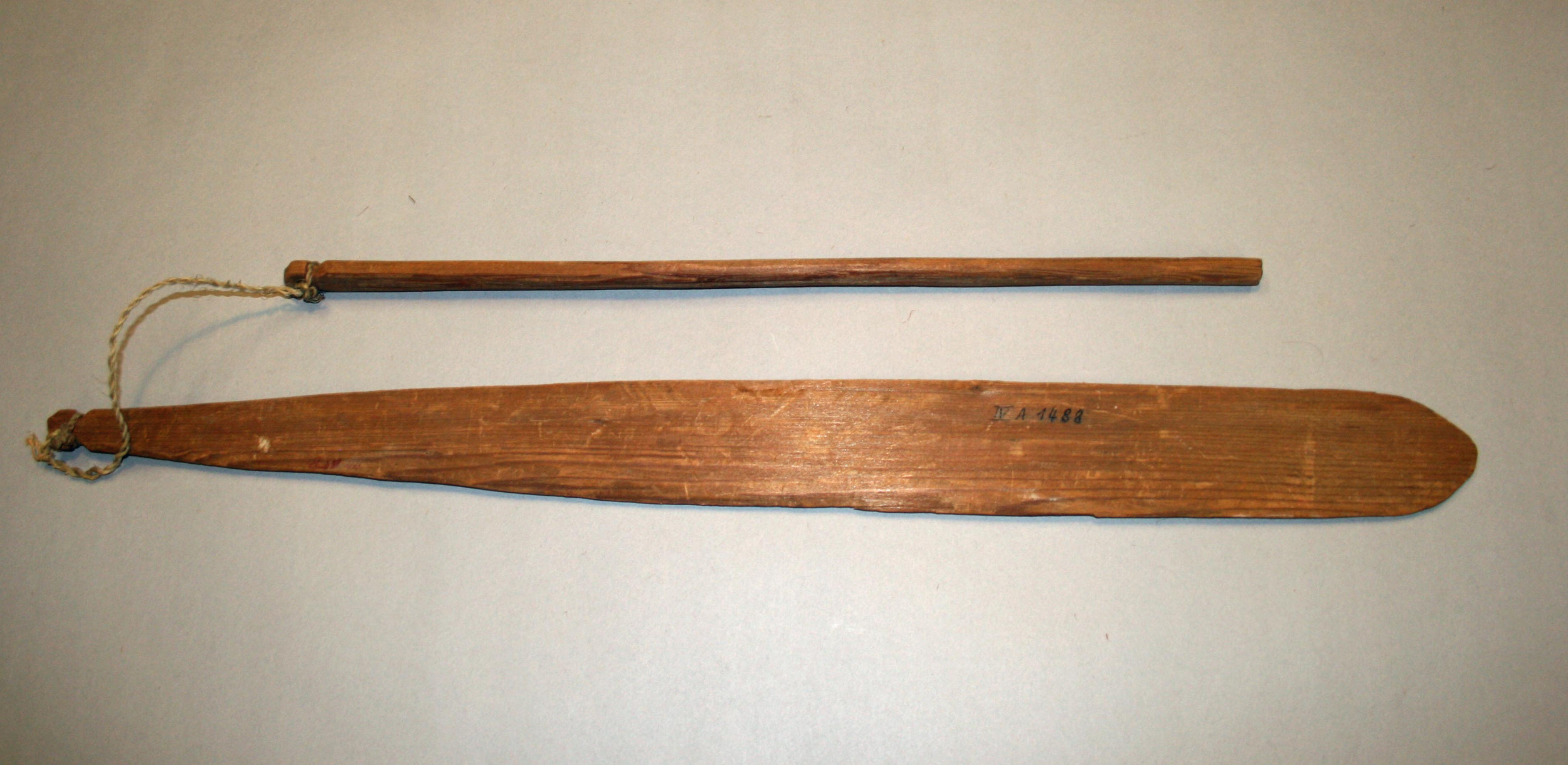
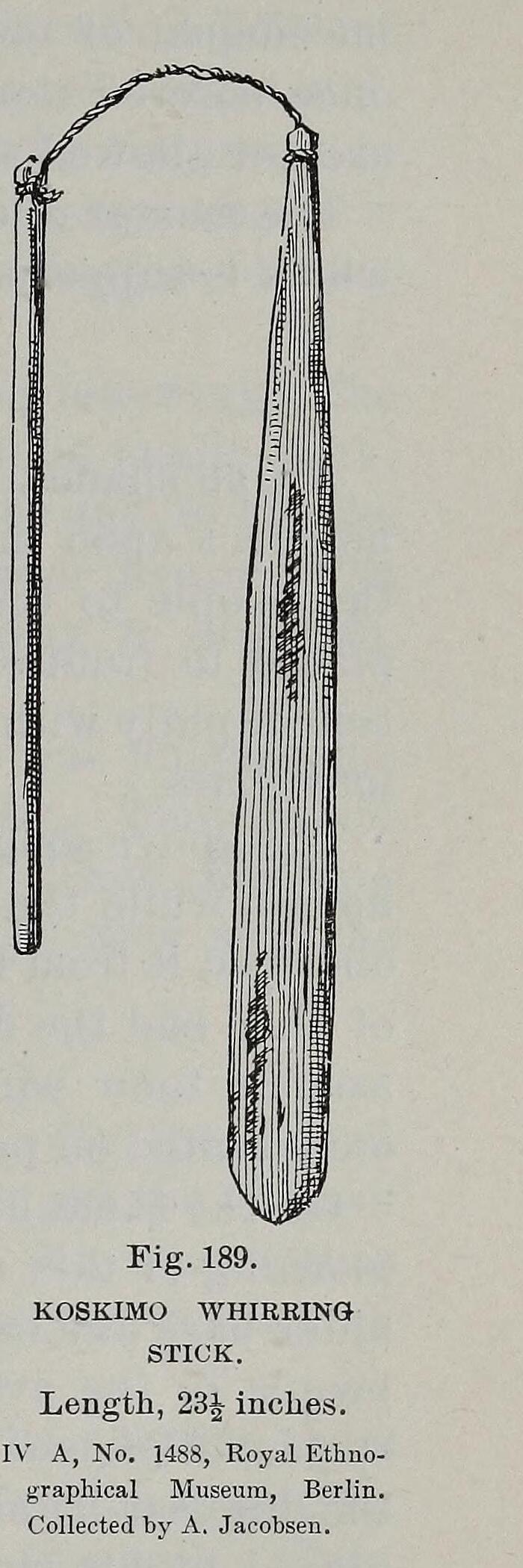
About midnight, men climbed quietly onto the roofs of the Koskimo houses and whirled the whirring sticks. The noise was the voice of Hai'aLilaqas, or of Wīnā'lag·ilîs, come to take away another novice; it sounded four times, ten minutes at a stretch. The stick Franz Boas drew for that night survives in Berlin, still on its cord and wooden handle. The Koskimo sounded it again in the nulam, a Wolf dance that could be held in any season. Drum and whirring announced the supernatural beings; the novices vanished into the house of the Wolves and came back on the fourth morning, singing, dressed in branches. Among the privileges they then displayed was the sisiutl, the Feathered Serpent, carried as a figure and as a spear hung with a hundred small heads.
Used in the nulam dances.
Philip Drucker, Culture Element Distributions: XXVI, Northwest Coast (1950), p. 268, note to element 856.
Particulars
- Object
- A lanceolate wooden blade pierced at the top and swung on a cord from a handle; 23½ in. (59.7 cm). Ethnologisches Museum, Staatliche Museen zu Berlin, IV A 1488 (coll. J. A. Jacobsen), catalogued by the museum as Hesquiaht.
- Function
- Whirled from the housetops at midnight in the winter dances; the sound was the voice of a spirit coming to take a novice.
Sources
- Philip Drucker, “Culture Element Distributions: XXVI, Northwest Coast,” University of California Anthropological Records 9:3 (1950), p. 199, elements 854–857, notes p. 268 View · archived
- Franz Boas, The Social Organization and the Secret Societies of the Kwakiutl Indians, Report of the U.S. National Museum for 1895 (1897), pp. 610–611, fig. 189
- Ethnologisches Museum, Staatliche Museen zu Berlin, IV A 1488 View
- Philip Drucker, Kwakiutl Dancing Societies, Anthropological Records 2(6) (1940), pp. 201, 219–220 View · archived