No. NA-S1952-006
Cupeño assembly-signal bullroarer
United States · California · North America
Sacred / spirit
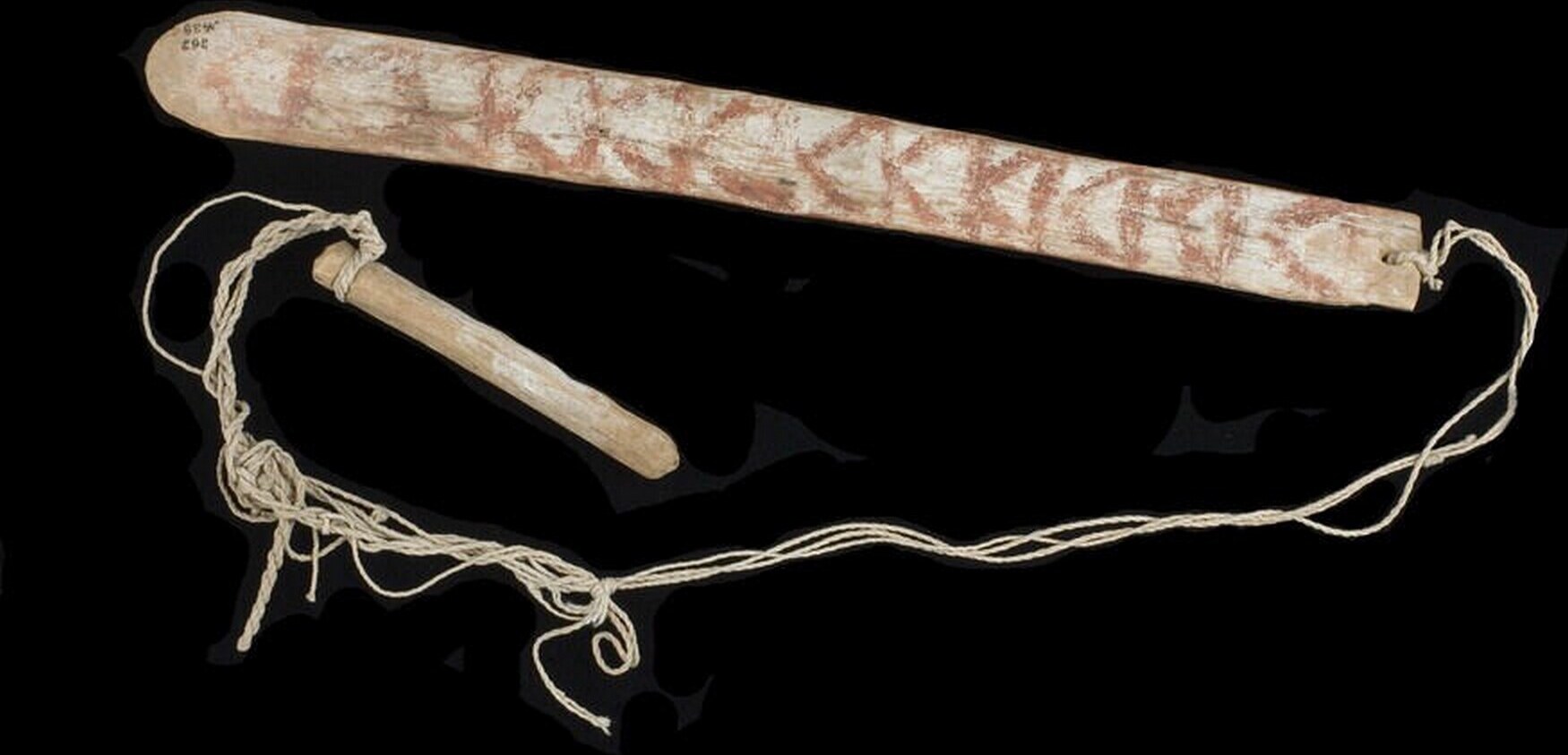
aīil
Source term: bullroarer
aīil = the bullroarers whirled by the two paha at the Cupeño Whirling Dance (Strong 1929:258)
The Cupeño Whirling Dance, for boys and girls of sixteen to twenty, reached its pitch with a shout. Inside the dance house one paha cried "hou-ou-ou!" and kicked the wall three times; the paha outside answered in kind, and the first rushed out to fall prone in the center of the dance enclosure. Then both pahas — painted red and black — whirled bullroarers, aīil, while a dancer in the eagle-feather skirt and a headdress of eagle down circled the enclosure, and the boys and girls danced one at a time, whirling and squatting until exhausted. The Cupeño themselves said the dance had come to them from the Luiseño.
Outside the circle were the bulk of the guests, all slowly dancing clockwise; inside the circle were the singers, and before them were the two red and black painted pahas, swinging bull roarers.
Strong 1929, Aboriginal Society in Southern California, p. 258
Particulars
- Function
- Whirled by the two red-and-black-painted paha at the Whirling Dance while boys and girls danced in the enclosure; ceremonial use only, to assemble people.
Source
W. D. Strong, Aboriginal Society in Southern California, University of California Publications in American Archaeology and Ethnology 26 (1929), p. 258; P. Drucker, 'Culture Element Distributions: V, Southern California,' Anthropological Records 1:1 (1937), p. 25