Atlas Essay —
I Pity the Fool That Stops the Roar
When a bullroarer falls silent or flies off its cord, someone pays: women killed for finding it, a boy carried off, a throat cut, a lie told
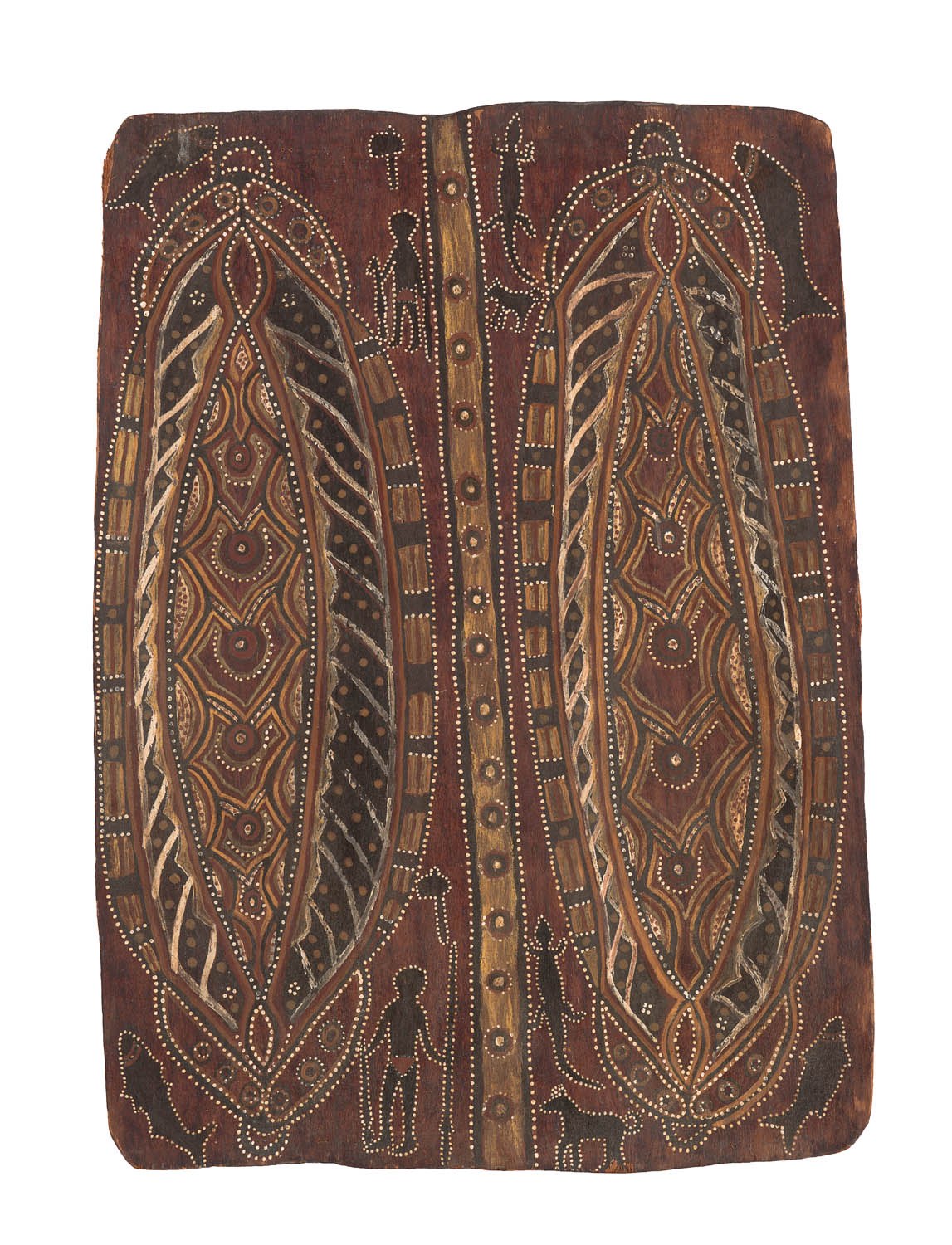
At Port Keats, on the coast of the Northern Territory of Australia, the Murrinh-Patha say the apostle bird Kudapun shaped the first bullroarer. He swung it and it roared. Then the string broke, and the blade fell into deep water. Two young women out fishing brought it ashore in their net, and did not know what it was. The men took them into the bush and “killed them by cutting their necks”. That is how men first came to own the bullroarer, and why they have kept it.
The bullroarer’s roar must not stop, and its blade must not get loose. Wherever the voice fails, goes silent or escapes its cord, from Australia and New Guinea to West Africa and the American Southwest, the story turns on what that costs: women killed for finding the blade, a novice carried into the sky, a woman’s throat cut, a cover story told, a blade set among the stars. The accident is the moment the secret lies most open, and every telling closes it again with a price.
In brief
- The Murrinh-Patha of Port Keats say the first bullroarer’s string broke and the two women who netted it from the water were killed “by cutting their necks” (Stanner, p. 45 n. 21).
- In Central Australia an Anmatyerre boy was told that unless he made the bullroarer sing, a being from the sky would “come down and carry him away”; among the Kaytetye, when tired men let the roar stop, Atnatu speared them and dragged them up into the sky.
- The Jinibara of south-east Queensland and a Cibecue Apache clown in Arizona both tied the roarer’s string to the swinger’s wrist, the Jinibara because “on no account must the bull-roarer be allowed to fall”.
- In Yorubaland, Nigeria, Oro “does not cry where women are”: when a king’s wife hid to watch, the voice went silent, then the thread broke and the flying flesh “cut the throat of the woman”.
- When a blade got loose in the dark, the Kurnai of Victoria told any woman who found it that it was “a paddle belonging to Tundun”; on the coast of New South Wales men beat their weapons so the women “would not hear it falling”.
- In Arizona a Yavapai shaman whose cord broke declared the bullroarer “had gone to sky”, and among the Eastern Navajo a roarer that came off its cord meant the patient was doomed.

The string broke
The Murrinh-Patha (Stanner wrote Murinbata) live around Port Keats, now Wadeye, on the coast south-west of Darwin. Their bullroarer is the emblem of the Old Woman, the Mother of All, whose secret name is Karwadi and whose open name is Mutjingga, and its roar is her voice. The anthropologist W. E. H. Stanner, who worked among them from the 1930s, set down how men got it:
“Kudapun, the apostle bird, who was coæval with Mutjingga (in spite of her supposed humanness), shaped the first bullroarer after her death. He found that it gave out its roar when swung, but the string broke and it fell into deep water. Two young women at fishing brought it ashore in a net. They were mystified by it, and thought it a bad and dangerous thing. Men took them into the bush (to the first mambana or secret place?) and killed them by cutting their necks. Thus, true men became possessed of the bullroarer for the first time and preserved it. The myth justifies the exclusion of women from the secret.”
W. E. H. Stanner, On Aboriginal Religion (1963; Sydney University Press ed., 2014), p. 45 n. 21.
Every step of the rite’s founding is an accident. The voice worked. The cord failed. The blade went where women were, into the water they were fishing, and came up in their net. They had done nothing but find it, and they did not even know what they had found. That was enough. The men cut their necks at the first secret place, and from that night the roarer was men’s.
Stanner ends on what the women know: “the ‘open’ or non-secret name of the bullroarer is Mutjingga. Women tell their children that its noise is her voice.” The women of Port Keats know what roars in the bush. What the myth guards is the blade, the thing itself, and the story of how it slipped its cord and came to them.
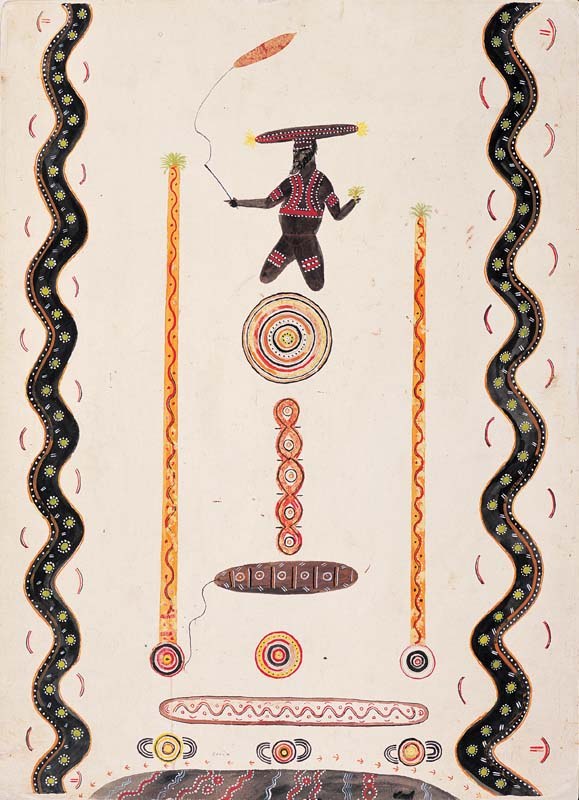
Port Keats painters tell the escape another way, and Indji’s bark painting of about 1963, at the head of this essay, carries it. In the Dreaming the hero Garaphon cut a series of patterns into a bullroarer and called his friends to dance. Its label reads: “Garaphon whirled his bullroarer around his head and it fled into the creek.” Afterwards an old man fishing in the creek found it, knew it for “proper business”, and called the old men together for the secret ceremony. When a man fishes the lost blade out of the water he founds the rite. When two women fish it out, they are killed for it.
The same accident founds the secret in two other places, both told in The First One Didn’t Work. In Yorubaland, in south-western Nigeria, the first Oro’s thread broke and the flying flesh killed a woman, as the section below tells. Among the Mandobo of the upper Digul River, in the Indonesian province of South Papua, the first fibre snapped and the blade “lands among the women and strikes one of them in the groin, where it sticks fast” (Boelaars 1970, p. 77, translated). It stuck so fast that her cousin could not cut it free, and a hornbill had to tear it out with its beak, her blood spattering its face (pp. 78–79). In all three places the first cord broke, and the blade went to the women.
Make the bullroarer sing
An instrument that can fly off and expose the secret must be kept roaring, and the peoples of Central Australia say so with threats. On 27 June 1901, camped near Barrow Creek on the Overland Telegraph Line in the Northern Territory, Baldwin Spencer wrote in his journal what an Anmatyerre man (Spencer wrote Unmatchera) told him a boy hears at his initiation. After the circumcision the boy is given his churinga, his sacred board, and warned that “it must on no account be left about in the bush but that he must carry it & if he were to leave it about & loose it then some one would kill his mother.” After the second cut his father hands him his own churinga:
“You must not go about the lubras camp when you carry it: if you do you will loose your churinga & your big brother will kill you. … Unless he make the bullroarer sing another arakurta who lives in the sky will come down and carry him away. The noise of the churinga is called ‘Luringa’. If the arakurta hears churinga ‘roar’ he says ‘That is all right’.”
Baldwin Spencer, field journal, 27 June 1901, transcription pp. 150–152 (Spencer and Gillen archive).
Lose it, and your mother dies. Carry it near the women, and your brother kills you. Let it fall silent, and you are carried off. Every way the instrument can fail has its price. An arakurta is a youth between the first cut and the second, and the one in the sky is a novice of the first times, cut by the hawk ancestors, who “went up into the sky” (Spencer and Gillen 1904, p. 498). He listens for the noise. As long as it roars, he says, “That is all right,” and “will not harm him” (p. 343).
Unless he make the bullroarer sing another arakurta who lives in the sky will come down and carry him away.Baldwin Spencer, field journal, 27 June 1901
Their northern neighbours the Kaytetye (Kaitish) put the rule into the sky-being who made the first churinga and swung it over his own sons. Atnatu “is glad when he hears the natives on the earth making the bull-roarer sound as they initiate the boys, but he is angry if they do not” (Spencer and Gillen 1904, p. 499). If the roar stops he rattles his spears, and if it stays silent “he hurls the spears down, and drags the men and boys up into the sky”. The Kaytetye tell of the one time it happened, at a place called Irribilia, when the men had spent so long at the sacred ceremonies that they let the roarers fall still and “the boys were actually cut without the swinging of the sacred Churinga”:
“Then Atnatu once more gathered up his spears, and this time hurled them down on the men, killed them, and dragged them up into the sky. Tradition says that he eat one of them — a young etwakurka — but found the flesh no good for food, so he did not eat the other men, but brought them to life again in the sky, and they have remained up there ever since, but cannot now be seen by natives on the earth. The lubras meanwhile, hearing no noise of the bull-roarers and no singing, became alarmed, and after a long time ran to the spot where they saw tracks and blood, but could find no other trace of the men.”
Spencer and Gillen, The Northern Tribes of Central Australia (1904), p. 347.
The roar was what kept the women in their camp. When it stopped, they came running to the secret ground, and found the blood of the cutting. Atnatu’s cannibal side is told in The Teacher Who Eats Boys; here the point is the silence. One gap in the noise, and the god took the men, ate a boy and opened the ground to the women. So every Kaytetye novice, healing in the bush, “must continually swing the Churinga so that Atnatu may hear him and be kept thereby in a good humour” (p. 347). “He must be careful to swing the bull-roarer, which is shown to him for the first time, or else Atnatu will spear him” (p. 500).
Tied to the wrist
A roar that must not stop needs a blade that cannot get away. The Jinibara of the Brisbane River uplands in south-east Queensland had a great bullroarer for the bora, the initiation, and the Jinibara elder Gaiarbau described its rig in detail:
“The large bull-roarer was called bundundabi, which means ‘a strong wind’. It was swung with two hands, and the performer wore a bracelet on his wrist. A strong lawyer cane ‘string’ was tied onto the bracelet at one end, the other end being fixed to the bull-roarer with strong kangaroo tendon, for on no account must the bull-roarer be allowed to fall, or the swinger would be punished. This instrument was used in the bora to call all the young initiates to get ready for the day’s initiation proceedings.”
L. P. Winterbotham, Some Original Views around Kilcoy (1982), p. 43, from Gaiarbau.
Cane, tendon and a bracelet: the Jinibara built the accident out of the instrument, and still kept a punishment waiting for the man whose blade fell. Half a world away a clown in Arizona used the same tether. On the evening of 28 March 1901 the Cibecue Apache of the Fort Apache Reservation held a curing dance for a woman of twenty who had fits. After midnight four devil-dancers came, and a clown with them, and Albert Reagan watched him work:
“In his left hand he held a forked stick, something like the trident of Neptune. With this he drove the people around at will … In his right hand he held a bull-roarer, a short medicine wand attached to a string which was tied around his wrist at the free end. By means of this string he whirled the wand through the air with vigorous force, thus making a peculiar, buzzing noise.”
Albert B. Reagan, “Notes on the Indians of the Fort Apache Region” (1930), p. 335.
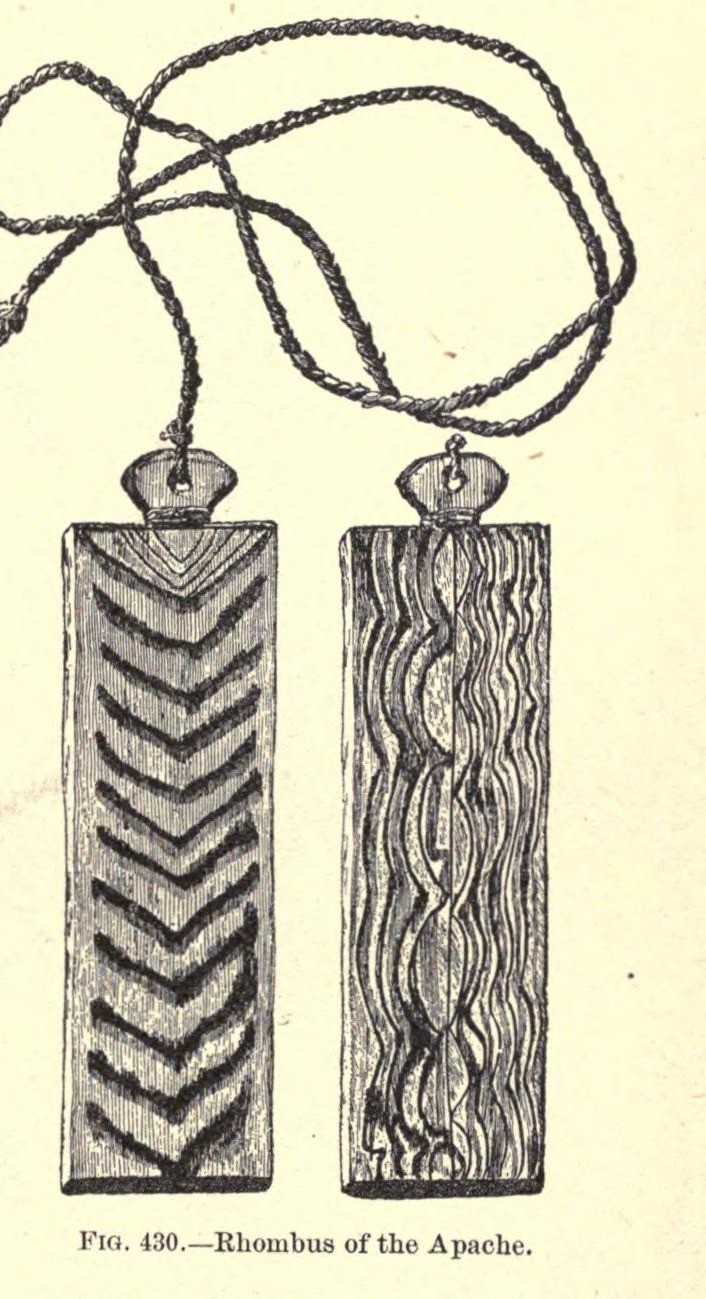
The clown wielded the roarer in the open, and the cost of a loose blade follows how much it hides. At a curing dance of the San Carlos Apache, where everyone watched the clown whirl it, Edward Gifford recorded a blade that “came off string twice, retrieved by spectators” (Gifford 1940, p. 152). Out in the open, a blade that falls is simply picked up and handed back. Where the roar is a voice from beyond the women’s camp, a falling blade is a disaster, and the men of the New South Wales coast prepared for it. At the Keeparra, the initiation of the peoples between Newcastle and the Macleay River, while the roarers sounded, the armed men standing round beat their weapons together:
“This noise is made so that if the string of one of the bull-roarers should break — which sometimes happens — the women would not hear it falling on the ground”.
R. H. Mathews, “The Keeparra Ceremony of Initiation”, Journal of the Anthropological Institute 26 (1897), p. 328.
“Which sometimes happens.” The Keeparra men knew their strings broke, and they built a wall of noise around the moment. The novices were told the roar was the voice of Goign, “who would come and eat them if he got the chance” (p. 331). The thud of wood on the ground would have told the women that Goign was a piece of wood.
Oro does not cry where women are
A broken string lets the blade out. Silence lets the women in, and in Yorubaland the god himself goes quiet to say they are there. Oro is the night voice of the Yoruba men’s society in south-western Nigeria, the bullroarer whose cry sends women indoors. John Parkinson took down two Oro legends from his carriers, and Richard Dennett printed them in 1910. In the first, a king wanted his wives at the yearly feast: “I am king, and I do like a king. All my wives are to be present when Oro sings.”
“But when Oro saw that women were present he kept silence. Then said the two Babalawo, ‘It is against the rules that women should be present when Oro is made, but since you are king we could not dictate to you at first, but now you yourself have proved that this cannot be done, for Oro does not cry where women are.’ … And the king said to his wives, ‘Go home,’ and they went; and the Babalawo said, ‘Sing again.’ Then as once more they sang, the Oro cried, ‘Baba ma mu-o.’”
John Parkinson, in R. E. Dennett, Nigerian Studies (1910), pp. 47–48.
The cry means “O father, don’t take them”, and the legend says that since the people first made Oro talk, “none of their children died” (p. 47). The roar keeps the children alive, and it goes dead the moment a woman stands in earshot.
The second legend, told in full in The First One Didn’t Work, makes the silence a detector. A king’s favourite wife hides in a great chair to watch, and the god’s own flesh, whirled on its thread, will not sound: “Something is wrong here” (p. 50). They find her, whirl again, and “the thread broke and the flesh flew off and cut the throat of the woman” (pp. 50–51). Silence found her, and the broken thread killed her.
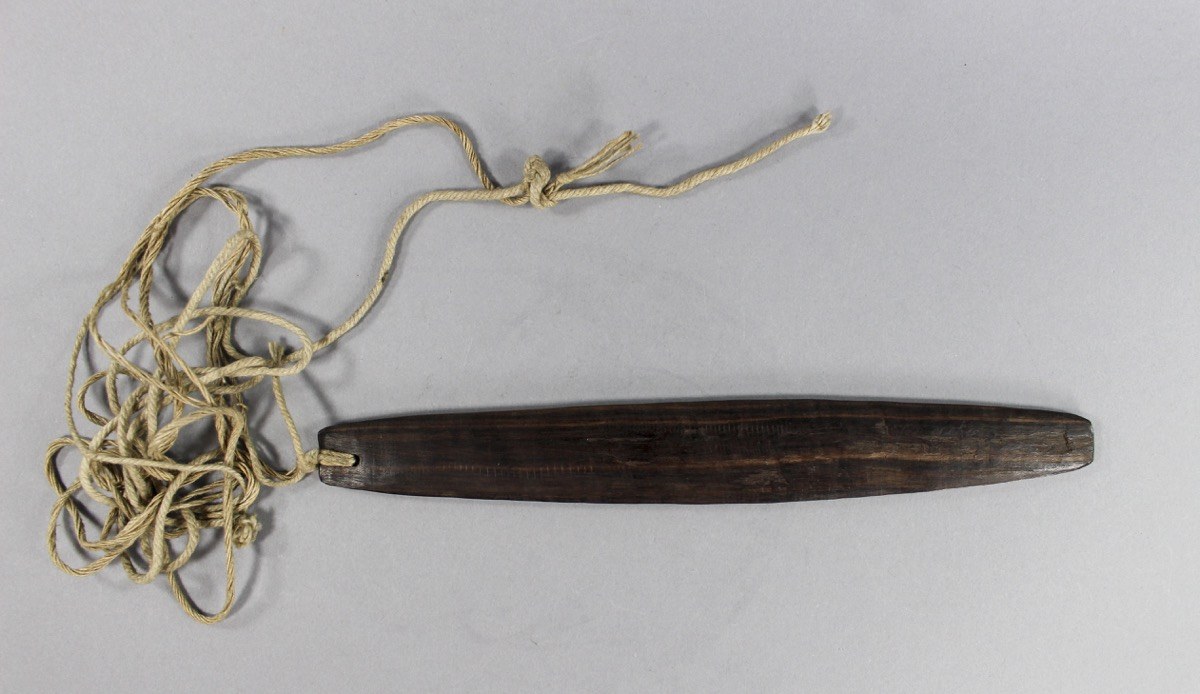
The Diné say it more briefly. Among the Western Navajo of Arizona, Gifford was told the bullroarer was used out of sight because it would “not sound if used in public” (Gifford 1940, p. 152). On the Rai Coast of Papua New Guinea, in Madang Province, the Ngaing say the god Gab’me made the first bullroarer and put it in an old woman’s net bag. “She tried various ways of whirling it but always failed. Later Gab’me taught her grandson the secret in a dream” (Gourlay 1975, p. 81, after Lawrence 1965). The instrument would not speak for a woman even when a god had given it to her.
A paddle belonging to Tundun
When a blade does get loose and a woman finds it, somebody has to explain it. The Kurnai (Gunai) of Gippsland, in south-eastern Victoria, had an answer ready. At their initiation, the Jeraeil, the newly made men took the roarers round the women’s camp at night “for the purpose, as they put it, of ‘frightening the women’”, and the women were told that Tundun himself was walking round the camp before going home. Alfred Howitt watched the Jeraeil and wrote it down:
“It sometimes happens that during this nocturnal perambulation one of the bull-roarers becomes detached from its string and is thus lost. If, perchance, it is afterwards picked up by a woman or child, their curiosity is satisfied by the statement that it is a ‘paddle belonging to Tundun’ which he is supposed to have dropped in returning home. The shape of the bull-roarer is much that of the little bark paddle which the Kurnai use when sitting down in their canoes.”
A. W. Howitt, The Native Tribes of South-East Australia (1904), p. 632.
The lie was ready because the truth was lethal. At the revelation the old men told the novices that a traitor had once shown the secrets to the women, and the sky god Mungan sent fire and the sea. An older telling makes the betrayal an accident with a lost blade. Long ago, Howitt heard, there was land south of Gippsland where the sea now is, and “some children of the Kurnai, who inhabited the land, in playing about found a turndun, which they took home to the camp and showed to the women. ‘Immediately,’ it is said, ‘the earth crumbled away, and it was all water, and the Kurnai were drowned’” (Fison and Howitt 1880, p. 269). A blade lying in the scrub had drowned the country once. Every boy was shown the roarer with an old man’s spear at his eye: “If you tell this to any woman you will die — you will see the ground broken up and like the sea” (p. 198). A headman told Howitt, nearly fifty years into white settlement, “If a woman were to see these things or hear what we tell the boys, I would kill her” (1904, p. 626). Against that, “Tundun’s paddle” was a mercy. The Kurnai Fall is told whole in its own essay.
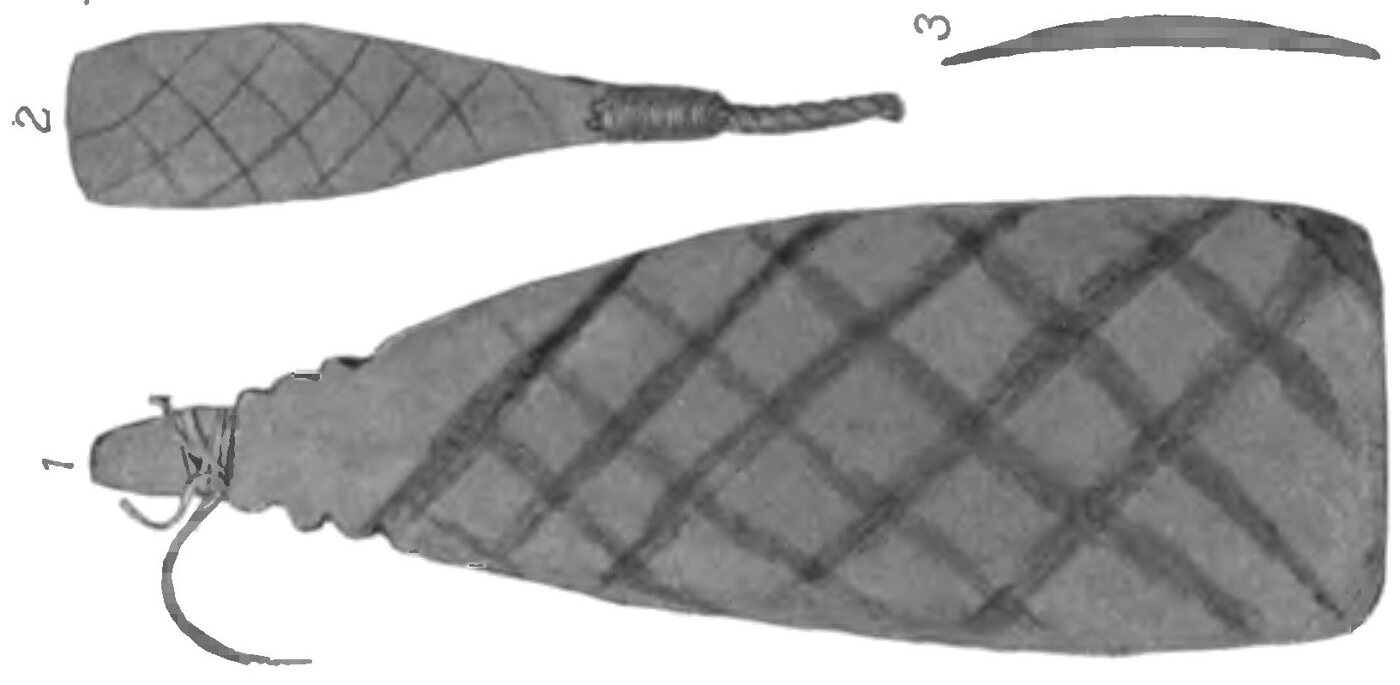
Where the voice is heard by the wrong ears, the wrong ears pay. In the mountains of southern California the Mountain Cahuilla whirled the bullroarer at the boys’ rite, and its sound “might only be heard by grown people”. Fred Coseros, a Mountain Cahuilla, told William Duncan Strong that “children who by chance heard these sounds were caught by the paha and put into the inner room of the wamkic with the maiswut, and were in a very dangerous situation. Their parents had to make considerable gifts to the net in order to secure their release” (Strong 1929, p. 164). Among their Serrano neighbours, “any person who looks to see where the noise comes from is tied up in the kitcateratc with the sacred feathers until his family pay to have him released” (p. 22). The child who hears is taken into the sacred house beside the sacred bundle and held there until the family pays the ransom.
In the forests of south-eastern Guinea the price was death. Among the Kono of Lola and Gô, Bohumil Holas wrote, the exclusion of women from the rhombe is “always extremely rigorous: a woman who has glimpsed the bullroarer will be put to death by poisoning, while an uninitiated man clears himself with a fine (for example a chicken, ten measures of clean rice) and by swearing to keep the secret; and at the very next poro ceremony he will be initiated by force, even if by custom his turn had not yet come” (Holas 1952, ch. XVIII, translated). The man who sees too early is initiated by force. The woman who sees is poisoned to death.
Gone to the sky
In Arizona the cover story was made up on the spot. The Northeastern Yavapai of the Verde Valley had shamans who swung the bullroarer in secret at night to call their spirit helpers before a cure, and who also swung it before the public. Gifford, recording among them in the early 1930s, set down what happened once:
“To summon aid of Skatakaamcha or akaka’, shaman sometimes secretly swung bullroarer at night before sucking in morning. Also swung bullroarer in public demonstrations. On one such occasion cord broke. Shaman declared bullroarer had gone to sky, but it fell near man in audience who later gave it to nonplussed shaman.”
E. W. Gifford, Northeastern and Western Yavapai (1936), p. 309.
The shaman reached for the sky as the Kurnai men reached for Tundun’s canoe. With the crowd watching, his instrument had come apart in front of everyone and shown itself a stick on a string. He said it had gone up, back to the powers it spoke for. The man it fell beside handed it back later, to a nonplussed shaman.
On the far side of the Pacific the same claim is myth. On Bardi country at the tip of the Dampier Peninsula in the Kimberley, Western Australia, the creator Djamar was swinging his galaguru when the hair-string broke and the blade flew up into the dark patch beside the Southern Cross, the Coalsack, where Djamar later followed it. In the East Kimberley the bird Banaga’s bullroarer “broke off the string and went into the sky”, and stayed in the Coalsack, “and women are not supposed to know of its existence” (Kaberry 1939, p. 12). Those stories are told in The Bullroarer in the Coalsack. The sky is also where Atnatu dragged the Kaytetye men when their roar stopped, and where the Anmatyerre arakurta waits to carry off the boy who lets his fall silent. A voice that escapes the hand goes up, and takes with it whoever let it go.
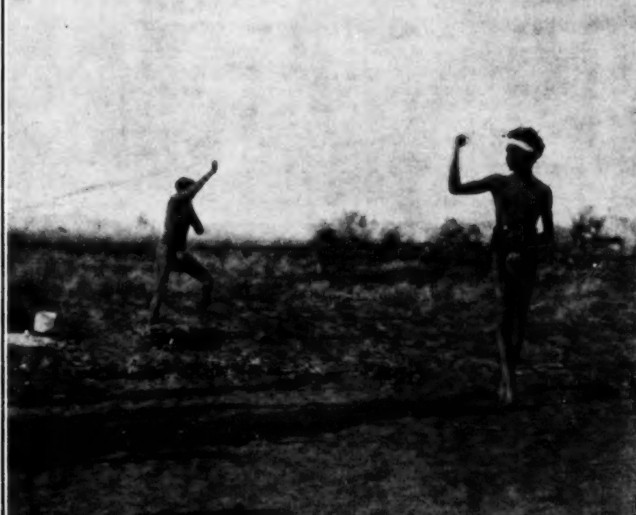
For the Eastern Navajo of New Mexico the failure was a verdict. The roarer was whirled for the sick, and Gifford wrote down the rule: “if bull-roarer came off cord or did not sound, sick person doomed” (Gifford 1940, p. 152). The voice that comes off its cord, or will not speak, takes the patient with it.
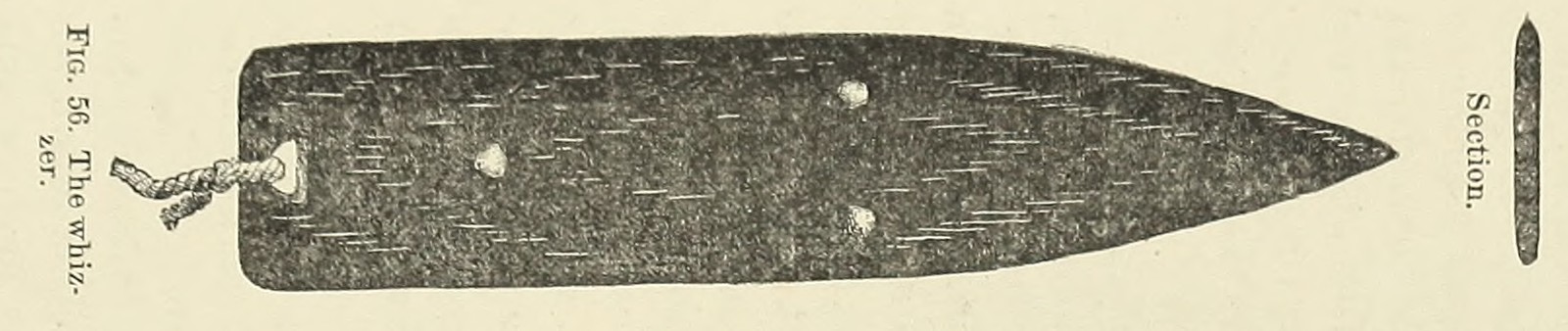
Never let it fall
A bullroarer is a voice that is also a piece of wood on a string. While it roars, it is Mutjingga, Atnatu, Tundun, Goign or Oro, and the women in the camp hear a being that comes to take the boys. The moment it stops, or the string parts, it is a slat lying in the grass, and anyone can pick it up. Every people in this essay knew that moment would come. The Keeparra said so in three words: “which sometimes happens.”
So they surrounded the moment with law. Before it happens: keep it roaring, or a being from the sky will spear you and carry you off; tie it to your wrist with cane and tendon; beat your weapons so the fall is not heard. When it happens: tell the woman it is Tundun’s paddle, tell the crowd it has gone to the sky, read it as the patient’s death. After it happens: cut the necks of the women who netted it, poison the woman who saw it, hold the child who heard it until his family pays. And at the beginning of things, the founding story is the accident itself. At Port Keats, in Yorubaland and on the upper Digul the first cord broke, the blade went to the women, and the rule of their exclusion was written in their blood.
The pattern runs from the Kimberley to Gippsland, from the Rai Coast and the Digul to the Yoruba towns and the Guinea forest, from the Verde Valley to the Fort Apache country and the mountains of southern California. Its parts travel with the instrument, and the instrument is the same everywhere it went: a voice that a secret depends on, held by a single cord. The roar must not stop. The blade must not get loose. When it does, the secret is open for one moment, and every people that kept the roarer has a story about who paid to close it.
Key sources
- W. E. H. Stanner, On Aboriginal Religion (1963; Sydney: Sydney University Press, 2014), p. 45 n. 21 (Kudapun’s first bullroarer).
- Indji, Garaphon and his Bullroarers (c. 1963), bark painting; label text reproduced in Mossgreen, An Important Private Collection, 14 September 2014, lot 9.
- Baldwin Spencer, Journal (1), Spencer Gillen Expedition to Central Australia, 1901–02, entry of 27 June 1901, transcription pp. 150–152 (spencerandgillen.net).
- Baldwin Spencer and F. J. Gillen, The Northern Tribes of Central Australia (London: Macmillan, 1904), pp. 343, 347, 498–500.
- L. P. Winterbotham, Some Original Views around Kilcoy, Book 1: The Aboriginal Perspective (Brisbane: Archaeology Branch, 1982), p. 43.
- Albert B. Reagan, “Notes on the Indians of the Fort Apache Region”, Anthropological Papers of the American Museum of Natural History 31 (5) (1930), pp. 334–335.
- E. W. Gifford, Apache-Pueblo, Culture Element Distributions XII, Anthropological Records 4 (1) (1940), p. 152, elements 2213–2215.
- E. W. Gifford, Northeastern and Western Yavapai, University of California Publications in American Archaeology and Ethnology 34 (4) (1936), p. 309.
- R. H. Mathews, “The Keeparra Ceremony of Initiation”, Journal of the Anthropological Institute 26 (1897), pp. 328, 331.
- John Parkinson, Oro legends, in R. E. Dennett, Nigerian Studies (London: Macmillan, 1910), pp. 47–51.
- K. Boelaars, Mandobo’s tussen de Digoel en de Kao (1970), pp. 77–79, after P. Drabbe (translated).
- K. A. Gourlay, Sound-Producing Instruments in Traditional Society (Canberra: ANU, 1975), p. 81, after P. Lawrence (1965), p. 205.
- A. W. Howitt, The Native Tribes of South-East Australia (London: Macmillan, 1904), pp. 626, 631–632, fig. 37.
- Lorimer Fison and A. W. Howitt, Kamilaroi and Kurnai (Melbourne: George Robertson, 1880), pp. 198, 269.
- W. D. Strong, Aboriginal Society in Southern California, University of California Publications in American Archaeology and Ethnology 26 (1929), pp. 22, 164.
- B. Holas, Les masques kono (Haute-Guinée française) (Paris: Geuthner, 1952), ch. XVIII, “Guèyoumo” (translated).
- Phyllis M. Kaberry, Aboriginal Woman: Sacred and Profane (London: Routledge, 1939), p. 12.