No. NA-S1952-001
Mountain Cahuilla jimsonweed bullroarer
United States · California · Southwest · North America
Restricted
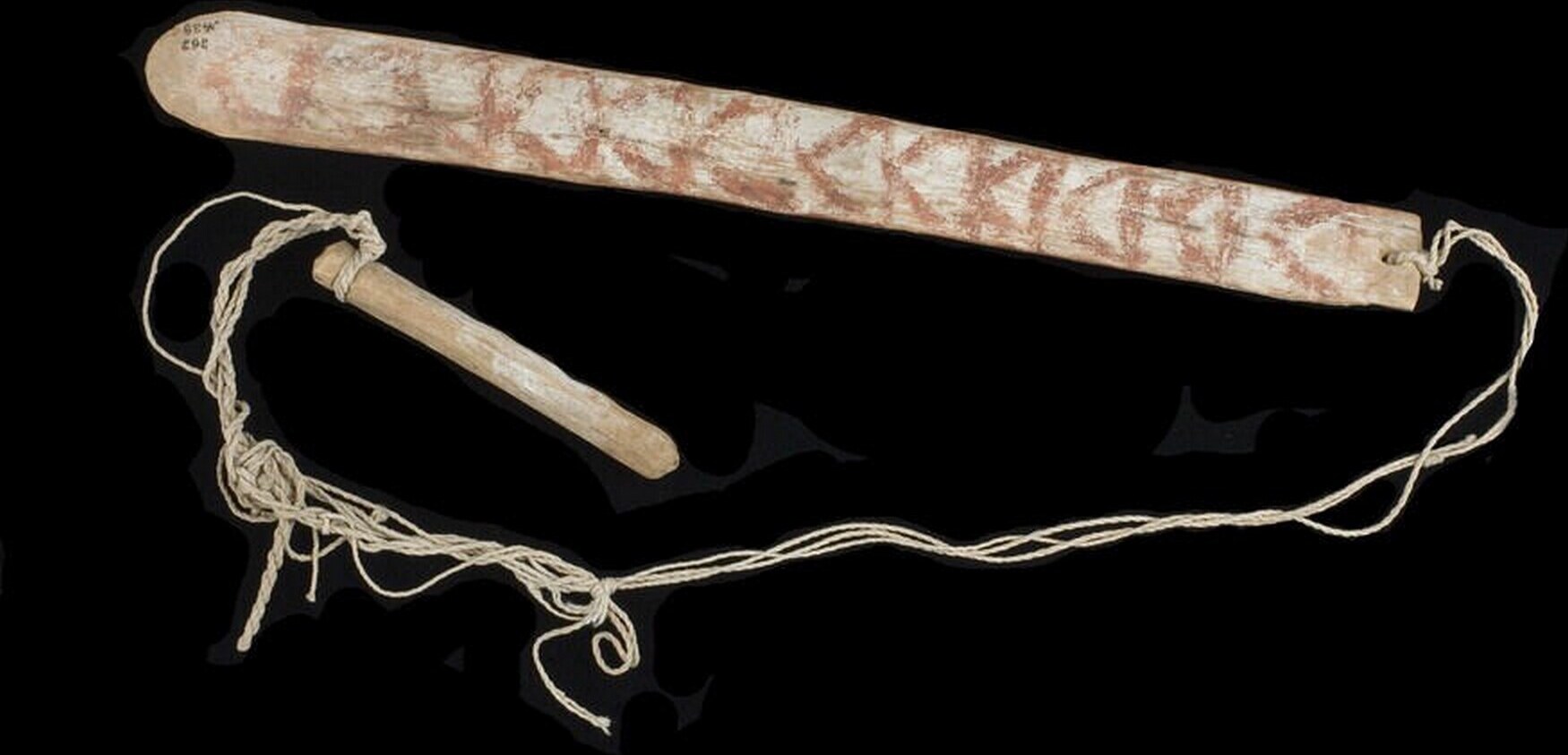
melawhic (northern Mountain Cahuilla); meūlakpic (southern Mountain Cahuilla)
Source term: bullroarer
At the Mountain Cahuilla jimsonweed drinking ceremony, the manet dancer who led the novices whirled the melawhic — a smooth flat stick about two feet long on a string — to warn women, children, and the uninitiated away from the dance house. Its sound was for grown people alone: a child who chanced to hear it could be seized by the paha and shut in the inner room with the sacred bundle, and the parents had to make considerable gifts to the ceremonial chief to buy the child's release. The rite itself was called Hemvachlowin: about a week beforehand certain old men gathered the plant the Cahuilla called rehasawel and the Spanish toloache, and cooked the decoction a long time in jars. The boys, between ten and eighteen, were kept in a brush enclosure outside the ceremonial house for five days, fed twice a day on food with no salt or grease, and allowed to see no one but those who brought it. On the fourth night an old man who knew exactly how much each could stand by age gave them the drink; they began to dance, grew dizzy, and were laid in a dark corner while the medicine men ran into the fire and tried to stamp it out with their bare feet. Juan Lugo of Agua Caliente, who had gone through the ceremony himself about sixty years earlier, said several men had died from drinking too much toloache or from eating the wrong thing afterward.
The decoction made from the jimsonweed was then given to them by some old man who knew exactly how much they could stand, according to their age. The Spanish word for this drink is toloache; the Cahuilla word is rehasawel or kiksawal.
Hooper 1920:346 (The Cahuilla Indians, UC Publications in Am. Arch. and Ethn. 16:7)
Particulars
- Object
- Smooth flat stick about two feet long, tied at the middle to a string and whirled overhead.
- Function
- The manet (jimsonweed) ceremony official led novices in dancing and whirled the ceremonial bullroarer as a warning to keep women, children, and the uninitiated away from the dance house.
Sources
- W. D. Strong, Aboriginal Society in Southern California, University of California Publications in American Archaeology and Ethnology 26 (1929), pp. 164, 168, 174 View · archived
- P. Drucker, “Culture Element Distributions: V, Southern California,” Anthropological Records 1:1 (1937), p. 25, items 924/926
- Hooper, The Cahuilla Indians, University of California Publications in American Archaeology and Ethnology 16:7 (1920), p. 346