Atlas Essay —
The Voice of the Holy Spirit
Biripi country in New South Wales, Arnhem Land, Auckland and the mystics of medieval Europe
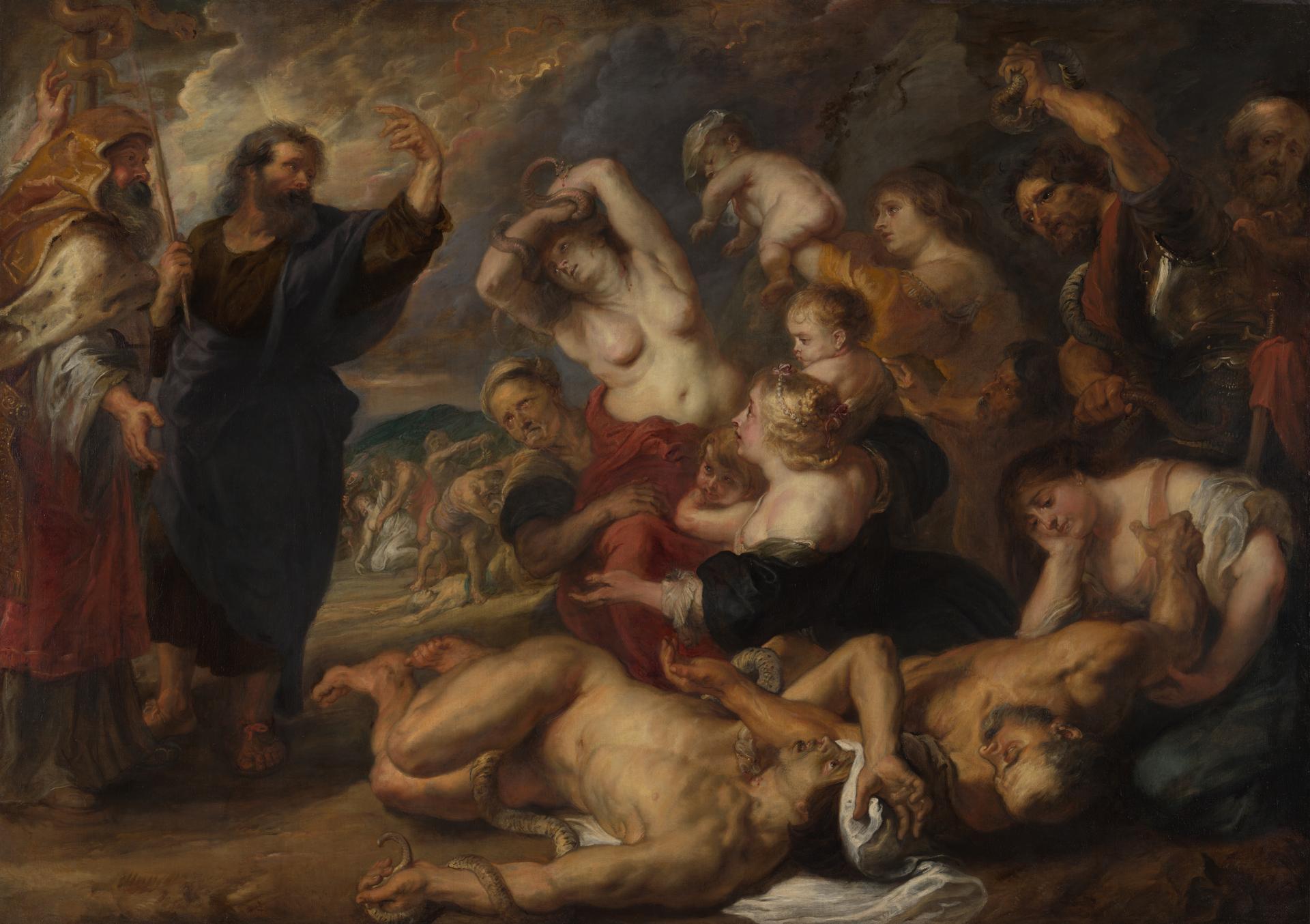
In Auckland, New Zealand, on 31 May 2016, the Catholic primary principals of Australia and New Zealand sat down together for the first time. The Australian president, Mark Mowbray, had brought two bullroarers painted by a pastor and elder of the Biripi, whose country lies on the mid-north coast of New South Wales. With them came a story an elder had written about Aboriginal Catholic spirituality and the Trinity. Mowbray told the room what the blades were for. From that day the two associations would have the voice of the Holy Spirit at their meetings.
When a Biripi pastor’s bullroarers became the voice of the Holy Spirit, Catholic Australia made the identification Europe’s medieval mystics had made before it. Christianity and the Aboriginal Dreaming both descend from the snake cult of consciousness, and in that roar two long-lost brothers know each other.
In brief
- The Biripi heard the bullroarer as a spirit’s voice long before 2016: at their Keeparra initiation, last held on the Manning River in 1889, the boys were told the roar was the voice of Goign.
- Harold Bayley read two medieval watermarks, which he traced to the dissenting Christian sects of France and Italy, as bullroarers, “an emblem of the regenerating power of the Holy Spirit,” and one of them carries a serpent.
- Christianity kept its serpent. John’s Gospel lifts up Moses’ bronze serpent as the image of the Son, and the Gnostic Testimony of Truth says of it, “For this is Christ.”
- In Arnhem Land, northern Australia, the bullroarer is the body and voice of the python Yurlunggur, and the boys he swallows come back as men.
- Both lines run back to a rite of the serpent and the roaring voice that began in the Upper Paleolithic and spread around the world at the end of the Ice Age.

The Spirit at the meeting
Jenny Jackson, who was in the room, wrote the day up three days later. The gifts went both ways. The Australians brought two candles bearing the wattle and the fern entwined in a cross. The New Zealanders gave a tokotoko, a Māori talking stick, which Jackson calls “a representation of the spirit world.” Mowbray’s gift was the two blades. Jackson explains them for her readers as “a sacred wooden object used in Aboriginal religious ceremonies,” whirled on a string. The story that came with them was called Gulambara and the voice of Yuludarra, and it was about the Trinity. The blades gave its third Person a voice. Mowbray explained that together the two associations
“will have the voice of the Holy Spirit at their meetings now and in the future.”
Jenny Jackson, “United: ACPPA & NZCPPA candles, a Tokotoko and bullroarers,” 3 June 2016
The Biripi had heard that voice before. Their country runs along the Manning and Hastings rivers, around Taree and Port Macquarie, and in the 1890s the surveyor R. H. Mathews wrote down the initiation its men shared with their neighbours, the Keeparra. He names the Biripi among the Keeparra peoples and dates the last Manning River performance to the winter of 1889. The Biripi bullroarer was a slat of ironbark fifteen and a half inches long, and when it roared the old men told the boys what they were hearing:
“The novices are told that the noise they hear is the voice of Goign, who would come and eat them if he got the chance.”
R. H. Mathews, “The Keeparra Ceremony of Initiation,” 1897, p. 331
A hundred and twenty-seven years after the last Manning River Keeparra, a pastor of the same people painted the same instrument, and it crossed the Tasman as the voice of the Holy Spirit. The blade kept its office through the change of names. It is still the sound of a being nobody sees, given to the people gathered in its presence.
The mystics drew it on their paper
Europe had made the same identification centuries before. Harold Bayley, an English student of the watermarks pressed into handmade paper from 1282 onward, was convinced they were a hidden language. To him they were
“thought-fossils or thought-crystals, in which lie enshrined the aspirations and traditions of the numerous mystic and puritanic sects by which Europe was overrun in the Middle Ages.”
Harold Bayley, The Lost Language of Symbolism, I (1912), p. 2
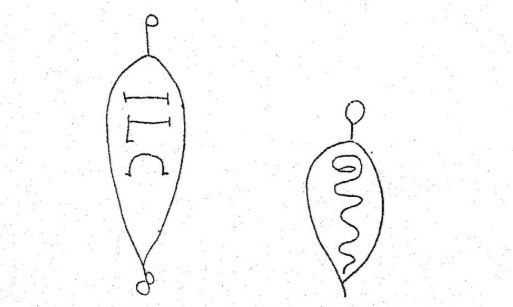
His papermakers were the Albigensians and Vaudois of southern France and the Cathars of Italy, the dissenting Christians Rome crusaded against and drove underground. Among their marks Bayley found a leaf-shaped blade hanging from a single cord. The objects, he wrote, “must, I think, be meant to represent Bullroarers,” and he matched them to blades in the British Museum. He cited Andrew Lang and A. C. Haddon on the Australian rites, and through a writer in the Hibbert Journal he quoted an Australian man: “Thunder is the voice of Him (pointing upwards) calling on the rain to fall and make everything to grow up new.” Then he gave the medieval meaning:
“Among the European mystics of the Middle Ages the bullroarer was apparently considered to be an emblem of the regenerating power of the Holy Spirit.”
Bayley, The Lost Language of Symbolism, I (1912), pp. 87–88
Inside the outline of the second blade the papermaker had drawn a snake:
“… on fig. 228 there appears a roughly executed serpent, the symbol of regeneration. No beast of the field has had so many lessons exemplified by its attributes as the serpent. The sloughing of its worn-out skin led to its adoption as a symbol of the spiritual re-birth …”
Bayley, p. 88
In a footnote he followed the roar back to Greece. Dionysus, “who possessed several of the attributes subsequently assigned to Jesus Christ, and at whose rites the Bullroarer was employed, was surnamed Bromius, i.e. the roarer.” In the Gurob papyrus, a Dionysian ritual text from Ptolemaic Egypt, the rhombos goes into the god’s basket in the same rite that carries a serpent formula. Bayley’s mystics had a blade, a cord and a snake on their paper, and they called it the Holy Spirit. The Auckland gift says it again in the same words.
A mighty rushing
Part of what Bayley heard was the sound itself. “Ezekiel describes the voice of the Spirit as ‘a great rushing,’” he wrote, “and there is a similar reference in The Acts to ‘a sound from Heaven as of a rushing mighty wind.’” At Pentecost that sound fills the house, tongues of fire settle on each of them, and they are filled with the Holy Ghost. In John’s Greek the Spirit and the wind are one word, pneuma, and Jesus tells Nicodemus that a man born of the Spirit is like the wind: “thou hearest the sound thereof, but canst not tell whence it cometh, and whither it goeth.”
Nineteenth-century ears already reached for that language. When Lang described the anthropologist E. B. Tylor whirling a bullroarer at the Royal Institution in London, the board “warmed to its work” and produced “a mighty rushing noise.” Lang also passed on what a woman of the Kurnai of Gippsland, in south-eastern Victoria, believed she had heard when the boys were being made men: Pundjel, “the chief supernatural being,” coming down “in a mighty rushing noise, that is, in the sound of the turndun.” The Kurnai woman heard her god descend in the roar of the blade, and the Scotsman who wrote it down found the words of Pentecost already in his mouth.
The serpent Christianity kept
The family likeness runs deeper than wind. Christianity never let go of its serpent. In the wilderness the Israelites were dying of snakebite, and God told Moses to make a serpent of brass and set it on a pole, so that “every one that is bitten, when he looketh upon it, shall live.” Israel kept the bronze serpent and burned incense to it, until King Hezekiah broke it in pieces. Jesus raised it again. In the same night conversation where he tells Nicodemus that a man must be born again, “of water and of the Spirit,” he reaches for Moses’ snake:
“And as Moses lifted up the serpent in the wilderness, even so must the Son of man be lifted up”
John 3:14
Rebirth by the Spirit and the serpent lifted up for life share a single conversation. The early Christians who read the Gospel most boldly drew the line straight. The Testimony of Truth, a Gnostic tract buried at Nag Hammadi in Egypt, makes the serpent of Eden the one who promises Eve that “the eyes of your mind will be opened,” and says of the bronze serpent, “For this is Christ; those who believed in him have received life.” The Peratae, a sect Hippolytus of Rome described in the early third century, taught that the perfect serpent Moses set up was the Word that was in the beginning with God:
“No one, then, he says, can be saved or return (into heaven) without the Son, and the Son is the Serpent.”
Hippolytus, Refutation of All Heresies V.12, trans. J. H. MacMahon
The snake speaks through wood
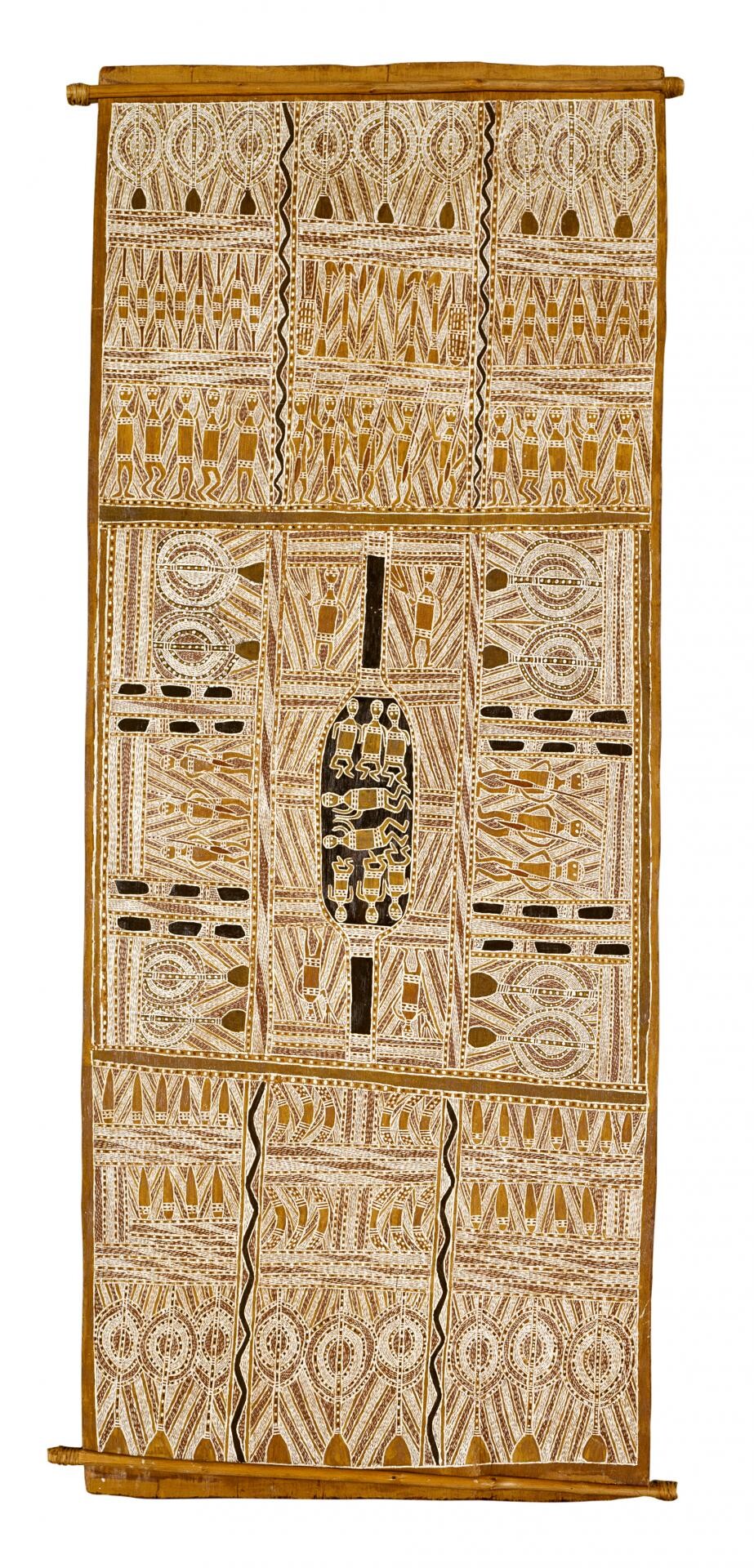
At the other end of Australia the serpent never had to be argued for. In Arnhem Land in northern Australia, in the Kunapipi ceremony that spread across the north, the bullroarer is the python Yurlunggur. James Davidson, who knew the Yolngu painter and songman Mathaman Marika, describes blades about a metre long, tied to a stick with string of human hair, swung while the chant is sung and the novices are decorated with blood: “The bullroarer represents the body of the snake, the hair string represents the fangs, and the noise made by the bullroarer is the voice of the snake.”
The Wawilak story tells how that voice was first caught. After the two Wawilak Sisters died, men raised a great pole for him, and it made no sound; so they took wood from a tree he had split with lightning, marked it with his design, threaded it with human hair and swung it, and heard him again. Ronald Berndt, who spells the python Julunggul, heard the voice come into the camp: “There is a hush; the deep-throated sound of Julunggul is heard by all in the camp.” The women cry out as the Sisters cried. The men become the snake. In W. Lloyd Warner’s account they sweep the boys into ground no woman may enter, swallowing them as Yurlunggur swallowed the Sisters, and weeks later give them back reborn as men.
A. P. Elkin carried the rebirth into the blade itself. In the wider Kunapipi, he writes, the curved ceremonial trench is the Mother’s womb, with two serpents engraved on its walls, and as the novice swings the bullroarer his spirit double, his “wood shade,” passes into the wood, which is her voice. When he is born again he leaves blade and double behind in the trench. “When the wood disintegrates, his ‘shade’ or double goes to his spirit-home, there to wait for his ‘flesh’ soul.” Born of water and of the Spirit, John says. In Arnhem Land the boys go into the python of the waterhole and come out new men, and the sound of the wind in the blade is the being who remakes them.
Two brothers meeting again
The Kunapipi python and the bronze serpent of Moses are strikingly close kin, and so are the roaring blade and the rushing wind of Pentecost. I read them as two branches of one inheritance. I have called it the snake cult of consciousness: an ancient rite “concerned with selfhood from which modern snake symbolism descends,” in which the serpent brings the knowledge that makes us human, and initiation kills the child so that a person can be born. In “The Bullroarer” I put its history in two sentences. In the Upper Paleolithic, new ideas about how to relate to the spiritual and social world “were ritualized in mystery cults that happened to use the bullroarer. These spread from Eurasia to the rest of the world, perhaps around the end of the Ice Age.”
The two brothers parted then and kept the family goods in different houses. One carried the rite to Australia and kept the snake in the wood, where boys heard the python roar in the bush and were swallowed and given back. The other kept it in the Near East. There the snake was lifted on a pole, broken by a king and lifted again on a cross, and the roar became the wind of the Spirit that blows where it will. In Eden the serpent opens the eyes of the mind; in the Kunapipi he swallows boys and returns them as men. Each house kept the rebirth.
After fifteen thousand years they met again on the mission stations and in the parishes, and for a long time they did not know each other. Christianity came to the Manning River as a stranger, and the last Keeparra there was held in 1889. The resemblance was waiting all the same. The Cathar papermakers had already pressed the blade and its serpent into their sheets and named it the Spirit that makes men new. When a Biripi pastor painted the blade, and an elder wrote the Trinity into a story, and the Catholic principals of two nations were told they now had the voice of the Holy Spirit, the gift was a recognition. Two long-lost brothers heard their father’s voice in each other’s mouths and knew whose sons they were.
Key sources
- Jenny Jackson, “United: ACPPA & NZCPPA candles, a Tokotoko and bullroarers” · archived (3 June 2016), “Candles,” “Bullroarers” and “Tokotoko” sections: the Auckland meeting of 31 May 2016 and the meaning given to the gifts.
- R. H. Mathews, “The Keeparra Ceremony of Initiation,” Journal of the Anthropological Institute 26 (1897): 320–340, esp. pp. 320–321 (the Biripi among the Keeparra peoples; the last Manning River ceremony, 1889) and p. 331 (the voice of Goign); R. H. Mathews, Notes on the Aborigines of New South Wales (1907), fig. 9.
- Harold Bayley, The Lost Language of Symbolism, I (1912), pp. 1–2 (watermarks as “thought-fossils” of the medieval sects) and pp. 85–88, figs. 227–228 (the bullroarer, the Spirit and the serpent).
- John 3:3–8, 14–15 · archived, with Numbers 21:4–9 · archived, 2 Kings 18:4 and Acts 2:1–4 · archived, King James Version.
- The Testimony of Truth · archived, Nag Hammadi Codex IX,3, translated by Søren Giversen and Birger A. Pearson: the Paradise passage and the bronze-serpent passage that follows it.
- Hippolytus, Refutation of All Heresies, Book V, chs. 11–12 (the Peratae), translated by J. H. MacMahon, Ante-Nicene Fathers 5 (1886).
- Andrew Lang, Custom and Myth (1884), “The Bull-Roarer: A Study of the Mysteries,” pp. 31 and 35, after Lorimer Fison, Journal of the Anthropological Institute, November 1883.
- James A. Davidson, “Mathaman: warrior, artist, songman” · archived, Art Bulletin of Victoria 29, online republication 18 June 2014: the Kunapipi chant, the bullroarer and Arafura Lagoon (1963).
- Ronald M. Berndt, Kunapipi: A Study of an Australian Aboriginal Religious Cult (1951), p. 36 (the first blade from lightning-split wood, as quoted in Chris Knight, Menstruation and the Origins of Culture, PhD thesis, UCL, 1987, p. 306) and p. 40 (Julunggul’s voice in the camp); W. Lloyd Warner, A Black Civilization (1937); A. P. Elkin, The Australian Aborigines, 4th ed. (1964), pp. 255–256 (the wood shade).
- Peter Paul Rubens, The Brazen Serpent · archived, probably 1635–40, National Gallery, London, NG59.
- Andrew Cutler, “The Snake Cult of Consciousness” (2023); “The Bullroarer” · archived (2024), “Summary and General Argument”; “The Snake, the Roar, and the Mirror” (Gurob papyrus); “The Logos and the Serpent” · archived (2025); “The Biggest Coincidence in Human Evolution” · archived (2026).