Atlas Essay · 14 October 2026
The Rainbow Serpent
Water, the Dreaming & the voice of initiation
A waterhole can be a place where an ancestor still rests. In Kakadu, the Rainbow Serpent opened passages through rock and made the pools in which life gathers. Her journeys belong to creation; her presence belongs to the country people inhabit now. Farther east, in Arnhem Land, a serpent can also be heard: a low wooden roar, turning in the air, calling young people toward the ancestral world.
Rainbow Serpent traditions join the making of Country with its continuing life. In particular northern Australian ceremonies, that relationship takes an audible form: the bullroarer sounds an ancestral presence, and initiation teaches people how to enter its Law.
In brief
- In Kakadu and the Kimberley, ancestral serpents remain associated with living waters, fertility and care for Country.
- The Yolngu Wawilak sisters’ encounter with a great python brings together monsoon rain, kinship law and ceremonial transformation.
- Among the Dalabon, a bird catches the serpent Mother’s voice in a bullroarer; in Warner’s Arnhem Land account, women answer its hidden sound in song.
- The Murinbata Mother Karwadi and the Daly River Rainbow Serpent Angamunggi belong to distinct accounts of initiation and ceremonial renewal.
The ancestor in the water
In the account shared by Kakadu National Park, the serpent travelled through the landscape, shaping waterholes and rocky passages. She remains within the places she made. The park’s Traditional Owners describe obligations toward those places as part of the inheritance creation left them. Water is habitat and sustenance, but it is also a presence to approach with care. [1]
“We believe she is still here today, resting, and should never be disturbed.”
Kakadu National Park, “Stories”
The English words Dreaming and Dreamtime describe ancestral creation and its continuing presence. Different peoples have their own concepts and terms. For the Murinbata, Stanner recorded a distinction between dreams during sleep and the ancestral past that continues as the source of things. [12] Aṉangu people of central Australia explain Tjukurpa as encompassing past, present and future, while guiding conduct, relationships and care for land. Knowledge grows through a lifetime of learning. Songs, stories, art and ceremony carry it. In the northern Kimberley, Aboriginal organisations use Lalai for the creative ancestral world from which their Country and Law come. These local terms retain their own meanings. [2] [3]
Country, too, has a larger compass than a stretch of terrain. It embraces lands and waters together with kinship, language, identity and responsibility. An ancestral journey can therefore be at once a story of how a river came to flow, an account of who belongs there, and a guide to how that place should be treated. Creation gives the country its shape and gives people relationships within it. [4]
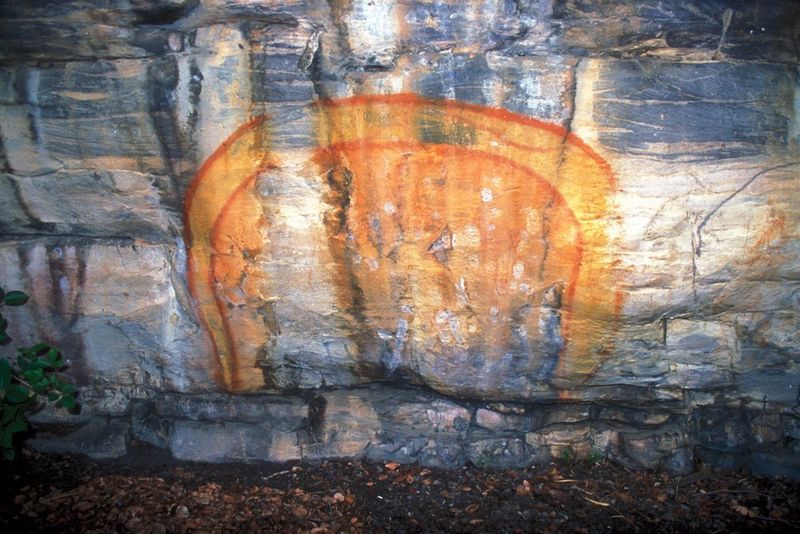
“Rainbow Serpent” is an English name under which many local beings have been gathered. Their names, bodies, genders and relationships differ. Kakadu’s public account names Almudj in Kundjeyhmi and Bolung in Jawoyn. In western Arnhem Land, Injalak Arts describes Ngalyod dwelling in billabongs and moving underground; her body can combine the forms of snake, kangaroo and crocodile. A being who creates and nourishes can also be dangerous, especially when people transgress the Law associated with a place. [1] [5]
The water stories extend far beyond the north. Speaking about the Swan River at Perth, Noongar Elder Marie Taylor describes the Waugal shaping the river’s course and still sleeping and moving within it. The relationship is local and present: the river passing through the city remains ancestral country. The northern ceremonies that follow are particular ways of inhabiting such a world. [6]
Wunggurr and the life of Country
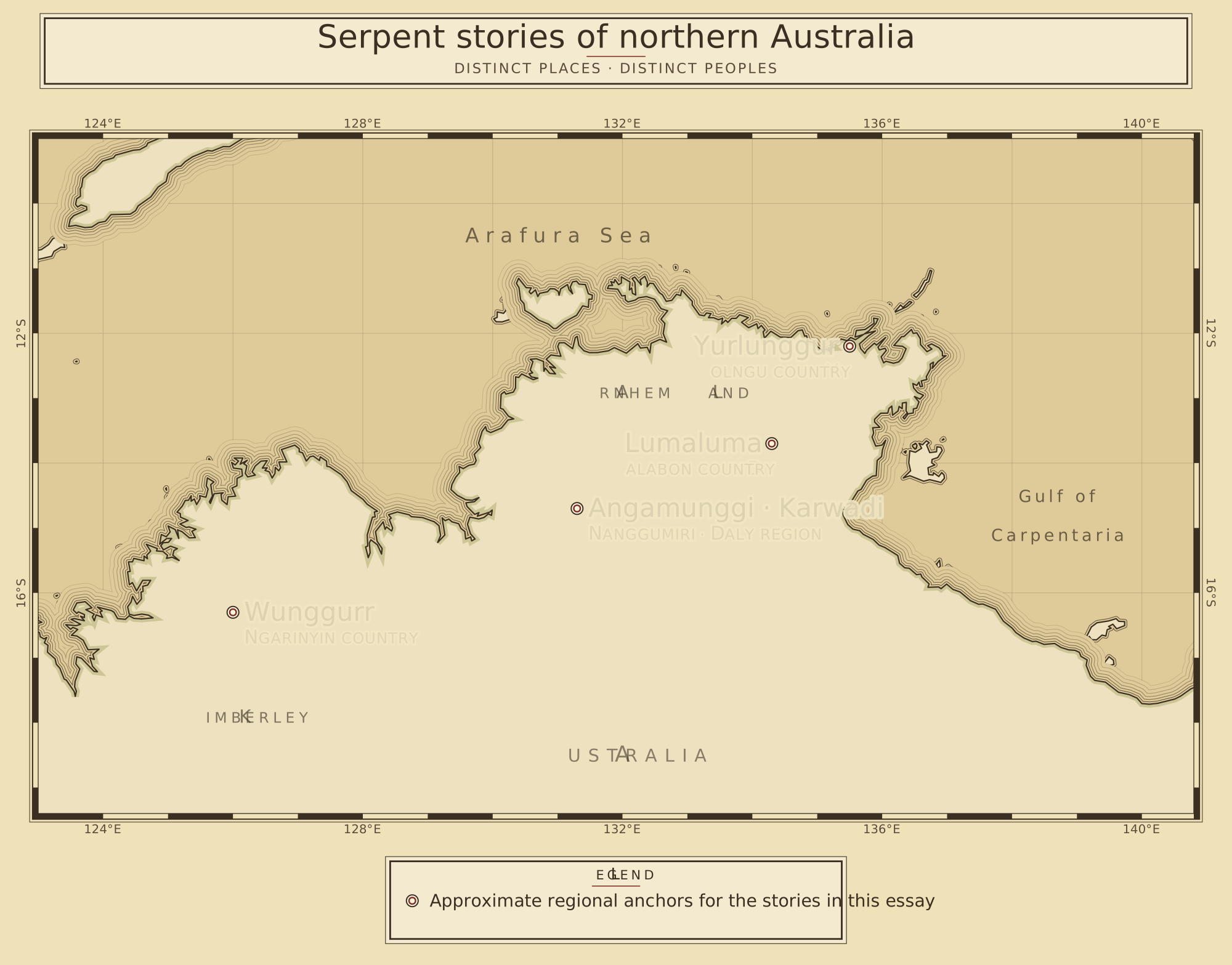
The map locates four of the northern settings visited in this essay. Its distances matter: the Kimberley, Daly River and Arnhem Land contain distinct peoples and ceremonial histories. The names beside the markers belong to those local accounts.
For the Ngarinyin of the Kimberley, Wunggurr is the Rock Python or Rainbow Serpent and the life force running through Country. The Wilinggin Healthy Country Plan describes that presence as especially concentrated in permanent waters, yet spread through land and sea. Wunggurr waters hold baby spirits. A child’s identity can be tied to one of these places: water, ancestry and a human life meet at a named part of Country. [3]
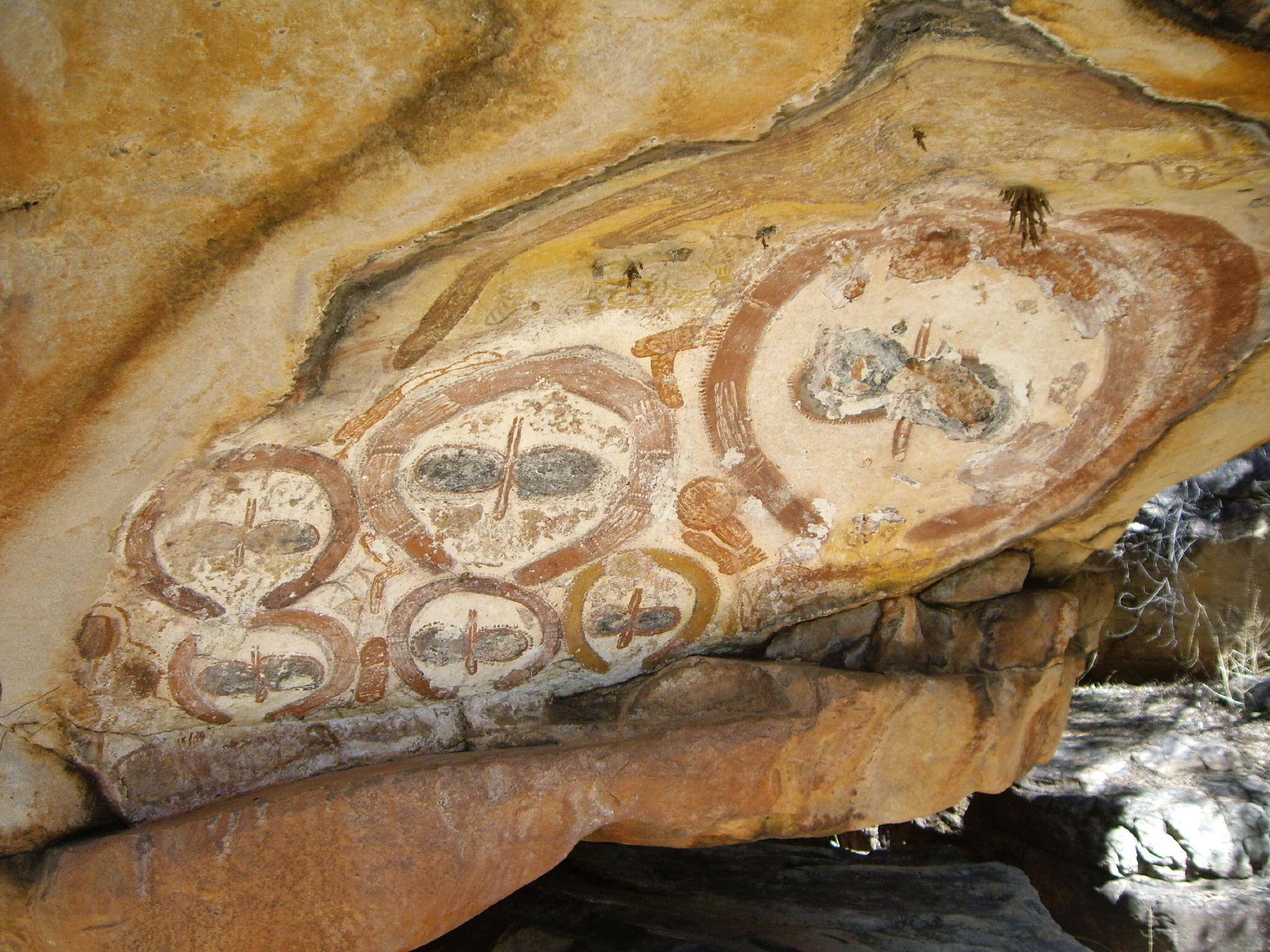
Wanjina, the great ancestral beings painted in rock shelters, belong to this same living world. Wilinggin’s account distinguishes their local presences from Wunggurr’s more pervasive life. The relationship has visible forms: some Wanjina head-bands end in a python’s head. The paintings are part of a country already inhabited by its ancestors. [3]
The sisters and the first monsoon
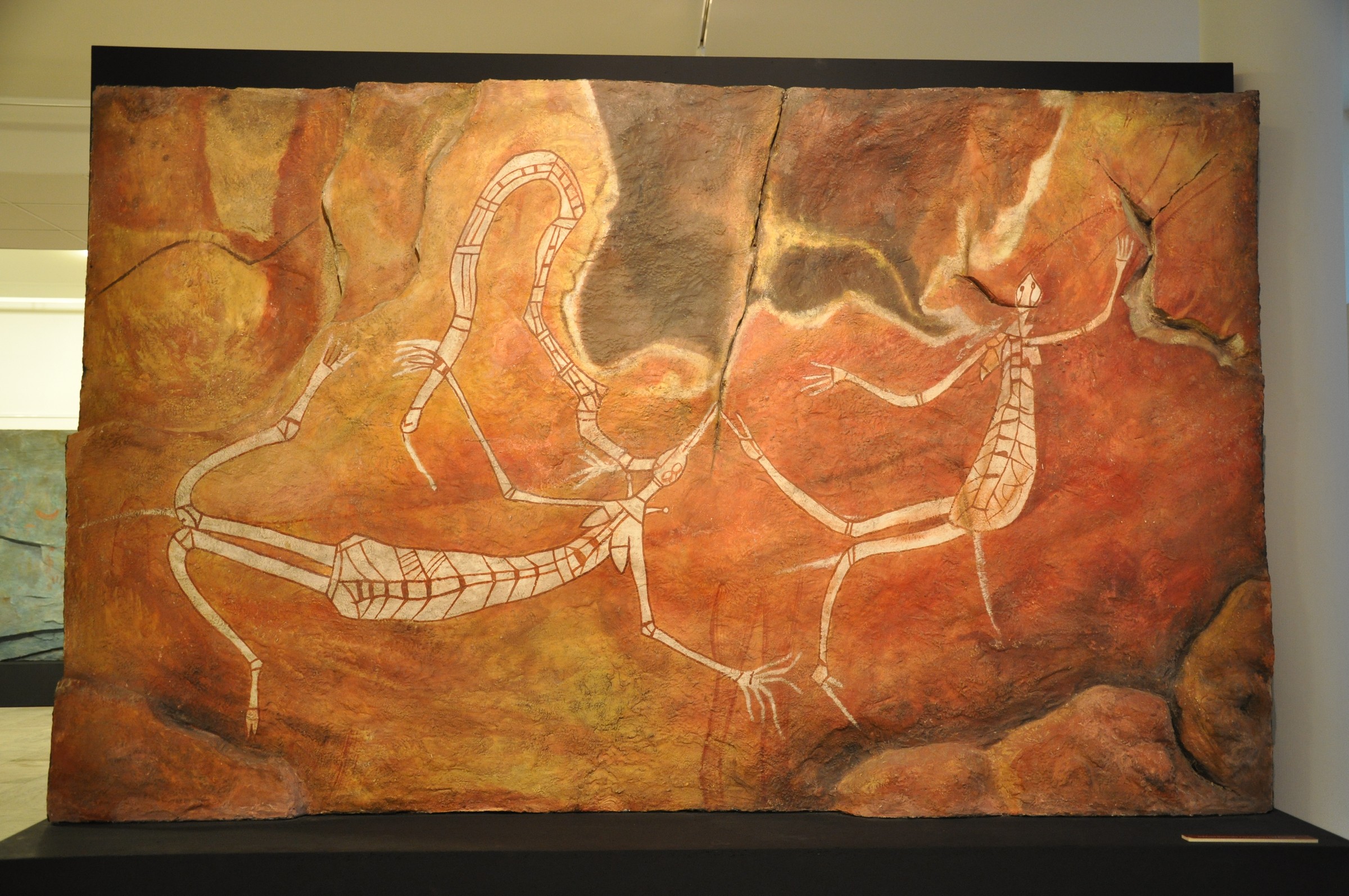
In Yolngu country in north-eastern Arnhem Land, the Wawilak sisters travel through a world they help to name. Their encounter with a great python is told in song, enacted in ceremony and painted on bark. Different clans hold different parts and versions of the ancestral history. The familiar spellings Wawilak, Wägilak and Wawaluk reflect that history’s passage through languages and publications.
In James Davidson’s account of the artist Mathaman Marika’s Wawaluk tradition, the sisters reach Mirramina, the python Yurlunggur’s waterhole. The serpent surrounds their camp and sings the rain of the first wet season. A sister throws a singing stick toward the sky; the python turns it into lightning. The storm is an ancestral event, and a beginning of the seasonal world. [7]
The National Museum of Australia’s account of the related Wititj narrative explains the law within the swallowing. The serpent devours the sisters, then learns from other serpents that he has swallowed beings of his own Dhuwa moiety, one of the two great divisions of Yolngu social and ancestral life. His act breaches a relationship that should have governed him. He becomes ill and expels them. The museum’s accompanying account of Dawidi’s paintings relates this transformation to initiation: boys pass into ceremony and emerge as men. In Gälpu paintings, male and female serpents also make rain clouds, while their tongues become lightning. [8]
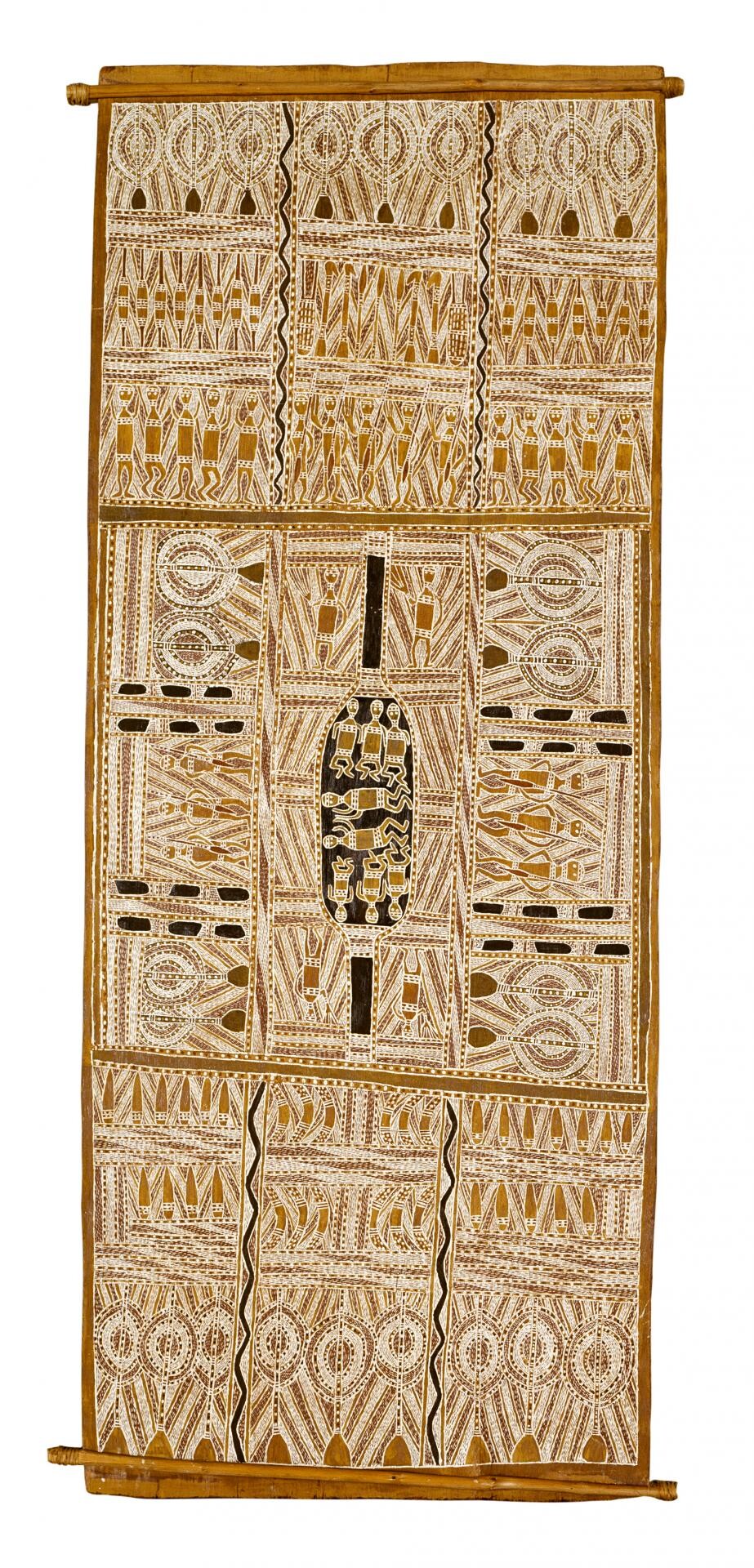
Marika’s 1963 painting of Arafura Lagoon lays out waterways, footprints and ceremonial things. When Davidson watched him paint a companion version in 1965, chanting accompanied the work. The design grew through song. Country could be walked, sung and painted, with each medium carrying part of the ancestral history. [7]
The serpent’s body, fangs and voice
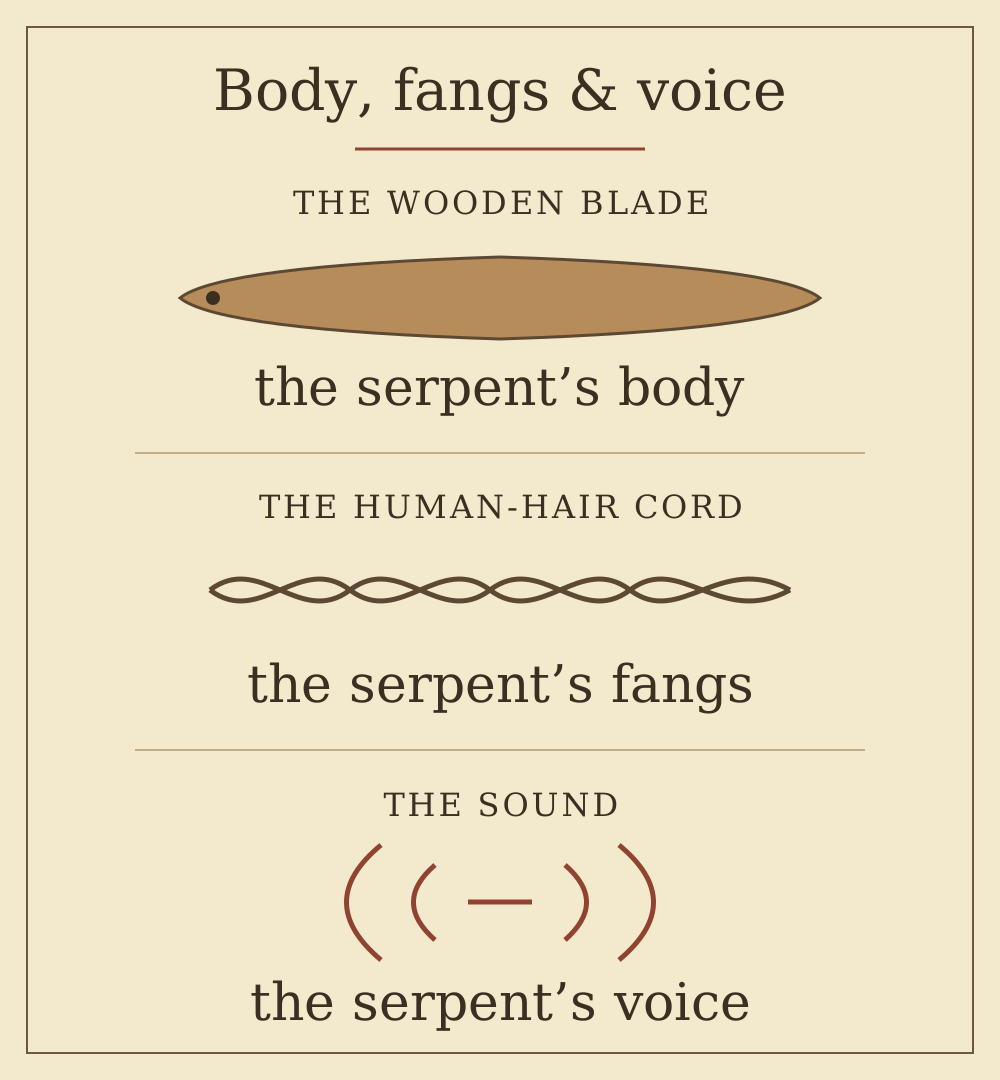
A bullroarer is a wooden blade swung on a cord. As it turns, it throbs. In Davidson’s Wawaluk–Kunapipi account, the blade is the snake’s body, the human-hair string its fangs, and the roar its voice. [7]
W. Lloyd Warner described another Arnhem Land Gunabibi account after fieldwork in 1926–1929. A man made the instrument he recorded as mandelprindi, fitted its hair cord and handle, covered it in blood or red ochre, and painted a snake upon it. Songs were sung over the instrument to strengthen it. Afterwards it could be wrapped in bark and kept in a hollow tree on ceremonial ground. Warner recorded the explanation that the bullroarer was “the snake itself.” [9]
A python is painted on the Yolngu paddle in the Atlas. Warner’s account opens a view into the ceremony around such instruments: paint and wood, song and breath, concealment and revelation worked together. Songs strengthened the object before its sound entered the gathering.
Warner’s opening scene has a whole camp singing. Men, women and children gather, and the clan songs bring their groups together. A man hidden nearby swings the bullroarer. Its low tone alternates with the male leader’s high call and the women’s answering chorus. Young men are then taken away by two men identified with water snakes, who will guard and instruct them. Secrecy surrounds the instrument, yet women have an active musical part in the ceremony.
Later, messengers carry its call toward other camps, summoning people to the final dance. The sound travels as the snake’s voice, and women answer in the part of the ancestral sisters. The bullroarer draws a boundary around knowledge; it also makes relationships audible across the gathering. Its voice can separate people, call them together, and place them within an ancestral scene. [9]
The bird that caught Lumaluma’s voice
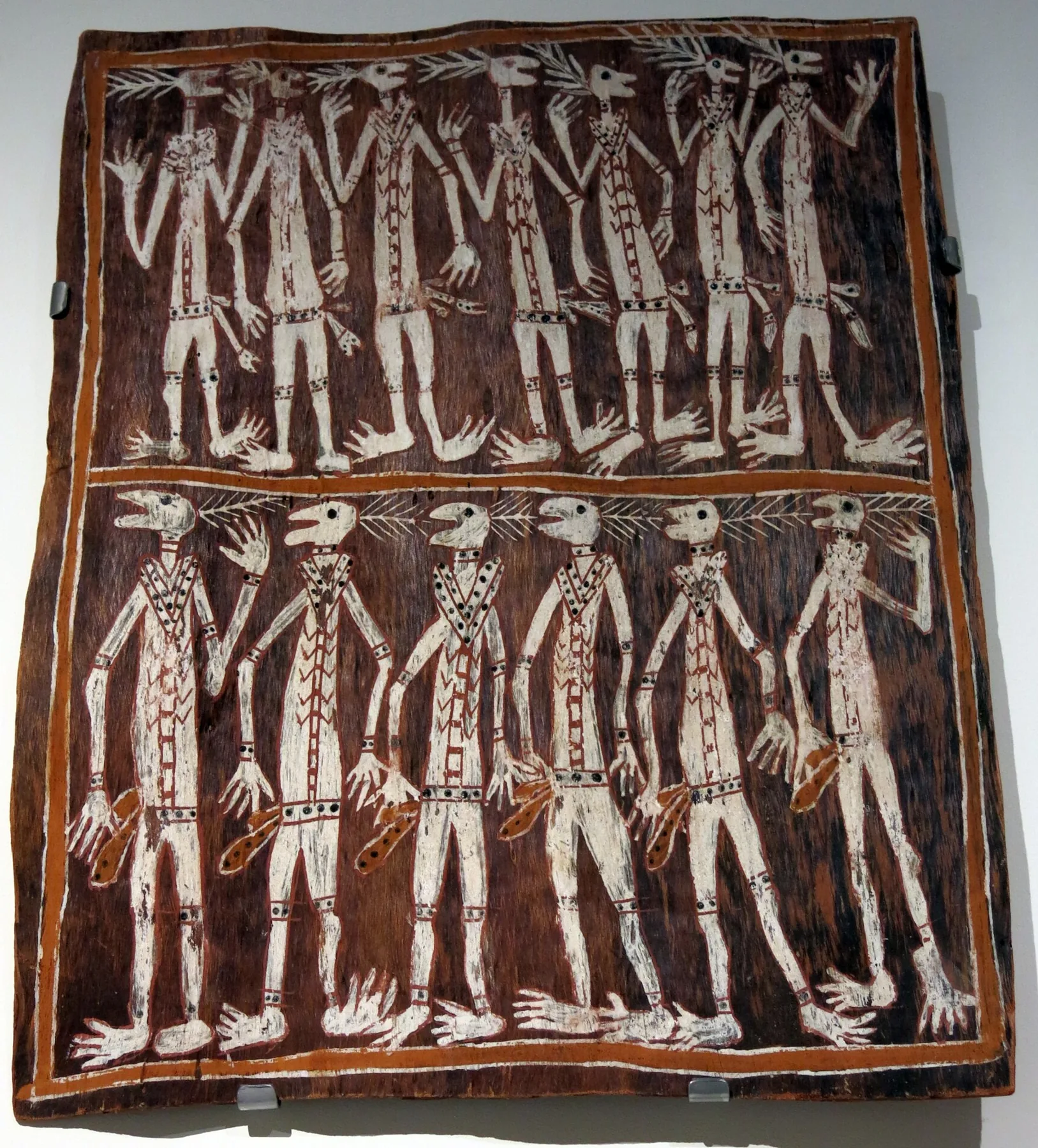
In southern Arnhem Land, the Dalabon account of Lumaluma gives the bullroarer its voice through a startling act of capture. The serpent Mother lived in the sea. She swallowed people offered to her in the Gunabibi, but brought back only their bones when she should have returned them alive. A father and son decided they would continue the ceremony without feeding people to her. [10]
A bird made a bullroarer to take her place. When Lumaluma next spoke, the left-handed night bird swung the new instrument and caught her voice. She remained in salt water. The father and son, their wives, the bird and two snakes travelled south, carrying the ceremony and its songs. A voice could leave its owner and continue to act in the world. In the Gunabibi, novices were understood to be swallowed by the Mother whose voice they heard. [10]
Maddock also recorded the Dalabon Mother Jingana holding all life inside herself until a left-handed spearman released it. He places Lumaluma beside her as Jingana or a version of her. The stories give different shapes to a profound maternal power: a body can contain life, withhold it, consume it or let it forth. The bullroarer belongs to one particular telling of that power, in which people continue the ceremony with the Mother’s captured voice.
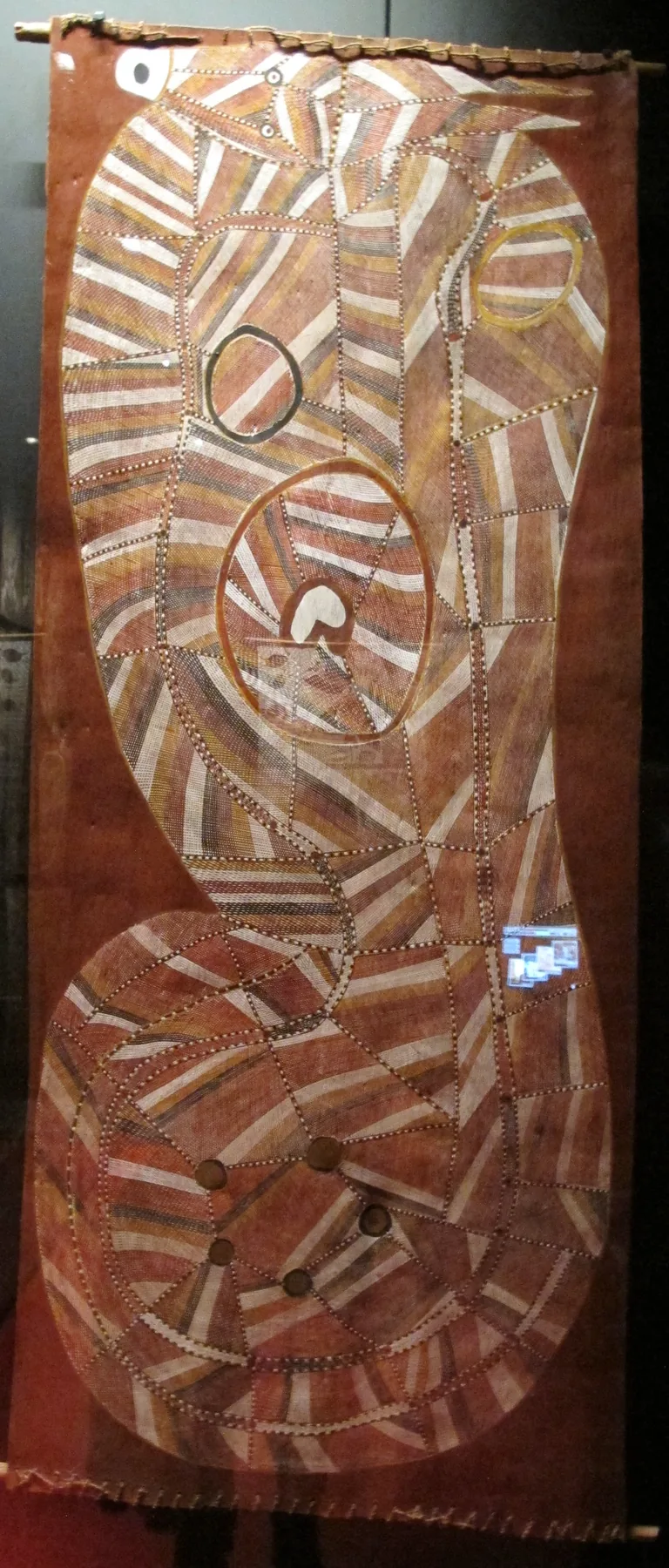
In the Arnhem Land stories, swallowing draws a person into an ancestor’s body. A ceremony can translate that event into a change of human standing: novices leave ordinary camp life, learn under the care and authority of elders, and return with new relationships and obligations. The instrument gives this passage a sound. Its meaning comes through the whole sequence of teaching and action around it.
Growing into ancestral country
Initiation has different stages, names and custodians in different communities. Even the word Kunapipi, also written Gunabibi and in other local forms, cannot supply a single script for the north. In the Atlas, the Mungarai Kunapippi and the Ngalakan kunapippi have their own recorded accounts. A shared ceremonial vocabulary leads into local histories.
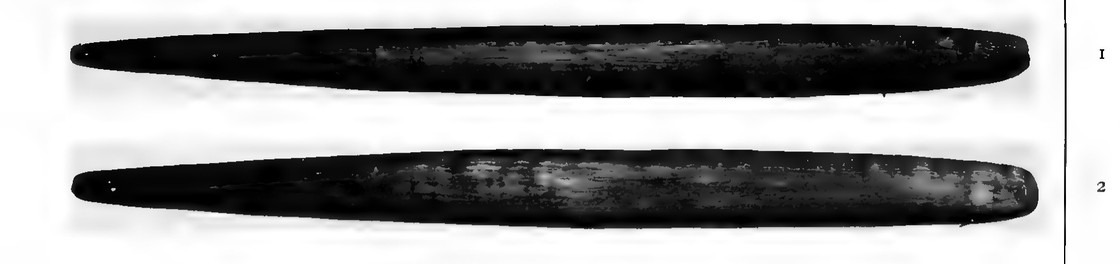
In the Kimberley, Bernard Moizo described Bunuba initiation through a boy’s changing relationships. His elder sisters’ husbands took him to a neighboring camp. Women mourned his departure as though he had died. After circumcision and during seclusion, he received a small wooden bullroarer made by his paternal grandfather, on a plaited-hair cord. Its sound was the voice of ancestral spirits. He would return to his family with a new name and standing. [11]
Moizo’s later study places initiation at Junjuwa beside a narrative in which two great serpents make the Fitzroy River and introduce circumcision. The novice’s roarer is a miniature counterpart of a larger sacred board, or churinga. Many local churinga referred to Rainbow Serpent episodes, yet none was understood as the serpent’s own churinga. That distinction leaves room for several relationships: an instrument can concern the serpent’s history without being identified with the serpent itself. [11]
Here, growing up draws a young person into relationships with elders, ancestral history and named country. The river’s creation and the institution of initiation appear within the same local narrative. The boy receives knowledge and an instrument from people whose kinship gives them a part in his making.
Karwadi calls from the bush
West of Arnhem Land, among the Murinbata, or Murrinh-Patha, of the Port Keats region, Stanner described the ceremony publicly called Punj. Its secret spirit-name was Karwadi, the Mother of All or Old Woman. The bullroarer marked her presence. Young men already circumcised years earlier entered another stage of knowledge. They lost their ordinary names and ornaments, were covered in blood, and expected to be swallowed alive and vomited forth.
At the climax, bullroarers sounded from concealment. Their roar approached. Older men cried out as if the Mother were calling from the bush; then the swingers appeared and the instruments were shown. A prospective brother-in-law gave each young man a new bullroarer. The youth met the sound through fear, revelation and kinship, and became responsible for knowledge once withheld from him. [12]
“Karwadi! Karwadi! The Old Woman is calling”.
W. E. H. Stanner, On Aboriginal Religion, p. 8
Karwadi’s maternal swallowing resembles the eastern serpent stories. Stanner’s account of this rite does not identify her as a Rainbow Serpent. Her name and maternal presence belong to the Murinbata account. Neighboring traditions share a way of describing initiation while telling different histories of its ancestral being.
Those histories also change in ordinary human time. Stanner’s portrait of Durmugam describes Nanggumiri men bringing an All-Mother cult from Victoria River country to the Daly River region. In the 1920s people there said Angamunggi, their Rainbow-Serpent All-Father, had gone away. A new ceremonial movement answered a sense of abandonment. Locally it took the form of Karwadi. Angamunggi and the Mother remain distinct in the account; the people who carried the ceremonies were named individuals, acting within a changing world. [13]
The sisters’ Law is still being taught
The ancestral stories continue through people who teach them. For the Rirratjingu and Marrakulu clans, the Djungguwan ceremony carries the Wawilak sisters’ Law through song, dance, art and instruction. In the Film Australia material held by the National Film and Sound Archive, Rirratjingu leader Bakamumu Marika explains its importance through discipline and respect within families. Initiation joins a child to earlier generations and ancestral origins. Each performance has its own circumstances. [14]
Yolngu leaders asked filmmakers to record ceremonies so their children and grandchildren could learn from them. The men leading the 2002 Djungguwan included people who had been children in the 1976 film. Knowledge passed through living bodies, voices and memories, with film becoming another means of carrying it forward. Children could grow into the leadership of a ceremony they had first encountered in the care of their elders. [15]
In the northern Kimberley, Wunambal Gaambera people describe their creator snakes as remaining in salt water, visible in waves, tides and currents. Their account brings ancestral action into the sea moving around them now. Country holds the beginnings of things and the relationships through which people continue to live. [16]
A waterhole, a painted bark and a wooden voice offer different encounters with that continuity. The serpent may rest beneath water, rise in a storm, or sound within a ceremony. Its local stories teach where life comes from, what can endanger it, and how people learn to take their place among its responsibilities.
Key sources
- Kakadu National Park / Parks Australia, “Stories”, Rainbow Serpent section. Traditional Owner account of creation, continuing presence and local names.
- Uluṟu–Kata Tjuṯa National Park / Parks Australia, “Tjukurpa”. Aṉangu explanation of Law, learning and past, present and future.
- Wilinggin Aboriginal Corporation, Wilinggin Healthy Country Plan 2012–2022, pp. 6–7; “About”, for the current public form Lalai.
- AIATSIS, “Map of Indigenous Australia”, explanation of Country and the diversity of peoples, languages and laws.
- Injalak Arts Centre, Joe Guymala, “Ngalyod (Rainbow Serpent)”, work 1318-24. Public cultural account accompanying the artist’s carving.
- State Library of Western Australia, “Walking on Water: Spirit of the Swan Coastal Plain”, transcript, Marie Taylor’s account of Waugal and the Swan River.
- James A. Davidson, “Mathaman: warrior, artist, songman”, Art Bulletin of Victoria 29, NGV web republication, 18 June 2014. Wawaluk narrative, Kunapipi instrument, and the 1963 and 1965 Arafura Lagoon paintings.
- National Museum of Australia, Old Masters: “Eastern Arnhem Land”, Mithinarri section. Gälpu serpent paintings and the related Wititj narrative; the Central Arnhem Land’s Dawidi section compares transformation to initiation.
- W. Lloyd Warner, A Black Civilization, revised edition, Harper Torchbook printing, 1964, pp. 280–282, 290–291. Gunabibi instrument, camp chorus and messengers. Fieldwork 1926–1929; first edition 1937. Page references follow the consulted printing.
- Kenneth Maddock, “Introduction”, in I. R. Buchler and K. Maddock, eds, The Rainbow Serpent: A Chromatic Piece (1978), pp. 11–12; “Communication and Change in Mythology,” in N. Peterson, ed., Tribes and Boundaries in Australia (1976), p. 166, for the fuller sea, bones and bird episode.
- Bernard Moizo, “La circoncision, un rite d’initiation australien” (1992), pp. 419–420; “Les serpents arc-en-ciel viennent toujours du nord” (2007), pp. 734, 736. The 1992 Bunuba account supplies the paternal grandfather; the later regional discussion has different kinship wording.
- W. E. H. Stanner, On Aboriginal Religion (1963; Sydney University Press edition, 2014), pp. 4–8, 25–26. Karwadi, Punj and Murinbata senses of Dreaming.
- Stanner, “Durmugam: A Nangiomeri” (1959), in White Man Got No Dreaming (1979), pp. 84–85. Angamunggi and the movement of the All-Mother cult.
- National Film and Sound Archive / Film Australia, “The role of the Djungguwan”; Ceremony, background interviews, §5.1, Bakamumu Marika, interviewed 2004.
- NFSA / Film Australia, “Full circle: 1976 and 2002 Djungguwan ceremonies”; “Djungguwan: Speaking to the Future – part 3”, on the leaders’ purposes for recording ceremony.
- Wunambal Gaambera Aboriginal Corporation, “Our Culture”, Lalai Story and Wanjina Wunggurr Law.