No. LOEB1929-028
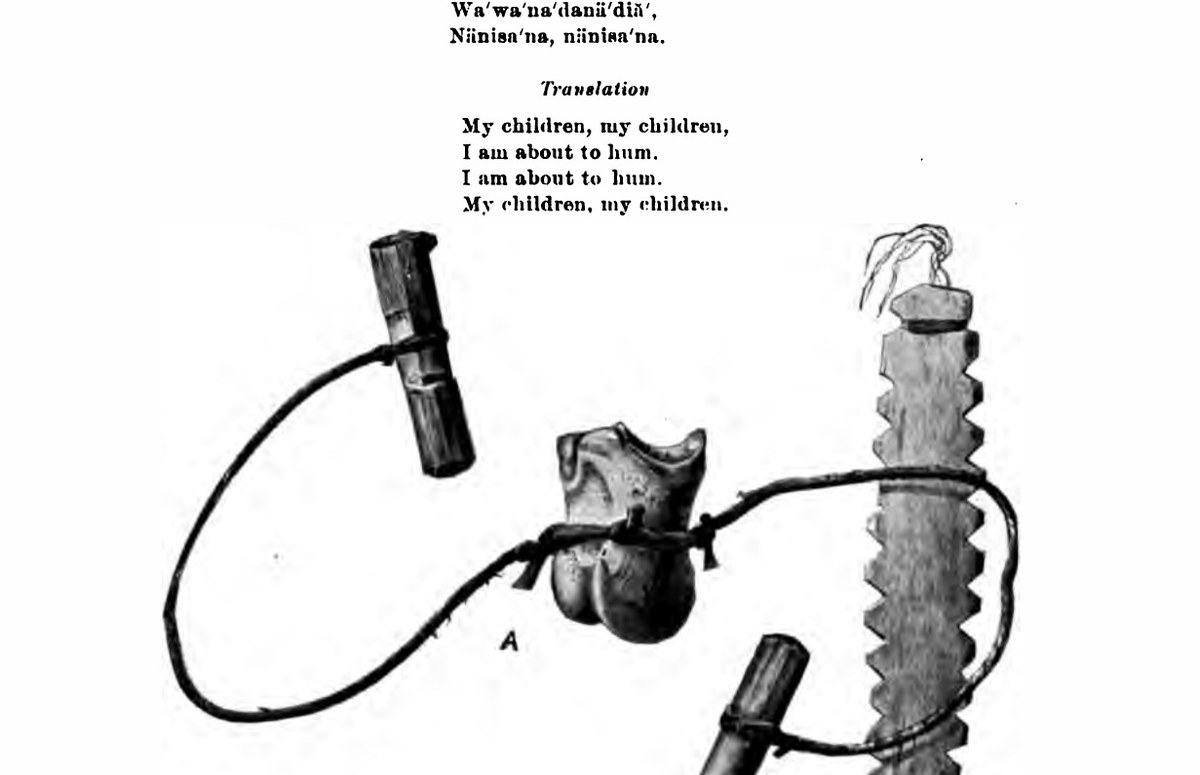
Arapaho toy or wind bullroarer
United States · Great Plains · Arapaho · North America
Play / practical

hateikuuca
Source term: "hateikuuca"
Among the Arapaho the bullroarer was a toy: a notched blade of bone only four or five inches long, tied to a two-foot thong and swung from a stick. Whirled fast it roared like a bull or distant thunder, and it was thought to make wind. Its name, hateikuuca, it shared with a buzzer of cow's foot-bone that was sometimes used in the Ghost Dance to start the singing. Among the closely related Gros Ventre, Kroeber found the bull-roarer and the buzzer to be only children's toys, both called nakaantan, "making cold" — the same word the Gros Ventre gave to the thermometer — which he traced to the widespread idea that the bull-roarer breeds wind. The Arapaho stood at the northern edge of the Plains bullroarer, as Edwin Loeb mapped it: here it still made wind, where among the Gros Ventre and Paiute it was only a toy.
If this specimen is typical of the Arapaho bull-roarer, the implement is quite different in form from the longer, pointed wooden bull-roarer of the Gros Ventre.
A. L. Kroeber, The Arapaho, IV: Religion (Bulletin AMNH 18, 1907), p. 396
Particulars
- Object
- A notched bone blade a little more than an inch wide and four or five inches long, cut square at the string end and deeply notched at the other, with about a dozen notches down each side; tied to a two-foot thong on a stick of equal length.
- Function
- A toy, also thought to produce wind.
Source
A. L. Kroeber, The Arapaho, IV: Religion (Bulletin AMNH 18, 1907), p. 396, fig. 153; Edwin M. Loeb, 'Tribal Initiations and Secret Societies,' University of California Publications in American Archaeology and Ethnology 25(3) (1929): 249-288, at pp. 271 and 284