No. VANSTONE1961-001
Northern Ute wind-caller for the summer-born
United States · Uintah and Ouray Reservation · Utah · North America
Weather / fertility magic
Source term: bull-roarer
No name is attached to this specimen; among the White River band the instrument was /neta=t+ mutunu=p+/.
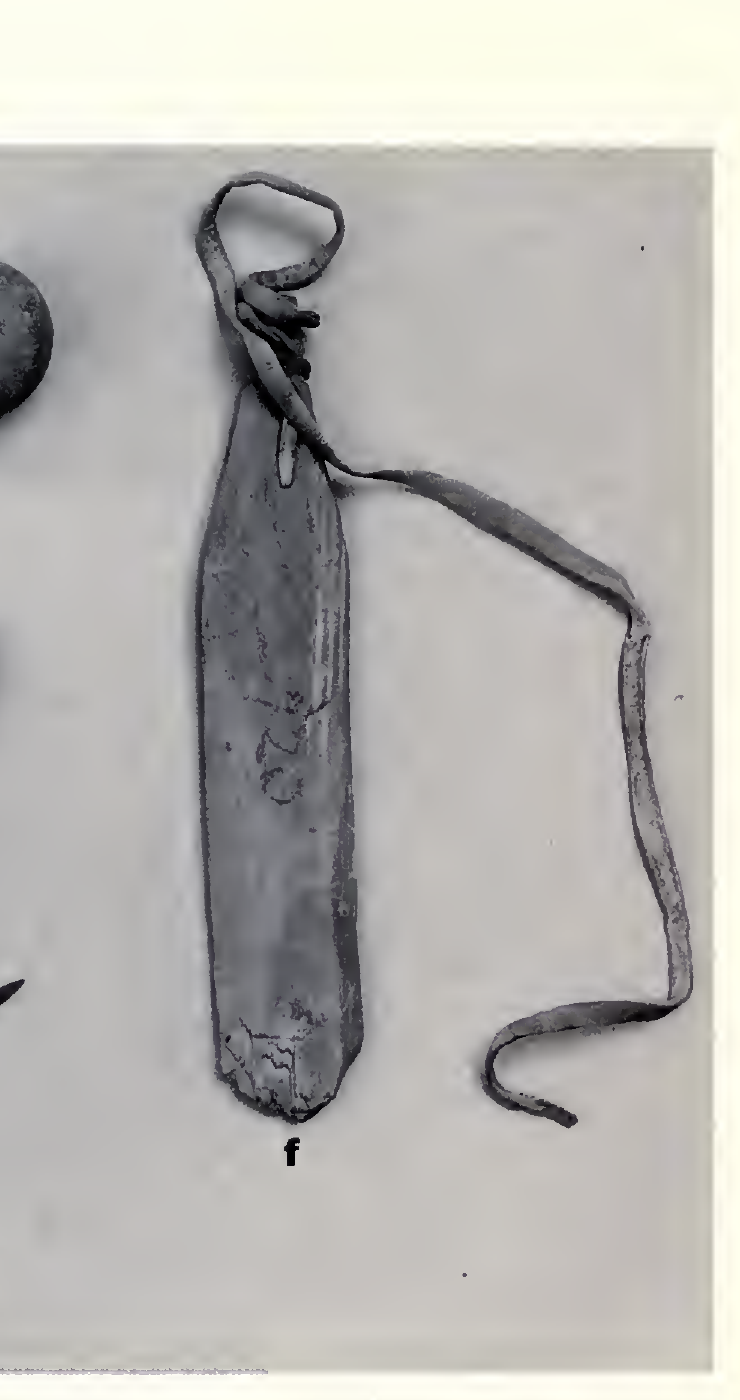
On the Uintah and Ouray Reservation, a Northern Ute hand cut a rough rectangular board, narrowed it at one end, and tied on a buckskin line - a toy, VanStone judged, made to be twirled for the pleasure of its own roar. Among Northern Utes at large, though, Anne Smith recorded a larger purpose: the bullroarer called the wind, and drove off rain and snow. It would answer only to someone born in the summer.
Attached at this notch is a length of buckskin line. Presumably the toy was activated by twirling the piece of wood while holding the buckskin line.
VanStone 1961:15
Particulars
- Object
- Crudely shaped rectangular wooden board narrowing to a notched proximal end, with one buckskin line attached at the notch.
- Function
- A wind-caller in Northern Ute practice - Anne Smith's ethnography records that the bullroarer was 'used to call the wind' and 'should be swung by someone born in the summer to bring wind to blow away rain or snow'; VanStone judged this particular buckskin-corded specimen a toy.
Sources
- James W. VanStone, An Ethnographic Collection from the Northern Ute in the Field Museum of Natural History (1961), p. 15; fig. 37f, p. 48; object 60974 View
- Anne M. Smith, Ethnography of the Northern Utes (1974), pp. 164, 279