No. LOEB1929-034
Gros Ventre toy bullroarer
United States · Northern Plains · North America
Play / practical
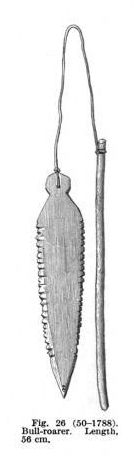
nakaantan
nakaantan — 'making cold', a name the Gros Ventre also gave the thermometer; Kroeber links it to the widespread idea that the bull-roarer breeds wind. Applied to both bull-roarer and buzzer.
Etymology. Kroeber records that the Gros Ventre called both the bull-roarer and the buzzer nakaantan, "making cold" (the same word they used for the thermometer), which he derives from the widespread Indian idea that the bull-roarer breeds wind.
The Gros Ventre called the bull-roarer nakaantan, 'making cold' — and when the trader's thermometer arrived on the Plains, they gave the strange new instrument the same name, for both were things that dealt in wind and weather. Kroeber, cataloguing in 1908, found no spirit speaking through it: a notched blade with a small neat head, half a metre long on its sinew cord, it was a children's toy, as was the buffalo-foot-bone buzzer that shared its name. Loeb's 1929 survey, sorting dreaded spirit-voices from playthings, filed the Gros Ventre firmly among the playthings — while their close kin the Arapaho whirled the same instrument to raise the wind itself.
The Havasupai, San Carlos Apache, and Papago associate the bullroarer with rain, while the Arapaho and the Klamath have an analogous use, to produce wind. Among the Gros Ventre and Paiute it is only a toy.
Loeb 1929, Tribal Initiations and Secret Societies, UCPAAE 25(3):284 (citing Spier, Havasupai Ethnography, AMNH Anthropological Papers 29:290, 1928)
Particulars
- Object
- Notched wooden bull-roarer, 56 cm (AMNH 50-1788; Kroeber 1908 fig. 26): a flat blade with a small well-marked head, long taper to a point, and numerous small edge-notches, its sinew cord about the length of its stick handle; one of two very similar wooden models. The two-string buffalo-foot-bone buzzer is a separate instrument.
- Function
- A children's toy: Kroeber records both bull-roarer and buzzer as 'only children's toys' among the Gros Ventre, Loeb citing Spier to the same effect.
Sources
- A. L. Kroeber, Ethnology of the Gros Ventre, AMNH Anthropological Papers 1(4) (1908), pp. 190-191, fig. 26, object AMNH 50-1788
- Edwin M. Loeb, 'Tribal Initiations and Secret Societies,' University of California Publications in American Archaeology and Ethnology 25(3) (1929), pp. 249-288, at p. 284 View · archived
- Leslie Spier, Havasupai Ethnography, AMNH Anthropological Papers 29 (1928), p. 290, via Loeb 1929, p. 284