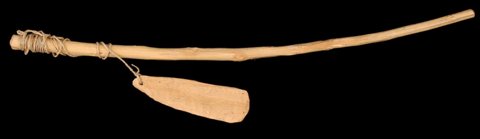
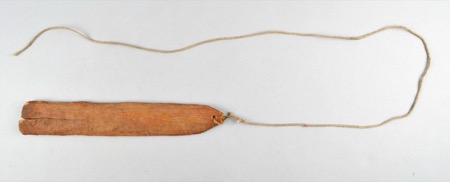
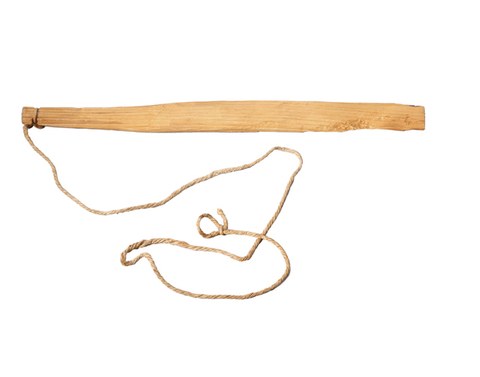
From the Nuba Mountains and the Ethiopian highlands through Kenya and Tanzania to Lake Malawi and Madagascar, whirled boards pass through many hands: girls who make their own, boys guarding crops, the messengers of a forest beast, the dancers of a snake-god. Some are cult instruments hidden from women; others are toys any child can cut.
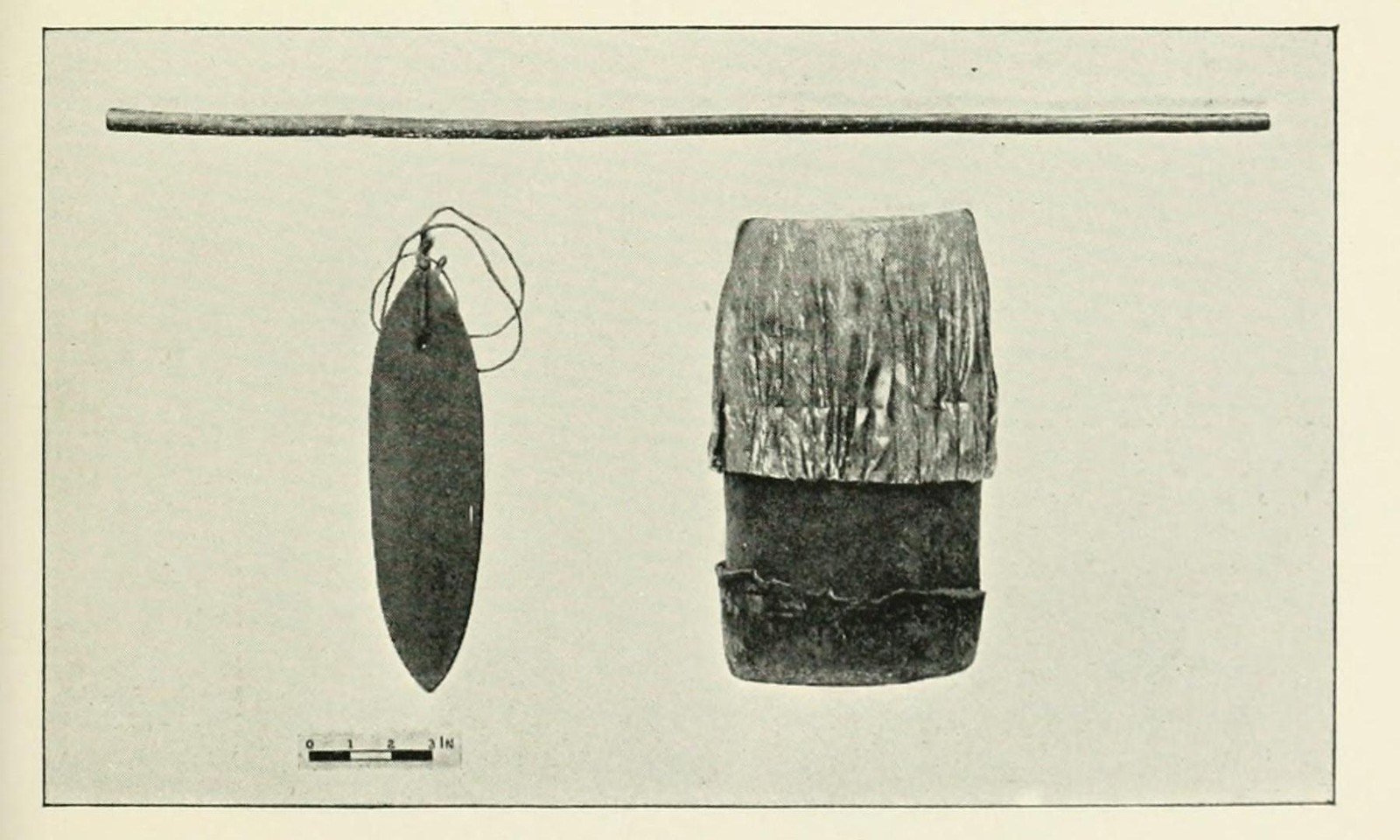
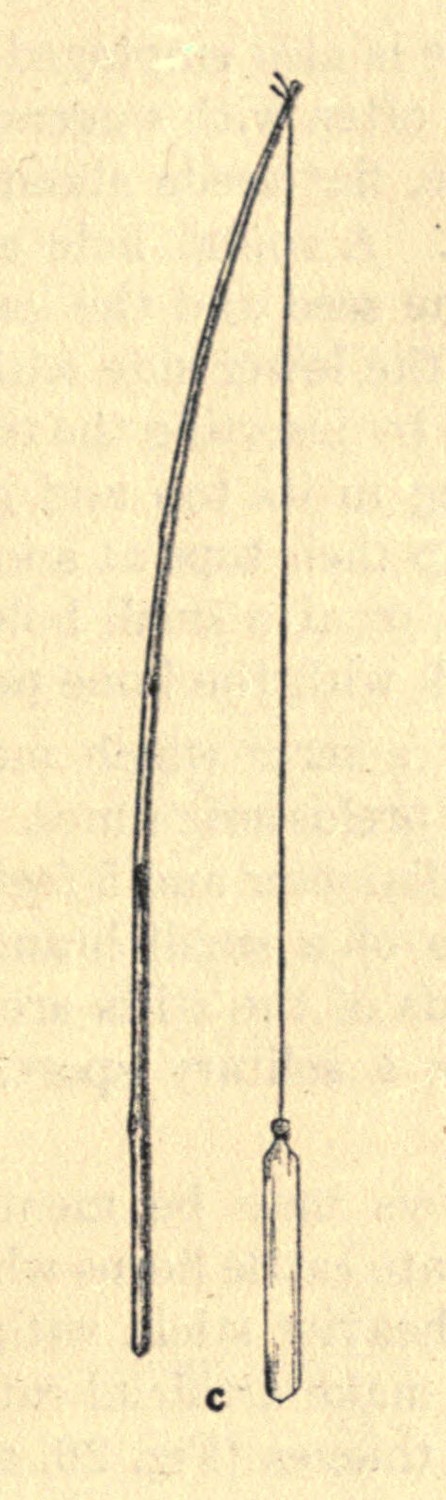
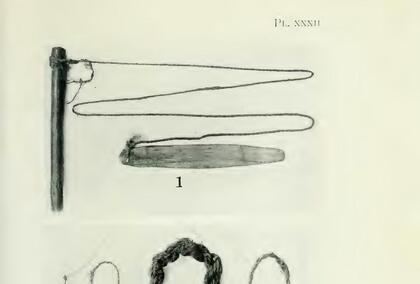
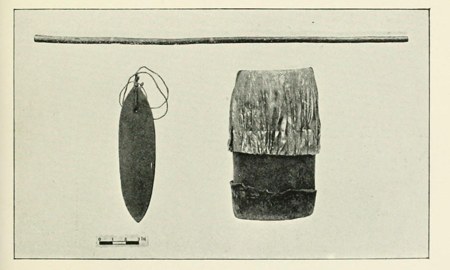
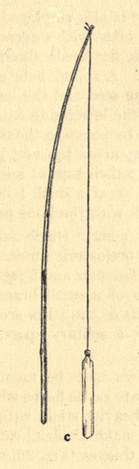
NandiHollis's plate of Nandi instruments: a bow above, the bullroarer — a dark elongated blade on a looped cord — at center.TanalaFig. 26c: the Tanala tavovoka, a boy’s toy swung on a long cord.
A Chagga child on Kilimanjaro hears a lion when an adult wants the crying to stop, and an older child can make the same loud board from thin wood and banana fibre. In the Pare Mountains of Tanzania, men swing the children of a forest beast through the evening country, and households put food outside for them. Beside Lake Victoria, a snake-god who rose from the water told his followers to dance with drums and bullroarers in every homestead. 8, 7, 6
On Kilimanjaro, Chagga children scraped an elongated piece of wood thin and swung it on a string of banana bast. It sounded like the heavy flapping of a large bird, and smaller children were afraid of it. The boards came out at the beginning of the greater rains, among the leaf hats, wooden slippers and home-made wind instruments that children fashioned for themselves. 8
The same sound could work from the adult down to the small child. To stop crying, an adult gave a lion or an irimu spectre its voice with a bullroarer: one more household threat, like the dangerous creature upstairs or the noise outside when a baby refuses supper. A Chagga child met the frightening voice at home long before any initiation school. 8
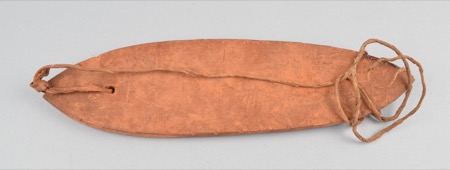
In Kamba country in Kenya, a small boy carried a roughly cut, pointed-oval wooden blade on a cord, a toy kept among the boys’ tops, air-guns and slings. 9
In the western Kenyan highlands and on the slopes of Mount Elgon, the board becomes an animal at the seclusion hut: the Nandi lion ngetundo that kept new initiates indoors after dark, the Gusii beast Enyabububu that threatened to eat the novices, the creature Kipsigis boys sang to keep off the roof of their menjo. Their schools have their own page, Western highlands: Elgon to Gusii. 1, 3, 4, 2
In the Pare Mountains of north-eastern Tanzania, ngurunguru were the children or messengers of an immense forest beast. The creature itself stayed in the forest, where it was said to swallow the incoming boys and give them back. Its messengers travelled. In the evenings before the mshitu forest festival, men swung humming boards through the country, and people who heard them put food outside their houses. 7
The messengers could leave more than an empty pot. A small stick beside it foretold the birth of a girl; a tiny bow foretold a boy. Women also prepared the novices: an older woman placed each boy four times in a seated woman’s lap while a man and the women answered one another. Then the boys went into the forest, where the beast waited to swallow them. 7
In 1913, the story goes, a gigantic snake rose from Lake Victoria, swallowed Onyango Dunde of Alego in western Kenya and immediately returned him to his hut. It named itself Mumbo, whose homes were the sun and the lake, and chose Onyango to speak for it. Its followers would live in plenty: crops would grow without labour, and cattle, sheep and goats would come up out of the water. Europeans would disappear. 6
Mumbo’s worship began at home. His adherents said the god had ordered sacrifice and dancing with drums and bullroarers in each boma, each family homestead. The groves and wooden images that some followers later set up had never been part of his instructions. 6
The snake could still be seen. From Asembo, across the Kavirondo Gulf, a waterspout once hung between cloud and lake. Asked what it was, an interpreter said that people called it Mumbo. 6
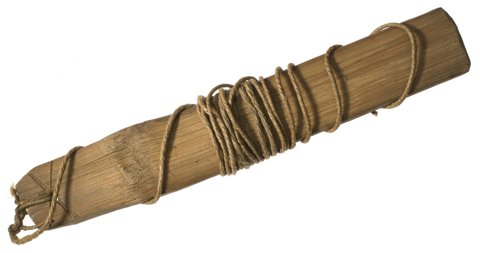
At Tadoro in the Nuba Mountains of Sudan, a film made on 24 and 25 December 1962 follows Koische, a girl of about ten, as she makes her own bullroarer. She split bamboo, tested its flexibility and shaved away the rough surface. She began the hole with a knife and finished it with the safety pin from her necklace. Cotton rolled on her thigh became the cord. Finally she stood on a stone to try the instrument, stopping to check its fastening. 11
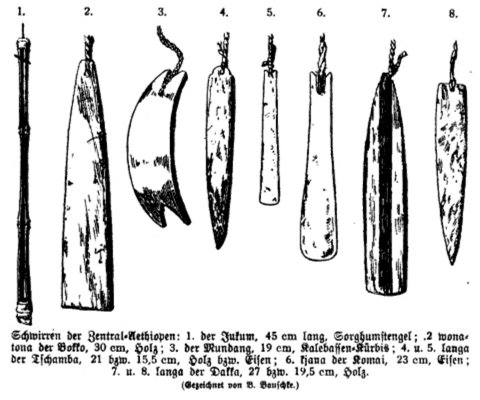
Only girls of eight to twelve made and played kurre, each on her own and on no special occasion. The growing grain imposed a season of silence. From sprouting until harvest, singing, dancing and musical instruments were forbidden: noise could injure the crop, and spirits dwelling in it could harm people. Until the harvest was in, the girls’ boards hung quiet. 11
Among other Nuba communities, girls whirled wooden roarers to chase birds from the harvest. Women could see and use these; the iron roarers of the kujur, the priest who held power over the harvest, were forbidden to them. The first grain became beer for a gathering of mature men in the kujur’s house, and only then was the crop released for everyone to eat. 12
In southern Ethiopia in 1934–35, neighbouring highland peoples gave the instrument very different lives. Among the Gedeo it was a cult implement anxiously hidden from women. At Gato, Kusume children swung it to frighten birds from the fields. The Burji remembered it at Omisso, an annual festival whose site rotated between communities; by the time of the expedition their Furissa was a children’s toy, and they denied that it had ever been meant to drive women away. 13
At the head of Lake Malawi, Konde children played with ifula, whose name means rain. Older people said it stopped the rain, and also that a well-disposed spirit paid no attention to a child’s game. 14
On Madagascar, Tanala children of seven to twelve whirled boards around their heads, one game among their home-made toys, and used the noise to frighten birds from the standing crops. 15
On Kilimanjaro, Chagga mothers kept their children in line with bogeys. A baby who would not eat its evening soup heard its elder brother outside, making the noise of a koko; the bananas in the attic, the mother said, were guarded by an animal with a prickly tail. When she wanted a child to stop…
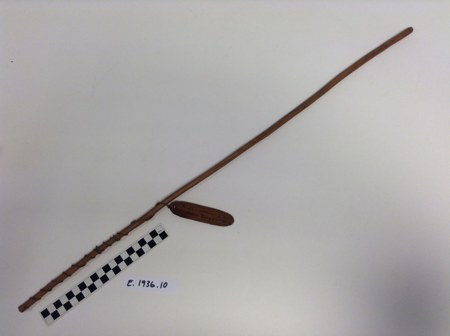
Representative — not this record’s object · Kikuyu kiburuti with its pole rig, 1907–1929 — 'Bull-roarer.
A small boy in Ukamba had his own bullroarer: a rough oval slice of wood, its cord threaded through a single hole at one end, spun on its string purely for the noise. Gerhard Lindblom counted it among Kamba children's playthings -- beside peg-tops, calabash-shell wheels, and trundled hoops -- but…
Representative — not this record’s object · Kikuyu ke-hu-ru-ta bullroarer from Kenya.
Among the Kipsigis of the Kericho highlands, boys newly circumcised and shut in the seclusion hut, the menjo, are first made into girls. They call one another chebi, 'girl', and use girls' names; their wounds are vaginas, and their blood is menstrual blood. Once they have healed, young men press…
Representative — not this record’s object · Nandi instrument plate with bullroarer.
eng'iti enene ('Big Beast of Outside'); enyabububu (the beast itself, onomatopoeic)
A Gusii boy was circumcised and then shut away, and while he was healing the beast came for him. It is called enyabububu, a name that imitates the sound it makes, and it swallows initiates; its wooden voice is eng’iti enene, the Big Beast of Outside, a flat piece of wood under a foot long, drilled…
Representative — not this record’s object · A Nandi bull-roarer; the Nandi, Sebei kin, also call it 'lion'
Pare (Wapare), Pare Mountains, north-eastern Tanzania
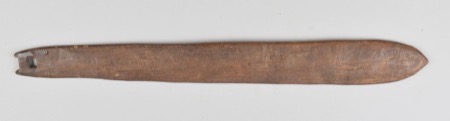
In the Pare mountains the ngurunguru went ahead of the mshitu: broad blades a forearm long, swung on their bands until the hills hummed. They were the children of the forest beast, and the beast itself waited in the initiation grove — the monster that swallowed the novices and, when the rites were…
Representative — not this record’s object · Plain wooden blade with a pierced stepped tang and rounded point.
Luo adherents of the Mumbo cult, Alego, western Kenya
In 1913, in the Alego country of Central Kavirondo, a man named Onyango Dunde was sitting in his hut when a gigantic snake reared out of Lake Victoria — so tall, they said, that its head touched the clouds — swallowed him whole, then a moment later spat him back, shaken but unharmed. The snake…
Representative — not this record’s object · Hollis's plate of Nandi instruments: a bow above, the bullroarer
Journal of the Royal Anthropological Institute 83(1): 9–36, p. 20. Entertainment and relief from pain; outside board and inside pot-and-skin instrument.
Anthropos 78: 369–410; pp. 369–371, 380–386, 406–407. Compares whole initiation institutions; concludes possible early borrowing by proto-Kalenjin from Bantu neighbours, with subsequent contacts in both directions.
Journal of the East Africa and Uganda Natural History Society 38–39: 13–17. Prophecy pp. 13–14; homestead sacrifices with drums and bullroarers p. 15; Asembo waterspout p. 17.
Pp. 113, 115–116: Katla priest-king; wooden crop scarers used by girls versus restricted iron roarers and first-fruits ceremony. The first-fruits sounding identification is qualified by Frobenius.