No. ROUTLEDGE1910-001
Munge Kikuyu bullroarer
Kenya · Historic Munge district · likely Mutira, Kirinyaga · East Africa
Play / practical
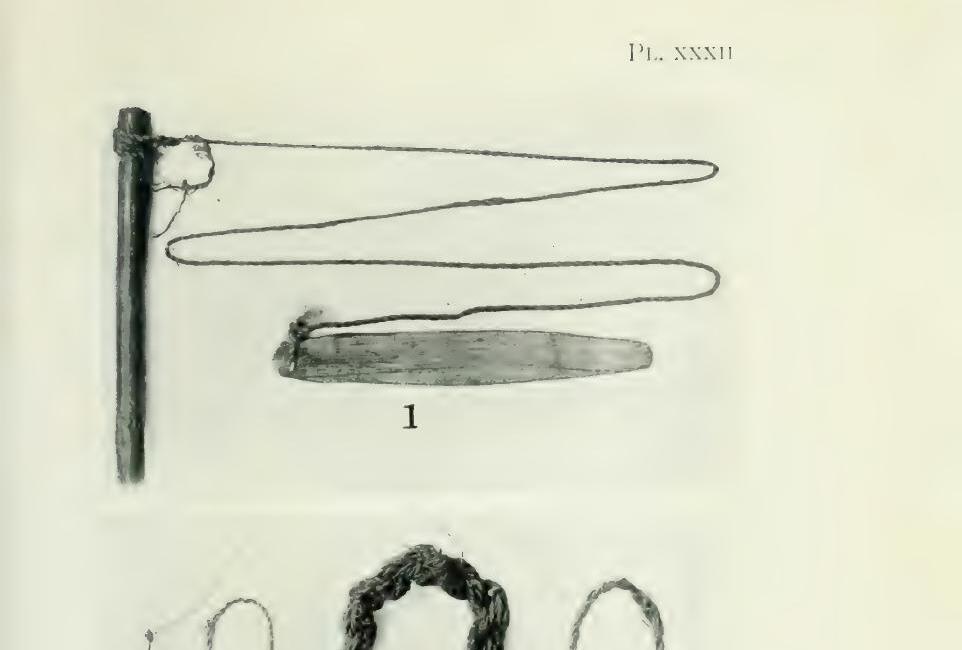
ke-hu-ru-ta
Source term: bullroarer
ke-hu-ru-ta = Kikuyu name printed in Routledge’s Plate XXXII caption and glossary.
Guarding the ripening grain from birds was, among the Kikuyu, what W. S. Routledge called "a serious business, in which the whole population take part" — watchers climbed platforms raised in the fields and pelted the raiders with stones and clods of earth. Into that clamour went the ke-hu-ru-ta: a flat wooden tongue on a bark-twine thong and a stick handle, whirled around the head and then twitched, not cracked like a whip. Well handled, Routledge wrote, it threw out a sound "something between a pistol-shot and the whoop of a motor syren." Scaring birds off the crops was, by custom, a man's one nominal share of the fieldwork; the cultivating was women's.
In use the thong is whirled around the head ... Used to scare birds.
Routledge 1910 Plate XXXII.1; British Museum Af1910,0604.53
Particulars
- Object
- End-pierced flat wooden tongue on bark-twine thong and stick handle.
- Function
- Bird-scarer; whirled overhead for a loud sound.
Source
W. Scoresby Routledge and Katherine Routledge, With a Prehistoric People: The Akikuyu of British East Africa (London, 1910), pl. XXXII.1; British Museum Af1910,0604.53