RAUM1940-001 - ethnographic attestation
Chagga humming board, a lion for crying children
Tanzania - Southern slopes of Kilimanjaro (Kilimanjaro Region) - East Africa
Play / practical
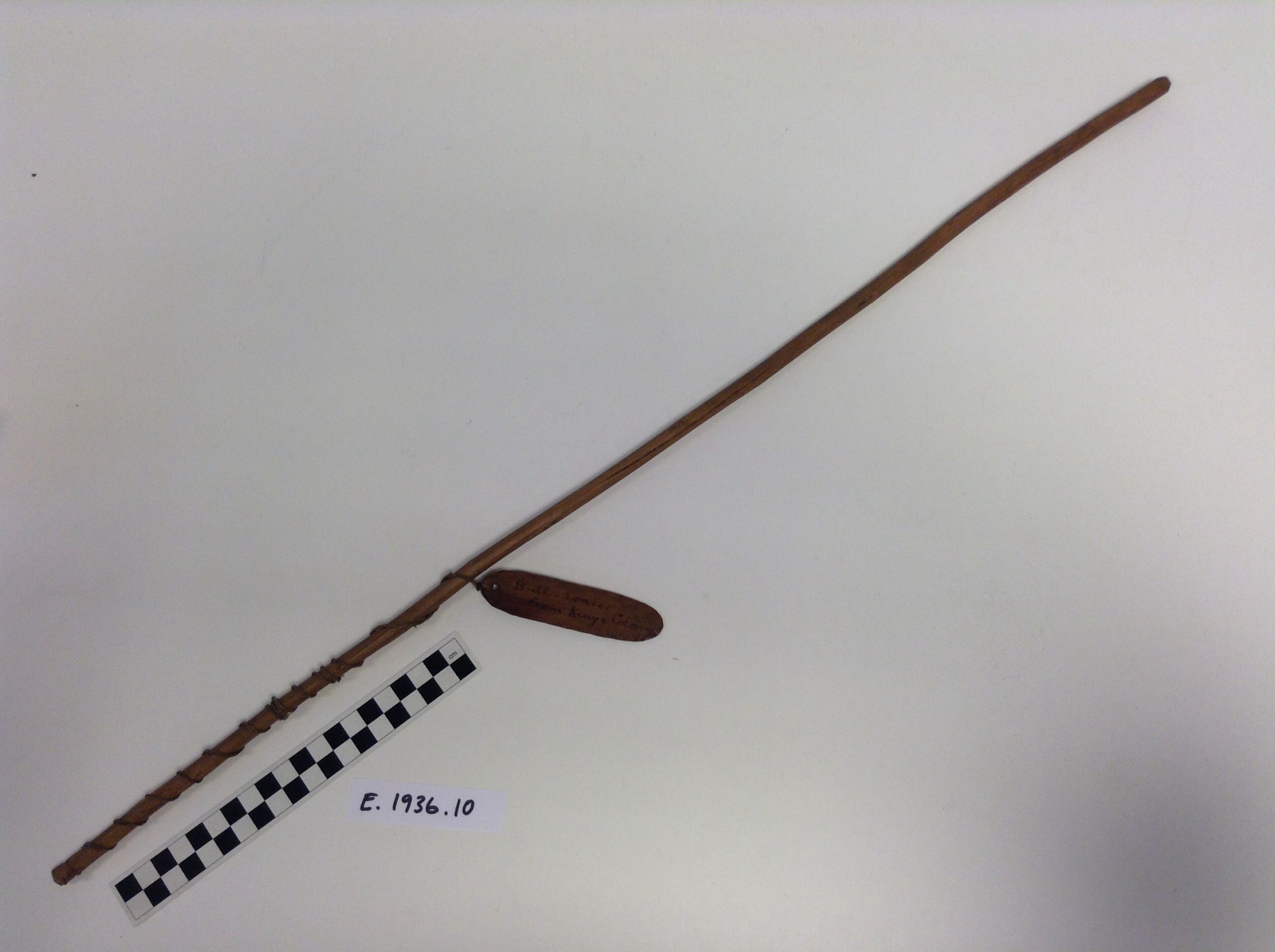
Source term: bullroarer; humming board
irumbu: a spectre whose voice, like the lion's, the bullroarer made to quiet a crying child.
On Kilimanjaro, Chagga mothers kept their children in line with bogeys. A baby who would not eat its evening soup heard its elder brother outside, making the noise of a koko; the bananas in the attic, the mother said, were guarded by an animal with a prickly tail. When she wanted a child to stop crying, a bullroarer gave voice to a lion, or to the irumbu spectre. Children made humming boards of their own, scraped thin and swung on banana-bast string. The little ones feared the noise, like a great bird beating its wings, and it was heard most at the beginning of the greater rains.
If she wants her child to stop crying, the voice of a lion or the irumbu-spectre is produced with a bullroarer.
Otto F. Raum, Chaga Childhood (1940), p. 213
- Object
- An elongated board of any wood, scraped thin and swung on a string of banana bast.
- Source
- Otto F. Raum, Chaga Childhood: A Description of Indigenous Education in an East African Tribe (London: Oxford University Press for the International Institute of African Languages and Cultures, 1940), pp. 213, 260
- Source location
Page references
Raum 1940 pp. 213, 260 (index: Humming boards, 260)
- Source confidence
- medium to high
- Location note
- Marangu, Kilimanjaro, Raum's base (Teachers' Training School); he describes Chagga practice generally.
Regions: Africa
- Spirit voice
- Toy / secular survival