No. JENSEN1936-001
Burji Omisso Furissa bullroarer
Burji highlands · southern Ethiopia · Africa
Sacred / spirit
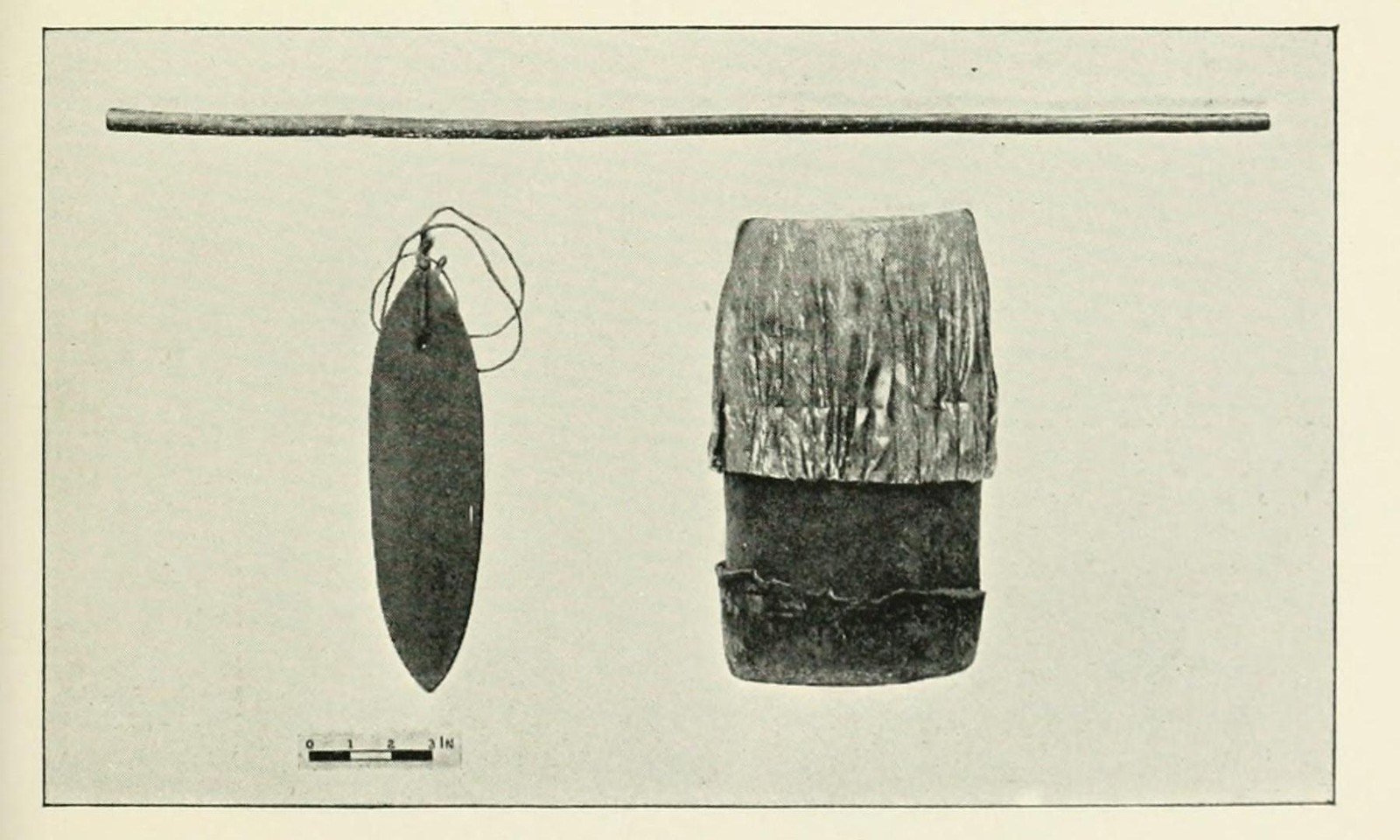
Furissa; gármi
Source term: Schwirrholz
Furissa: the Burji name recorded in 1934–1935, when the bullroarer had become a children's toy; gármi: the Burji word for it in Hermann Amborn's 2009 ethnography, where it is still only a plaything.
At the annual Omisso festival, whose gathering place rotated among Burji, Alga, and Amarro, the bullroarer once sounded as Furissa. By the 1930s it had crossed into childhood and survived as a toy. Decades later the children set to guard the fields kept watch from wooden platforms and drove off birds and monkeys with slings; their bullroarer, gármi, was still only a plaything.
In alten Zeiten wurde bei dem Feste ein Schwirrholz verwandt, angeblich aber nicht, um die Frauen zu verscheuchen; heute dient es nur noch als Kinderspielzeug (Furissa).
In former times a bullroarer was used at the festival, but reportedly not to drive the women away; today it serves only as a children's toy (Furissa).
Jensen, Wohlenberg and Wohlenberg, Im Lande des Gada (1936; reprinted as Im südlichen Abessinien), p. 145
Particulars
- Object
- Bullroarer identified by instrument class; no material, dimensions, cord, perforation, blade shape, mechanics, or object figure is supplied.
- Function
- Formerly sounded at Omisso, an annual Gada cult festival; by 1934-1935 it survived only as a children's toy. Informants denied that it served to drive women away.
Source
Jensen, Wohlenberg and Wohlenberg, Im Lande des Gada (1936; reprinted as Im südlichen Abessinien), p. 145