No. EXH2026-002
Tanala
Madagascar · Eastern forest escarpment, Fianarantsoa (Ifanadiana-Ikongo) · Africa
Play / practical
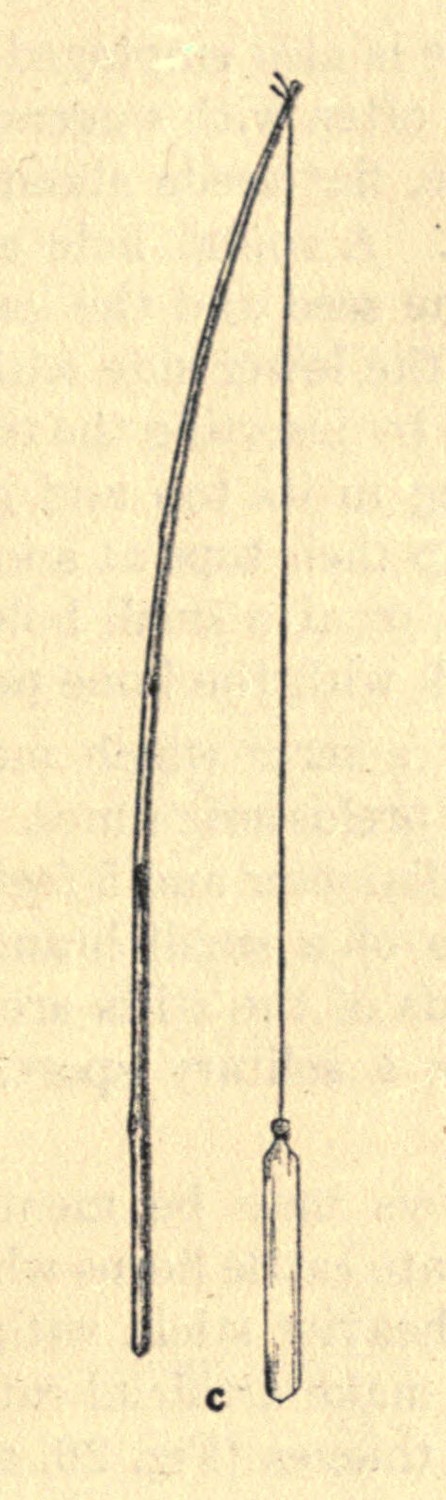
tavovoka
Source term: bull-roarer (tavovoka)
tavovoka — Linton's Tanala term for the bull-roarer, the same word he records for a spinning teetotum.
Among the Tanala of Madagascar's eastern forest the bull-roarer had fallen entirely out of adult hands by the time it was recorded. Ralph Linton, who collected for the Field Museum on the Marshall Field Expedition of 1926, found it in the hands of small boys from seven to twelve: a flat strip of bamboo bluntly pointed at the ends, tied by a cord about two feet long to a slender stick and swung round the head to make a whistling, rushing noise of no great volume, with, he noted, no ceremonial use or significance. Curt Sachs gives the Tanala blade as roughly thirteen centimetres long and two wide, and records that on the west the Sakalava made theirs of bamboo, dry bark, pieces of calabash, or hazomalany camphorwood, calling it kitambovo in the district of Beroroha and tambovo around Sakaraha.
Removed from its domain, the world of magic, it seems to be extremely rare on Madagascar and is no longer found in the hands of adults. It has become a simple children’s toy or, at best, a scarecrow for birds menacing the seeds.
Curt Sachs, "The Musical Instruments of Madagascar" (TDE-Journal trans. of Les instruments de musique de Madagascar, 1938), p. 62
Particulars
- Object
- Flat bamboo blade, pointed at both ends (~13 cm by 2 cm per Sachs), on a cord c. 2 ft fixed to a stick handle; Field Museum specimen Cat. 185479.
- Function
- Children's toy, swung round the head; also used to frighten birds away from the standing crops.
Source
Ralph Linton, The Tanala: A Hill Tribe of Madagascar (Field Museum Publication 317, 1933), p. 253 and fig. 26c; Curt Sachs, Les instruments de musique de Madagascar (1938), p. 62