MERRITT1976-001 - ethnographic attestation
Bukusu leopard-voice bullroarer
North Kabras location, Kakamega District - Bungoma–Kakamega Bukusu country, western Kenya - East Africa
Restricted
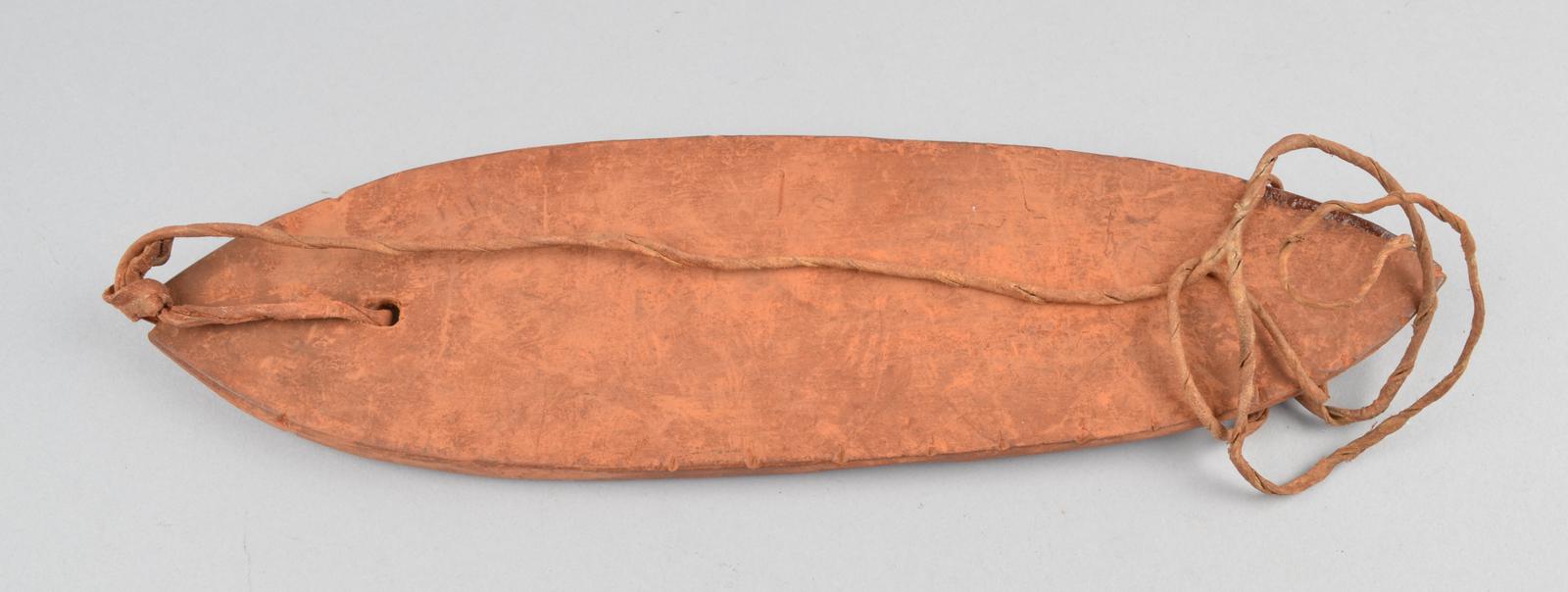
Source term: bull-roarer
Khulicha: the Bukusu post-circumcision coming-out ceremony itself (not an instrument term). Mwalye / Bamwalie: the clan custom, glossed by Merritt as "those coming from the east," associated with the leopard scene. entwitwi: a double-headed friction drum, sounded by rubbing a wet reed against its membrane, recorded as a possible substitute for the bull-roarer in the same rite (Simiyu 2011, p. 29) — a distinct instrument, not photographed here as the bullroarer.
At Lwandeti, in Bukusu country of western Kenya, the Khulicha coming-out closed the circumcision season for boys of the Mwalye custom. Women and the uninitiated were warned to stay clear of the night's activities, for those of the Mwalye — "those coming from the east" — would deal with a leopard that was loose nearby. As the Khulicha songs were sung, a bull-roarer sounded the leopard's growl, and the initiates were taught a song of protection to keep the roaring leopard from eating them; on hearing it, the elders ate bananas and drank beer, calling out that they had heard him and were glad. Before the night ended, each initiate was taken aside and given two parallel cuts near the left elbow, understood as the claw-marks left by the leopard he had wrestled. All were then sworn to secrecy, on pain of madness, a withered arm, or a hunched back. A friction drum could stand in for the bull-roarer in the same rite.
A bull-roarer is used to simulate the leopard's growl.
John Hilton Merritt, A Study of Change in Circumcision Rituals among the Abaluyia of Bungoma and Kakamega Districts of Western Kenya since 1910 A.D. (PhD thesis, University of Nairobi, 1976), p. 87.
- Object
- No Bukusu-specific morphology is recorded. Merritt's thesis text names the instrument only in English as a "bull-roarer," with no blade, cord, or whirling description given, and no object photograph exists. A double-headed friction drum, `entwitwi`, sounded by rubbing a wet reed against its membrane, is recorded as an occasional substitute for the bull-roarer in the same rite (Simiyu 2011, p. 29, Plate 4); it is a physically distinct instrument and its photograph must not stand in for the bullroarer.
- Source
- John Hilton Merritt, A Study of Change in Circumcision Rituals among the Abaluyia of Bungoma and Kakamega Districts of Western Kenya since 1910 A.D. (PhD thesis, University of Nairobi, 1976), p. 87: "A bull-roarer is used to simulate the leopard's growl" (n. 97, naming the informant Yohana Mukhumu, son of Lumbasi, interviewed at Lwandeti, 20 February…
- Source location
Page references
p. 87 (bull-roarer sentence and n. 97); p. 141 (n. 90, Khulicha observation); Simiyu 2011, p. 29 (entwitwi)
- Source confidence
- medium Approximate centroid for the North Kabras location / Lwandeti area, Kakamega District, western Kenya; the source names the locality but not a precise ceremonial site.
- Spirit voice
- Initiation rite
- Forbidden to women