Around Mount Elgon on the Uganda–Kenya border and across the western Kenyan highlands, Sebei, Bukusu, Marakwet, Nandi, Kipsigis and Gusii initiation schools make an animal heard at night. Boys grasp a lion in the dark, carry a leopard’s claw marks, feel skull jaws snap at their legs, and at last learn to whirl the board themselves.
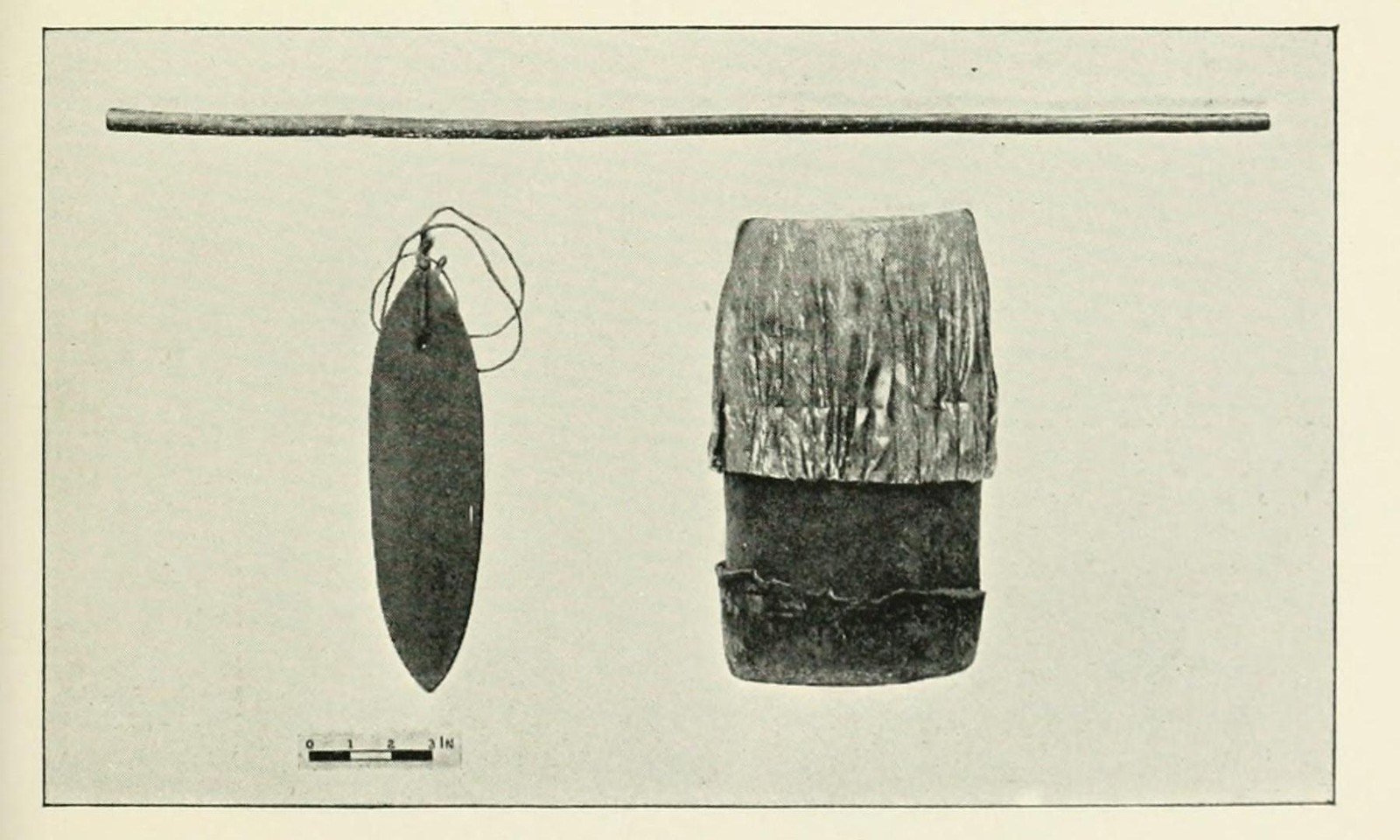
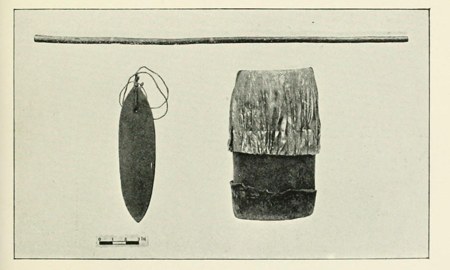
NandiHollis's plate of Nandi instruments: a bow above, the bullroarer — a dark elongated blade on a looped cord — at center.
A Sebei initiate goes into the dark to seize a lion. Older men make its roar with a board on a thong, out of sight, while instructors hide in the bush. In the Bukusu Khulicha coming-out, a boy wrestles a leopard whose claws leave two cuts near his elbow. North and south of Mount Elgon, on the Uganda–Kenya border, the animal a boy has heard all through seclusion finally takes hold of him. 4, 6
For Sebei boys north of Mount Elgon, the secret encounter opened the final ceremonies of coming out. They had heard the roaring all through seclusion. Now each was taken alone to the lion in the dark and made to grasp it, while an instructor scratched him with bent thorns. The lion also had a body of monkey skin. Older men worked the bullroarer out of the initiates’ sight, while instructors hid in the bush. 4
Afterward the boys were shown the bullroarer and made to whirl it until they were very tired. A loose blade was a terrible omen, so a boy’s father or brother was to inspect the thong: someone with evil intentions might cut it partway through. The sound had to stop dead, never die away. Girls had their own separate encounter, inside a tightly closed house. 4
Khulicha is an additional course of circumcision kept by the Bamwalie line of the Bukusu and their Tachoni neighbours, south of Mount Elgon. Early in it comes a river ceremony with blessings for crops and future children. The boys crawled through a temporary hut into the water; a defanged snake, naluvonga, hung over the riverside entrance and thorns over the other doorway. Afterward the initiates were carried across like dead bodies and told to wake. 6
The leopard came at coming-out. Bedding was burned and the initiates went to a banana grove. Women and uninitiated people were warned away from the night’s proceedings because the leopard was loose. A bullroarer made its growl, though a friction drum could stand in for it. 6
The novices sang for protection from being eaten. Elders ate bananas, drank beer and announced their pleasure at hearing the animal. Each boy was taken aside, seized and given two parallel cuts on the tender flesh near his left elbow: the claws of the leopard he had wrestled. Before dawn the boys swore secrecy, and they carried the marks home. 6
Among the Marakwet on the Kerio escarpment of western Kenya, boys were warned that the kaptorus wild animal would attack. It came on a moonless night. Men closed in on the seclusion hut whirling boards at different speeds; inside, guardians snapped goat and sheep skull jaws against the boys’ legs while others struck them with nettles. Some boys confessed wrongs they had kept back. Next morning, final counselling explained the night. 5
Among the Nandi, ngetundo, lion, named both the bullroarer and the boys’ friction drum. The first was a small oval piece of wood whirled on goat hide; the second a wooden barrel covered with skin and sounded by friction. The girls’ leopard was another friction drum, made from a water jar. 1
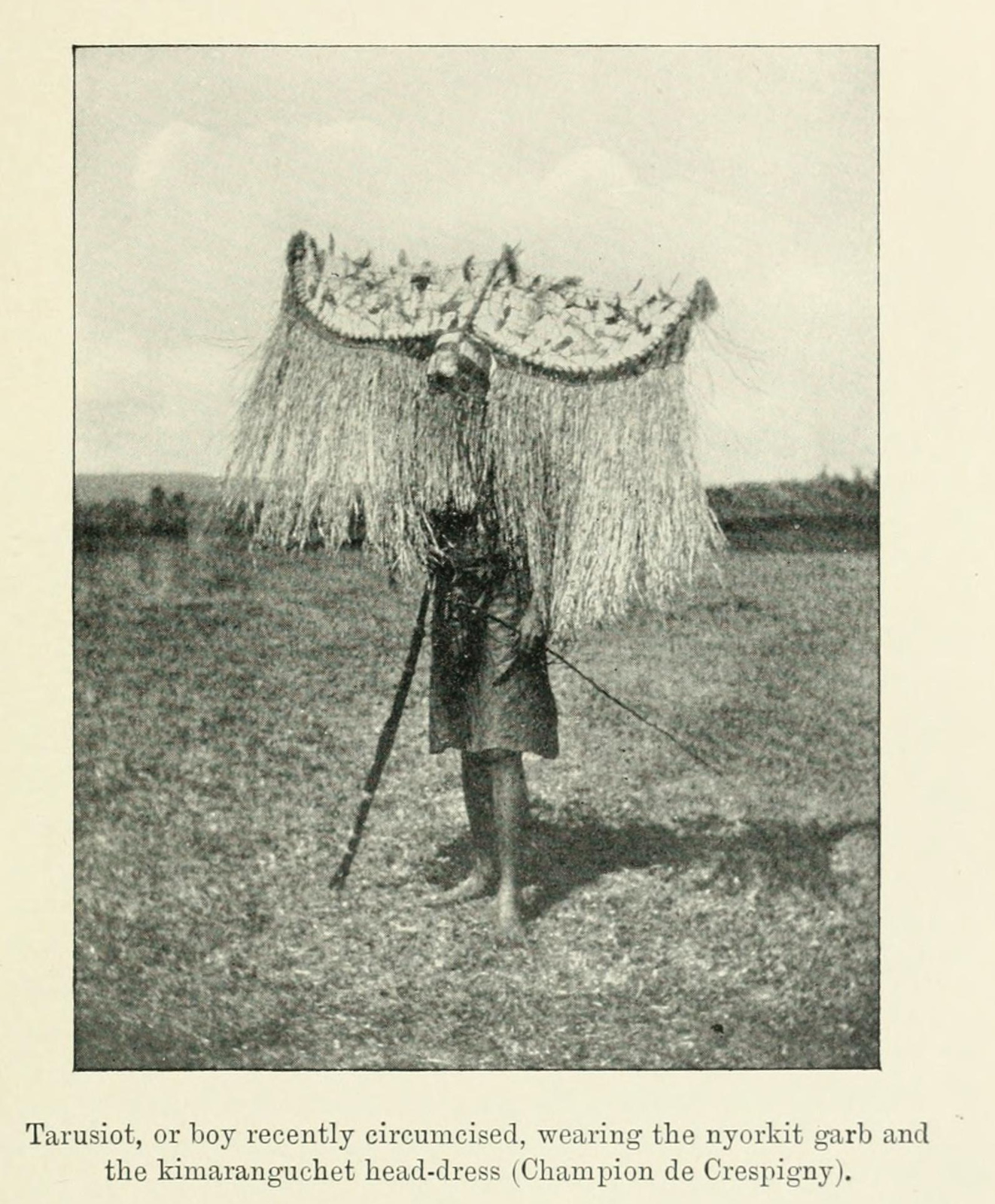
Newly circumcised boys wore women’s nyorkit garments and hunted birds while they healed, but could not stay out after dark: warriors sounded ngetundo at night to keep them in their huts. Later, at rikset, the novices were shown the bullroarers and friction drums and taught to play them, along with a warrior’s duties. Their mothers then gave them a warrior’s equipment. 1
In Gusii country, in the Kisii hills east of Lake Victoria, the beast Enyabububu had an outside voice and an inside one. Eng’iti enene, the Big Beast of Outside, was a wooden board whirled on a cord; the House Beast was a pot covered with wet skin, sounded by rubbing a stick. Boys were threatened with being eaten, then shown the bullroarer that made the sound. The beast was not meant to terrify them: its visit could entertain a recovering novice and take his mind off the pain. 3, 9
For Kipsigis boys in the mid-1960s, initiation needed a household as well as an operation. Fathers chose a man to feed the secluded boys, instructors to conduct the rites and a skilled operator. The feeder and his wife became father and mother to the initiates for life. Fathers and boys gathered the materials and built the menjo, a domed hut with a grass floor and rough walls, unlike any ordinary home. 2
There the boys were told an animal would take them at night, and sang to keep it away while young men whirled a roarer and shook the menjo roof. Many saw through it. Young herdboys made small roarers of their own from flat seed pods and sisal, though men confiscated them, and one former initiate remembered finding the hidden instrument himself while out hunting during seclusion. 2
The schools around Mount Elgon have long traded people and practice. Sebei and Gisu intermarried and fought; Bukusu communities absorbed clans of Kalenjin origin. Khulicha came to the Bukusu from Nandi practice. The rites themselves travelled further back: the Bantu-speaking ancestors of the Luhya and Gusii took them up first, the proto-Kalenjin borrowed them, and later exchanges ran both ways, carrying Bukusu and Gisu custom to the Sebei and Kalenjin custom to the Gusii. 7, 6
All through their seclusion the newly circumcised Sebei boys heard the lion roaring. At the secret night rite that opened their coming-out, they were taken into the bush, away from the houses, to meet it. While older men whirled the bull-roarer, sponsors hid in the dark with a lion made of monkey…
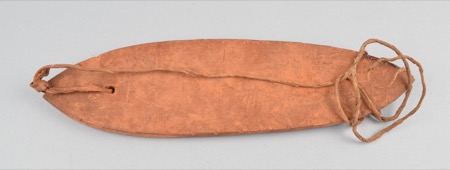
Representative — not this record’s object · A Nandi bull-roarer; the Nandi, Sebei kin, also call it 'lion'.
A defanged snake hung impaled above the river-side doorway through which Bukusu initiates crawled into the water four times. They were carried across the stream like dead bodies, then awakened. This was the first stage of Khulicha, the coming-out ceremony after circumcision. Later, a bullroarer…
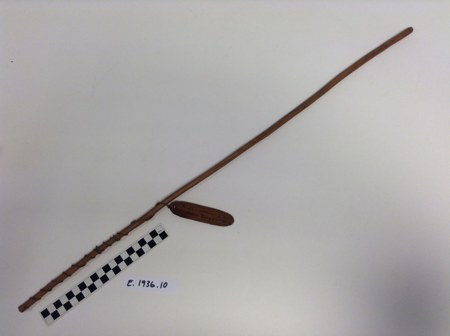
Representative — not this record’s object · Kikuyu kiburuti with its pole rig, 1907–1929 — 'Bull-roarer.
Marakwet boys in seclusion lived in the huts of kaptorus, 'the place of initiands', and were warned long in advance that a wild beast would come for them. It came on a moonless night: kimaketip kaptorus, 'the kaptorus wild animal'. Men closed in on the hut whirling bull-roarers at different speeds,…
Representative — not this record’s object · A bull-roarer of the Nandi, Kalenjin neighbours of the Marakwet.
Among the Nandi of the Kenya highlands, the bull-roarer is called ngetundo, "lion." Warriors armed with these instruments visited the seclusion huts of recently circumcised boys after dark and sounded them, A. C. Hollis recorded in 1909, to make the boys "think that lions are prowling about outside…
Among the Kipsigis of the Kericho highlands, boys newly circumcised and shut in the seclusion hut, the menjo, are first made into girls. They call one another chebi, 'girl', and use girls' names; their wounds are vaginas, and their blood is menstrual blood. Once they have healed, young men press…
Representative — not this record’s object · Nandi instrument plate with bullroarer.
eng'iti enene ('Big Beast of Outside'); enyabububu (the beast itself, onomatopoeic)
A Gusii boy was circumcised and then shut away, and while he was healing the beast came for him. It is called enyabububu, a name that imitates the sound it makes, and it swallows initiates; its wooden voice is eng’iti enene, the Big Beast of Outside, a flat piece of wood under a foot long, drilled…
Representative — not this record’s object · A Nandi bull-roarer; the Nandi, Sebei kin, also call it 'lion'
Journal of the Royal Anthropological Institute 83(1): 9–36, p. 20. Entertainment and relief from pain; outside board and inside pot-and-skin instrument.
Pp. 290–291: separate coming-out encounters; boys’ bullroarer and monkey-skin lion; hidden operators, thorn scratches, disclosure, prolonged whirling, family cord inspection and sudden damping.
Pp. 84–88: Bamwalie and Tachoni Khulicha; river rite; p. 87, leopard voice, substitute drum and claw marks. Notes 88–99, pp. 141–142, separate reported details and observation.
Anthropos 78: 369–410; pp. 369–371, 380–386, 406–407. Compares whole initiation institutions; concludes possible early borrowing by proto-Kalenjin from Bantu neighbours, with subsequent contacts in both directions.