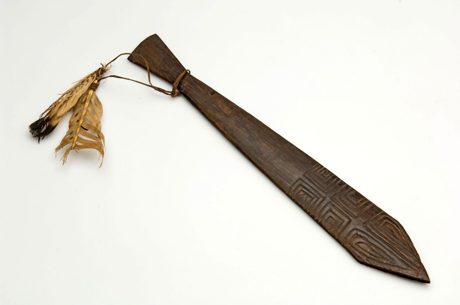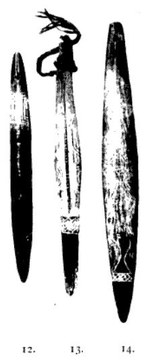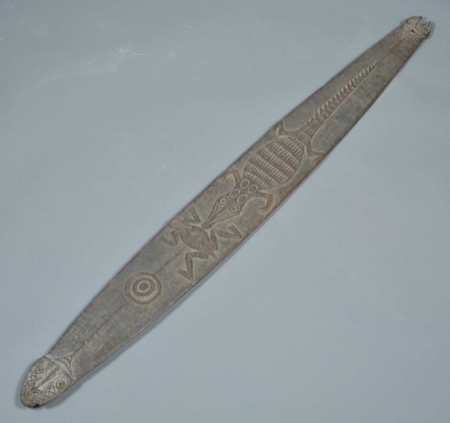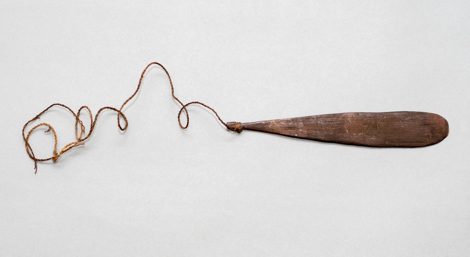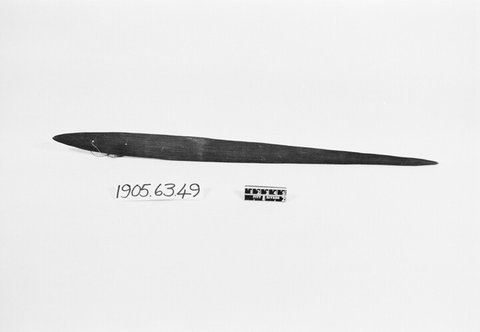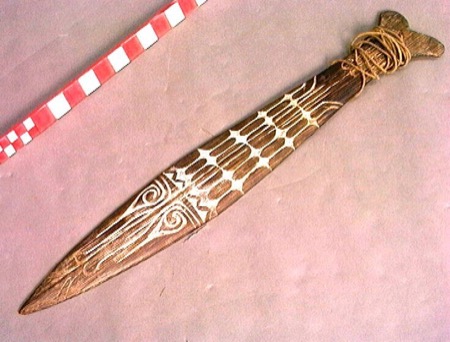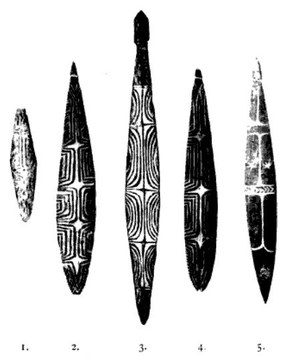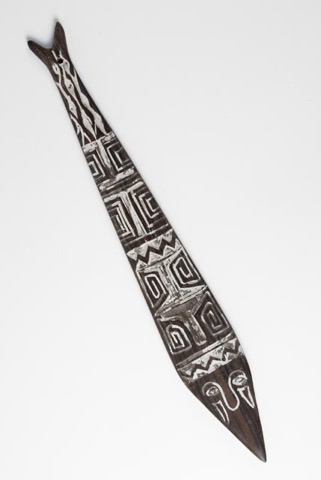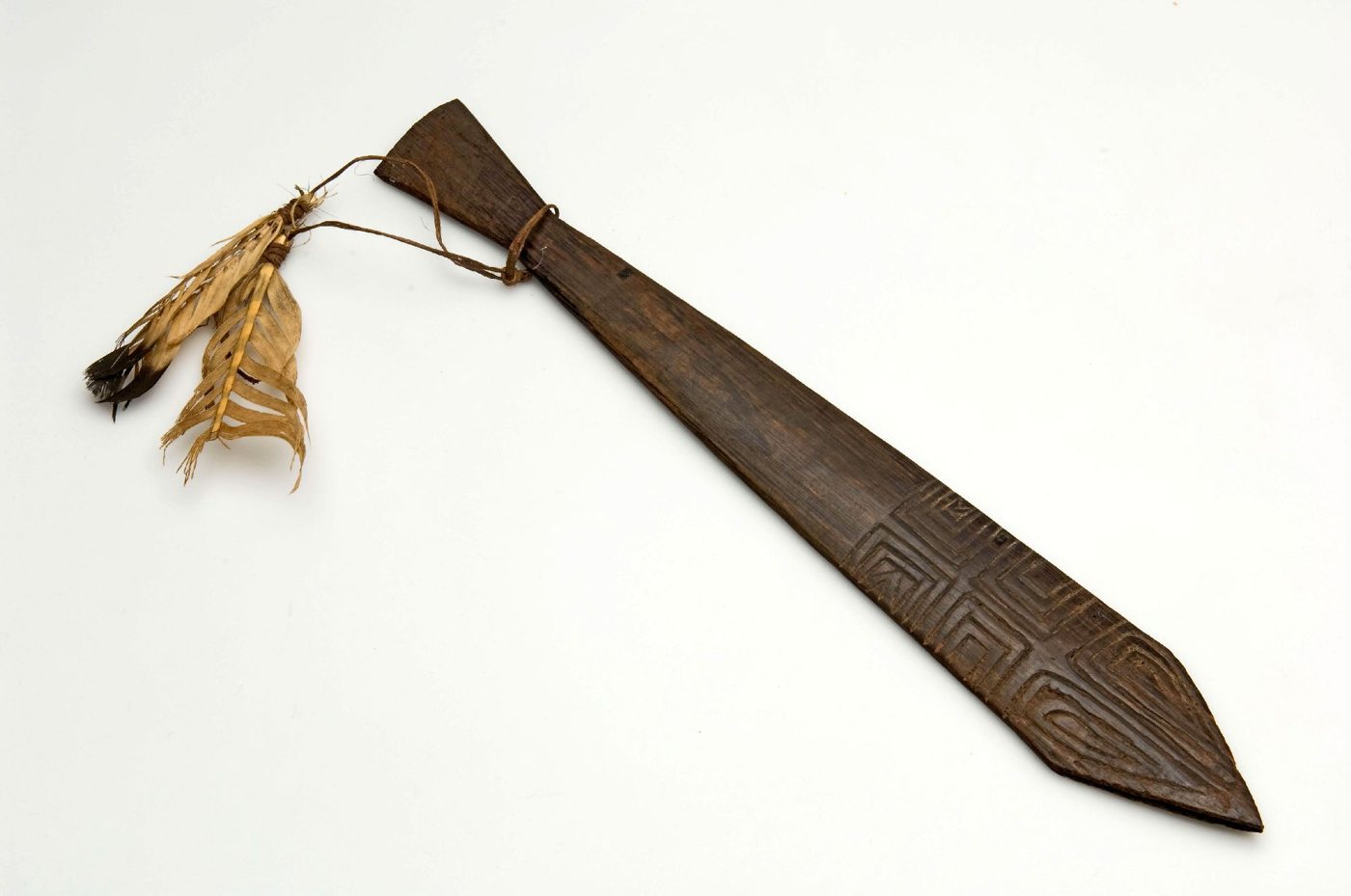

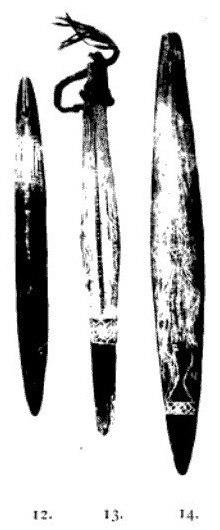
The men wait at their territorial boundary with their own bullroarers. A party arrives from the next village, where the celebration has just ended, carrying blades already anointed with semen. The hosts rub their instruments against the visitors’. Now their blades are alive, and they may sound. This is how Sosom, a giant as tall as a coconut palm, makes his yearly round of the Marind country on the south coast of West Papua. East of the Marind lie the Trans-Fly lowlands, running to the Fly River in Papua New Guinea. There the same instrument is born from a woman’s body and stolen by a bird, marks a clan, closes a mourning and speaks the first words of a language. 2, 3, 6, 7
Marind-anim · Gambadi (Torou, Gambadi and Yetakuma tribes), Kwavaru / Kau · Nen speakers, Bimadbn · Ende (Pahoturi River, Western Province PNG), Limol
A giant on the road
Sosom is a giant whose body is said to be stone, so tall he can stand with a foot on either bank of a river. He comes with the east monsoon, and his roar is the bullroarer; instrument and giant share the name. Boys are brought to him to be swallowed and given back unharmed. His home is placed at Tamargar, a hill near Yanggandur in Sota territory. From there he travels west through the coastal villages towards Anasai, turns inland to the lower Kumbe and returns east through the interior. 2
Each village on the road has its own sosom-miráv, the ceremonial ground, and must know when its neighbour has finished before it can receive the giant. The touch of blade on blade at the boundary passes him on. Each participating boan, a clan grouping, supplies a bullroarer, and the blade of the Kai-zé clan outranks the rest, because Sosom is its déma, its ancestral being. Sosom passes through Kumbe territory but never visits Kumbe village itself. 2
What a host prepares
The sosom-miráv is enclosed by a fence of close-fitted coconut leaves more than two metres high, decorated with croton and young palm fronds. Food is piled on wooden forks around it. When boys are to be initiated, a raised platform gives the giant a seat. The men show outsiders giant footprints in the sand and other enormous traces of his arrival, and laugh about them among themselves; the blades and the central phallic pole they treat with real gravity. 2
Sosom never arrives alone. The blades are his roar; split bamboo pipes, their halves bound together and blown so that air escapes along the split, give a piercing shriek. They are not flutes. They are his nakari, the young women he carries under his arm. At the boundary the pipes need no waking and never touch the other village’s pipes, a sign of their lower rank. The men sing bandra as the giant approaches and keep singing through the night. 2
Wanumb gives birth to the humming child
A coastal story gives Sosom two lives. He comes from the far east, from the Fly, in a beautiful canoe, trades it for a local boat and walks west when rough seas end his voyage. Nagi and Runggu go with him. On Komolom, a small island at the western end of the Marind coast, he is killed and beheaded; his head runs east underground while his spirit returns overland. Near Saror he enters a married woman, Wanumb, and she bears him again as a son. The child hums mu-u, mu-u without end and maddens the elders. Grown, he pesters the girls and beats the smaller boys. At last the men cut off his penis and drive him out. The penis falls into the river and becomes a watersnake. 2
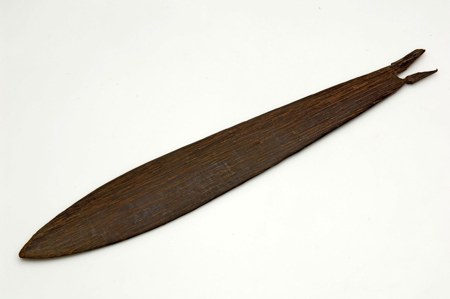
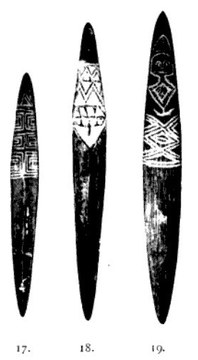
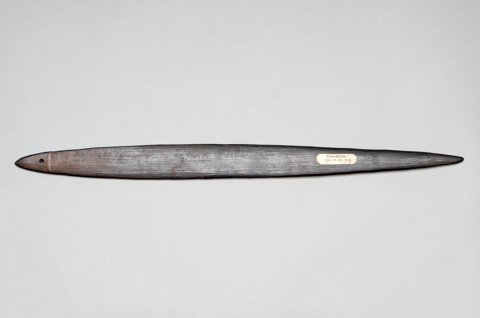
That severed member is the first bullroarer. An inland telling from Aboi has Sosom’s organ stuck fast in a girl until a stork pulls it free with its beak, and van Baal read the extracted penis as the first blade, the serpent’s own voice in the men’s hands. Marind blades are often fish-shaped, and coastal men told Verschueren that the sosom blade was a fish. Anda, the catfish, is also a crude word for penis. 2
The humming exile is caught by women fishing a swamp behind Wendu. They try a dance song, then a dirge, and cannot quiet him. The men send them away and sing manggu, the opening Sosom song, then bandra. His growl mounts into an overwhelming roar, and he teaches them the rites. Farther east he finds women already whirling bullroarers at Mayo and Yavar-makan. He gives the women the Mayo road and keeps his own road for the men. 2
Wendu opens the performance
In 1952 Wendu staged a public farewell to the old rites. Boys crouched beneath a platform, backs to the entrance, as Sosom approached amid singing men, whirling blades and shrieking pipes. His face was masked, his body dressed in fibre and croton leaves. The platform shook; a dark tail came down towards the boys. Then the sound stopped, and their fathers and uncles drew them out to meet him. A hardwood pole was set upright and the company circled it, each boy led between two elders. At last Sosom knelt, the men took off his decorations, and an entirely ordinary man stood where the giant had been. 2, 4
The giant’s name travels the coast
At Setavi in Semariji country, east across the border in the Trans-Fly, the bullroarer is sosa, the Marind giant’s own name, embodied as an old man who leaves the water to dry himself by a fire. Kunst followed the feast westward out of the Trans-Fly to the Kanum and from the Kanum to the Marind. An Aboi teller sent Sosom himself to live among the Kanum beyond the Yawim River, and said the Kanum had the cult from him before the Marind learned it. His hill stands in Kanum country at Sota, and Kanum men joined the Marind rites. 3, 11, 2
Born from a woman, stolen by a bird
Across the Trans-Fly, the bullroarer was first a woman’s. Among the Keraki of the Morehead River, the moiank sounded first for Yuma, wife of the sky-being Kambel, until Kambel took it from her. At Kwavaru the Gambadi tell of Tiv’r the Originator and his wife Engu, who became pregnant not with a child but with the bullroarer. Whenever she moved it sounded faintly, and she told him it was his dogs howling in the bush. He sent bird after bird to fetch it, and finally the little bird Serekute snatched it as she bent over, sweeping. The theft drew her first menstrual blood. Tiv’r claimed the instrument for men, found a fibre fit to swing it and showed it to his son. 3, 2
Keraki · Gambadi (Torou, Gambadi and Yetakuma tribes), Kwavaru / Kau
At Rouku, Komnzo speakers, whose language is one of the Trans-Fly’s Yam family, tell the story at Fütha. A man hears a roar inside his wife’s belly and sends birds to fetch the sacred wooden ŋofoŋofo. The ones that fail are splashed with her blood, which is why their plumage is red; one finally brings the bullroarer out, and initiated men have kept it ever since. Two of the birds, ktikti and dirdir, carry names that echo words for vulva in the distant Nen and Blafe languages, a meaning only a knowing listener hears. An Ende telling from the Pahoturi River has the instrument swing from a woman’s body until a jealous man tears it away, taking her power and starting her menstrual suffering. 1, 7
Komnzo speakers (Farem), Rouku · Ende (Pahoturi River, Western Province PNG), Limol
A house waits for the bananas
On the upper Bian River, inland among the Marind, a long screen divides the ceremonial house between men and women. Two sloping trunks, uk, cross the screen, one for each of the two moieties, Geb-zé and Mahu-zé. Each side has its own fire and entrance; a third fire is the Babé’s and must burn throughout the rites. The owning side hangs its principal ézam blade from a long bamboo beside that fire, and people ask its permission before eating or sleeping. 2
Growth sets the calendar. Coconuts and bananas are planted near the house. Sprouting coconuts are dug up and eaten at the opening, and the closing rites wait for the bananas to bear, about nine months later. Between the great moments people speak softly. An old man swings an ézam, the bamboo percussion starts, and the song for that hour is sung. When the smaller blades finally sound, women are told the Babé’s wife has arrived, and the larger blades answer as her husband. 2
The closing pair are coconuts made into human heads. A tuft of husk becomes a hairdo, the germ holes eyes and mouth, and one nut gets a fibre beard. Husband and wife are killed in turn with a club and eaten by the assembled men. Semen collected during the sexual rites is shared out to take home, to drink or to rub on houses, crops and bodies. 2
Yei-nan: a blade beneath the tongue
Among the Yei-nan of the upper Maro River, kupör blades are rubbed with kunai grass and lime to sharpen their squeaking voice. Novices are told the instrument will enter beneath the tongue, and its later extraction shows which powers they may use. The founding story gives each ancestral yevale its own kupör and its own country, delivered by Orei’s canoe. 8
A new kupör also closes a mourning. The community leaves the burial house for a new building. Heads, jaws and bones are washed and hung from a branched pole, and the bullroarer is planted in the ground beside it. The next day people put on their ornaments and dance for the first time in more than a year. 8
A clan knows its own blade
At Bimadbn, in Nen country, names tell instruments and owners apart. Meyang is one kind; mérmér another. The Seregu clan’s blade is agalsge, while giñgiñ meyang is the Kiembturer people’s. The materials have their own words too: qét palm for the blade, strangler-fig fibre for the cord. Coconut and sago leaves make the dénd, a noisemaker with no sacred standing. 6
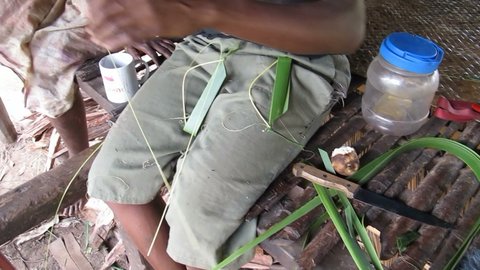
Bine speakers likewise call the bullroarer wagra and the coconut-leaf buebue a children’s toy. At Rouku, Nakre Abia made a leaf frfr on film; the wooden ŋofoŋofo stayed hidden. Blades from Masingara and Bensbach show the range of forms the region produced. 9, 1, 10
Komnzo speakers (Farem), Rouku · Masingara (Bine) · Bensbach
The first words come out of the palms
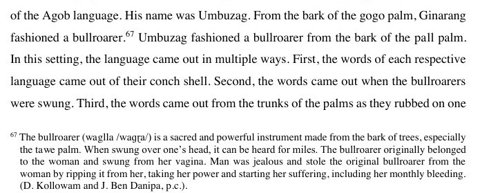
The Ende language began at Boze, where a green and a red tawe palm grew with their trunks entwined. At their feet lay two conch shells holding the first words. Ginarang made a bullroarer from the green palm’s bark and Umbuzag one from the red. Ende and Agob words came out of the conchs, out of the swinging bullroarers and out of the trunks rubbing together. The language owners tried their words on one another; words joined words, and the languages grew. 7
Names that carry the tradition
| People | Name | Meaning or use |
|---|---|---|
| Marind | sosom; sosom-miráv | The bullroarer and giant; the named ceremonial ground 2 |
| Komnzo, Rouku | ŋofoŋofo; frfr | Wooden sacred bullroarer; separate coconut-leaf toy 1 |
| Nen, Bimadbn | meyang; mérmér | Distinct named kinds of religious bullroarer 6 |
| Ende, Pahoturi River | waglla | Sacred palm-bark bullroarer; words emerge from it in the language-origin story 7 |
| Yei-nan | kupör | Instrument used in initiation and placed beside ancestral remains at the close of mourning 8 |