No. EA-DEFU-001
Incised-eye jade insect-head pendant
China · Chaoyang, Liaoning; typologically attributed to the Hamin Mangha type of Hongshan culture · East Asia
Function not recorded Candidate only
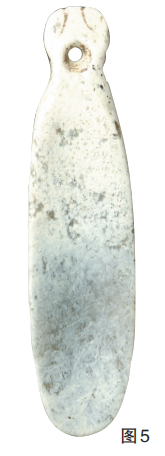
玉虫首匕形器
Source term: yu chongshou bixingqi (jade insect-head bi-shaped object)
玉虫首匕形器 (yù chóngshǒu bǐxíngqì): “jade insect-head bi-shaped object,” Zhang Pengfei's name for the type.
A tiny pair of incised arcs gives this eight-centimetre jade pendant a face. Below that rounded head, its body pinches into a perforated neck and then broadens into a pale leaf, gently hollowed on one side. The effect is not abstract geometry so much as a creature paused in stone — the reason Zhang Pengfei singled it out as the clearest “insect-head” form.
顶端由上向两侧分别琢出两道弧形线,突显左右两端,形似凸出的双眼。
Two curved lines are cut from the top toward each side, emphasizing the two ends like protruding eyes.
Zhang Pengfei, China Cultural Relics News, 23 April 2024, p. 6.
Particulars
- Object
- An opaque green-jade pendant, 8 × 2 × 0.6 cm, with a c. 0.3 cm perforation through its narrow waist. Its small rounded upper end bears two incised arcs read as eyes; below, a leaf-shaped body is slightly convex on one face and concave on the other, with a thick centre and thin edges.
- Function
- Published as an insect-form pendant; no acoustic use is recorded.
Source
Zhang Pengfei, “东北史前玉器‘匕形器’之命名探讨” [A discussion of naming prehistoric Northeast Chinese jade bi-shaped objects], China Cultural Relics News, 23 April 2024, p. 6, Fig. 5. The author recorded the piece in a 2012–16 survey; it is held by the De Fu Museum, Chaoyang